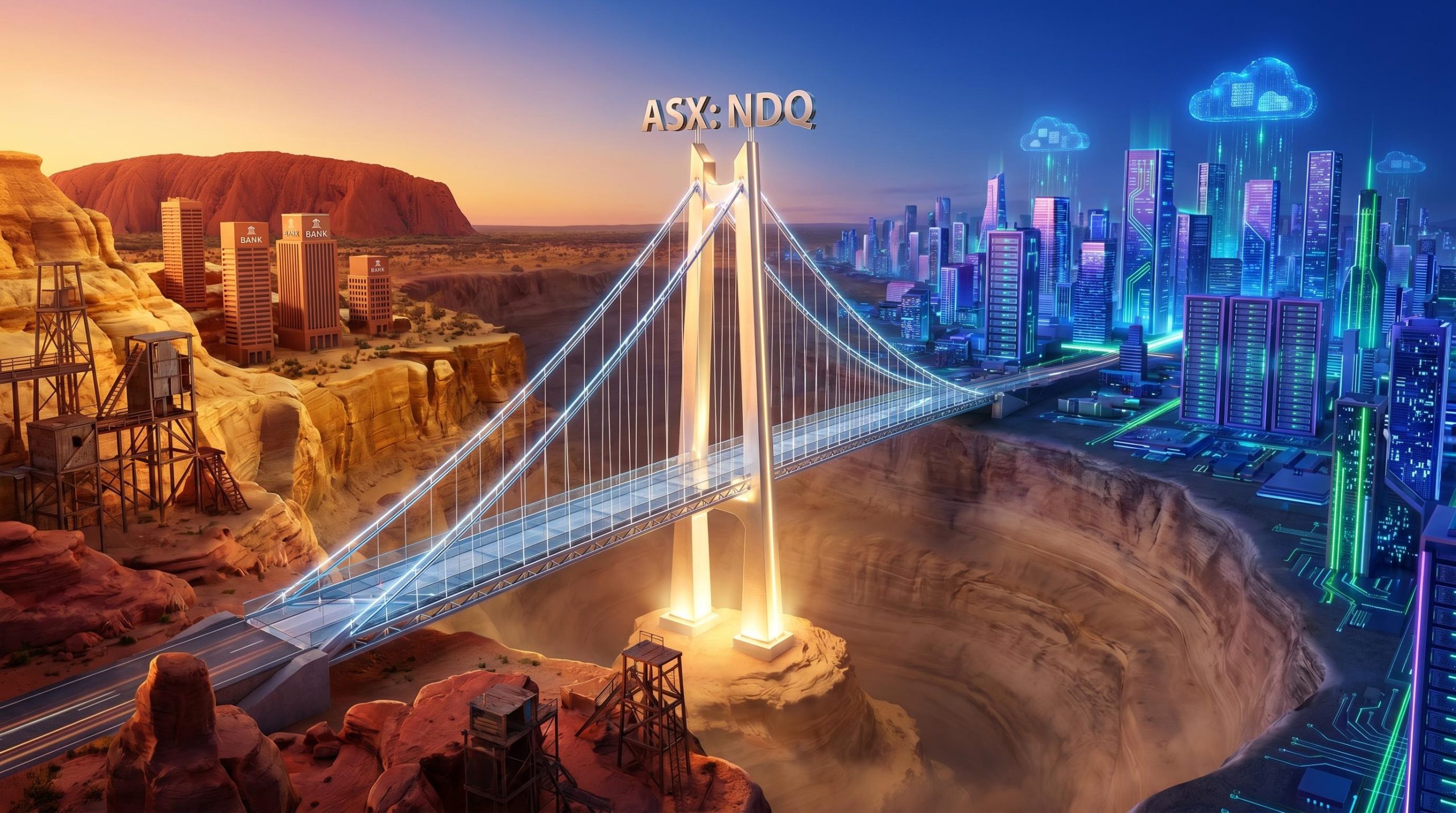
The ASX gives Australian investors world-class access to banks, miners, and supermarkets. It gives them almost no access to the companies reshaping the global economy. For a growing number of investors, one ETF has become the practical fix.
As of May 2026, the Betashares Nasdaq 100 ETF (ASX: NDQ) holds approximately $8.59 billion in net assets, making it one of the largest growth-oriented ETFs on the ASX. That size reflects a decade of Australian investors quietly solving a structural gap in their home market. With artificial intelligence (AI) and technology themes continuing to dominate global equity returns, the fund’s appeal is accelerating rather than fading.
This article explains exactly what NDQ contains, why the ASX cannot replicate it, what the AI tailwind means for the fund’s holdings in practical terms, and what risks Australian investors must weigh before committing capital.
The ASX’s blind spot that NDQ was built to fill
What a default Australian portfolio actually looks like
An Australian investor who holds domestic equities, whether through direct shares, an index fund, or a self-managed super fund (SMSF), owns a portfolio shaped by banks, miners, and healthcare. The Big Four banks, BHP, Rio Tinto, Woodside Energy, and a handful of healthcare names account for an outsized share of the ASX’s total market capitalisation. Returns are driven by commodity cycles, housing credit, and domestic consumer spending.
That composition is not a flaw. It reflects Australia’s economic structure: a resource-rich, services-heavy economy with a globally competitive banking sector. The concentration becomes a problem only when investors treat ASX exposure as complete portfolio coverage, which many do.
Research on Australia’s home bias in equity investing shows that financials and base materials together account for close to half of the ASX 200 by weight, while technology represents roughly 5% compared with approximately 27% in the S&P 500, a structural gap that directly explains why domestically focused portfolios systematically miss the global technology sector.
The global technology companies that aren’t listed here
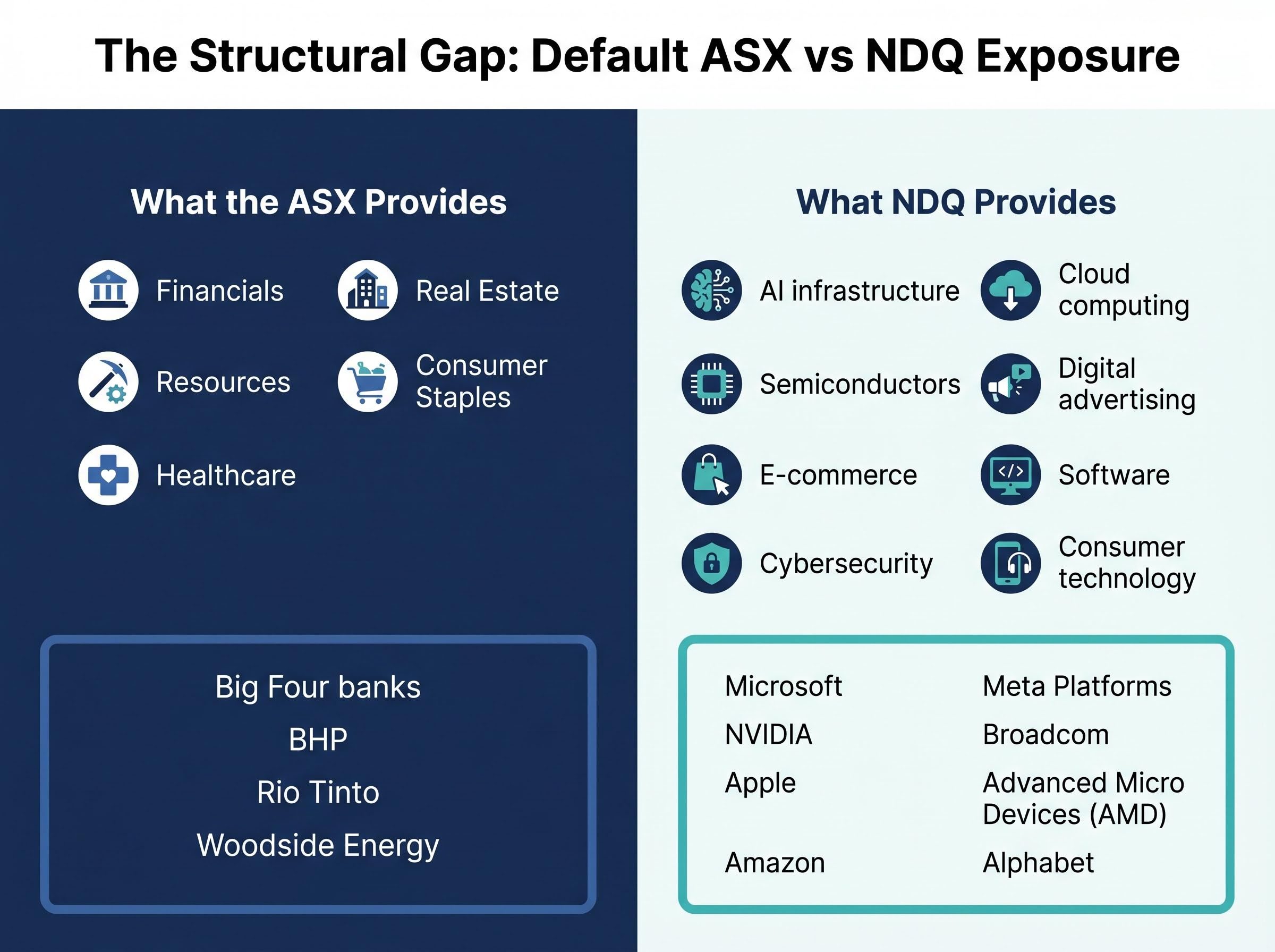
Microsoft, NVIDIA, Apple, Amazon, and Meta Platforms do not trade on the ASX. Neither do Broadcom, Advanced Micro Devices (AMD), or Alphabet. Accessing these businesses requires either an international brokerage account or a vehicle that does it automatically.
The contrast is stark:
- What the ASX provides: financials, resources, healthcare, real estate, consumer staples
- What NDQ provides access to: AI infrastructure, cloud computing, semiconductors, digital advertising, e-commerce, software, cybersecurity, consumer technology
NDQ’s $8.59 billion in net assets (as at 18 May 2026) reflects the scale of investor demand for this gap-filling function. The fund does not replace an Australian equity allocation. It complements one.
The shift toward international equity ETFs has accelerated to the point where, in Q1 2026, international funds overtook domestic funds as the most purchased ETF category on the Selfwealth by Syfe platform for the first time on record, with $6.9 billion flowing into international equity ETFs across the Australian market in that quarter alone.
When big ASX news breaks, our subscribers know first
What the Nasdaq 100 actually contains
The Nasdaq-100 Index comprises the 100 largest non-financial companies listed on the Nasdaq exchange, rebalanced semi-annually. It spans technology, communication services, consumer discretionary, and semiconductor businesses. NDQ tracks this index directly, giving Australian investors a single ASX-listed transaction to access the portfolio.
The current top holdings reveal how concentrated the fund’s exposure has become at the upper end.
| Holding | Weight (%) | Sector |
|---|---|---|
| NVIDIA | 9.0% | Semiconductors |
| Apple | 7.3% | Consumer Technology |
| Microsoft | 5.2% | Software / Cloud |
| Amazon | 4.7% | E-commerce / Cloud |
| Alphabet | Meaningful combined weight | Search / Digital Advertising |
The top four holdings alone represent approximately 26% of the fund. Rounding out the top ten are Meta Platforms, Tesla, Broadcom, AMD, and Micron Technology.
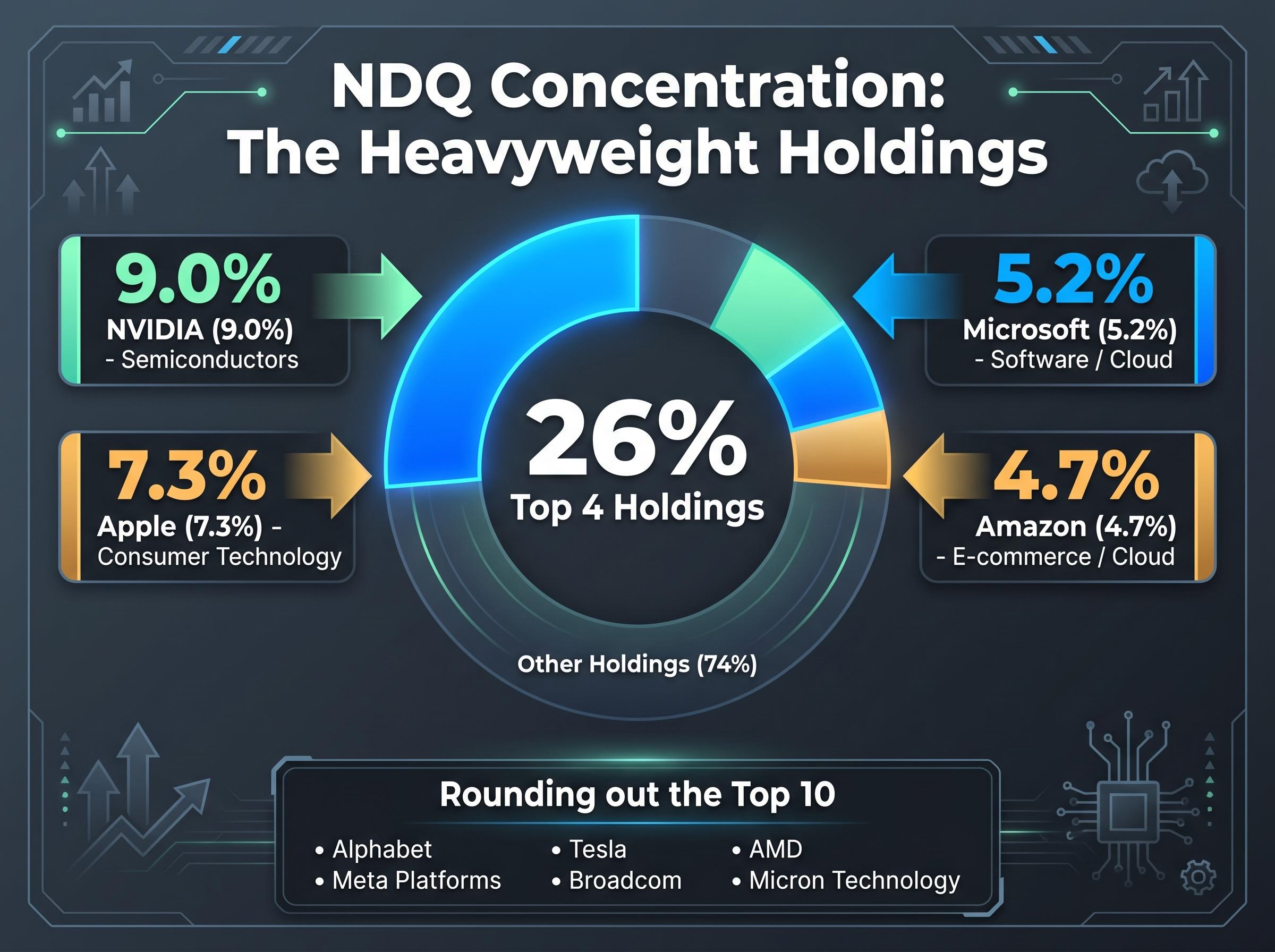
NVIDIA’s position shift: NVIDIA has risen from a mid-table holding to the fund’s single largest position at 9.0%, reflecting the AI-driven reordering of the technology sector rather than broad index rebalancing.
NDQ is unhedged, meaning Australian investors carry AUD/USD currency exposure. This is a structural feature of the fund, not an oversight. The management cost is 0.48% p.a., and the trailing 12-month distribution yield sits at approximately 0.9% (as at 30 April 2026).
Why AI makes the Nasdaq 100’s holdings structurally different from a typical tech bet
AI is not a discrete sector within the Nasdaq 100. It is a capability being embedded across software, cloud infrastructure, semiconductors, search, digital advertising, and consumer devices simultaneously. That cross-cutting nature is what distinguishes the current AI theme from previous technology cycles, where a single product category (smartphones, social media) drove returns.
The picks-and-shovels layer: chips and data centres
NVIDIA, Broadcom, and AMD supply the processing hardware that AI systems require. Every large language model, every cloud AI service, and every enterprise AI deployment depends on accelerated computing infrastructure. NVIDIA’s rise to 9.0% of the fund reflects infrastructure demand specifically, not general sector momentum.
The application layer: where AI meets revenue
Microsoft monetises AI through its Azure cloud platform and Copilot integrations across Office products. Alphabet has embedded AI into search results and advertising targeting. Meta Platforms uses AI to optimise ad delivery and content recommendation at scale. These are not speculative plays on future revenue; they are existing businesses integrating AI into products that already generate billions in quarterly earnings.
- AI infrastructure: NVIDIA, Broadcom, AMD (chips, data centre hardware, accelerated computing)
- AI applications: Microsoft (cloud, enterprise software), Alphabet (search, advertising), Meta (advertising, content platforms)
According to the Betashares March 2026 ETF Review, NDQ and other US technology ETFs continued to deliver positive performance year-to-date, though returns were more measured than the 2023-2024 surge. The AI theme is maturing, not disappearing.
AI enthusiasm may produce short-term valuation excess. The investment thesis does not require every AI growth projection to prove accurate. It requires the broad adoption trend to continue.
How the fund has actually performed, and what the 2022 drawdown tells investors
One-year return (after fees, AUD, reinvested distributions): 24.94% as at 30 April 2026.
That figure captures a strong period for US technology equities. It does not capture the full experience of owning this fund.
- Pre-2022: NDQ delivered strong double-digit annualised returns as US mega-cap technology companies outperformed global equities benchmarks.
- 2022 drawdown: The Nasdaq-100 and NDQ suffered a peak-to-trough drawdown exceeding 30%, driven by rising interest rates and a broad technology sector sell-off.
- 2023-2024 recovery: The Nasdaq-100 reached new highs by late 2023, powered by AI and cloud-computing tailwinds. NDQ’s recovery outperformed broad US equity benchmarks over rolling three and five-year periods.
- 2025-2026 continuation: Returns have moderated from the explosive 2023-2024 pace, with volatility spikes around US Federal Reserve policy decisions and earnings seasons, but the trajectory remained positive through Q1 2026.
The 2022 drawdown is not a historical footnote. It is calibration data. An investor who held $100,000 in NDQ at the 2022 peak saw that position fall below $70,000 before recovering. Those who sold near the trough locked in the loss and missed the recovery.
NDQ’s long-term return record, including a 10-year annualised figure of approximately 19.87% after fees, sits alongside a concentration profile where the top 10 holdings represent more than 50% of the portfolio, a pairing that makes the fund one of the strongest-performing and most structurally concentrated ETFs on the ASX.
The Betashares Target Market Determination (TMD) designates NDQ for growth-oriented investors with a medium-to-long-term horizon and higher risk tolerance. At 0.48% p.a., the management cost is modest, but it compounds across the multi-year holding periods this fund genuinely requires.
The risks Australian investors must not overlook
None of the risks below invalidate NDQ as an investment. Each one changes the sizing conversation. A fund that suits a 10% satellite allocation may not suit a 40% core position.
- Concentration risk: The top four holdings (NVIDIA, Apple, Microsoft, Amazon) account for approximately 26% of the fund. A single regulatory action, earnings shock, or competitive disruption at any one of these companies creates material portfolio impact.
- Currency risk: NDQ is unhedged. A rising Australian dollar reduces returns even when underlying US stocks advance. AUD/USD movements have historically added meaningful volatility to Australian investors’ actual returns.
- Valuation risk: Multiple analyst perspectives suggest AI-leader valuations may be pricing in optimistic growth scenarios, increasing downside risk from current starting points.
Nasdaq 100 valuation risk has become more concrete in 2026, with the index’s roughly 18% rally from April lows pushing momentum indicators into overbought territory at a defined resistance zone, while Magnificent Seven earnings must now deliver verifiable AI revenue to justify the premiums currently embedded in NDQ’s largest holdings.
Concentration and currency: the structural risks
With NVIDIA alone at 9.0%, a single semiconductor company’s fortunes carry significant weight within the fund. If the AUD strengthens from, say, US$0.64 to US$0.70, an Australian investor’s returns contract by roughly 9% in currency terms alone, regardless of what the underlying stocks do. These are permanent structural features of the fund, not risks that fade with time.
ASIC INFO 230 provides guidance for retail investors on exchange-traded products, covering index concentration, liquidity, tracking error, and suitability assessment.
ASIC Regulatory Guide 282, published in November 2025, sets out the regulator’s expectations for exchange-traded products sold to retail investors in Australia, covering index concentration, liquidity risk, tracking error, and the suitability assessment obligations that product issuers and advisers must meet.
Valuation and timing: the cyclical overlay
Entry point matters for a growth-tilted fund. Firstlinks commentary has suggested combining NDQ with broad global index funds or factor-diversified funds to moderate concentration risk. The Betashares TMD explicitly designates NDQ as unsuitable for investors seeking capital stability or very short-term outcomes.
Whether current AI-leader valuations prove justified will depend on adoption curves that remain uncertain. That uncertainty is not a reason to avoid the fund. It is a reason to size the position deliberately.
Whether NDQ belongs in your portfolio comes down to one question
Can the investor tolerate the volatility that concentration, growth tilt, and currency exposure deliver, in exchange for access to the businesses the ASX structurally cannot provide?
That question breaks into four practical checks:
- Time horizon: A minimum five-year holding period is the baseline. The 2022 drawdown took roughly 18 months to recover. Investors with shorter timelines face the risk of selling into a trough.
- Drawdown tolerance: A 30%-plus decline is within this fund’s demonstrated range. If that would trigger a sell decision, NDQ is unlikely to deliver its long-term return potential.
- Diversification gap: Investors whose portfolios are dominated by ASX financials, resources, and property have a genuine structural gap that NDQ directly addresses. Those already holding broad international equity funds may need less of it.
- Fee and structure check: At 0.48% p.a., NDQ offers proportional stakes in NVIDIA, Apple, Microsoft, Amazon, and 96 other globally significant businesses through a single ASX-listed transaction.
Context: The Australian ETF industry reached $329.4 billion in total funds under management as at March 2026, according to the Betashares Australian ETF Review. ETF investing is no longer a niche strategy; it is a mainstream allocation tool, and NDQ’s $8.59 billion in net assets reflects its position within that market.
Firstlinks commentary has cited NDQ as a widely used “growth satellite” holding within diversified Australian portfolios, particularly among SMSF investors seeking international technology exposure.
This article is for informational purposes only and should not be considered financial advice. Investors should conduct their own research and consult with financial professionals before making investment decisions. Past performance does not guarantee future results.
NDQ has earned its place as a default international allocation for growth-oriented Australians
The ASX cannot deliver what Nasdaq-100 companies represent. NDQ is the most direct and cost-effective way to close that gap from an Australian brokerage account.
That does not make it a universal solution. The fund’s concentration, growth tilt, and unhedged currency exposure make it a considered allocation, one that demands genuine tolerance for volatility and a multi-year commitment.
As AI, cloud infrastructure, and global digital platforms continue expanding, the case for maintaining exposure to Nasdaq-100 constituents does not weaken simply because the initial excitement around AI has moderated. For the investor profile described throughout this article, NDQ remains one of the most efficient vehicles available on the ASX to access the businesses shaping the next decade of global equity returns.