
Picture a short position on Humana, built on a chart read you still stand behind. Then a regulatory release lands after the close on Thursday, 8 October 2026, and the stock jumps sharply in after-hours trading, leaving you roughly 13% down on the position by the time you react. The uncomfortable question for any short seller’s risk management is simple: did you do something wrong, or did nothing go wrong at all?
Every short seller eventually meets a gap they could not trade around. The loss itself is rarely the real problem. The diagnosis is.
If you call luck an error, you over-correct and abandon a method that works. If you call an error luck, you repeat it. The next three sections give you a way to classify a losing trade, show how your position count caps the damage, and set out a rule set for the after-hours moment when your judgement is under the most pressure.
Why did one Humana headline cost a diversified short book 13%?
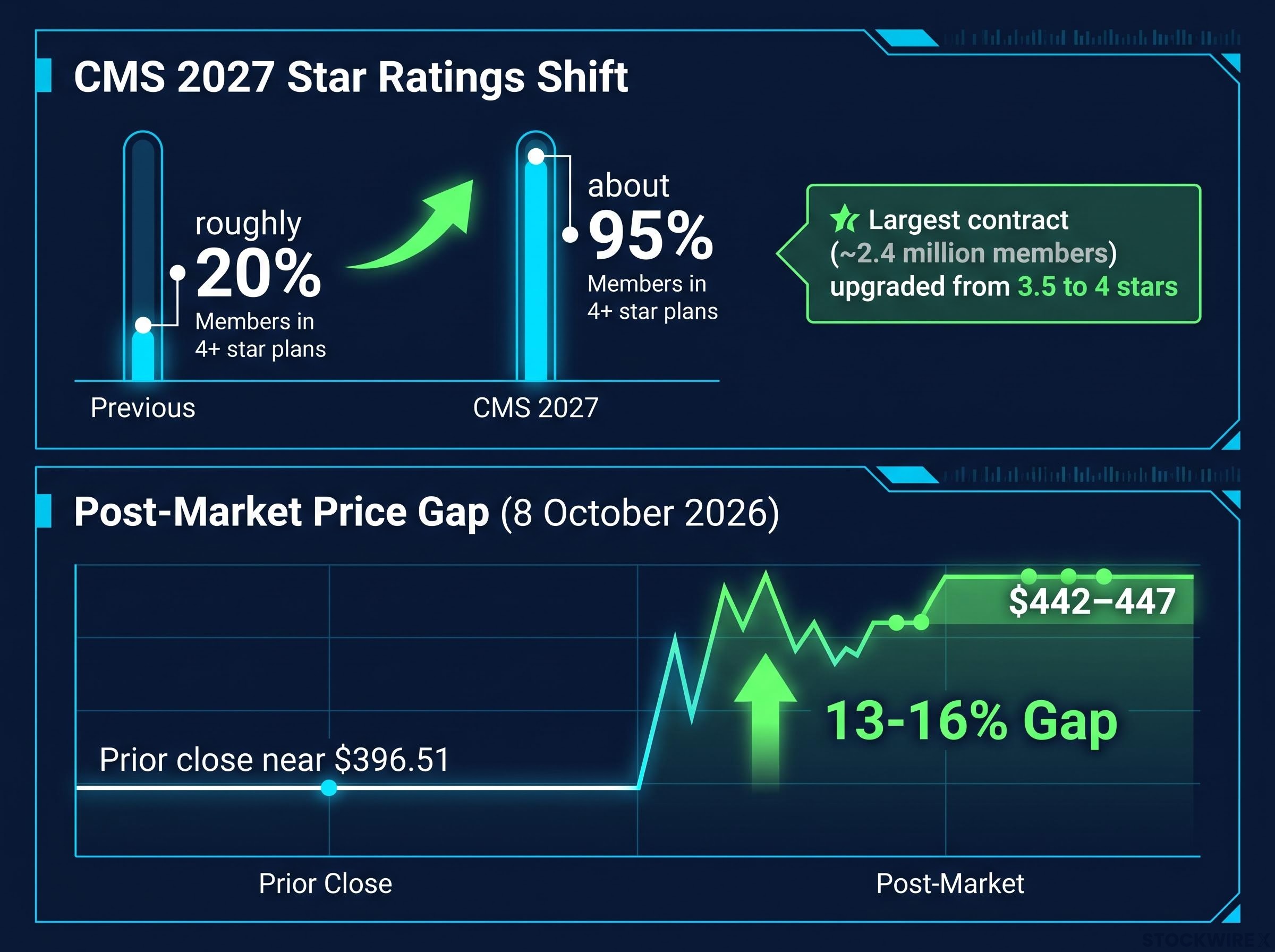
The move was fast. Seeking Alpha reported Humana (HUM) up about 13% post-market on Thursday. By Friday morning, reports placed the stock around $442-447, up from a prior close near $396.51. That is a gap of roughly 13-16%.
The trader in this case recalled a rise of about $65 after hours. Published figures are somewhat smaller, and the gap likely reflects different timestamps within extended trading, where prices can swing minute to minute.
None of this came from earnings. It came from the Centers for Medicare & Medicaid Services (CMS), which released its 2027 Medicare Advantage Star Ratings. For a short seller, this kind of non-earnings regulatory shock hitting after the close is the hardest kind of move to defend against. A stop-loss order cannot fire at a price the stock never trades at during regular hours.
Why a half-star matters so much
CMS Star Ratings are a quality score, from one to five stars, that the government assigns to Medicare Advantage (MA) plans. MA plans are private health plans that deliver Medicare benefits to older Americans. A plan needs at least 4 stars to qualify for quality bonus payments from CMS.
Humana’s largest MA contract, covering about 2.4 million members, moved from 3.5 to 4 stars. The ratings work on a lag, so 2027 ratings drive bonus payments in the 2028 payment year.
The key number Humana said about 95% of its MA members would be in plans rated 4 stars or higher for 2027, compared with roughly 20% the year before.
A half-star change removed a multi-billion-dollar revenue overhang for the company. What this means for you is that any short in a regulated sector carries a binary event sitting behind the thesis, however sound the chart looks.
Crowding was not the culprit either. As of 15 September 2026, short interest in HUM stood at 2.85 million shares, or 2.38% of float, with 3.29 days to cover. Days to cover estimates how many average trading days it would take short sellers to buy back their shares. “Not crowded” did not mean “safe.”
That is because shorts carry three risks that long positions do not:
- Unlimited upside loss: a stock can only fall to zero, but it can rise without a theoretical ceiling.
- Gap risk: news outside regular hours can jump straight past your stop.
- Squeeze dynamics: short covering combined with new buying can push a price beyond fair value.
These short selling risks, from unlimited loss potential to borrow fees and squeezes, compound one another, which is why you need to understand all of them before treating one gap as a verdict on your method.
When big ASX news breaks, our subscribers know first
How does spreading risk across 30 positions limit a single-stock shock?
If that list makes shorting sound reckless, the answer lies in arithmetic. The trader here spreads risk across about 30 positions, and that is why one roughly 13% loss was absorbable.
Consider a hypothetical. Suppose your short book holds 30 equally sized positions, each about 3% of your equity. A 13% adverse move on one of them costs you about 0.4% of the account. That hurts, but it is a bad day rather than a broken account.
Another way to cap damage is to size each short at a fixed dollar risk, dividing the amount you are willing to lose by the distance between your entry and your stop, so conviction never decides position size.
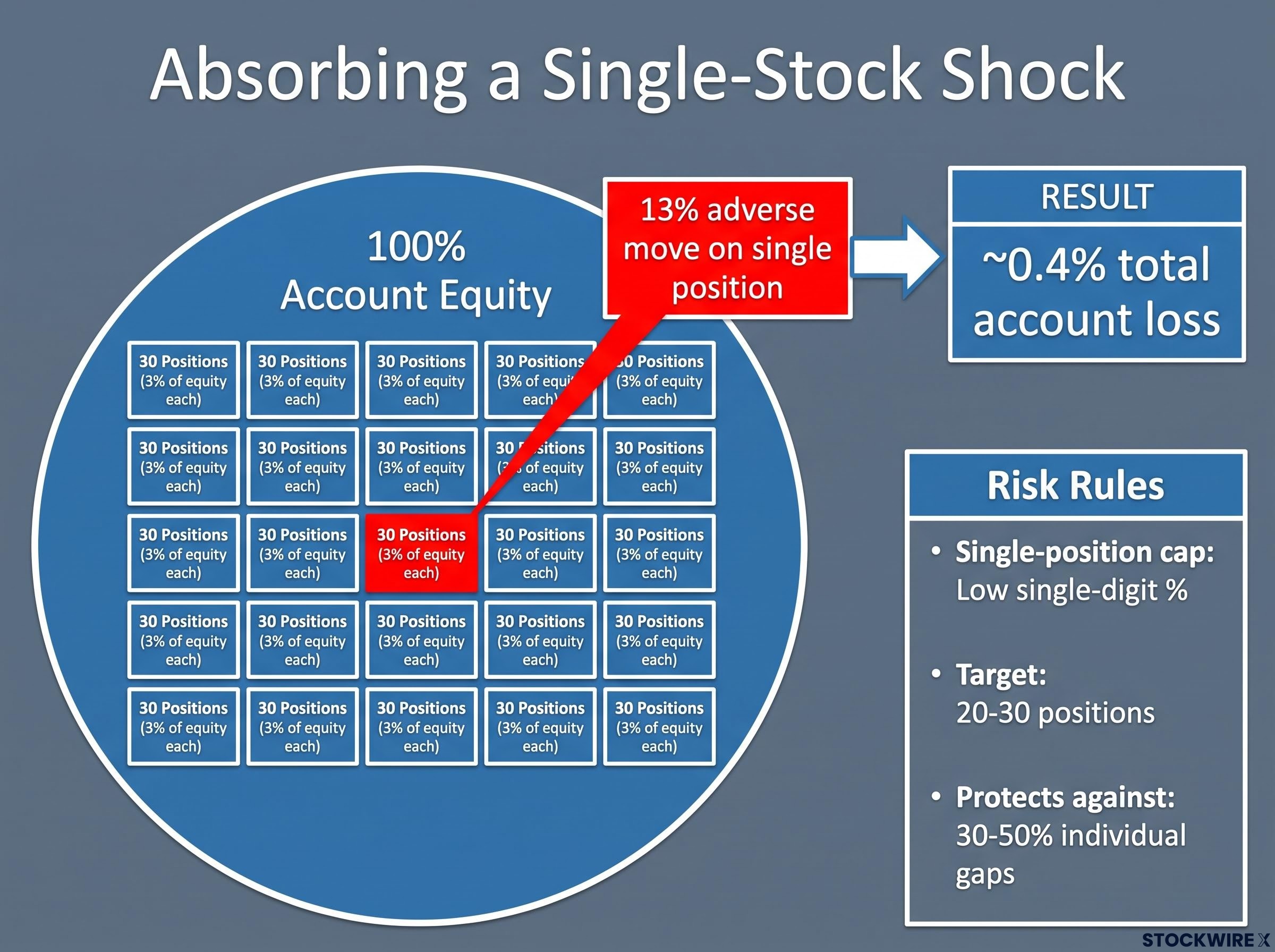
Professional practice builds on that logic. A common approach caps each short at a low single-digit percentage of equity, so even a 30-50% adverse move is survivable.
| Rule | Typical range | What it protects against |
|---|---|---|
| Single-position cap | Low single-digit % of equity | A 30-50% gap on one name |
| Number of positions | Roughly 20-30 | Any one event dominating results |
| Sector or regulatory limit | Set by the trader (e.g. Medicare Advantage) | Several shorts hit by the same ruling |
| Aggregate short notional and maximum daily loss | Set by the trader | Book-wide damage on a bad session |
The sector row deserves attention. In the original discussion, the co-host held UnitedHealth (UNH), a peer managed-care name. Regulatory news rarely hits one company in isolation, so three “different” shorts can turn out to be one bet.
Diversification has limits, though. A spread-out book can still take noticeable damage if sizing is loose or event screening is weak. Some hedge funds also defend concentration, arguing that deep research on fewer names helps them avoid opaque regulatory exposure altogether.
Your position count and sizing rules decide whether a surprise like this becomes a footnote or a crisis. Check now whether several of your shorts share the same regulator.
Is covering a short in thin after-hours trading worth the cost?
When a stock is ripping against you at 5pm, buying it back feels like taking control. Sometimes it is. You react immediately, and you may avoid a larger move if the rally keeps running into the next session.
The costs are less visible. Guidance from FINRA, Fidelity and Schwab describes extended-hours trading in consistent terms: fewer participants, shallower order books and wider spreads. The spread is the gap between the highest price a buyer will pay and the lowest price a seller will accept.
| Factor | Benefit of covering after hours | Cost or risk |
|---|---|---|
| Speed | Immediate reaction to the news | Decision made under peak stress |
| Price direction | May avoid a larger continued move | May lock in an overshoot that later reverses |
| Liquidity | Exit is available at all | Thin books and slippage on larger orders |
| Spreads and orders | Limit orders give some price control | Wide spreads; market orders can fill far from the last trade; some brokers restrict order types such as stops |
Public, event-specific data on after-hours spreads during this HUM move could not be found, so any precise cost figure would be guesswork. The outcome is clearer.
The trader habitually covers after hours. It has helped before. This time, the stock later gave back part of its gains, so waiting would have produced a better exit.
A habit that occasionally works can still be the worse process, because it locks in the extreme price rather than letting partial reversion happen. Write your rule before the next gap, not during it:
- Decide in advance the account-level loss that would justify trading after hours.
- Below that line, place no extended-hours orders and wait for regular-hours liquidity and more information.
- If you do act, use limit orders only and size the order for a thin book.
Bad luck or bad process: how do you tell the difference?
The trader’s own verdict was bad luck. The chart analysis was sound, the event felt unforeseeable, and self-criticism did not seem warranted. That instinct has solid backing.
Trading psychologists such as Brett Steenbarger and Mark Douglas have long argued that you should judge a trade by its process, not its result. Good trades can lose and bad trades can win. Judging by outcome alone is called outcome bias, and it pushes you to fix things that were never broken.
The core principle Judge the process, not the outcome. A loss only signals an error if a rule was missing or broken.
Short sellers argue over this line constantly. After GameStop in 2021, many funds decided their losses reflected missing crowding and liquidity screens. Campaigns against Herbalife drew both readings: some saw insufficient scenario analysis, others saw bad luck inside well-researched work.
Ask these three questions after every large loss:
- Was a CMS ratings shock explicitly part of the risk plan for the position?
- Was the position sized so a 15-20% gap would be tolerable?
- Were after-hours rules defined in advance, or improvised under stress?
Applying the test to the Humana short
Here is where the comfortable verdict gets harder to hold. The CMS Star Ratings release is a scheduled annual event, so the date was foreseeable even if the 3.5 to 4 upgrade was not.
If a full-size short ran through that date with no reduction, no hedge and no after-hours plan, the loss points to process. If size was modest and pre-set rules were followed, it leans toward luck.
Only the trader knows which of those describes the position. The point for you is that a loss which feels like pure luck often contains a calendar entry you could have checked.
What to change, and what to leave alone, after a loss like this
Classify the loss honestly, let sizing and diversification absorb the shocks you cannot predict, and settle your after-hours rule while you are calm. Three changes are worth making:
- Check every short against a calendar of known regulatory and data releases.
- Cap your combined exposure to any single regulator or sector.
- Write down your after-hours rule and keep it where you trade.
What to leave alone is a sound chart-based thesis. One gap does not prove the method wrong.
Before you open your next short, ask whether its biggest scheduled event is on your calendar and whether your size would survive it.
For readers wanting the full playbook behind a chart-based thesis, our deep-dive into how experienced traders build and manage short positions covers entry signals and stop placement above structural levels.
This article is for informational purposes only and should not be considered financial advice. Investors should conduct their own research and consult with financial professionals before making investment decisions. Past performance does not guarantee future results.