
Most traders who short stocks assume the two hardest problems are finding the right names and managing correlated exposures when the market turns against them. A framework built around fixed-dollar-risk position sizing argues that only one of those problems is worth solving mechanically, and it is not the one most people spend their time on.
The approach examined here treats dollar risk normalisation as the single governing constraint on position size, applies it symmetrically across ETFs and small-caps, and treats correlation as an environmental fact rather than a variable to engineer around. That is a deliberate and specific philosophical stance, not an oversight.
Here is exactly how this framework is constructed, where it diverges from institutional portfolio-construction thinking and why, and what the instrument choice between direct shorts and puts reveals about the underlying logic. The goal is a working mental model you can stress-test against your own process, with a clear sense of when the framework’s assumptions hold and when they strain.
The formula that governs everything: normalising dollar loss per trade
Position sizing in this framework starts with a question that has nothing to do with how many shares to short. It starts with how many dollars you are willing to lose.
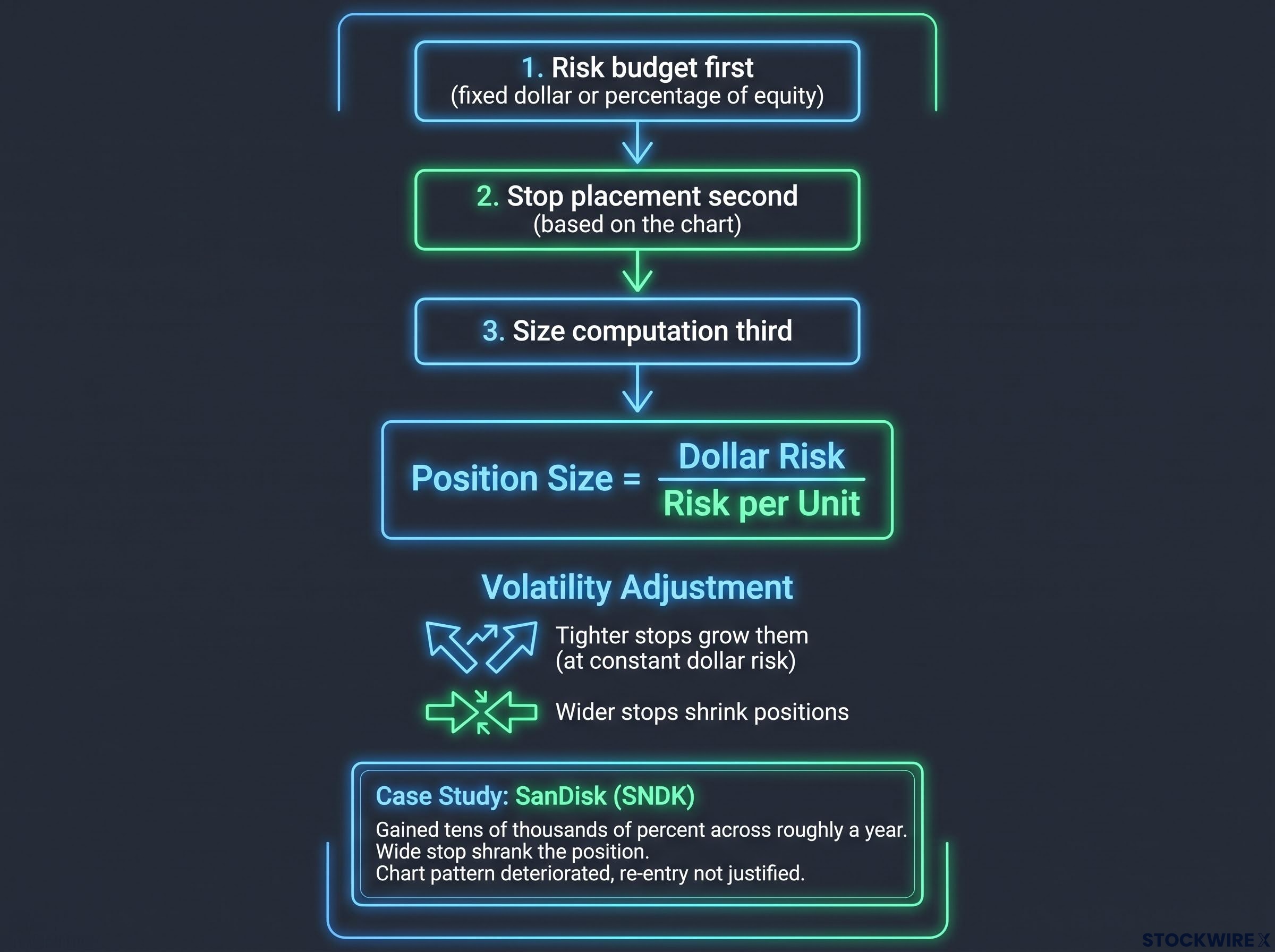
The sequence matters. Three decisions happen in a fixed order, and no discretion enters the third step:
- Risk budget first. Decide how many dollars to risk on this trade, either as a fixed dollar amount or as a percentage of account equity.
- Stop placement second. Place the stop where the setup is invalidated, based on the chart, not on a round number or a comfort level.
- Size computation third. The formula does the rest.
Shares Short = Target Dollar Loss ÷ (Entry Price − Stop Price)
Or in its general form: Position Size = Dollar Risk ÷ Risk per Unit
Once the stop is placed, size is a calculation. Not a choice, not a conviction expression, not a portfolio-weight target. A calculation.
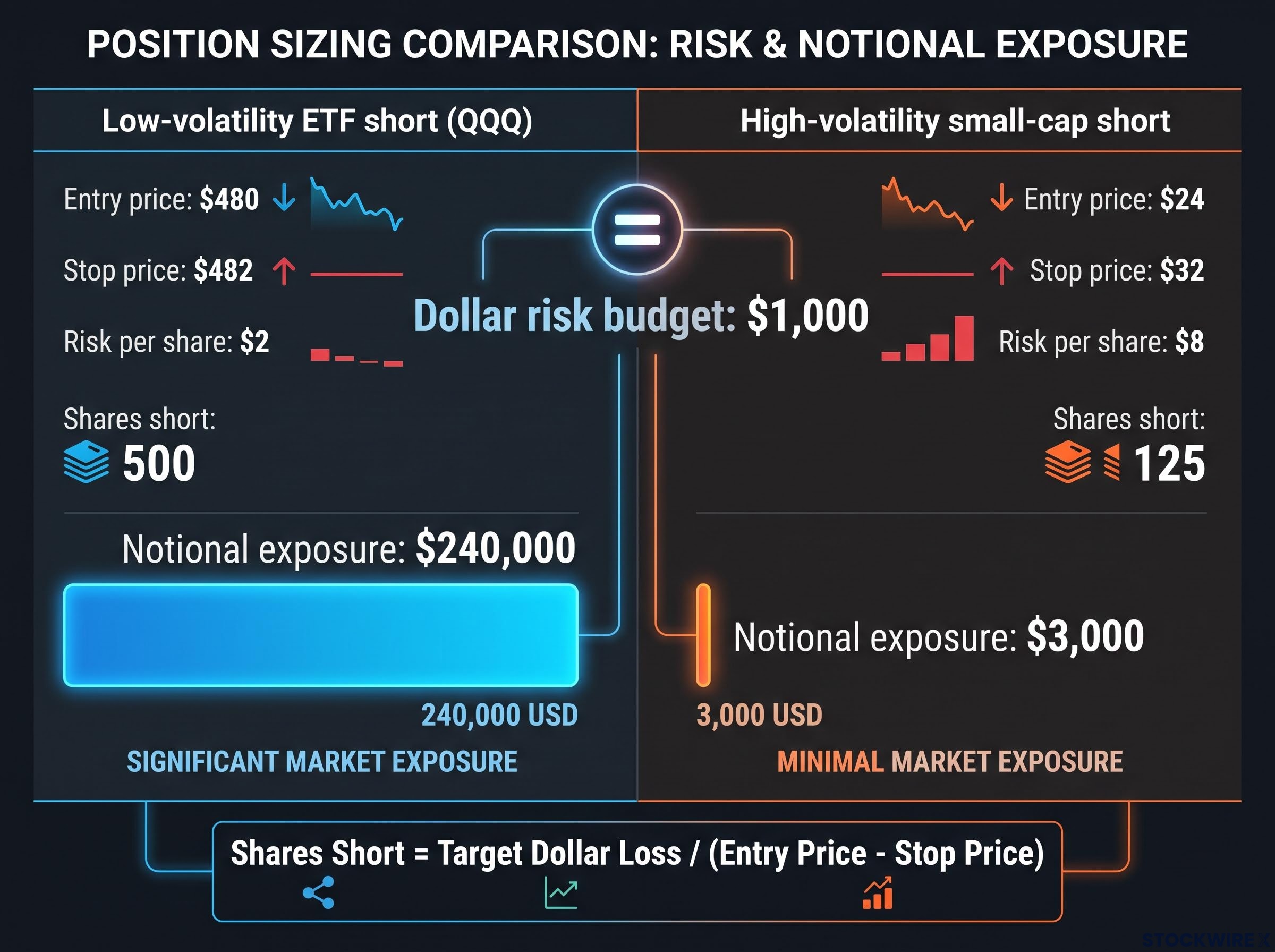
What this produces in practice is a notional size disparity that looks wrong if you are used to thinking in portfolio weights. Because the goal is to keep maximum dollar loss consistent across every position, a broad index ETF like QQQ with a stop only $2 from entry can end up carrying a notional exposure roughly 20 times greater than a volatile small-cap where the stop must sit $8 away. That outcome is what the formula is designed to produce, not a side effect to be corrected.
Leveraged ETF position sizing introduces a compounding layer that the fixed-dollar formula does not automatically capture: a 3x ETF with a stop $2 from entry carries three times the underlying index sensitivity per share, meaning the notional exposure figure the formula produces understates actual market risk by the leverage multiple.
| Attribute | Low-volatility ETF short | High-volatility small-cap short |
|---|---|---|
| Entry price | $480 | $24 |
| Stop price | $482 | $32 |
| Risk per share | $2 | $8 |
| Dollar risk budget | $1,000 | $1,000 |
| Shares short | 500 | 125 |
| Notional exposure | $240,000 | $3,000 |
The $240,000 notional position and the $3,000 notional position carry the same dollar risk: $1,000 if stopped out. Position size in this framework is not an expression of conviction or portfolio weight. It is purely a function of how tight a stop the chart allows, and understanding that distinction changes how you should read any position built this way.
When big ASX news breaks, our subscribers know first
How volatility enters the framework, and how it does not
A common assumption is that volatile stocks require special treatment: separate rules, tighter risk budgets, or outright avoidance. This framework handles volatility through one channel only, and it is the same channel that governs everything else.
Stop distance is where volatility enters. A more volatile name demands a wider stop to avoid getting shaken out by noise. A wider stop, at constant dollar risk, produces a smaller position. A calmer name allows a tighter stop, which produces a larger position. The formula does not know or care that one name is volatile and the other is not. It only knows the distance between entry and stop.
Three adjustments happen automatically inside the formula:
- Volatility adjustment: wider stops shrink positions; tighter stops grow them, at constant dollar risk.
- Account size adjustment: when dollar risk is defined as a percentage of equity, the nominal risk budget scales with account growth and contracts with drawdowns.
- Market regime adjustment: when volatility spikes broadly and stops widen across the entire book, all positions shrink simultaneously without manual intervention.
For a trader running short positions, this means that a parabolic, hard-to-borrow, frightening-looking name does not require a courage calculation before sizing. It requires the same mechanical step as every other trade: measure the stop distance, apply the formula, and the position shrinks to a level that fits the risk budget.
The SanDisk case: where the chart overrode the size adjustment
SanDisk (SNDK) shows how the sizing principle and the entry decision function independently of each other. SNDK gained tens of thousands of percent across roughly a year of trading, establishing itself as one of the most violently volatile short candidates available.
The volatility-adjusted sizing principle worked as designed: the wide stop distance shrank the position to a level consistent with the rest of the book. But when the stop was hit, the chart pattern had deteriorated to the point where re-entry was not justified. The sizing formula did not kill the trade. The chart did. That separation of sizing logic from trade selection logic is a feature of the framework, not a tension within it.
Correlation as given: the explicit choice to normalise what you can
The most intellectually honest position in this framework is also the one that sounds the most uncomfortable. Correlation across positions is treated as an unavoidable environmental condition, not an active risk variable to be managed.
This is not a gap. It is a choice.
Institutional portfolio-construction frameworks do manage correlation. They deploy Value-at-Risk (VaR) models, which estimate the maximum expected loss over a given period at a given confidence level. They impose sector constraints and factor limits. But those tools belong to a separate domain entirely, one that operates outside the fixed-dollar-per-trade world this approach inhabits.
Beta-weighted position sizing represents the institutional layer this framework explicitly sets aside: where the fixed-dollar approach normalises dollar loss per trade, beta weighting normalises market-risk exposure per position, producing materially different notional sizes when the two methods are applied to the same book.
The framework’s resolution: normalise what is controllable (dollar loss per position), accept what is not (correlation during stress periods).
Standard retail and intermediate trading risk literature is silent on correlation management for discretionary traders, not contradictory to it. The literature focuses on risk per trade and volatility-based sizing. Precise, enforceable correlation controls are absent from this domain because they require infrastructure (factor models, real-time covariance matrices) that sits in a different world.
The two framework domains operate separately:
- Fixed-dollar discretionary: governs this framework. Each position is sized by its own chart-based stop and a consistent risk budget. Portfolio-level correlation is acknowledged, not engineered.
- Institutional VaR/factor model: governs the correlation-managed alternative. Sector, factor, and beta constraints layer on top of individual position sizing.
For a trader building a short book, this means a cluster of correlated positions is not a structural error in the framework. It is a known and accepted consequence of running positions with the best individual setups. The protection against correlation-driven drawdowns is not diversification engineering but the bounded dollar loss on each name.
Traders who attempt to manage correlation in a discretionary short book often end up skipping high-conviction setups to avoid overlap, or sizing down entire sectors to hit a portfolio-level constraint. This framework rejects that trade-off, and what the reader accepts in return is the possibility of a correlated drawdown across well-sized individual positions.
Direct shorts versus puts: when the instrument choice reveals the framework’s logic
Options appear in only about 1 in 30 trades within this framework, with the remaining positions taken as direct shorts. That proportion is not the product of caution for its own sake. It reflects a clear-eyed assessment of the specific problems long puts are suited to solving, and the costs they carry when those conditions are not present.
Three conditions push a trade from a direct short toward a long put:
- Extended timeframe: the bearish thesis requires months or quarters to play out, making a direct short expensive to carry.
- Borrow difficulty or squeeze risk: the stock is hard to borrow, or short-squeeze dynamics make holding a direct short position impractical.
- Execution friction: market conditions or liquidity make establishing or maintaining a direct short position unreliable.
When options are used, only simple long put purchases are made. No multi-leg structures. No debit spreads. The rejection of spreads is where the framework’s internal logic is most visible: if the thesis involves a large directional move, capping the payoff to reduce premium outlay is a bad trade. That reasoning flows directly from the same logic that governs position sizing throughout the framework, where the goal is to let a correct thesis pay off fully, not to trim both risk and reward symmetrically.
Short squeeze mechanics follow a self-reinforcing sequence that the fixed-dollar framework addresses structurally: because each position carries a bounded maximum loss, a squeeze-driven move stops the trade at the stop price rather than triggering an open-ended loss spiral.
One live position illustrates this in practice: March 2027 put options on FXI (a Chinese equity ETF), with enough time remaining to absorb a slow-developing thesis. Tight bid-ask spreads are normally a condition for entering options trades, though that standard was relaxed here given the extended duration available. Long puts cap risk at the premium paid but introduce time decay and require correct timing on both direction and pace, which narrows the window for a profitable outcome relative to a direct short.
| Attribute | Direct short | Long put |
|---|---|---|
| Risk profile | Theoretically unlimited loss | Loss capped at premium paid |
| Time-decay exposure | None | Constant; accelerates near expiry |
| Borrow/friction exposure | Borrow costs, recall risk, squeeze risk | None once purchased |
| Payoff cap | None (stock can go to zero) | None (stock can go to zero) |
| Typical use in this framework | Default method (~29 of 30 trades) | Extended timeframe or high-friction setups (~1 of 30) |
The framework itself describes its options use as unsophisticated relative to professional standards. That candour is a marker of intellectual honesty: the tools are simple because simplicity keeps risk bounded and knowable in advance.
What this framework trades away, and what it delivers in return
Four rule-based practices define the framework, applied in sequence:
- Risk budget: fix the dollar or percentage risk per trade as the primary control.
- Stop placement: place the stop where the chart invalidates the setup.
- Size computation: compute shares short mechanically as Dollar Risk ÷ (Entry − Stop). No discretion at this step.
- Correlation acceptance: accept that portfolio correlation may spike in stress, and focus solely on ensuring each position’s maximum loss is bounded and known in advance.
The framework’s strongest claim is that it separates conviction from size. Conviction governs whether to take the trade. The formula governs how large the position is. That separation removes the most common source of discretionary inconsistency in short book construction: the tendency to oversize positions where confidence is highest and undersize where it is lowest, which inverts the relationship between risk and reward.
The trade-offs to hold alongside the strengths
The framework’s primary accepted cost is correlation risk during stress. A book of individually well-sized positions can still produce a correlated drawdown if multiple names move against the book simultaneously. The framework does not pretend otherwise. It accepts this outcome as the price of running the best individual setups without diversification constraints.
A secondary trade-off appears when options are used. Long puts introduce time-decay and timing exposure that direct shorts do not carry. The premium paid is the bounded risk, but the requirement to be correct on both direction and pace narrows the window for a profitable outcome.
Both trade-offs are known and explicit rather than hidden. That transparency is itself a feature of the framework’s design. Once the stop is placed, size is a calculation, not a choice, and that constraint is what makes the framework durable across different market environments.
For investors wanting to see what correlated drawdowns look like across a real portfolio structure, our full explainer on correlated drawdowns in stress regimes examines how the 2026 stock-bond correlation extreme has dismantled the cushioning assumption built into the most widely held portfolio construction in retail investing.
This article is for informational purposes only and should not be considered financial advice. Investors should conduct their own research and consult with financial professionals before making investment decisions. Past performance does not guarantee future results.