
A $16 million wave of Tesla call buying looks like someone knew something. Yet three of the four breakevens sat above the Wall Street average price target of about $396.50. Most of the money was also timed to expire one day after a product event that, by most accounts, never took place.
In October 2025, about $16.03M in short-dated Tesla (TSLA) calls was concentrated in four strikes around the Roadster reveal and Q3 earnings. A year later, you can judge the logic of the trade against what actually happened, which makes it a useful case study in any Tesla options trading strategy built around a single event.
The Roadster reveal did not happen on 15 October 2025. It was postponed into 2026, so this is a lesson in method, not a recommendation.
Here is how to read event-driven options flow, calculate breakevens, compare them with implied moves and analyst targets, and treat event risk as a separate risk. You can use the same checks on the next headline trade you see.
What did the $16 million Tesla call trade actually look like?
Start with the evidence, before anyone tells you what it means.
The trades went through on Tuesday, 7 October 2025, with Tesla closing near $377.80. Three of the four were executed in the last 90 seconds of the session. The figures come from tastytrade’s “Signal vs. Noise” analysis of the options tape. No named public source gives contract counts or notional values for these purchases, so you are working only with premium figures.
| Expiry | Strike | Premium | Breakeven | Catalyst Covered |
|---|---|---|---|---|
| 16 Oct 2025 | $385 | $6.89M | ~$393.56 | Roadster reveal only |
| 16 Oct 2025 | $397.50 | $2.51M | ~$401.56 | Roadster reveal only |
| 23 Oct 2025 | $400 | $4.3M | Not itemised in source | Roadster reveal and Q3 earnings |
| 23 Oct 2025 | $390 | $2.33M | Not itemised in source | Roadster reveal and Q3 earnings |
The 385 call was priced at 39% implied volatility, which is the market’s estimate of how much the stock is likely to swing, built into the option’s price. The 16 October expiries captured the scheduled Roadster reveal but expired before earnings. The 23 October expiries covered both, because Q3 results landed on 22 October.
Because every option price, Greek and probability estimate on your chain is derived from implied volatility, a 39% reading on the 385 call tells you how much movement the market had already paid for before the trade printed.
The concentration in one number About $16M in calls, with nearly 60% expiring one day after the known event.
The 16 October contracts totalled about $9.4M, roughly 59% of the premium. The 23 October contracts totalled $6.63M.
The concentration of premium just past the catalyst tells you these buyers were paying for a specific event window, not a broad view on Tesla. That distinction matters because a correct view on Tesla can still lose money if the window closes before the event arrives.
When big ASX news breaks, our subscribers know first
How do you read options flow, breakevens and implied moves?
A $6.89M call print on your screen looks like conviction. Once you work through the mechanics, it looks far less certain.
Breakeven and implied move
Breakeven is the share price an option needs at expiry for the buyer to recover the premium paid. For a call, it equals the strike price plus the premium per share.
Take the 16 October 385 call. Its breakeven of about $393.56 sat against a $377.80 close, so Tesla needed to rise about 4.2% in nine days just for the buyer to break even.
The implied move is the price swing the options market expects by a given date. It is usually inferred from the at-the-money straddle, a position that buys both a call and a put at the strike nearest the current share price. Through 16 October, options implied a move of about 5.8%, a range of roughly $356 to $400.
The 397.5 call’s breakeven of about $401.56 sat outside that range. A routine product update would probably not have been enough. That strike needed news the market was not already expecting.
The rule that matters The stock’s actual move has to exceed what is already priced in, not just head in the right direction.
Theta, IV crush and why flow is ambiguous
Theta is the amount of value an option loses each day as expiry approaches. For short-dated options, theta is very high and speeds up in the final days, so buying near-term calls before an event is effectively renting convexity. Convexity here means the chance of outsized gains if the stock moves sharply.
IV crush is the fall in implied volatility after an event passes. Volatility is bid up into a catalyst and then collapses, whichever way the news breaks. That can cut an option’s value even when the stock rises.
The print itself also hides most of the story. Cboe and Options Industry Council (OIC) materials point out that reported blocks do not show whether a trade opens or closes a position, or whether it hedges another holding. Tastytrade educators add that a large call buy can be a speculative bet, a hedge against a short stock position, or one leg of a spread, collar or ratio structure.
Alerts about unusual options activity confirm only that abnormal volume hit a strike, and you still need structural markers such as strike laddering, execution timing and offsetting flow to judge whether it reflects conviction.
Practitioners disagree on how to value these trades. Premium buyers treat the cost as the “price of admission” for limited downside and large potential upside. Premium sellers argue that event risk is systematically overpriced and that realised moves often fall short of implied ones.
Treat any headline “unusual flow” figure as one leg of a position you cannot see. Then run four checks:
- Find the breakeven.
- Compare it with the implied move.
- Compare it with analyst targets.
- Identify what the position could be hedging.
The second check is the first real test. It tells you whether the bet needs ordinary news or extraordinary news to pay off.
Why does event risk make a Roadster-style bet so fragile?
The Roadster has a long record of slipping dates.
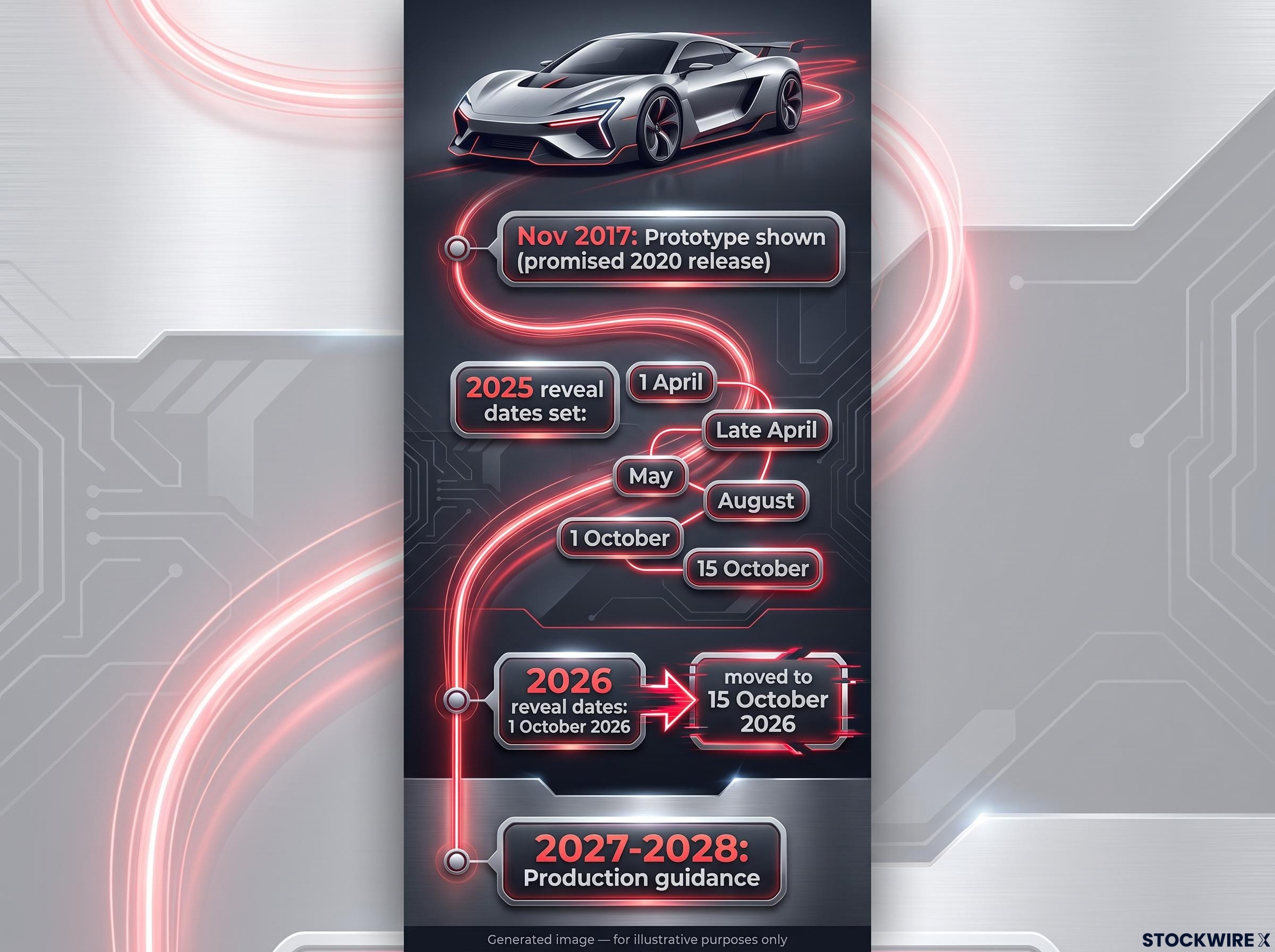
Tesla showed the prototype in November 2017 with a promised 2020 release, and that release did not happen. According to the tastytrade presenter, 15 October 2025 was the sixth reveal date set that year. The sequence ran as follows:
- 1 April
- Late April
- May
- August
- 1 October
- 15 October, which the presenter’s account says did not happen, with the reveal pushed into 2026
Later reporting from Reuters, TechCrunch, Electrek and others describes an outdoor event near Waco, Texas, first set for 1 October 2026. According to Tesla’s post on X, it was moved to 15 October 2026 because of a severe weather forecast. That date is six days away. Production guidance, based on statements Elon Musk made in November 2025, points to 2027-2028.
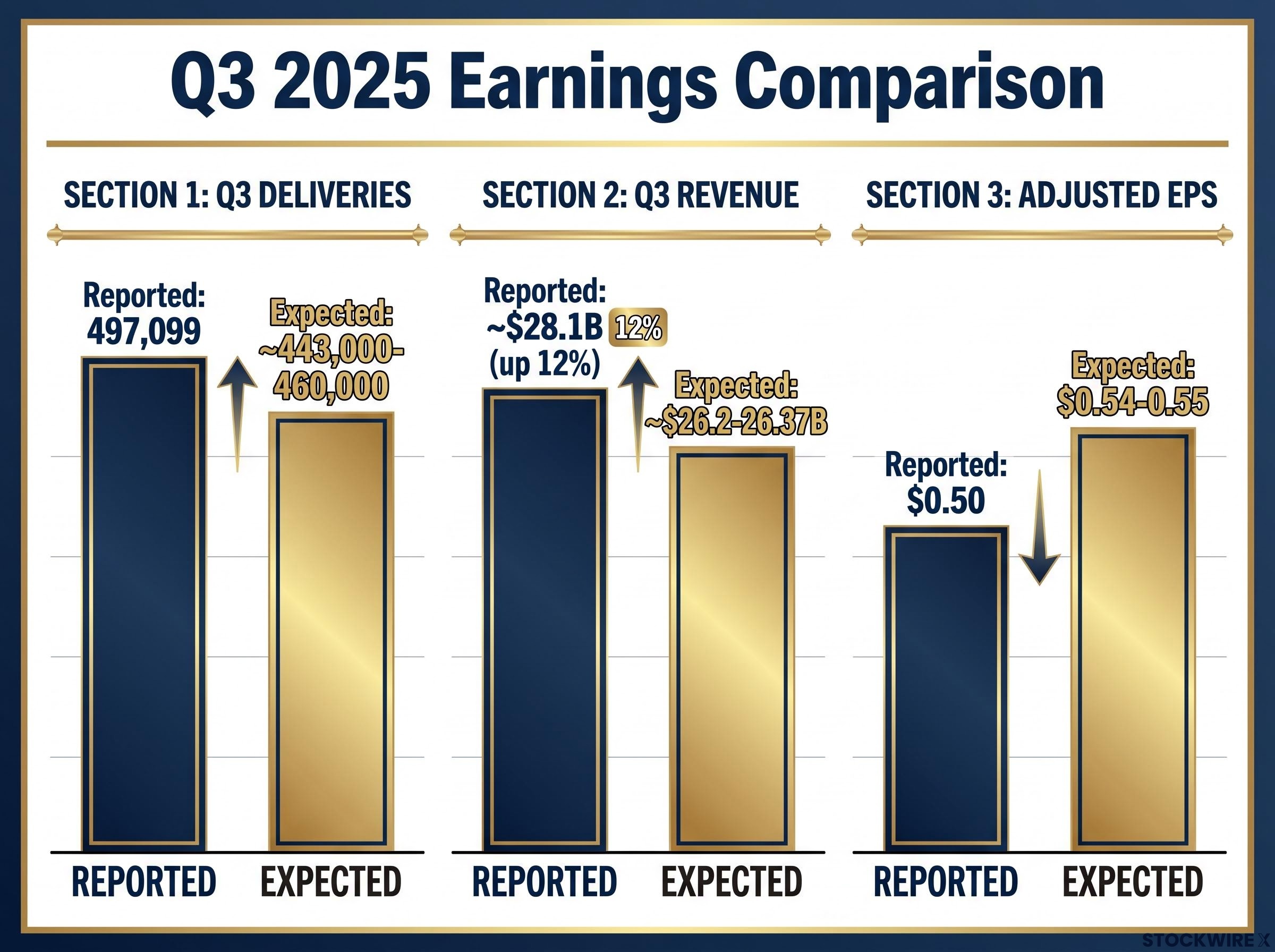
Meanwhile, other news was moving the stock. Tesla reported Q3 deliveries on 2 October 2025, and the shares rose about 5%. Earnings followed on 22 October:
| Metric | Reported | Expected |
|---|---|---|
| Q3 deliveries | 497,099 | ~443,000-460,000 |
| Q3 revenue | ~$28.1B (up 12%) | ~$26.2-26.37B |
| Adjusted EPS | $0.50 | $0.54-0.55 |
Adjusted earnings per share (EPS), a measure of profit for each share after excluding certain one-off items, missed expectations. CNBC reported that the stock fell roughly 5% in after-hours trading.
The sources also conflict on free cash flow, which is the cash a business generates after capital spending. The presenter cited negative $1.06B, apparently from an earlier period. Post-earnings reporting puts Q3 at nearly $4.0B. Check figures like this against company filings before you rely on them.
Past launch events have been cited as examples of volatility collapsing once details came out, but that history is unverified. The broader lesson still applies: a delay can leave short-dated buyers holding decaying premium with no catalyst before expiry.
Your real exposure in a trade like this is to the calendar as much as to the share price. If a catalyst has a record of slipping, you are paying time decay on an event that may not arrive before your options expire. Size for that date risk before you decide on direction.
What did the outcome prove, and what should you take from it?
The calls won, and by a wide margin.
Tesla closed at $428.75 on 16 October 2025 and $448.98 on 23 October 2025. Both closes sat above every breakeven, including the highest in the set at about $408.34. The only consensus figure available for comparison is the roughly $396.50 average target from that October, and both closes cleared it as well.
The source accounts also indicate the Roadster reveal did not happen on 15 October 2025. If so, the gains did not come from the event the trade was timed around. The buyers were right about the price but, on that evidence, wrong about the reason.
That distinction matters. The Securities and Exchange Commission (SEC) and the Financial Industry Regulatory Authority (FINRA) both warn retail investors about this kind of trade.
Regulatory caution SEC investor education warns that options can lead to rapid losses, particularly in short-term speculation by traders who do not understand time decay and volatility.
FINRA cautions that concentrated short-term bets are inappropriate for many retail investors. The OIC advises careful sizing for event-driven trades. Academic and brokerage data show that retail traders systematically lose money on short-dated out-of-the-money options around news events. An out-of-the-money call is one with a strike above the current share price.
FINRA options guidance stresses that options carry significant leverage and can lose value quickly, which is why a short-dated call bought ahead of a single event deserves position sizing based on losing the entire premium.
Institutions may also hedge with stock, spreads or longer-dated options. If you copy only the visible leg, you take on the risk without that protection.
The presenter read the concentration of bets as the signal and the dismissal of $400 as noise. The counter-argument is that following headline flow mostly exposes traders to mispriced volatility rather than inside knowledge.
A winning result tells you the bet paid off once. It does not tell you the method was sound. Before you act on any unusual options flow story, ask:
- Is this an opening trade, or could it be closing or hedging an existing position?
- How far is the breakeven from the current price, and is it inside the implied move?
- Does the breakeven sit above analyst targets?
- Has the catalyst slipped before, and does the expiry leave any buffer for a delay?
- Could you afford to lose the entire premium?
This analysis is educational and is not investment advice. Past performance does not guarantee future results, and any forward-looking statements are speculative and subject to change.
A repeatable checklist for judging the next event-driven options trade
The method holds up even though the Tesla trade itself proves little. Start by reading the structure: strikes, expiries and timing. Calculate the breakeven, then test it against the implied move and against analyst targets. Next, look at how reliable the catalyst is, because a delay-prone event adds date risk on top of direction risk. Finally, size the position on the assumption that you could lose the full premium.
Use the October 2025 trade as a template for process, not a signal to copy. The next Tesla reveal, now scheduled for 15 October 2026, and every earnings date after it, will produce more large prints. Work through the checklist before you form a view on what the flow means.
This article is for informational purposes only and should not be considered financial advice. Investors should conduct their own research and consult with financial professionals before making investment decisions.