Here is a rule that trips up almost every new currency trader: inflation is supposed to be bad for a currency. Higher prices erode purchasing power, so the money should be worth less. Yet in Australia today, an inflation surprise often pushes the Australian Dollar higher, not lower.
That tension is not a glitch. It sits at the centre of how modern currency markets read the Reserve Bank of Australia, and getting it wrong is one of the most common ways retail traders misread the AUD.
The Reserve Bank of Australia (RBA) stands behind almost every meaningful move in the Australian Dollar. Its decisions on interest rates, its balance sheet operations, and even the tone of its language ripple straight through to the currency. Learn how the RBA thinks, what tools it holds, and how markets interpret its signals, and the AUD stops looking like a random variable and starts reading like an instrument you can actually track.
This explainer builds you a coherent mental model linking RBA monetary policy to Australian Dollar outcomes. You will move through the full toolkit: the mandate that sets the RBA’s direction, the cash rate that drives most short-term moves, the counterintuitive inflation relationship, the quantitative easing and tightening tools working in the background, and the macro indicators that signal what comes next.
What the RBA is actually trying to do
The RBA is not chasing a single number. It is balancing three pressures at once, and that is precisely why its decisions are never simple and always matter for the currency.
Its mandate rests on three pillars:
- Price stability, anchored to a core inflation target band of 2-3%.
- Full employment, keeping as many Australians in work as the economy sustainably allows.
- The economic prosperity and welfare of the Australian people more broadly.
The central anchor The RBA targets core inflation of 2-3% as a medium-term average, not a hard ceiling. A brief overshoot does not automatically force a response.
That distinction matters more than it sounds. Because the target is an average over time, the RBA can tolerate inflation sitting above 3% for a stretch without slamming on the brakes, provided it expects the number to drift back down. This is why markets watch the RBA’s forecasts as closely as its actual decisions.
The RBA holds 8 formal scheduled policy meetings each year, supplemented by ad hoc emergency sessions when conditions demand them. That cadence tells you when decisions land and gives you fixed dates to build your currency watchlist around. The next scheduled policy update is set for 2:30 pm on 29 September 2026.
Here is what this reframe buys you. Once you understand that the RBA is weighing inflation, employment, and prosperity simultaneously, you stop treating rate decisions as binary flip-a-coin events. The bank does not cut or hike at the first sign of a single data point. It reads a cluster of indicators, which is exactly why you need to read several of them too when you are forming a view on where the AUD is heading.
When big ASX news breaks, our subscribers know first
The cash rate and why it moves the AUD
The cash rate is the RBA’s primary conventional tool, and it is the engine behind most short-term AUD moves. It is the overnight interbank lending rate, meaning the interest banks charge each other to borrow overnight. From there it flows through to mortgage rates, business borrowing costs, and ultimately how much Australians spend.
Follow the money and the currency logic assembles itself:
- The RBA lifts the cash rate.
- Domestic interest rates rise, making Australian bonds and deposits pay more.
- Foreign investors, hunting better returns, want in.
- To buy those Australian assets, they must first buy Australian Dollars.
- That extra demand for the currency lifts its value.
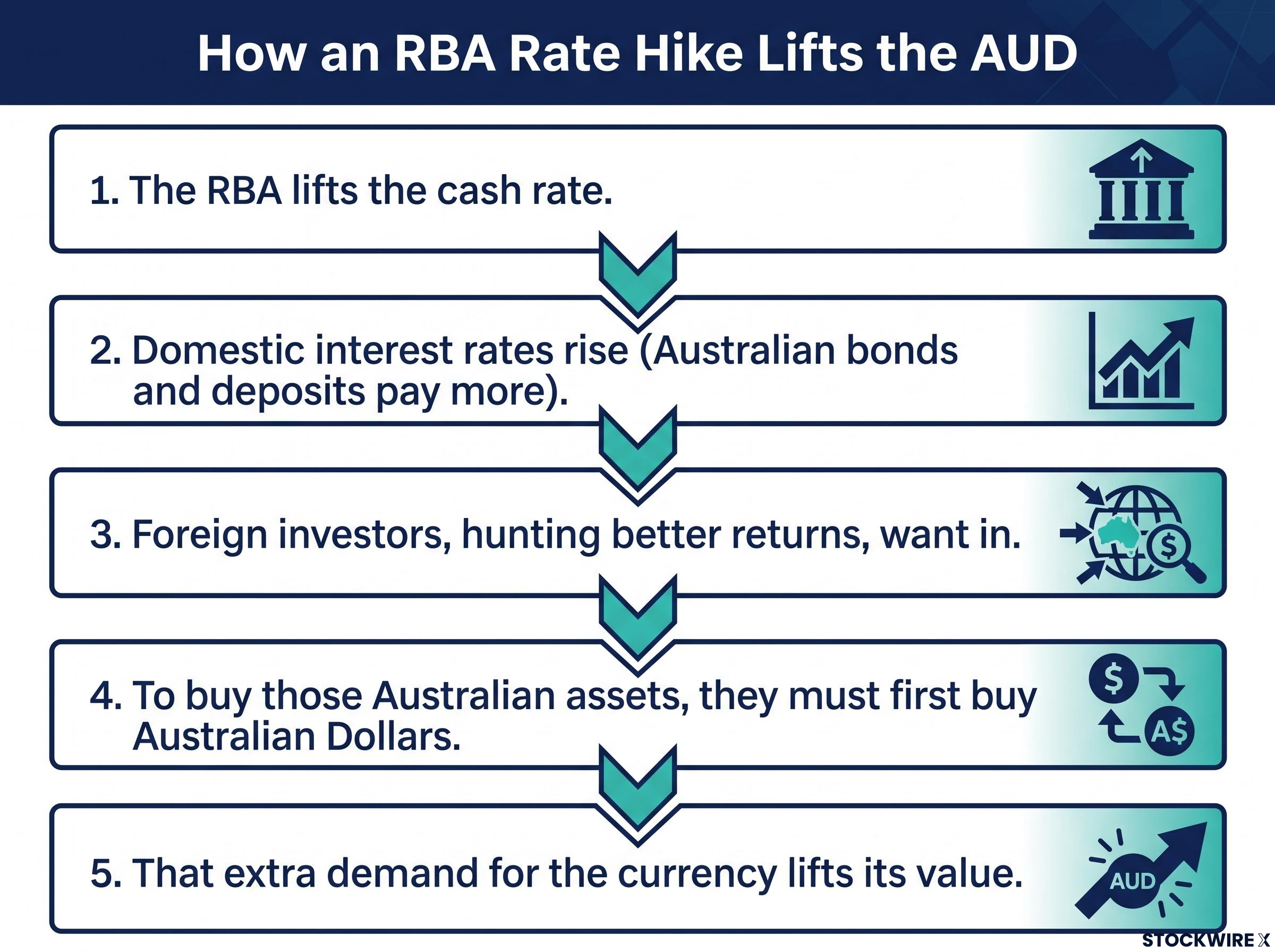
This is the rate differential at work. It is not the absolute level of Australian rates that matters, but the gap between Australian rates and those in the US, Europe, and Japan. Those three represent the largest pools of internationally mobile capital, so when Australian assets out-yield theirs, capital rotates toward the AUD. RBA research and Australian Treasury macroeconomic analysis both confirm that an unanticipated domestic rate rise should cause an immediate appreciation of the currency.
The rate differential between Australia and its peers widened to as much as 235 basis points in May 2026, when the RBA hiked to 4.35% while the Fed, ECB, and Bank of England all held, giving the AUD a structural yield advantage over the currencies of the three largest pools of internationally mobile capital.
The recent history shows the mechanism in full force. Between 2022 and 2024, the RBA delivered cumulative tightening of 425 basis points. As of the most recent completed meeting on 11 August 2026, the board voted unanimously to hold the cash rate target at 4.35%, effective 12 August 2026. Heading into the 29 September 2026 meeting, market and analyst commentary anticipates a possible 25 basis point hike.
Now for the detail that separates informed traders from reactive ones. The AUD responds not just to what the RBA does, but to the gap between what it does and what markets expected.
Expectations vs. outcome In April 2015, markets were positioned for a rate cut. The RBA held instead. The AUD gained more than 1% in a single day. Removing the expectation of lower rates behaved exactly like a tightening move.
That example carries a practical lesson for you. Watching market pricing for upcoming meetings is as important as watching the decision itself, because the currency moves on the surprise, not the setting. If a hike is fully priced in, the decision alone may barely move the AUD.
RBA statement language can compress short-end yields, rally rate-sensitive equities, and weaken the AUD within a single trading session, even when the cash rate itself does not move, because markets are constantly repricing the probability of future hikes based on the tone of the board’s written commentary.
Why inflation can strengthen the AUD (and when it does not)
Back to the puzzle from the opening. Inflation is supposed to weaken a currency, yet an inflation surprise in Australia often lifts the AUD. The resolution lies in how modern capital markets work.
In the pre-liberalisation era, when cross-border capital was tightly restricted, inflation genuinely dragged a currency down by eroding its purchasing power. Today, with capital moving freely across borders, an inflation surprise signals something else entirely: a coming rate hike. Higher inflation prompts the RBA to lift rates, higher rates attract capital, and that capital demand lifts the currency. Inflation itself is not desirable; it is the rate response it triggers that moves the money.
The current data shows exactly the environment where this dynamic operates. According to Australian Bureau of Statistics data released on 26 August 2026, headline CPI rose 3.5% in the 12 months to July 2026, down from 3.8% in June. Trimmed mean, or underlying, inflation held at 3.6% over the same period. Both sit well above the 2-3% target band.
The July 2026 inflation overshoot, where trimmed mean held at 3.6% against a 3.5% forecast, illustrates exactly this dynamic: a single upside surprise collapsed rate-cut expectations within hours and repriced the probability of a further cash rate hike to around 50%.
Here is what the forecasts tell you. RBA and Westpac analyses project underlying inflation to remain above 3% until mid-2027, and not to return to the midpoint of the 2-3% range until early 2028. That is not a fleeting overshoot. It signals that the RBA’s restrictive stance is a structural condition rather than a short-term episode, which keeps rate differentials elevated and provides ongoing support for the AUD, barring a global shift toward risk aversion.
| Condition | Short-term AUD effect | Long-term AUD effect | Historical example |
|---|---|---|---|
| Inflation surprise signalling coming rate hikes | Positive (capital inflows) | Neutral to positive if real rate advantage holds | Contemporary rate-differential dynamics |
| Sustained inflation outpacing trading partners without real rate support | Muted or negative | Negative (purchasing power erosion) | 1970s-1980s TWI depreciation |
When the rule reverses: sustained inflation without real rate support
The AUD-positive story only holds under conditions. When inflation runs hot for a sustained period without a matching real interest rate advantage, the old textbook logic reasserts itself.
RBA analyses using Purchasing Power Parity principles, the idea that exchange rates adjust over time so that a basket of goods costs roughly the same across countries, show the pattern clearly. In the 1970s and 1980s, when Australian inflation outpaced its trading partners, the nominal trade-weighted index for the AUD depreciated steadily to stop Australia losing competitiveness.
There is also a feedback loop to watch. A depreciating AUD raises the price of imported goods, which feeds back into domestic CPI, which pushes the RBA toward more aggressive tightening to avoid a wage-price spiral.
And the differential cuts both ways. ANZ research confirms that if Australia holds its rates steady while peer central banks hike, the widening gap can drive the AUD lower against those currencies. Rate differentials are not a one-directional tailwind.
Quantitative easing and quantitative tightening: the RBA’s balance sheet tools
Watch the RBA’s balance sheet expand or contract and you are reading a signal most retail investors ignore entirely. Beneath that surface movement sit two unconventional tools that shape the AUD quietly, regardless of where the cash rate sits.
Quantitative easing (QE) is the tool the RBA reaches for when rate cuts alone are not enough. The bank creates new Australian Dollars and uses them to buy assets, predominantly government bonds. That injects liquidity into the financial system and pushes bond yields down, and the combination places downward pressure on the AUD.
The RBA’s own COVID-19 response is the concrete example. Its emergency toolkit included:
- A $100 billion government bond purchase program.
- Yield curve control, capping the yield on a specific government bond.
- A Term Funding Facility (TFF) providing cheap funding to banks.
Purchases under the bond program ceased after 10 February 2022.
From QE to QT: the policy reversal and its currency implications
Quantitative tightening (QT) is the reversal, and the RBA has chosen the gentle version of it. Rather than actively selling bonds into the market, which would be disruptive, it simply stops reinvesting the proceeds when bonds on its balance sheet mature. The holdings run off naturally over time.
This passive approach withdraws liquidity gradually and broadly supports the AUD as financial conditions normalise. Because there is no active selling, markets absorb it with far less disruption, which is exactly why the RBA picked this path.
The balance sheet trajectory tells the story in numbers.
| Date | RBA balance sheet size | Status |
|---|---|---|
| 30 June 2023 | Approximately $598 billion | Passive QT underway |
| 30 June 2024 | Approximately $414 billion | Continued run-off |
| Projected September 2026 | Approximately $357 billion | Ongoing normalisation |
Passive QT has run since mid-February 2022, with annual bond maturities of roughly $35 billion to $45 billion feeding the runoff. Even so, the balance sheet remains at least twice its pre-pandemic size, so normalisation is far from finished.
Here is why this matters to you. That trajectory from $598 billion toward $357 billion means the RBA is still in active QT mode. That is a structural tailwind for the AUD working quietly in the background, independent of whatever the cash rate does at any single meeting. Most retail investors miss it entirely, which is precisely why it is worth tracking as a second input for your currency view.
What macro indicators tell you about the RBA’s next move
The cash rate is the output. The inputs are a cluster of economic indicators the RBA weighs at every meeting, and knowing which ones to watch turns you from a reactor into an anticipator.
The RBA’s decision at each meeting is shaped by GDP growth, the unemployment rate, wages growth, business and consumer confidence, and PMI readings, sitting alongside the headline CPI and trimmed mean inflation figures. Read them together and you can form a view before the decision lands rather than chasing the headline after.
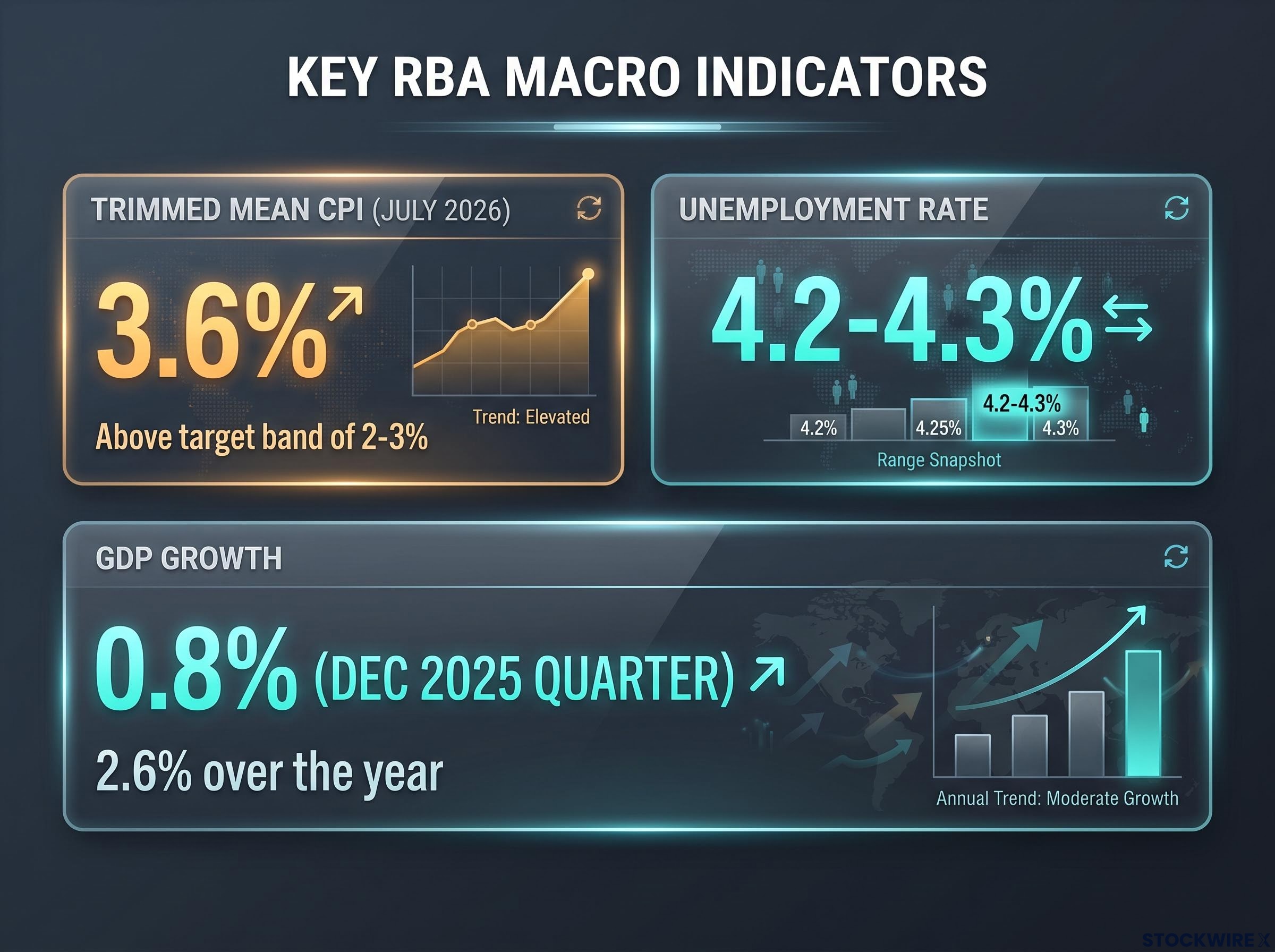
The current environment is telling. Trimmed mean inflation sits at 3.6% while unemployment tracks around 4.2-4.3%, meaning the RBA is navigating a still-tight labour market alongside inflation structurally above target. That combination leans toward continued restrictive policy.
| Indicator | Current reading | What it signals for the RBA | AUD implication |
|---|---|---|---|
| GDP growth | 0.8% (Dec 2025 quarter), 2.6% year | Moderate expansion, no urgency to ease | Broadly supportive |
| Unemployment | Around 4.2-4.3% | Tight labour market, inflation risk lingers | Supportive (hawkish lean) |
| Trimmed mean CPI | 3.6% to July 2026 | Above target, restrictive stance justified | Supportive |
| Wages growth | Watched for spiral risk | Key input to inflation persistence | Conditional |
GDP grew 0.8% in the December 2025 quarter and 2.6% over the year, per the May 2026 Statement on Monetary Policy. That is enough expansion to keep the RBA leaning restrictive rather than reaching for cuts.
The 29 September 2026 meeting is the live case study. Market and analyst commentary anticipates a possible 25 basis point hike, and the recent record shows how the AUD reacts to exactly this kind of move.
The RBA inflation outlook heading into the September 2026 decision is complicated by a genuine split between still-elevated trimmed mean at 3.6% and a deteriorating labour market, with unemployment rising to 4.5% in July as employment fell nearly 28,000 below consensus, making the board’s next move far less straightforward than recent hike history implies.
The hike-to-currency link On 3 February 2026, the RBA raised the cash rate to 3.85%. The Australian Dollar extended gains by 0.9% immediately after, reaching approximately US$0.7002.
A second example reinforces it. On 17 March 2026, the AUD bounced 0.2% following another hike and Governor Bullock’s hawkish post-decision commentary.
Here is the read for the September meeting. Two consecutive 2026 hikes each produced immediate, measurable AUD gains, which means a September hike is likely already partly priced in. The actual currency reaction will hinge less on the hike itself and more on the tone of Governor Bullock’s post-decision language. Watch the words, not just the number.
Putting it together: reading the AUD through the RBA’s lens
You now have five layers that stack into a single framework. The mandate sets the direction. The cash rate is the primary signal. QT is the structural support humming in the background. Inflation data drives the expectations game. And the macro indicators tell you when the next move is coming.
The single most important principle running through all of it: the AUD is moved as much by what the RBA is expected to do as by what it actually does. Your edge lies in monitoring market pricing for upcoming meetings alongside the data itself, so you are positioned before the surprise rather than reacting after it.
Run this checklist before each meeting:
- Check current market pricing for the RBA’s next rate move.
- Read the latest trimmed mean CPI against the 2-3% target.
- Check the unemployment rate for labour-market tightness.
- Review the Governor’s most recent language for hawkish or dovish tone.
The near-term setup is clear. Underlying inflation is projected above 3% until mid-2027 and back to the midpoint only by early 2028. The balance sheet is still shrinking toward roughly $357 billion by September 2026, down from $598 billion in June 2023. And a possible September hike sits directly in view. Those forces together mean the RBA’s settings are likely to stay AUD-supportive through the near term, though the extent will be decided meeting by meeting as the data evolves.
This article is for informational purposes only and should not be considered financial advice. Investors should conduct their own research and consult with financial professionals before making investment decisions.
Past performance does not guarantee future results. Financial projections are subject to market conditions and various risk factors, and forward-looking statements are speculative and subject to change based on economic developments.