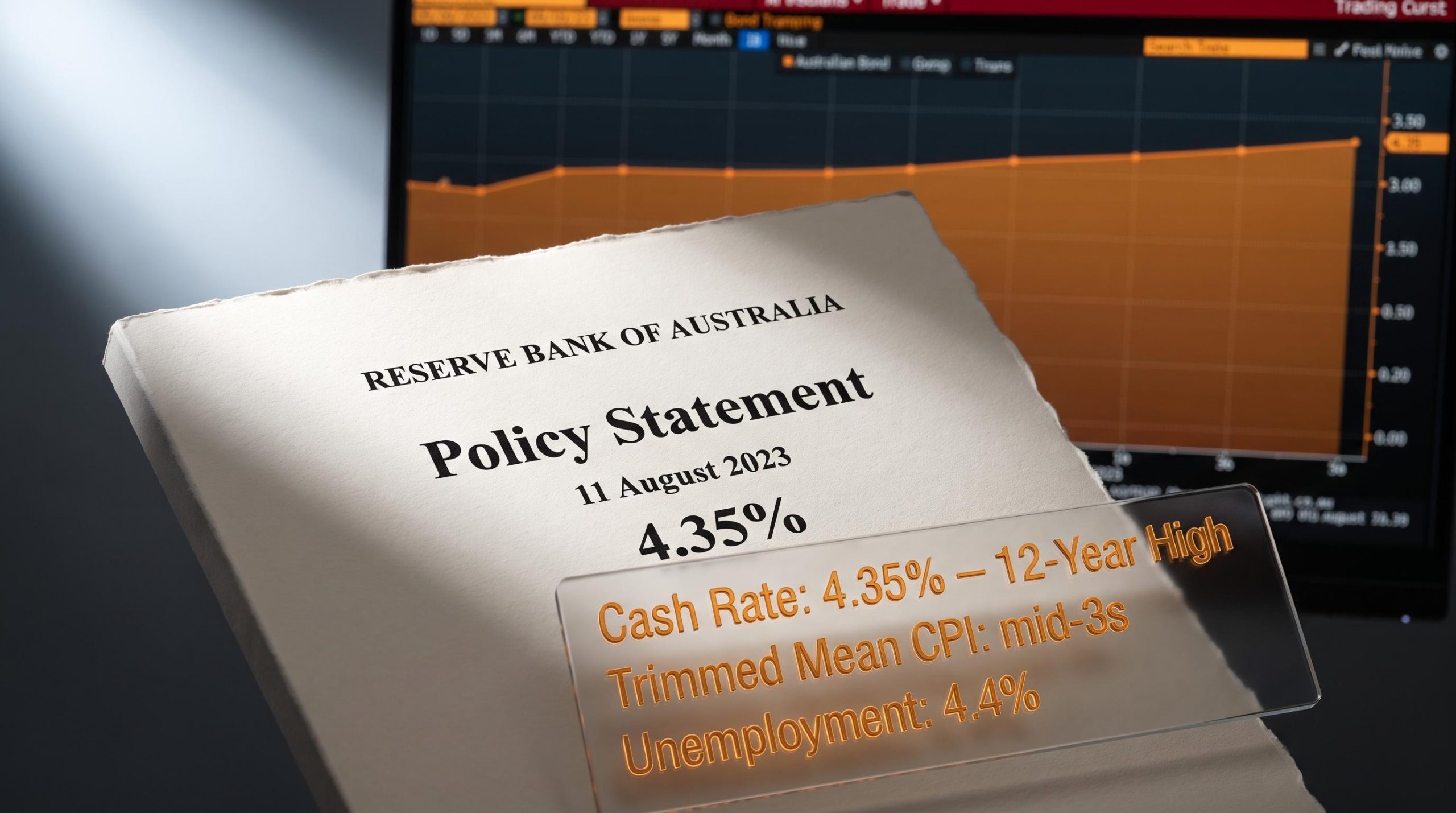
The rate decision on 11 August is, for all practical purposes, already made. The cash rate will hold at 4.35%. Markets know it. Major bank economists know it. Governor Michele Bullock has all but telegraphed it. If you are watching the RBA next Monday for a rate call, you are watching the wrong thing.
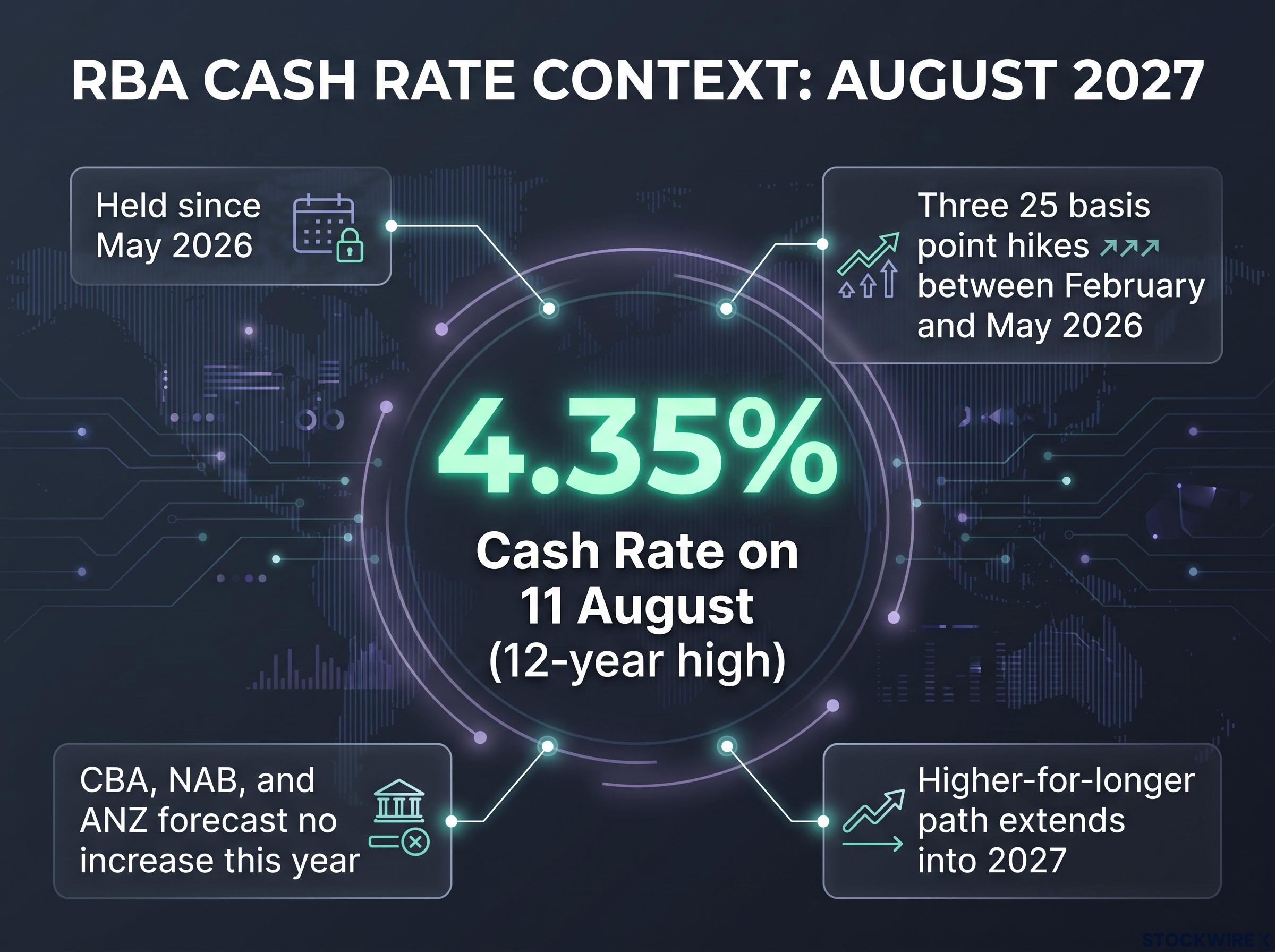
The genuine uncertainty sits inside the language that accompanies the hold. The RBA has been at 4.35%, a 12-year high, since May 2026, following three consecutive 25 basis point hikes. CBA, NAB, and ANZ economists are not forecasting another increase this year. Yet futures curves have not fully eliminated hike probability, and the Board’s stated bias remains toward further tightening “if needed.” That conditional has not been withdrawn, and whether it softens, holds, or hardens on Monday is the real event.
Here is what the language in the statement will actually tell you about where Australian rates are heading, and which assets will feel the shift first.
The rate hold is priced in. The policy statement is not.
A hold at 4.35% on 11 August aligns with everything the RBA has signalled and everything the market expects. The cash rate sits at its highest level in 12 years, reached after three hikes between February and May 2026. This is consensus territory.
The reason a fully anticipated hold moves nothing on its own is mechanical. Markets price the expected future path of rates, not individual meeting outcomes. A hold that everyone forecasted does not alter that path. What does alter it is a change in the RBA’s bias, its stated willingness to hike again or its willingness to step back from that posture.
Three things are already priced in:
- The rate will hold at 4.35% on Monday
- The higher-for-longer path extends into 2027
- Near-term rate cuts are not part of the discussion
What is not priced in is whether the RBA’s conditional tightening bias is still live or effectively retired.
Markets trade changes in the expected future rate path, not individual meeting outcomes. A hold everyone expected is a non-event. The language around it is where the signal lives.
That asymmetry is what makes the August statement consequential. A hawkish lean mostly confirms the status quo, moving nothing. But a genuinely neutral signal, one that steps back from explicit tightening conditionality, could reprice short-end rates and rate-sensitive sectors within the same trading session.
When big ASX news breaks, our subscribers know first
What the August statement actually is, and why language precision matters
The RBA does not simply announce a rate and move on. Alongside the 11 August decision, it publishes the Statement on Monetary Policy (SMP), a document that updates the Board’s inflation, growth, and labour market forecasts and elaborates on its risk assessment. These are two distinct documents doing different jobs.
The post-meeting statement sets the immediate tone and policy bias. The SMP provides the quantitative forecast revisions, updated projections for inflation, unemployment, and GDP growth, that give that tone its specificity. A hawkish statement paired with downgraded inflation forecasts sends a very different signal than a hawkish statement paired with unchanged or lifted projections.
The RBA’s inflation target band sits at 2-3%, and the Board has stated that policy must remain “sufficiently restrictive” until inflation is moving sustainably back to that range. Phrase-level precision in how they describe that condition is not semantics. A single wording shift, from explicit tightening conditionality to general vigilance, can reprice bond curves and sector weights within hours.
The third consecutive hike in May 2026 was accompanied by forward guidance language that explicitly preserved full optionality, neither committing to a pause nor signalling a fourth move, a construction that left markets in exactly the interpretive uncertainty the August statement is now expected to resolve.
The four signals to track in the August statement
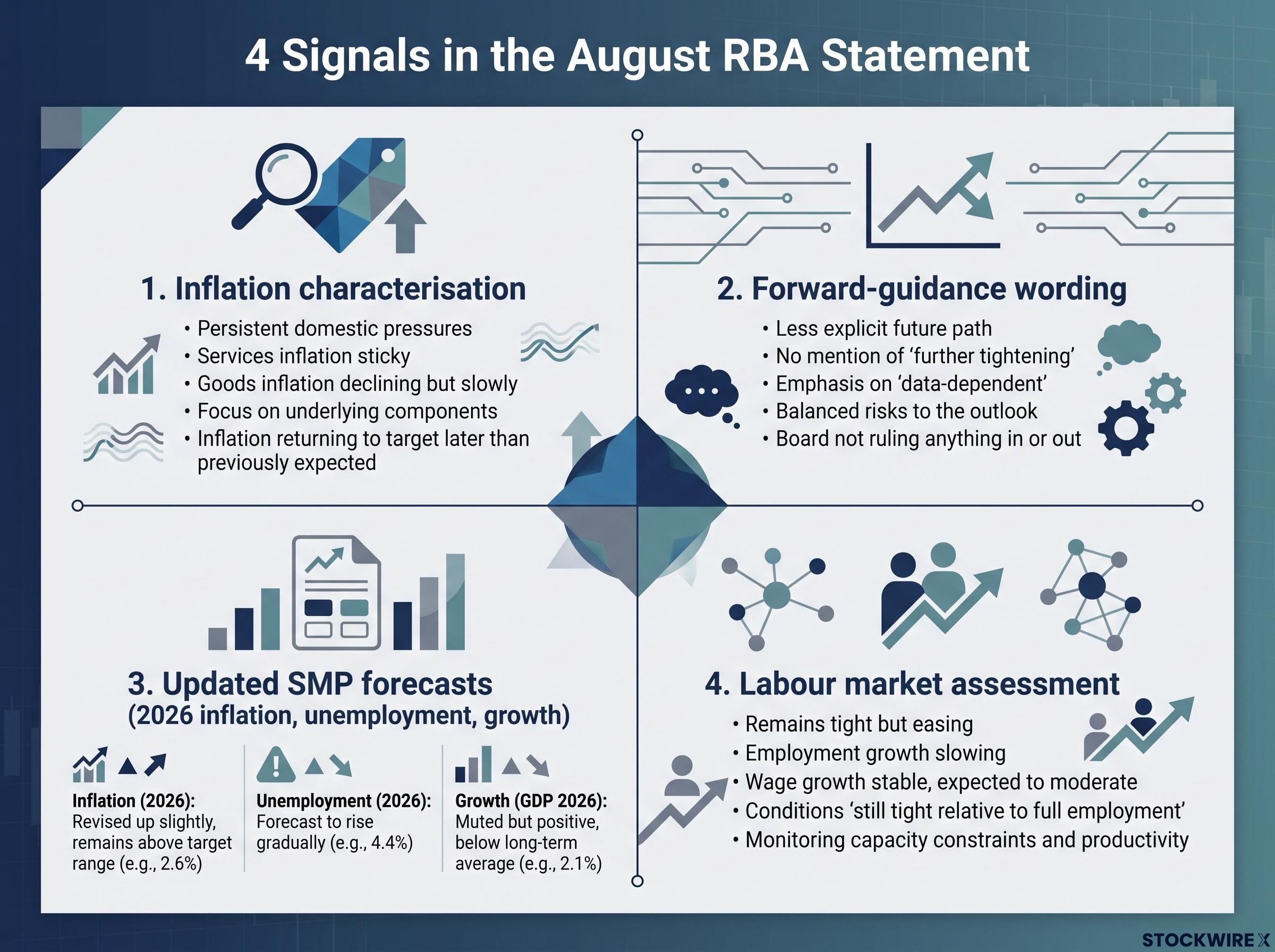
- Inflation characterisation: Whether the RBA describes recent data as encouraging but insufficient (still hawkish) or signals greater confidence that inflation is on a credible path back to target. Any acknowledgement that inflation risks are now “more balanced” would be a material dovish signal.
- Forward-guidance wording: The distance between “the Board remains vigilant to upside inflation risks” and “further tightening may be required if inflation does not moderate as expected” conveys meaningfully different tightening bias. A shift away from explicit conditionality toward general vigilance softens the stance.
- Updated SMP forecasts: Downward revisions to the 2026 inflation profile confirm disinflation is progressing. Upward revisions to unemployment and lower growth forecasts support the case for holding rather than hiking further.
- Labour market assessment: If the RBA describes the labour market as “resilient” and able to “tolerate current settings,” that supports the higher-for-longer message. Stronger concern about faster-than-expected deterioration raises the bar for any additional tightening.
Inflation is cooling, but not convincingly enough to close the door on hikes
The June 2026 CPI reading came in below the March 2026 peak, with the latest monthly movement edging fractionally into negative territory. That gave markets a degree of comfort. However, a single benign print falls well short of the sustained evidence the RBA has said it requires before reassessing its policy stance.
The June 2026 CPI outcome delivered a trimmed mean of 3.6%, beating both consensus estimates and the RBA’s own May forecast of 3.8%, which is the precise reason markets entered the August meeting with modestly reduced hike probabilities rather than the elevated expectations that preceded the June decision.
Underlying inflation tells a less comfortable story. Trimmed mean inflation, which strips out the most volatile price movements to capture the persistent trend, is still running in the mid-3s. That sits materially above the 2-3% target band. Earlier in 2026, the RBA revised its inflation outlook higher and signalled that above-target inflation would persist “for some time,” a framing that justified the hiking cycle.
The Board has stated that policy must remain “sufficiently restrictive” until inflation is moving sustainably back to the 2-3% target band.
The soft June print reduces near-term hike risk, but investors should treat it as one reading rather than a directional confirmation. The question the August statement will answer is whether the RBA reads the softening the same way markets do, or whether the Board sees the cooling as fragile.
Several pressure points could reassert themselves and disrupt the disinflation path:
- Services inflation remains sticky and resistant to rate tightening
- Rental costs continue to climb, driven by supply constraints
- Energy prices carry upside risk from geopolitical disruption
- Global supply chain pressures remain a background factor
Australia’s inflation trajectory is the single variable with the most power to shift the August statement’s tone. Whether the RBA describes recent data as credible progress or an insufficient pause will set the interpretive frame for the rest of the year.
The labour market is softening, but not enough to force the RBA’s hand
The June 2026 unemployment rate came in at 4.4%, holding flat against recent months and pointing to measured economic deceleration rather than abrupt deterioration. Growth has slowed and unemployment has risen from its lows, prompting commentary that the jobs market is “softening a little faster than expected.” Nonetheless, the degree of cooling recorded to date has not been enough to shift market pricing toward rate cuts.
The ABS Labour Force June 2026 release confirms the 4.4% unemployment rate alongside a stable participation rate, data points the RBA will use directly when characterising whether the current degree of labour market softening is orderly or faster than expected.
The RBA itself has been direct about what it needs to see: some further cooling in demand and the labour market to finish the job on inflation, but not a disorderly deterioration that would shift the balance toward easing. The Board remains prepared to raise rates again if inflation conditions do not materialise as expected.
Economists expect the August SMP to raise unemployment forecasts modestly and acknowledge weaker housing activity and slower growth, without signalling a downturn. That creates a middle-ground reading where neither the resilience case nor the softening case is dominant.
A 4.4% unemployment rate in a higher-for-longer environment does not tell you whether the RBA is done. It only confirms policy is working as intended so far. How the August statement characterises the labour market trajectory, whether conditions are easing in a controlled manner or deteriorating at a pace that warrants reassessment, is the interpretive question investors need to answer.
| Scenario | Labour Market Signal | Statement Tone | Policy Bias | Key Asset Impact |
|---|---|---|---|---|
| Orderly cooling | Unemployment stable or rising gradually; participation holds | Confident, patient | Higher-for-longer confirmed; tightening bias maintained | AUD supported; rate-sensitive equities stay under pressure |
| Faster-than-expected deterioration | Unemployment rising more quickly; participation softening | Cautious, acknowledging downside risks | Bar for further tightening raised; neutral stance emerging | AUD weakens; rate-sensitive equities rally on lower terminal-rate expectations |
What the August statement means for Australian dollars, equities, and bonds
The statement’s tone flows directly into three asset classes, and the directional logic in each case depends on whether the RBA delivers a hawkish hold or a neutral one.
Australian dollar. A hold with maintained tightening optionality and persistent inflation-risk language supports AUD. It keeps the rate differential intact against central banks already closer to their own easing cycles. A statement that clearly downplays further-hike risk removes some of that support, and AUD would likely give ground, particularly against currencies where monetary policy is still tightening or holding at higher levels.
Global central bank divergence, with the RBA at 4.35% while the Fed, ECB, and Bank of England held steady in May 2026, created a rate differential of up to 235 basis points that continues to underpin AUD support; whether the August statement softens tightening language determines how much of that differential support the currency retains.
Rate-sensitive equities. The asymmetry here is sharpest. Real estate, utilities, and consumer discretionary sectors would benefit from a signal that the tightening cycle is effectively complete, lower perceived terminal-rate and funding-cost risks directly improve the earnings outlook for these sectors. If the RBA re-escalates tightening rhetoric, those same sectors underperform on renewed fear of another hike.
Short-duration bonds. Current curves embed a higher-for-longer profile into 2027 with residual hike probability but no near-term cuts priced. A clearly terminal signal from the RBA could compress short-end yields as markets trim remaining hike probabilities and pull forward expectations for the first cut. A hawkish re-emphasis would push implied peak-rate expectations higher.
The asymmetry is real: a hawkish hold mostly confirms the status quo, but a genuinely neutral signal from the RBA creates room for meaningful moves in rate-sensitive sectors and the short end of the bond curve within days.
| Asset Class | Hawkish Hold Outcome | Neutral/Dovish Hold Outcome |
|---|---|---|
| AUD | Supported by maintained rate-differential | Weakens as rate-differential support diminishes |
| Rate-Sensitive Equities | Continued pressure from higher terminal-rate expectations | Rally on reduced tightening risk and lower implied funding costs |
| Short-Duration Bonds | Short-end yields hold or push higher | Short-end yields fall as hike probabilities are trimmed |
What the August 11 statement will actually tell you about where rates are heading
The rate decision next Monday will not change anything that is not already in market prices. The statement and SMP will answer three questions that markets cannot yet resolve:
- Is the RBA reading disinflation as credible and sustained, or fragile and insufficient?
- Is the labour market cooling in an orderly way, or is the deterioration accelerating beyond expectations?
- Is the tightening cycle effectively complete, or is another hike still conditionally live?
The SMP’s forecast revisions, updated projections for inflation and unemployment, are the quantitative anchor for interpreting the qualitative language. If the numbers confirm the tone, the signal is clean. If they contradict it, the market will price the numbers over the words.
The statement will not change the rate. But it will change what investors should expect from every RBA meeting that follows.
This meeting will not resolve everything. The full picture will depend on subsequent data through Q3 2026, and the RBA will update its assessment again. But the August statement sets the interpretive frame, it tells you whether the RBA is leaning toward closing the tightening chapter or keeping it open. That distinction is the difference between positioning for a rate plateau and preparing for residual hike risk through 2027.
Investors who enter the meeting with a clear framework for reading the statement’s tone, rather than waiting for headline summaries, will be faster to identify which scenario the RBA has landed in and better positioned to assess whether their current exposures need adjustment.
For investors wanting a worked example of how post-meeting language moves short-end rates and the Australian dollar in real time, our full explainer on RBA forward guidance and AUD pricing covers the May 2026 press conference, the specific phrases that drove the AUD/USD move, and the technical levels that defined the trade that session.
This article is for informational purposes only and should not be considered financial advice. Investors should conduct their own research and consult with financial professionals before making investment decisions. Forward-looking statements regarding RBA policy direction are speculative and subject to change based on incoming data and Board deliberations.
—