#
Here is an uncomfortable truth about selling options premium: you can be completely right about your edge and still lose everything.
The backtest looks clean. The expectancy is positive. The strategy has printed profits across years of historical data. And yet the account goes to zero anyway, not because the edge was fake, but because you could not survive the periods where the edge was being tested. This is a survivability problem, not a strategy problem, and the two are almost always confused.
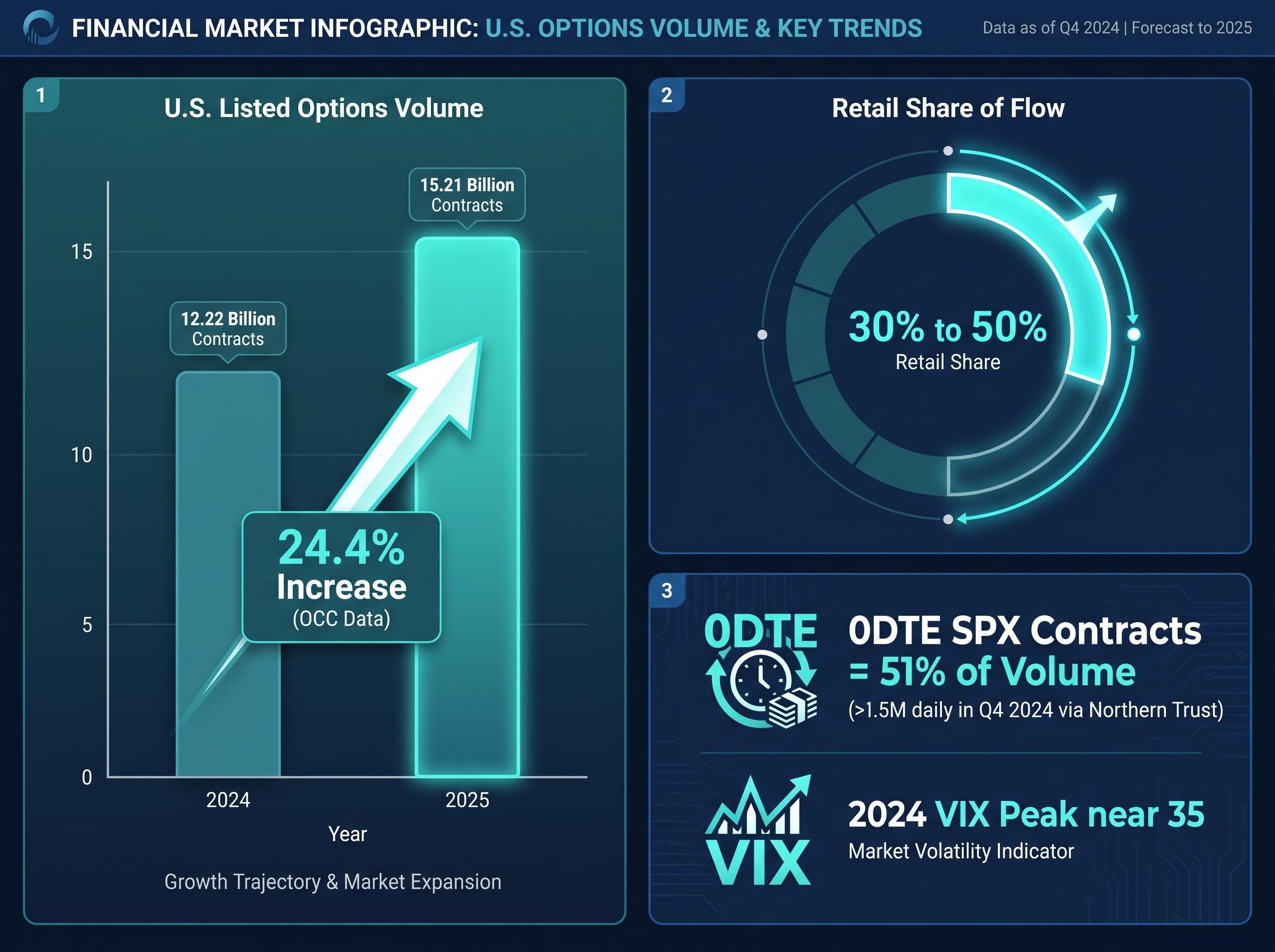
The stakes have never been higher. U.S. listed options volume reached 12.22 billion contracts in 2024, the fifth consecutive record year, then climbed a further 24.4% to roughly 15.21 billion in 2025, according to Options Clearing Corporation (OCC) data. Retail traders now account for an estimated 30% to 50% of that flow, and most of them are working from backtests that quietly assume they will remain in every position through every drawdown. That assumption is the flaw that ends careers.
After reading this, you will have a diagnostic. You will know whether your current account size and strategy structure can actually express the edge you believe you have, or whether you are running something that works on paper but cannot survive contact with a real volatility event.
What backtests cannot tell you about surviving a real drawdown
Every backtest of an options-selling strategy carries one hidden assumption that quietly decides whether the numbers mean anything. The assumption is that you stay at the table.
The model holds every position through every losing stretch. It never gets a margin call. It never panics after three red days in a row. It never closes early because the mark-to-market loss got too painful to look at. It just keeps selling premium, mechanically, through everything. That is the moment where the model and your actual behaviour diverge, and it is precisely the moment most backtests refuse to acknowledge.
Real-world performance falls short of backtested performance for four core reasons:
- Overfitting to benign historical volatility regimes, where the strategy learned to win in conditions that no longer apply.
- Ignoring transaction costs, slippage, and liquidity constraints that quietly erode returns.
- Assuming uninterrupted participation, meaning no margin calls and no psychological exits.
- Failing to model ruin risk, the losses large enough to end the strategy entirely.
The deepest problem sits underneath all four: survivorship bias.
The population that does not exist Published backtests rarely include the traders who blew up or walked away. If a backtest does not count the people who quit after a devastating drawdown, it is describing a population of survivors only. That population does not exist in the real world.
Your backtest, then, is not a performance forecast. It is a description of how a perfectly disciplined robot would have traded. The gap between robot discipline and human behaviour under pressure is where most retail options-selling careers quietly end.
When big ASX news breaks, our subscribers know first
When the historical regime no longer applies
Volatility is not stationary. The range of outcomes a strategy experienced from 2013 to 2019, a stretch of unusually calm markets, does not reliably predict what it will face in a post-2020 world of macro shocks, geopolitical flashpoints, and same-day options flow.
Academic analysis of European and U.S. derivatives markets noted the VIX peaking near 35 during the 2024 U.S. elections and Ukraine ceasefire negotiations, a concrete picture of what genuine stress looks like for a short-volatility seller. A strategy tuned to a calm era will systematically understate how severe a drawdown can get in a violent one.
VIX regime shifts complicate the survivability calculus further: the indicator has operated across three structurally distinct periods since 2017, and a strategy calibrated to one regime’s typical spike pattern may be badly undersized for the amplitude a different regime produces.
The structure of the market itself has shifted. According to Northern Trust’s Options Quarterly Commentary, zero-days-to-expiry (0DTE) SPX contracts, options that expire the same day they are traded, averaged more than 1.5 million contracts per day in Q4 2024 and made up 51% of total SPX options volume. That single change amplifies the intraday swings a short-volatility seller has to survive, and no backtest built on the old regime captures it.
The three forces that push traders out of positions at exactly the wrong moment
Capitulation rarely arrives as a single event. It arrives as a cascade, where emotional pressure, margin mechanics, and market structure hit at the same time during one volatility spike. Understanding the sequence matters, because each force feeds the next.
- The emotional layer. Behavioural research on loss aversion and the disposition effect shows that traders disproportionately fear further losses after a sharp drawdown. The instinct is to close positions and stop the pain, which triggers exits precisely when risk premia are largest and short-volatility positions are most valuable to hold.
- The mechanical layer. As volatility rises, brokers and clearinghouses raise margin requirements on short options positions. A trader who fully intends to ride out the drawdown can be forced to liquidate regardless of conviction, simply because the margin call arrives before the recovery does.
- The systemic layer. During macro events, systematic strategies and retail traders de-leverage at the same time, creating a feedback loop. Rising volatility forces selling, which raises volatility further, which forces more selling. Short-volatility holders get trapped in an escalating exit dynamic that no individual can control.

The scale of the mechanical layer is worth pausing on. OCC held $297 billion in margin at year-end 2024 alongside a $19.1 billion clearing fund, which tells you the machinery enforcing those margin calls is vast, automated, and indifferent to your conviction.
Capitulation forms the bottom Practitioner commentary makes a sharp observation: many traders exit involuntarily near the lows, because it is the simultaneous capitulation of multiple participants that actually forms those lows. The fear of re-entering after selling at the bottom then causes them to miss the recovery entirely, compounding the original loss.
| Mechanism | Trigger condition | What the trader experiences |
|---|---|---|
| Emotional | Extended drawdown, consecutive days of unrealised losses | An overwhelming urge to close positions and stop the pain |
| Mechanical | Volatility spike raising margin requirements on short positions | A margin call forcing liquidation regardless of conviction |
| Systemic | Synchronised de-leveraging during a macro event | A volatility feedback loop that traps the position in an escalating exit |
When the VIX ran to roughly 35 in 2024, all three of these mechanisms could operate at once. That is the point: capitulation is rarely a personal failure of willpower. It is a structural outcome produced by the intersection of your psychology, your broker’s risk systems, and market feedback dynamics. The only reliable defence is a position structure that reduces your exposure to all three before the event arrives.
The tail risk in premium selling is precisely what win-rate statistics obscure: a 70% historical win rate is compatible with a single event that wipes out multiple years of accumulated gains, as the August 2024 VIX spike to 65.73 and the Allianz Structured Alpha collapse both confirmed.
Why account size is not just a constraint but a strategy selection variable
Most traders treat their account size as the thing they have. The more useful frame is that account size is the thing that decides which strategies are even available to you.
Start with where the edge actually lives. The edge in options selling belongs to the act of selling premium broadly, because implied volatility in out-of-the-money options tends to be overstated. It does not belong to any particular structure. You choose the structure based on what your account can survive, not on what the edge theoretically requires.
A concrete comparison makes this obvious. Earning 10% on a $100 position generates $10. A $10,000 account selling an iron condor for a $20 credit needs only a 50% profit target to produce that same $10. Defined-risk structures can replicate the dollar outcome at a lower absolute win-rate requirement, which is a meaningful advantage when survival is the goal.
| Structure | Credit collected | Maximum loss | Behaviour during a volatility spike |
|---|---|---|---|
| Naked put (undefined-risk) | Higher | Very large, effectively open-ended | Margin requirement escalates sharply; suited only to very high resilience accounts |
| Short strangle (undefined-risk) | Highest | Large on both sides | Margin can escalate on both legs at once; a ruin vector for smaller accounts |
| Iron condor (defined-risk) | Lower | Capped at a known maximum | Margin stable and predictable; survivable through drawdowns |
| Vertical spread (defined-risk) | Lower | Capped at a known maximum | Margin stable; lowest ruin probability |
Here is the part that matters most. The win-rate differential between defined-risk and undefined-risk strategies is described across sources as relatively modest, not dramatic. So when you move to iron condors, you surrender only a small slice of edge, while gaining a large amount of survivability. That is a trade almost every retail account should take.
Vertical spreads and broken-wing butterflies flip theta to the seller’s favour while capping margin to the maximum known loss, which is precisely why practitioner educators recommend defined-risk structures as the entry point for retail accounts that cannot meet the margin requirements of naked short positions.
Below a certain account size, undefined-risk strategies stop being strategy choices and become ruin vectors:
- They cap nothing, so a single volatility spike can generate a margin call that eliminates the account before the position recovers.
- They demand very high resilience to mark-to-market stress, a level of tolerance most retail accounts do not have.
- They operate in a market where 0DTE flow at 51% of SPX volume produces exactly the sharp intraday swings that punish naked short positions.
Institutional, regulatory, and practitioner sources converge on the same conclusion: naked options selling suits only accounts with very high resilience to margin escalation. The practical implication for you is blunt. If your account cannot absorb a significant drawdown on the capital deployed in your short positions without triggering a margin call or an emotional exit, you are not yet running the strategy you think you are running.
A practical framework for matching strategy structure to financial resilience
The analysis is only useful if you can apply it to yourself. This is a decision sequence, moving from honest self-assessment to a strategy choice grounded in your actual financial position rather than a backtest result.
The three self-assessment questions before choosing a structure
Before you pick a structure, quantify three things about your own situation:
- What is the maximum dollar loss this account can absorb before a margin call or an emotional exit becomes likely? Not the loss you hope to avoid, the loss you can genuinely withstand.
- Can positions be monitored intraday during volatile sessions, or is this an end-of-day account? Same-day and high-gamma exposure demands real-time attention that many part-time traders cannot provide.
- Is the account large enough to diversify across multiple uncorrelated underlyings while still holding meaningful cash buffers? Concentration in a single name or a single expiry is where sudden margin stress does its worst damage.
These questions are the filter that decides whether defined-risk or undefined-risk structures are appropriate for you. They are not risk management bolted on after you have already chosen a strategy. They come first.
Once you have your answers, apply the five criteria that authoritative sources consistently recommend for retail options sellers:
- Use defined-risk structures unless your account size and risk tolerance are genuinely very high.
- Avoid excessive 0DTE or high-gamma exposure without robust intraday monitoring.
- Diversify across underlyings and expiries; avoid oversizing relative to margin capacity.
- Maintain substantial cash or collateral buffers to absorb margin escalation during a spike.
- Treat backtests as scenario tools only, and explicitly model the worst-case drawdown.
The practitioner record from the March and April capitulation episodes reinforces every one of these. Traders who exited near the lows missed the recovery, which compounded the loss and destroyed the return profile the backtest had promised. Regulators say the same thing from a different direction: guidance from the FCA, FINRA, SEC, and ESMA converges on suitability, leverage awareness, and sufficient capitalisation as prerequisites for short options strategies, not afterthoughts.
The FCA restricted options rules mandate specific risk warnings and suitability assessments before retail investors can access complex short options strategies, reflecting a regulatory consensus that leverage awareness and sufficient capitalisation are prerequisites, not afterthoughts.
Survivability comes first Proper position sizing and disciplined risk management are not add-ons that reduce risk around the edge. They are the precondition for expressing the edge at all. An edge you cannot hold through a drawdown is not an edge in practice.
The honest takeaway for most retail sellers is this: either run defined-risk structures, or build your account to the resilience threshold that undefined-risk strategies genuinely require. Do not attempt naked short positions on capital that cannot survive the first serious stress event.
This article is for informational purposes only and should not be considered financial advice. Investors should conduct their own research and consult with financial professionals before making investment decisions. Past performance does not guarantee future results, and financial projections are subject to market conditions and various risk factors.
Matching strategy to resilience, not to ambition
The central argument comes down to one idea. The edge in options selling is real, and it belongs to the asset class broadly, but accessing it requires a position structure and account size that can survive the drawdown periods that edge expression inevitably passes through. The backtest describes the destination. Your account and your temperament decide whether you arrive.
The progression from defined-risk to undefined-risk is a career path, not a binary choice. A trader who starts with iron condors and vertical spreads on a properly sized account is not abandoning edge. They are building the survivability record and the capital base that eventually qualify them for higher-credit, higher-resilience strategies.
So the question to sit with is not whether your backtest shows positive expectancy. Almost any premium-selling backtest does. The question is whether your account, your position structure, and your intraday monitoring capacity are sufficient to hold through the next VIX spike to 35 or beyond without being forced out or frightened out. Answer that honestly, and the strategy chooses itself.
For readers wanting to stress-test the edge claim against a full historical record, our full explainer on long-run premium-selling returns covers 19 years of Cboe Put Write Index data, including the compounding cost of volatility reduction and how fast, violent gap moves overwhelmed the income engine during the 2020 COVID crash.