Most Australian investors who want technology exposure reach for NDQ and stop there. In 2026, that instinct leaves a lot on the table, because the technology universe has fractured into sub-themes so distinct that a broad Nasdaq-100 fund and a fund built around AI power infrastructure share almost none of the same holdings or return drivers.
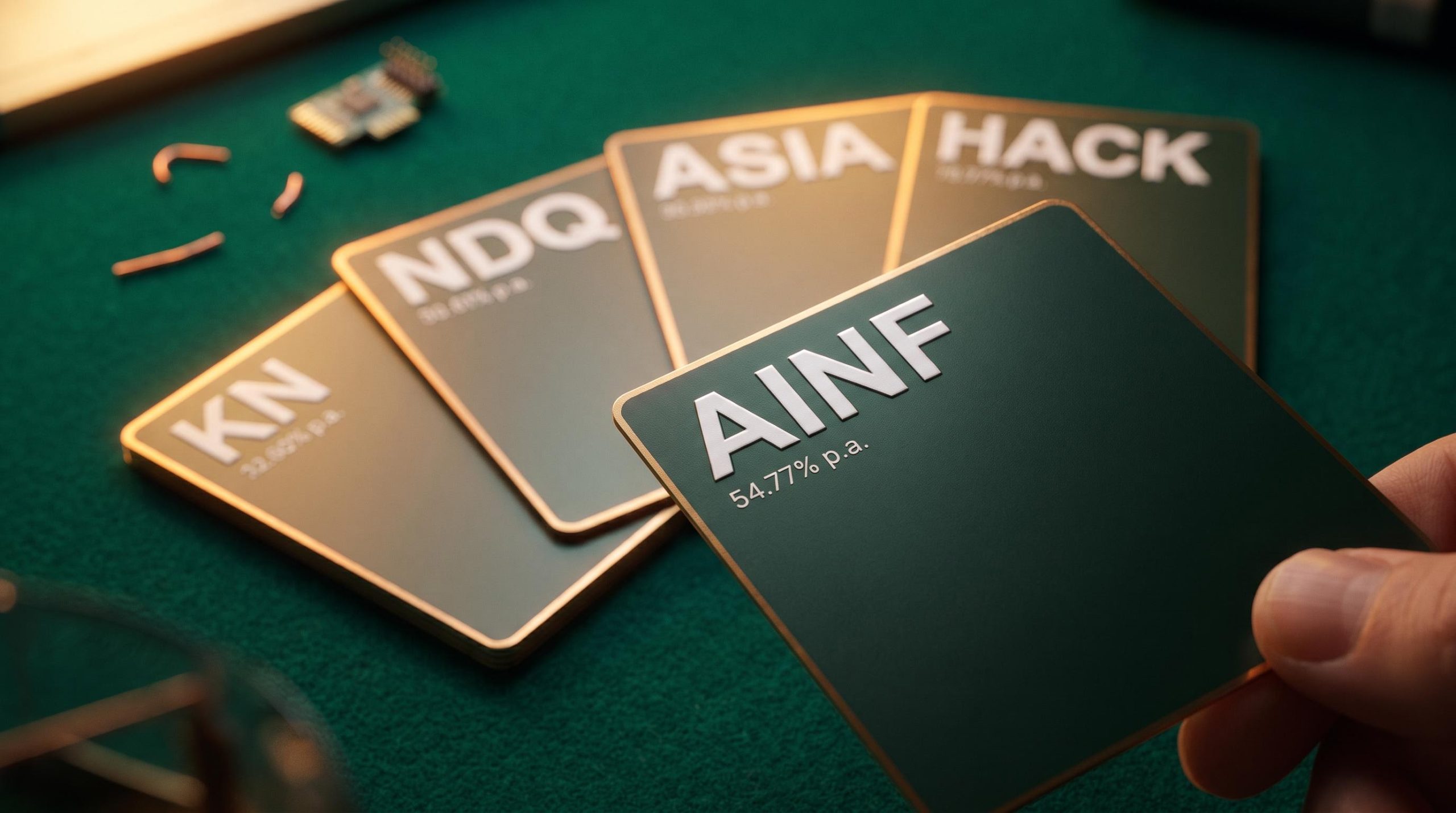
Four ASX-listed technology ETFs make this fracture visible: NDQ, ASIA, HACK and AINF. Each one tells a separate structural story about where technology is heading. NDQ’s one-year return sits near 15%. ASIA has returned 63.50% over the same window. AINF, barely 18 months old, is already annualising above 54% since inception. These are not variations on a single idea. They are four different investment theses wearing the same “tech” label.
This guide is a navigation tool for that mess. After reading, you will know exactly what each fund owns, what macro conviction sits underneath it, and how to combine them without accidentally doubling up on the same risk. The frame throughout is core versus satellite, and thesis-first selection: choosing each fund for a specific reason rather than chasing whichever chart looks best.
What each ETF actually owns and why it matters
Start with the holdings, because the holdings do the arguing for you. Once you see what sits inside each fund, the idea that these four are interchangeable “tech bets” falls apart on its own.
NDQ, the Betashares Nasdaq 100 ETF, tracks the 100 largest non-financial companies listed on the Nasdaq. That spans artificial intelligence, cloud computing, software and digital advertising, but it is really a broad-based US mega-cap growth fund rather than a pure technology instrument. With around $9.4 billion in assets under management and a management fee of 0.48%, it is the institutional anchor of the group.
NDQ’s structural role as a broad US mega-cap growth vehicle is inseparable from what the ASX cannot provide: technology represents roughly 5% of the ASX 200 by weight compared to approximately 27% in the S&P 500, a gap that explains why so many Australian portfolios reach for the Nasdaq-100 as their first offshore holding.
ASIA, the Betashares Asia Technology Tigers ETF, covers leading Asian technology firms across semiconductors, ecommerce, gaming, hardware and digital platforms, spanning China, South Korea, Taiwan and India. This is a regional bet layered on top of a sectoral one. It holds roughly $1.5 billion in assets, with a fee of 0.67%.
HACK, the Betashares Global Cybersecurity ETF, holds companies protecting networks, cloud infrastructure, devices and data worldwide. Its demand is tied to regulatory pressure and the expanding AI attack surface rather than software platform growth. It manages around $1.7 billion at a fee of 0.57%.
AINF, the Global X Artificial Intelligence Infrastructure ETF, is the outlier. It holds the physical backbone of AI: semiconductors, data-centre equipment, networking, power infrastructure, cooling systems and raw-material producers, copper names included. It is the smallest of the four at roughly $200 million in assets, also charging 0.57%.
| ETF Ticker | Mandate Focus | Geographic Tilt | Management Fee |
|---|---|---|---|
| NDQ | Broad Nasdaq-100 mega-cap growth | United States | 0.48% |
| ASIA | Asian tech: chips, ecommerce, gaming, platforms | China, South Korea, Taiwan, India | 0.67% |
| HACK | Global cybersecurity software and services | Global (US-weighted) | 0.57% |
| AINF | AI physical infrastructure and materials | Global (US, Europe, LatAm) | 0.57% |
AINF holdings breakdown: more industrial than you might expect
Look at what AINF actually owns and the label starts to feel misleading. As at 25 September 2026, its top-10 holdings were:
- Arista Networks (6.34%): data-centre networking equipment
- Southern Copper (5.60%): copper producer for grids and cabling
- Freeport-McMoRan (5.59%): copper producer
- Amphenol (5.27%): connectivity components and interconnects
- Schneider Electric (5.27%): power management and data-centre systems
- Antofagasta (5.08%): copper producer
- Teck Resources (4.95%): metals and mining with copper exposure
- ABB (4.90%): electrification and automation
- Eaton Corp (4.78%): electrical power systems
- Delta Electronics (4.65%): power supplies and data-centre equipment
Four copper producers sit inside an “AI ETF.” That single detail reframes the whole theme. AI infrastructure investing is an industrial and materials story as much as a semiconductor one, because building data-centre capacity at scale needs copper for cabling, power-management systems to feed the racks, and electrification hardware to move the load. None of those companies appear in NDQ, ASIA or HACK, which is exactly why owning AINF alongside the others gives you genuine differentiation rather than more of the same.
When big ASX news breaks, our subscribers know first
The macro forces driving each theme in 2026 and beyond
Performance tells you what happened. The macro engine tells you whether it should keep happening. Each of these four funds runs on a different one, and the strength of the tailwind varies more than the shared “tech” label suggests.
AINF sits on the largest structural story of the four. According to PwC’s 2026 analysis of global AI infrastructure investment, cumulative capital expenditure on AI infrastructure is estimated at US$31.6 trillion over the coming years, covering data centres, networking and power systems. That is the long-run framing. The near-term picture matters more for an investor deciding today.
The number that anchors AINF’s near-term case JPMorgan projects hyperscaler capital expenditure at approximately US$697 billion in 2026, up from the roughly US$300 billion that LSEG data shows leading hyperscalers committed across 2025.
Hyperscaler capital expenditure directed at physical data-centre and power infrastructure rather than model development is the underlying force that makes AINF’s industrial composition coherent: Microsoft, Alphabet, Amazon, and Meta have committed a combined US$700-725 billion for 2026, spending that flows directly to power systems, networking equipment, and the copper cabling that connects it all.
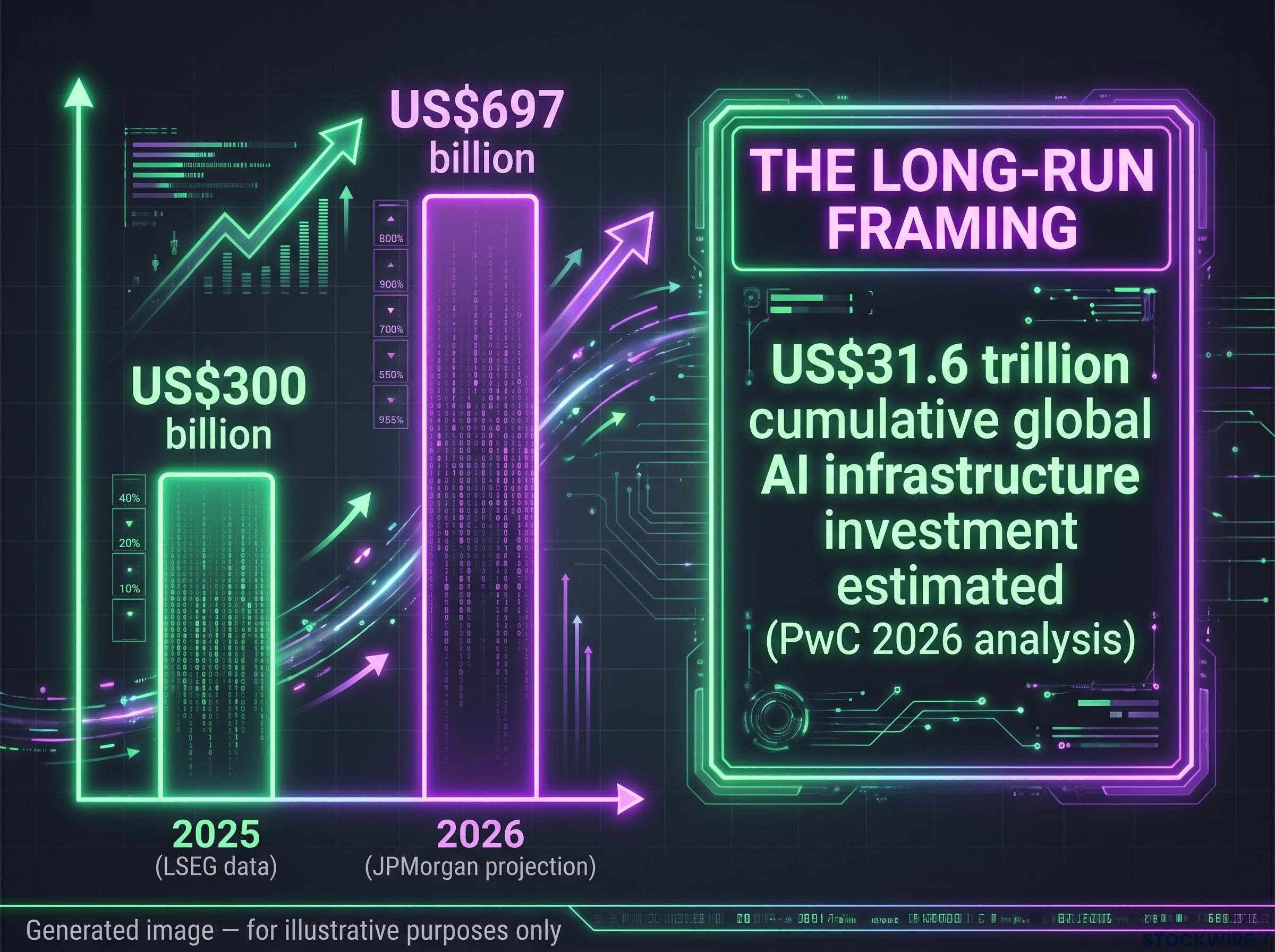
That figure is the one to hold onto. It signals that the companies buying Arista’s networking gear, Schneider’s power systems and Freeport’s copper are not pulling back. That directly supports AINF’s near-term earnings outlook, which is the difference between a theme that is still spending and one that has already peaked.
ASIA’s engine is regional. PwC’s data-centre outlook expects Asia-Pacific to account for roughly US$8.2 trillion of that cumulative capex, led by China and India through sovereign AI strategies and regional digitalisation. That is a real structural anchor, but it comes bundled with geopolitical complexity that the other three funds largely avoid.
NDQ, by contrast, has no single thematic catalyst. Its driver is broad US technology platform dominance and earnings growth across many large companies. That is why it behaves differently in a portfolio: it rises and falls with the whole US growth complex rather than one capex cycle or one regulatory trend.
Why cybersecurity demand is structurally different from other tech spending
HACK runs on the steadiest engine of the four, and it is worth understanding why. Cybersecurity budgets in financial services, healthcare and critical infrastructure are increasingly non-discretionary, driven by regulation, incident-reporting rules and breach liability rather than by whether a company feels like upgrading.
HACK’s non-discretionary demand profile is anchored by Australian regulatory frameworks including the SOCI Act and the Notifiable Data Breaches scheme, which create a domestic spending floor that operates independently of global macro conditions and distinguishes cybersecurity budgets from ordinary IT expenditure.
The three demand drivers behind the theme:
- Regulatory pressure: governments are tightening data-protection, operational-resilience and incident-reporting rules, pushing security budgets to grow faster than overall IT spending
- AI attack-surface expansion: as organisations deploy AI across cloud, edge and on-premise systems, there is more to defend, and generative AI tools lower the barrier for attackers to craft sophisticated phishing and malware
- Ransomware and state-sponsored campaigns: rising volumes mean organisations cannot cut security spending without raising the odds of a catastrophic breach
Here is the part that matters for you. AI adoption does not compete with cybersecurity spending; it feeds it. As hyperscalers pour hundreds of billions into AI infrastructure, those assets become high-value targets that require parallel security investment. HACK is a bet that security spend scales alongside AI infrastructure rather than being squeezed by it.
What the numbers say about performance and risk
You probably already suspect these funds have run hard. The trailing data confirms it. The risk section then complicates that picture, and you should finish this part holding both the optimism and the caution at once.
| ETF | 1-Year Return | 3-Year Return (p.a.) | Since Inception | MER |
|---|---|---|---|---|
| NDQ | ~15% | 19.92% | N/A | 0.48% |
| ASIA | 63.50% | 39.23% | N/A | 0.67% |
| HACK | ~24.8% | 24.27% | N/A | 0.57% |
| AINF | 39.02% | N/A (launched April 2025) | 54.77% p.a. | 0.57% |
ASIA’s 63.50% one-year return and AINF’s 54.77% annualised since-inception figure are the standouts. That last number deserves a caveat you should apply before treating it as evidence of durability: AINF only launched in April 2025. Its entire track record sits inside a period of strong AI infrastructure sentiment. It has never been tested through a sustained capex slowdown or a broad equity drawdown, so weight it accordingly. Past performance does not guarantee future results.
Risk categories to weigh before you allocate
Trailing returns tell you what happened. These four risks tell you what could happen differently.
- Currency risk: NDQ, HACK and AINF hold offshore equities, largely unhedged. A rising Australian dollar can eat into your returns even when the underlying shares are climbing, because AUD/USD moves independently of share prices.
- Concentration and single-theme risk: HACK and AINF each ride one cluster of economic drivers. If the AI capex cycle turns or regulatory conditions shift against the theme, either fund can underperform the broad market for extended stretches even while equities generally do fine.
- Geopolitical risk: ASIA carries this most acutely. US-China export controls on advanced chips, Taiwan supply-chain sensitivity, and domestic Chinese regulatory actions against platform companies and fintechs can reset valuations quickly and are not something fundamental analysis alone can predict.
- Behavioural risk: thematic ETFs attract trend-chasing. Retail investors tend to buy after strong runs and sell after drawdowns, which often leaves them underperforming the fund itself.
The honest read is that these funds have delivered, and that every reason they delivered comes attached to a reason they might not next time. Both belong in your assessment.
How to think about tech ETFs as building blocks in a portfolio
Understanding what each fund does is one thing. Seeing where each might belong in your specific situation is another. This is a framework, not a set of rules, and it starts with one distinction: core versus satellite.
NDQ works as a core global growth allocation. Its diversification across the Nasdaq-100 and its $9.4 billion in assets make it the kind of broad holding many Australian investors build around. ASIA, HACK and AINF are satellite positions: each expresses one specific conviction, and each should be sized as the smaller, riskier component it is.
Satellite positions typically warrant only a modest share of your equity bucket. The reason is straightforward. Concentration, drawdown risk and the potential for long stretches of underperformance against broad benchmarks all argue for keeping single-theme exposure contained.
Thematic ETF position sizing guidelines suggest keeping any single theme below 5% of a total portfolio, sitting satellite positions on top of a diversified core that fills 70-90% of the allocation, a framework that maps directly onto the core-satellite logic this article applies to NDQ, AINF, HACK and ASIA.
The three-step sequence for building this out:
- Establish your core with NDQ or equivalent broad-market exposure that spreads risk across many companies and factors
- Identify the specific macro conviction each satellite requires before buying: AINF needs belief in sustained AI infrastructure capex, HACK needs belief in structurally rising cybersecurity budgets, and ASIA needs belief in Asian digital-economy growth plus a tolerance for geopolitical risk
- Size each satellite so a sharp drawdown in one theme does not derail the whole portfolio
Each thematic ETF should map to a specific view you actually hold, not a performance chart you admire.
One practical point for Australian investors: all four ETFs are ASX-listed and settle in AUD, so you can access them through a standard brokerage account without needing a foreign-currency setup. The underlying assets remain foreign-currency-denominated, which is where the currency risk noted earlier comes from.
Avoiding overlap and managing position sizing
This is where the holdings analysis pays off. NDQ and AINF barely overlap, because AINF’s industrial and materials composition sits almost entirely outside the Nasdaq-100 software and platform names. That makes them genuinely complementary rather than two versions of the same trade.
Contrast that with NDQ paired with a separate US software or growth ETF. There you are likely doubling up on the same return drivers without realising it, holding two funds that rise and fall on the same factor.
Before adding any new thematic position, check the holdings overlap. Most ETF provider websites publish full holdings, and third-party platforms such as ETFinfo.com.au let you compare funds side by side. AINF at $200 million in assets is also a much smaller fund than the others, which can mean wider bid-ask spreads during stressed markets, so factor liquidity into your sizing too.
What to watch heading into 2027 and beyond
The most useful forward-looking work is not a return forecast. It is a short list of conditions under which each thesis would break, so a change in position becomes a logical response to evidence rather than a panic reaction to price.
For each fund, the variables worth tracking:
- NDQ: AUD/USD direction, since currency movement is a meaningful secondary driver of your returns, and broad US technology earnings growth
- ASIA: US-China technology export controls and Taiwan developments, both of which can reset valuations rapidly and cannot be forecast through fundamentals alone
- HACK: regulatory expansion across financial services, critical infrastructure and government, plus major breach-event frequency (breaches typically accelerate security spending rather than reduce it)
- AINF: hyperscaler capex guidance and AI data-centre demand signals, measured against JPMorgan’s US$697 billion 2026 baseline
The single most important watch item is AI infrastructure capex continuity for AINF. Any sign of hyperscaler pullback, over-capacity announcements or a shift in data-centre investment plans would hit the fund’s earnings outlook directly. Set against PwC’s US$31.6 trillion cumulative estimate, the long-run story remains intact, but the near-term spend is what moves the fund now.
Keep AINF’s short history in view too. Launched in April 2025, it has not been through a full market cycle, so its behaviour during the next significant equity correction will tell you far more about its durability than any figure from its first 18 months.
Thematic ETFs reward investors who entered with a clear thesis and exit when that thesis changes, not those who hold passively until a drawdown forces the decision. Knowing your break conditions now is what keeps the later decision rational.
Making an informed call on tech ETF exposure heading into 2027
The four-fund framework comes down to this. NDQ is the broad anchor, diversified enough to sit at the centre of a portfolio. AINF and HACK are conviction-dependent satellites with genuinely different underlying economics: one an industrial and materials play on AI capex, the other a regulation-backed bet on rising security budgets. ASIA is a regional-plus-sectoral position that only makes sense if you can carry the geopolitical risk that comes with it.
Performance chasing is the wrong entry logic for all four. Each fund should be matched to a specific view you hold about a structural trend, sized to the risk it carries, and checked against your existing holdings for overlap.
The question to answer heading into 2027 is not which fund topped the tables in 2026. It is which macro and sectoral trends you believe will persist, and which risks you are genuinely prepared to carry.
This article is for informational purposes only and should not be considered financial advice. Investors should conduct their own research and consult with financial professionals before making investment decisions. Past performance does not guarantee future results, and financial projections are subject to market conditions and various risk factors.