Since 1 January 2025, intentional underpayment of wages has been a criminal offence in Australia. Most company directors have not yet reckoned with what that means for them personally.
The reason is structural. Payroll has always been treated as a back-office function, a process that runs, pays people, and moves on. It was never framed as a source of personal criminal exposure at board level. But the Fair Work Legislation Amendment (Closing Loopholes) reforms changed that equation, and the gap they exposed is not one of intent or competence. The problem lies in the space between a pay run finishing and that pay run carrying independent proof of legality. The payroll platforms most organisations rely on today were built to execute payments, not to generate evidence that those payments satisfied every applicable legal obligation.
What follows maps three layers of this problem. You will understand exactly what the law now requires of directors personally, where the structural gap in most payroll systems sits, and how a new category of independent payroll assurance is beginning to close it. Hubify’s (ASX: HFY) equity position in HubLab, and its insurance-backed platform CERTAiNTY, provides a concrete worked example of where early-stage capital is moving inside that category.
What the law now says, and why January 2025 was the turning point
Under the Fair Work Legislation Amendment (Closing Loopholes) reforms, a new criminal offence of intentional wage and entitlement underpayment commenced on 1 January 2025. The offence has been operative for over 18 months.
The threshold is intent. The prosecution must prove beyond reasonable doubt that the employer intentionally engaged in conduct resulting in an underpayment. Genuine mistakes, honest errors, and inadvertent payroll failures remain civil matters only. They still carry consequences, including back pay, civil penalties, and reputational damage, but they do not carry imprisonment.
What changed is the category of consequence for deliberate conduct. Before January 2025, payroll underpayment was treated primarily as an administrative compliance failure. Now it is a criminal offence with penalties that land on individuals, not just companies.
“Since 1 January 2025, intentional underpayment of employees’ wages and entitlements has been a criminal offence under the Fair Work Act, in addition to attracting civil penalties.”
The penalty structure reflects how seriously the legislature treats the shift:
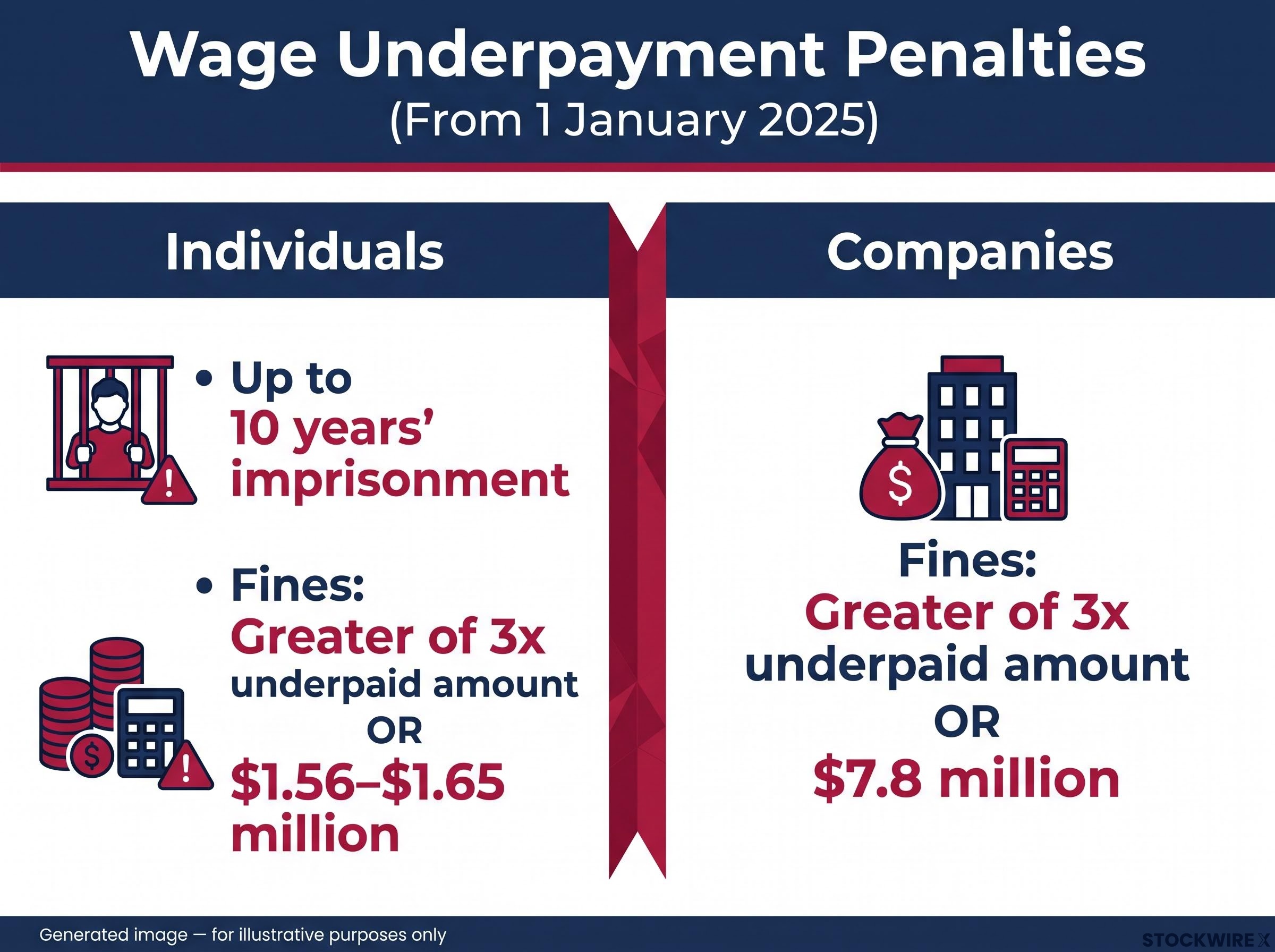
- Individuals (including directors and managers involved in the conduct): up to 10 years’ imprisonment and/or fines of up to the greater of three times the underpaid amount or approximately $1.56-$1.65 million
- Companies: fines up to the greater of three times the underpaid amount or approximately $7.8 million
The enforcement pathway runs through the Fair Work Ombudsman (FWO), which investigates suspected criminal underpayments and refers suitable matters to the Commonwealth Director of Public Prosecutions or the Australian Federal Police. The offence applies to conduct on or after 1 January 2025, including ongoing patterns of underpayment that commenced before that date but continued past it.
The Fair Work Ombudsman criminal prosecution guidance confirms the enforcement pathway: the FWO investigates suspected intentional underpayments and refers suitable matters to the Commonwealth Director of Public Prosecutions or the Australian Federal Police, with individual penalties reaching up to 10 years’ imprisonment or fines exceeding $1.8 million.
This is not an incremental tightening of existing rules. It is a categorical change in where consequences land. Any director who has not yet engaged with this personally should note one critical fact: this is not a future reform or a proposal under consultation. It became enforceable law more than 18 months ago, and it carries personal criminal exposure, not organisational inconvenience.
Beyond the criminal penalty exposure, automatic disqualification consequences flow separately from a conviction under the Corporations Act, meaning a director found liable for intentional wage theft faces not only fines or imprisonment but an immediate prohibition from managing any corporation without a further court process.
When big ASX news breaks, our subscribers know first
When “we thought the system was right” stops being a defence
Personal criminal liability does not attach to a director automatically by virtue of holding the title. The exposure is specific: a director must be “involved in” the offence, for example by authorising the underpayment, directing the conduct, or knowingly permitting intentional underpayment.
“Under the new framework, intentional wage underpayment can expose not only the company but individual directors and managers who are involved in the conduct to criminal prosecution and imprisonment.”
The Australian Chamber of Commerce and Industry (ACCI) guidance is explicit: individuals involved in the underpayment can be subject to criminal prosecution including up to 10 years’ imprisonment.
That threshold feels protective until you consider how regulators will assess what “involved” means in practice. The legislation preserves a clear legal distinction between intentional wage theft and honest mistakes. But regulators and courts will scrutinise whether what presents as “systemic payroll error” is truly inadvertent or instead reflects knowing or reckless disregard of wage obligations. A persistent or unmanaged pattern of errors could be characterised as intentional conduct, not because the payroll team intended to underpay, but because the directors knew the system was unreliable and failed to act.
The governance implication is direct. “We relied on the payroll system” is not a compliance strategy. It is an exposure. Regulators expect evidence of proactive compliance measures, not a post-hoc claim that the business believed its system was correct.
The Vella conviction illustrates that director criminal liability does not require elaborate concealment; a governance structure that places unchecked control in a single individual is itself the vulnerability regulators and courts treat as the operative failure.
The safe harbours that do exist, and what accessing them actually requires
The reforms include two statutory safe harbour mechanisms designed to protect employers who take proactive steps:
- Voluntary Small Business Wage Compliance Code: a safe harbour for small businesses that follow prescribed compliance steps
- Cooperation Agreements: written agreements between the FWO and employers who admit underpayments and agree on a remediation plan
Both are operative as part of the framework in force since 1 January 2025. Both require active engagement with the FWO and genuine cooperation, including timely remediation of identified underpayments. Neither is available to a director who passively assumed the payroll was correct and only engaged with the regulator after a problem was discovered.
The practical standard is now demonstrable proactive steps, not passive confidence. If you hold a director title and run staff under Modern Awards, the question to carry back to your board is not “do we trust our payroll team?” It is “what evidence do we have that our payroll is legally correct?”
The structural gap between what payroll systems do and what the law now requires
The compliance problem most directors have not yet identified is not about bad actors in payroll teams. The core issue is a fundamental mismatch in purpose: payroll software was engineered to perform a processing function, while the legal environment now demands something categorically different from it.
Conventional payroll platforms were designed to process and disburse pay. They calculate hours, apply rates, generate payslips, and transfer funds. Their architecture was never intended to produce independent confirmation that each payment satisfied the precise legal obligation flowing from the relevant Modern Award, enterprise agreement, or individual contract.
| Function | Payroll System Design | Legal Requirement Post-2025 | Gap Consequence |
|---|---|---|---|
| Payment calculation | Processes pay based on configured rates | Every payment must meet exact award obligation | Configuration errors produce legally incorrect payments the system treats as correct |
| Compliance verification | Self-reports that the pay run completed | Independent evidence that payments were lawful | No second party verifies legality of outputs |
| Award interpretation | Static rate tables requiring manual updates | Dynamic compliance across regularly updated awards | Outdated rates persist until manually corrected |
Australia’s award system introduces layers of genuine complexity that make this gap especially hazardous. The conditions that produce systemic errors without any deliberate intent include:
- Rates of pay, penalty rates, and allowances that shift depending on industry, classification, and the hours an employee works
- Entitlements that vary across Modern Awards, enterprise agreements, and individual employment contracts
- Scheduled updates to award rates and conditions that require ongoing reconfiguration of payroll settings
- Intricate interaction rules governing base rates, overtime loadings, and weekend or public holiday penalties
In practice, most Australian businesses operate without any independent third-party check on their payroll outputs. A system reporting that it completed a pay run provides no assurance that the amounts paid were lawful. The volume of wage underpayment class actions and FWO enforcement activity across Australian businesses is consistent with widespread, systemic gaps in payroll accuracy.
The analogy to financial reporting is worth examining. External financial audits impose independent verification over reported financial figures for certain entities, and that independence is precisely what gives the assurance its credibility. Payroll has never had an equivalent mechanism, with no external party placing their own reputation and financial standing behind a claim that a pay run was correct, even as underpayment now attracts criminal penalties. The question for your board is not whether your payroll team is trustworthy. It is whether your payroll system independently proves compliance.
Technology governance failures in regulated infrastructure, as the decade-long ASX CHESS project demonstrated, tend to compound when the accountability mechanism between the technology layer and the governance layer is indirect, which is precisely the structural problem independent payroll assurance is designed to resolve for directors relying on payroll platforms.
Closing the gap: the emergence of independent payroll assurance
The category responding to this structural gap is not general AI compliance software. The distinction matters.
HubLab and Hubify describe CERTAiNTY as “Australia’s first insurance-backed payroll assurance engine.” That claim is company-reported and not independently verified, but the insurance-backed structure is the specific feature that differentiates this category from a vendor’s own compliance dashboard.
“Australia’s first insurance-backed payroll assurance engine” (HubLab and Hubify, company-reported; not independently verified)
The structure works like this: an external underwriter reviews the platform, satisfies itself that the outputs are accurate, and issues insurance cover on the back of that assessment. Because that underwriter bears real financial consequences if the platform is wrong, their sign-off carries evidential weight that no vendor self-certification can match. That is structurally different from a vendor self-certifying its own compliance. It is closer in governance logic to an audited financial statement than to a software feature.
According to HubLab, the platform’s operational metrics include:
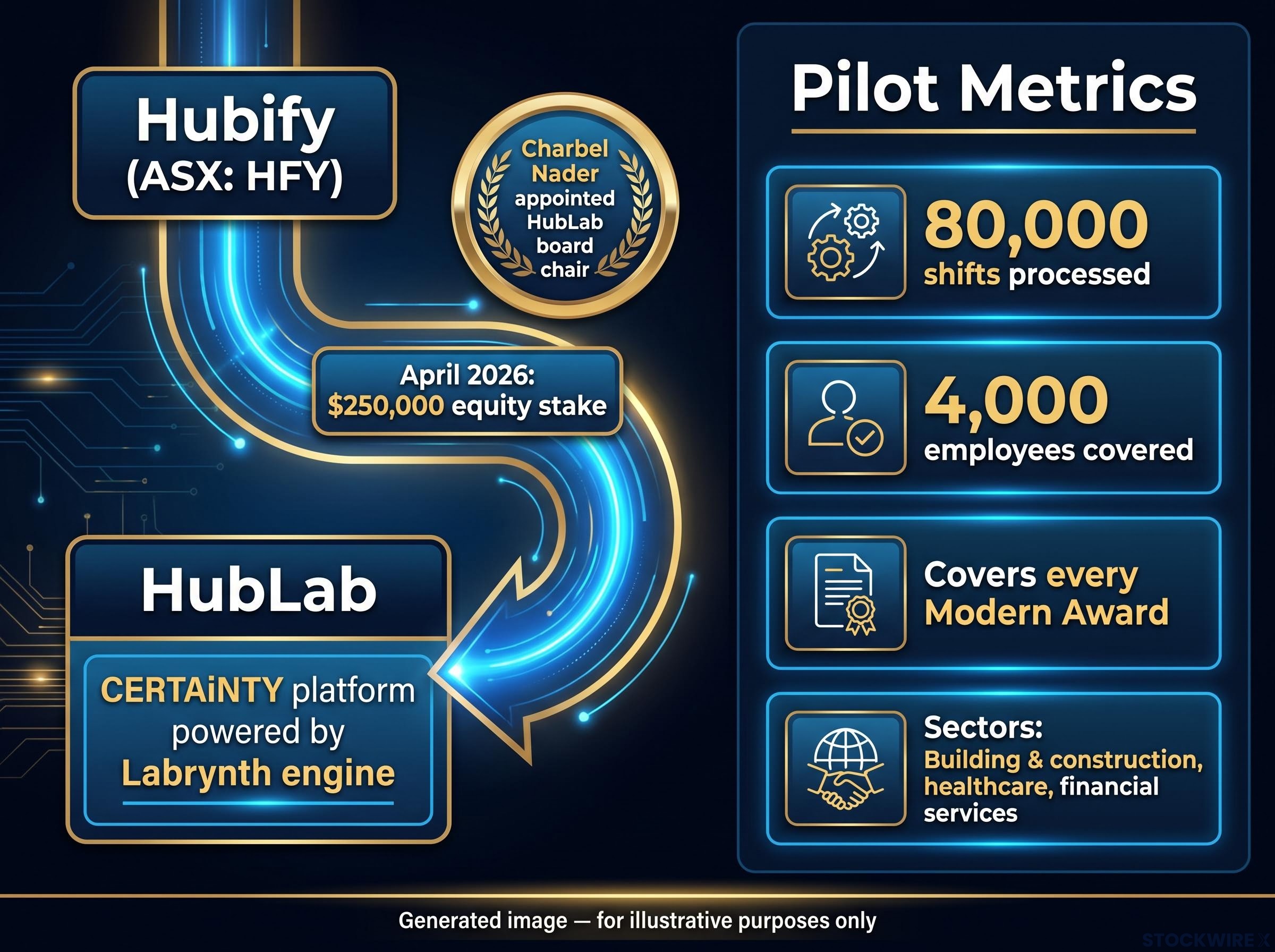
- More than 80,000 shifts processed as of the reported pilot period
- More than 4,000 employees covered under an enterprise pilot with a listed enterprise (name not disclosed)
- Coverage stated to span every Modern Award
- Expansion reported into building and construction, healthcare, and financial services, sectors characterised by complex, high-risk award structures
- Technology engine reported as Labrynth
For a director assessing what proactive compliance steps look like under the new regime, the insurance-backed structure is the operative distinction. It is not that an AI tool checks your payroll. It is that an independent party with financial skin in the game has validated the output. That converts the tool from a nice-to-have dashboard into a governance protection mechanism, one that generates the kind of independently verifiable evidence regulators expect when assessing whether a director took reasonable steps.
How Hubify structured its position inside a compliance category most businesses have not yet found
In April 2026, Hubify (ASX: HFY) made a targeted $250,000 equity investment in HubLab, announced via ASX announcement dated 17 April 2026.
The investment logic follows a build-vs-buy-vs-stake framework. Developing payroll assurance capability in-house would have required substantial time and resources from an established SME technology provider, with no guarantee of producing the specialist depth the problem requires. Buying a specialist outright risked burdening the opportunity with integration complexity at too early a stage. Taking a focused equity stake in a company that had already built and deployed a working solution allowed Hubify to secure a meaningful position in the category efficiently, without the cost and delay of internal development.
The deal’s structural elements:
- Investment: $250,000 equity stake in HubLab
- Governance link: Hubify Non-Executive Director Charbel Nader appointed as HubLab board chair
- Technology engine: Labrynth, powering the CERTAiNTY platform
- Strategic frame: connects Hubify to the regulatory technology and compliance infrastructure category
The board chair appointment is the detail that separates this from a passive financial position. Rather than maintaining an arm’s-length investor relationship, the two companies now share a direct governance connection through a single named individual accountable to both boards, which materially changes the nature of the stake.
Distribution logic and what Hubify’s existing client base means for CERTAiNTY’s reach
Hubify’s established relationships with SME and enterprise customers create a ready-made channel for HubLab’s product. A significant portion of those customers are likely operating without any independent payroll assurance today, and many will not yet have recognised that such a product exists or that they need it. That is the specific gap the legislative change opens: genuine, urgent compliance demand running ahead of customer awareness.
The broader relevance for investors tracking regtech and compliance infrastructure within ASX-listed companies is the category expansion itself. Regulatory technology now extends beyond data security into demonstrable legal compliance across multiple regimes, including workplace law. Hubify’s early equity stake, paired with the board-level governance link and the distribution channel through its existing client base, places it inside that category shift from the outset rather than as a late entrant.
For investors, the relevant question is not the dollar size of the stake. It is the governance structure around it. The board chair appointment turns a financial position into an operational one, and the distribution logic through Hubify’s existing client base provides a commercial pathway that a pure financial investment would not.
What directors should take from this, now that the law is already in force
The legal and governance arc is now complete, and it compresses into three points:
- The legal reality: intentional underpayment is criminal and personal. Genuine errors remain civil, but regulators will scrutinise whether persistent patterns reflect knowing disregard. The law has been operative for over 18 months.
- The governance gap: payroll systems were built to move money, not to produce proof that every payment was legally correct. Treating a system’s own output as sufficient compliance evidence is not a defensible position; it is an unmanaged liability.
- The compliance category responding: independent payroll assurance, in which an external party bearing genuine financial risk certifies that each pay run met its legal obligations, is developing into the governance mechanism that the safe harbour framework implicitly rewards.
The safe harbour protections built into the reforms require proactive compliance steps and genuine remediation. Tools that generate independently verifiable evidence of reasonable steps taken are the operational mechanism for accessing those protections. That is what converts independent payroll assurance from a discretionary governance tool into something closer to an expected director standard.
Corporate insolvency pressures running at their highest level since the 1990-91 recession create an enforcement dynamic worth noting: FWO and ASIC investigations do not close when a company enters liquidation, and directors of insolvent entities face compounded exposure when underpayment patterns are uncovered during administration.
Financial reporting and payroll compliance are converging toward the same accountability logic. External audit became a baseline expectation for financial statements because independent verification is more credible than self-reporting. Now that payroll non-compliance carries criminal consequences up to and including imprisonment, the argument for applying that same verification principle to payroll follows naturally from first principles.
Hubify’s early equity position in HubLab is one example of where capital is moving inside this category. It is relevant both to compliance professionals evaluating whether the category is gaining credibility and to investors assessing early-stage regtech exposure on the ASX.
The question to carry back to your board is specific: what is the independent evidence that your payroll is legally correct, and not just your system’s word for it?
This article is for informational purposes only and should not be considered financial advice. Investors should conduct their own research and consult with financial professionals before making investment decisions.
These statements are speculative and subject to change based on market developments and company performance. Past performance does not guarantee future results.