
A disqualification order is not a paper sanction. On 2 July 2026, a jury sitting in the District Court of Western Australia convicted Joanne Jennifer Pellew, a former director from Ascot, Western Australia, on four criminal counts. Not an ASIC infringement notice. Not a civil penalty. A criminal conviction, prosecuted by the Commonwealth Office of the Director of Public Prosecutions (CDPP), for dishonestly using her position as a director and for managing a corporation after bankruptcy had stripped her right to do so.
The verdict matters beyond its immediate facts. ASIC’s disqualification regime touches thousands of Australians navigating financial difficulty every year, and the gap between knowing you are disqualified and understanding the criminal exposure that comes with it is dangerously wide. The Pellew case collapses that gap in concrete, jury-tested terms.
Here is a precise map of how director disqualification works in Australia, what counts as a breach, and why this conviction, while an outlier in enforcement terms, illustrates the outer limits of a regime that applies to every disqualified person. The sentencing on 4 September 2026 will sharpen the picture further.
What the jury decided: four counts, one verdict, and what was acquitted
The jury returned guilty verdicts on four counts. Three were brought under s 184(2)(a) of the Corporations Act 2001, the provision that makes dishonest use of a director’s position a criminal offence. The fourth count was brought under s 206A(1)(a), which bars a person from managing a corporation while subject to a disqualification.
The jury returned not guilty verdicts on three further s 206A counts. That matters. The jury drew careful distinctions, affirming specific conduct and declining to affirm the rest.
The anchor financial fact: approximately $739,655 moved in three separate transactions during May 2018 out of Ochre Training Pty Ltd and into Ochre Workforce Solutions Pty Ltd. These transfers formed the factual basis of the three dishonesty counts.
The acquittals tell you something specific about how criminal liability works under s 206A. Conviction requires precise evidentiary proof of management activity at a defined time. General proximity to a company is not enough. For any disqualified person assessing their own exposure, that distinction is the difference between criminal risk and legal noise.
| Event | Date |
|---|---|
| Fund transfers (s 184 offences) | May 2018 |
| Bankruptcy disqualification effective (s 206B) | 20 February 2019 |
| Managing while disqualified offence (s 206A) | 20-27 June 2019 |
| ASIC five-year order commenced (s 206F) | 28 October 2019 |
| Charges laid | July 2021 |
| Jury verdict delivered | 2 July 2026 |
| Sentencing scheduled | 4 September 2026 |
When big ASX news breaks, our subscribers know first
How director disqualification works in Australia: the three pathways
The Corporations Act 2001 creates three distinct routes to director disqualification. They operate independently, they can stack, and understanding how they interact is what separates an informed reading of the Pellew case from a surface-level one.
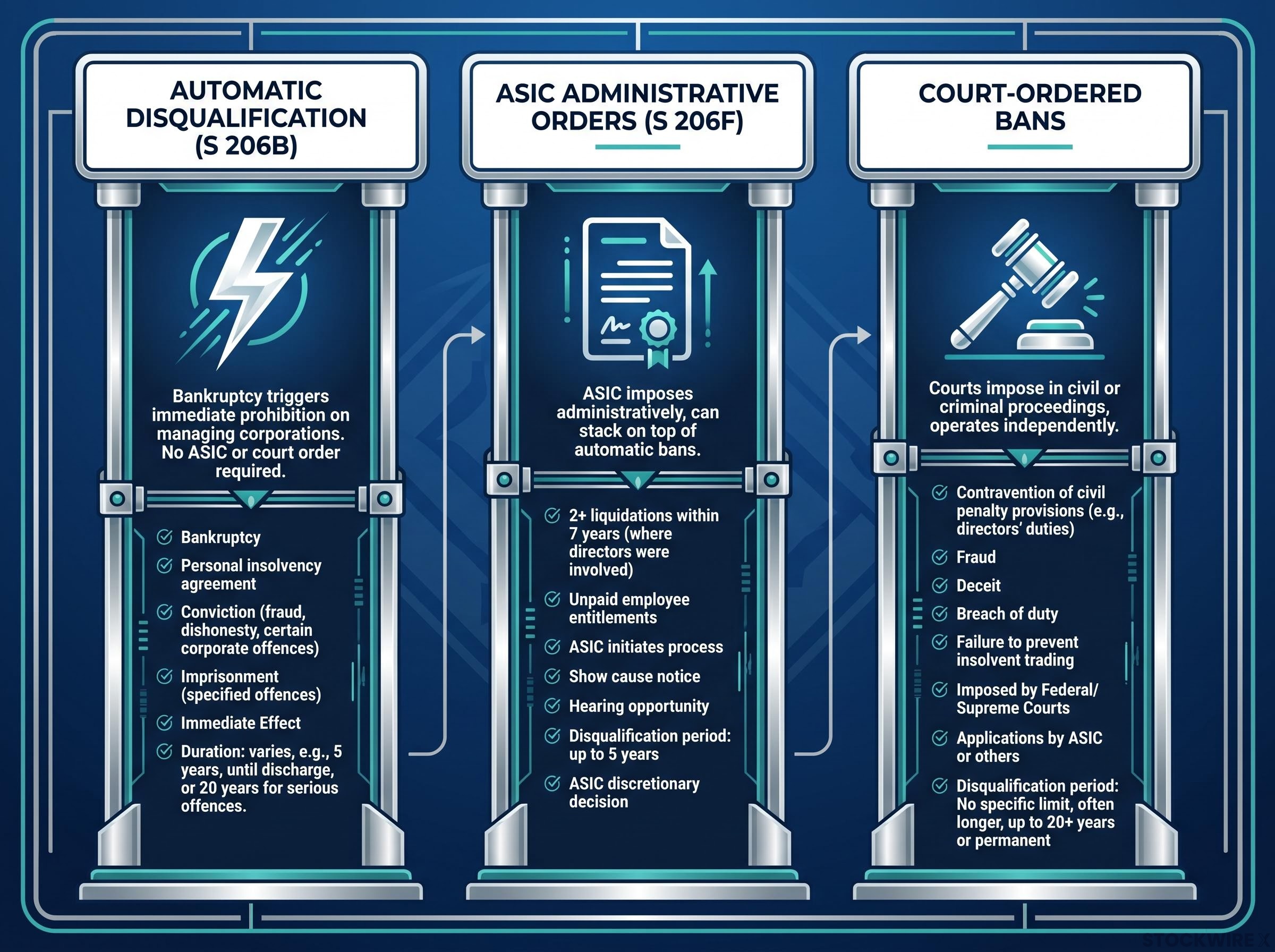
- Automatic disqualification (s 206B): Bankruptcy triggers an immediate prohibition on managing corporations. No ASIC decision is required. No court order is issued. The moment a person is declared bankrupt, the ban is live.
- ASIC administrative orders (s 206F): ASIC can impose disqualification orders administratively. These are separate from, and layered on top of, automatic disqualifications. The five-year order applied to Ms Pellew, beginning 28 October 2019, is recorded in ASIC media release 19-311MR.
The ASIC administrative disqualification power under s 206F sits alongside the automatic bankruptcy prohibition as a separate and stackable mechanism, one that does not require a court proceeding, a criminal conviction, or any formal legal process before the ban takes effect.
- Court-ordered bans: Courts may impose disqualification in civil or criminal proceedings, operating independently of both the automatic and administrative mechanisms.
The automatic trigger is the one that catches people off guard. There is no letter from ASIC. No court hearing. No grace period. If you go bankrupt on a Friday, you are prohibited from managing corporations on Monday. ASIC’s disqualification register, which is publicly accessible, records these bans, but the prohibition does not depend on the register entry. It depends on the bankruptcy itself.
What “managing a corporation” actually means under s 206A
Section 206A does not require formal appointment as a director for liability to attach. A person whose instructions the appointed directors habitually follow, a shadow director, falls within the prohibition.
This has direct consequences for nominee director arrangements. Structuring a nominee around a disqualified principal does not provide safe harbour if the disqualified person retains substantive control or gives directions. The law looks at the reality of who is making decisions, not the corporate register.
Why the June 2019 charge rested on bankruptcy, not the ASIC order
This is the legal precision point most readers will miss. The managing-while-disqualified offence occurred between 20 and 27 June 2019. The ASIC five-year order did not commence until 28 October 2019, more than four months later.
The s 206A conviction therefore rested entirely on the s 206B automatic bankruptcy disqualification, which had been in force from the date Ms Pellew was made bankrupt on 20 February 2019. The ASIC order extended and formalised the prohibition for subsequent conduct, but it played no role in this particular criminal count.
The specific management act was the execution of a labour hire agreement with the Western Australian Country Health Service, conducted on behalf of Ochre People Pty Ltd during that narrow window. That single act, during a single week, grounded the conviction.
The criminal charge was anchored to the automatic bankruptcy ban, which preceded the ASIC administrative order by over eight months. The CDPP prosecuted on the basis of s 206B, not s 206F.
For any person who has gone bankrupt and assumed their obligations begin only when ASIC issues a formal order, this timing sequence is a direct correction. The law imposed the ban the moment bankruptcy was declared, and the prosecution relied on exactly that.
The penalties ahead and what the sentencing will weigh
Under the provisions as they stood at the time of offending, each of the four counts carried a maximum penalty of five years imprisonment. The theoretical aggregate across all four counts is 20 years.
That number is a statutory ceiling, not a sentencing guide. Australian courts apply the totality principle, a judicial check that prevents the aggregate sentence from being disproportionate to the overall criminality. A sentence that “crushes” is one that fails this test.
The three s 184 counts arise from closely related fund transfers within a single month. Courts may treat these as a single course of conduct, compressing the effective penalty. The s 206A count, regulatory defiance of a different character, may attract partial cumulation, meaning part of its sentence runs consecutively rather than concurrently.
The distance between the 20-year theoretical maximum and the sentence Ms Pellew is likely to receive is where you need to sit. Understanding what courts actually weigh helps calibrate the regime’s deterrent reality without overstating it. Sentencing is scheduled for 4 September 2026.
Executive disqualification benchmarks set by the Federal Court in the Star Entertainment penalty proceedings, where a chief legal officer received a longer ban than the CEO despite a smaller fine, show that courts assess intensity of personal duty independently of seniority title, a calibration logic that will inform how the Pellew sentencing court weights the combination of financial dishonesty and regulatory defiance.
| Count | Provision | Conduct | Maximum penalty |
|---|---|---|---|
| 1-3 | s 184(2)(a) | Dishonest use of position (three fund transfers, May 2018) | 5 years and/or 2,000 penalty units each |
| 4 | s 206A(1)(a) | Managing while disqualified (labour hire agreement, June 2019) | 5 years and/or 600 penalty units |
Where criminal prosecution sits in ASIC’s enforcement spectrum
Civil enforcement is the more common outcome for s 206A breaches. Pecuniary penalties, extended court-ordered bans, and public censure handle the bulk of ASIC’s caseload. Criminal prosecution is reserved for a narrower category: knowing and deliberate management activity combined with dishonesty or persistent disregard of regulatory orders.
The Pellew case followed a specific escalation pattern:
- The s 206B prohibition took effect when Ms Pellew was declared bankrupt (20 February 2019)
- ASIC investigated the conduct
- ASIC issued a five-year administrative disqualification order (media release 19-311MR), taking effect from 28 October 2019
- The breach came to light through the counterparty, the Western Australian Country Health Service, with the labour hire agreement identified via its contracting and procurement records
- ASIC referred the matter to the CDPP (media release 21-158MR)
- The CDPP prosecuted; a jury returned guilty verdicts (2 July 2026)
The presence of a government health service as counterparty tells you something about ASIC’s information network. It extends well beyond corporate registers. Public procurement records, government contracting systems, and liquidator reports all function as live surveillance inputs.
Dual disqualifications, an automatic ban plus an ASIC administrative order stacked on top, function as a regulatory escalation signal. They mark a person as high-risk, justify closer monitoring, and make any subsequent breach far more likely to attract criminal rather than civil treatment.
What the Pellew case signals about ASIC’s referral appetite
The CDPP’s willingness to take this matter to a full jury trial is itself a signal. This was not a plea deal. The prosecution carried the evidentiary burden on each count and secured conviction on four of seven.
The ASIC-to-CDPP referral pipeline that produced the Pellew prosecution follows the same institutional architecture ASIC uses across its criminal enforcement priorities, with the Rodney Forrest insider trading matter confirming that the pipeline from investigation to jury trial can be completed in approximately one year when the dedicated enforcement machinery is fully engaged.
The coexistence of s 184 dishonesty charges with the s 206A managing charge suggests ASIC’s referral was driven by the combination of financial misconduct and regulatory defiance, not either alone. For practitioners assessing future enforcement risk, that combination, dishonest conduct layered onto a disqualification breach, appears to be the threshold condition that moves a matter from civil to criminal.
Criminal jury convictions for s 206A managing-while-disqualified remain relatively rare in Australian enforcement practice. The Pellew verdict does not change the statistical balance, but it sharpens the upper bound of what the regime can deliver.
What this verdict means for directors, advisers, and compliance practice
The Pellew conviction produces three distinct sets of implications, each addressed to a different audience.
- For directors: The bankruptcy disqualification is automatic and immediate. No notification from ASIC is required before the prohibition is live. Governance arrangements must reflect this the moment a bankruptcy event occurs. Continued management activity after that point is a criminal offence, full stop.
The dual enforcement model that runs corporate penalties and individual director proceedings in parallel means that a company settling with ASIC does not extinguish personal liability for the individuals who made the relevant decisions, a structural feature that applies across dishonesty charges, disclosure failures, and disqualification breaches alike.
- For advisers: Nominee director structures do not insulate a disqualified principal who retains substantive control. Any arrangement where a disqualified person instructs or directs appointed directors should be assessed against the shadow director test under s 206A. The Pellew case shows the enforcement ceiling that applies when that test is met.
- For compliance practitioners: The ASIC disqualification register is publicly accessible and should be a standard onboarding check for any incoming director, key consultant, or beneficial owner in a corporate governance or transaction context. The register is the first line of defence; the Pellew prosecution shows what happens when it is ignored.
The practical warning: A person who goes bankrupt on a Friday is prohibited from managing corporations on Monday. There is no letter, no grace period, and no process to complete first. The prohibition is live from the moment of bankruptcy.
The most consequential takeaway is the one most likely to be underestimated. The automatic operation of s 206B means that thousands of Australians entering bankruptcy each year become subject to a criminal prohibition they may not even know exists until it is too late.
This article is for informational purposes only and should not be considered financial advice. Investors should conduct their own research and consult with financial professionals before making investment decisions.
The Pellew conviction as a calibration point for disqualification risk
The Pellew verdict is not a deterrence headline. It is a calibration instrument. It establishes what the enforcement ceiling looks like when automatic statutory bans, formal ASIC orders, dishonest fund transfers, and government-counterparty exposure combine in a single factual matrix.
ASIC’s willingness to refer and the CDPP’s willingness to prosecute through to jury trial confirm that the criminal pathway for managing while disqualified is not theoretical. It is operational.
The 4 September 2026 sentencing will provide the next data point, and the most concrete signal yet of how Australian courts weight the combination of financial dishonesty and regulatory defiance in director conduct cases. That sentence will set the benchmark that every disqualified person, adviser, and compliance professional measures against.
—