Gold has surged to approximately $4,739 per ounce as of May 2026, near all-time highs, driven by a succession of geopolitical shocks spanning NATO spending commitments, US-China technology sanctions, and Middle East escalation. The question facing most investors is not whether the world is uncertain, but what to actually do about it. Geopolitical volatility is not new, but the 2025-2026 environment has compressed multiple distinct shock events into a short window, testing the resilience of portfolios across asset classes simultaneously. Investors face a specific tension: the instinct to act clashes with evidence that reactive decisions typically destroy value. This guide provides a practical, evidence-grounded framework for navigating geopolitical instability, covering why certain assets behave the way they do during crises, which tools institutional investors are using, and how to build a plan that withstands turbulence without requiring the reader to predict the next headline.
Why geopolitical shocks ripple through your portfolio in predictable ways
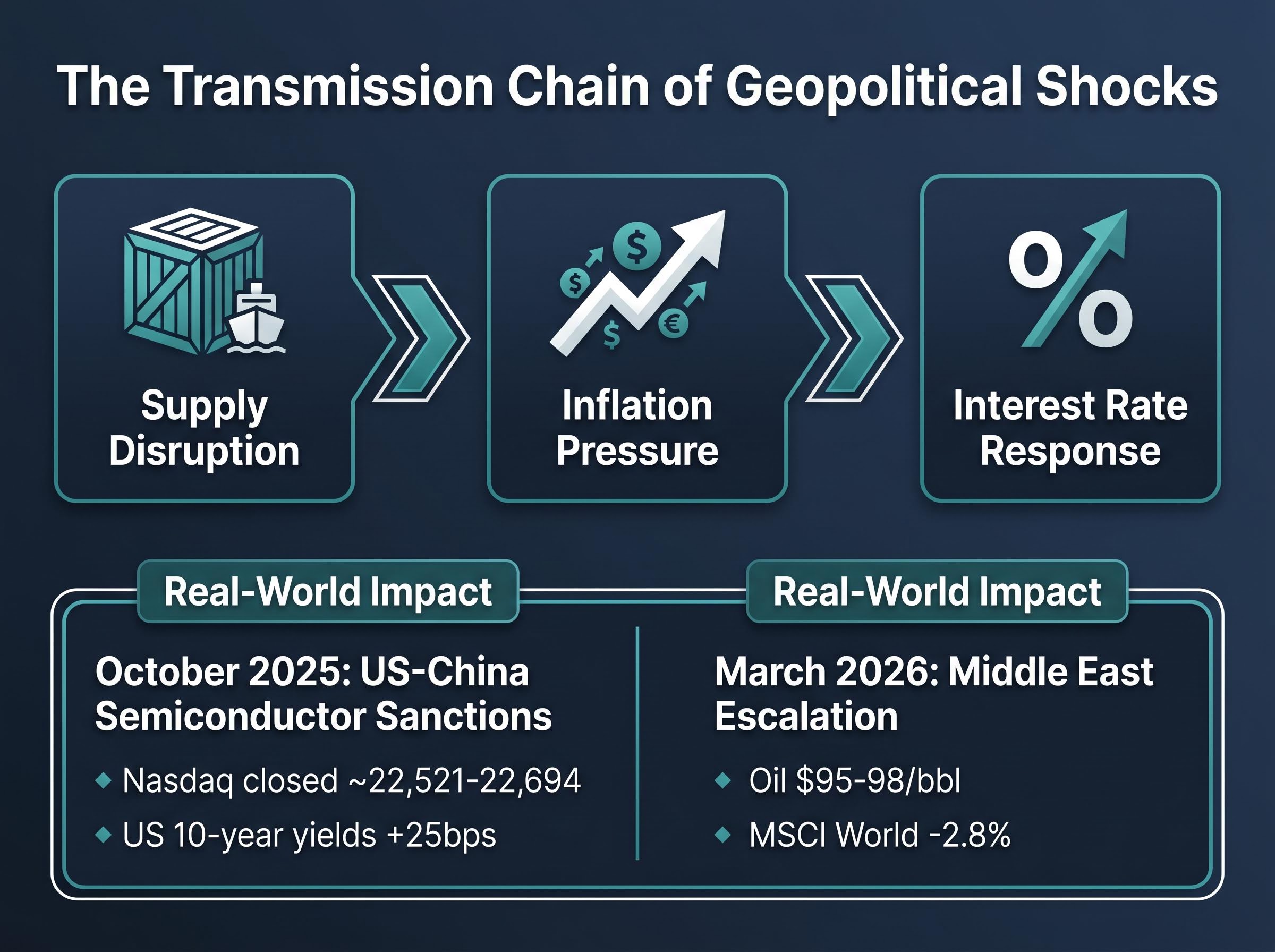
Geopolitical events feel chaotic, but the way they move through financial markets follows a repeatable pattern. Understanding this transmission chain is the difference between reacting to headlines and anticipating what comes next. The mechanism works in three stages:
The recurring gap between geopolitical risk and stock market behaviour is explained by how markets process these events: not as proportional headline shocks, but as probability-adjusted inputs to future earnings, which is why consensus predictions have consistently overestimated equity damage across multiple recent crises.
- Supply disruption: A geopolitical event (conflict, sanctions, trade restrictions) disrupts the physical supply of goods, energy, or technology components. Prices for affected commodities rise.
- Inflation pressure: Higher input costs feed through to consumer prices and producer margins, pushing inflation expectations upward across economies.
- Interest rate response: Central banks and bond markets reprice yields higher to reflect persistent inflation risk, which in turn compresses equity valuations and erodes the market value of existing bond holdings.
This chain played out with precision during the March 2026 Middle East escalation. Oil prices reached approximately $95-98 per barrel, and the MSCI World Index declined roughly 2.8% in direct response. Months earlier, the October 2025 US-China semiconductor sanctions triggered a Nasdaq decline (closing around 22,521-22,694 on 14 October 2025) alongside a +25 basis point spike in US 10-year Treasury yields, the inflation-and-rates chain compressing within days rather than quarters.
The IMF’s April 2026 World Economic Outlook warned of a 0.5-1% GDP drag from structural trade fracturing, urging central banks to prioritise inflation control over growth stimulus.
None of these responses were surprises in hindsight. The pattern is the same whether the trigger is a Middle East conflict, a semiconductor export ban, or a NATO spending commitment. Recognising this allows investors to build portfolios that absorb the shock rather than scramble after it.
What rising rates mean for bond holders
When yields rise, the market value of existing bonds falls. This inverse relationship is straightforward: a bond paying 4% becomes less attractive when new bonds offer 4.4%, so its price adjusts downward.
Current yields reflect the cumulative pressure of the 2025-2026 geopolitical environment. The US 10-year Treasury sits at approximately 4.38-4.41%, while the UK 10-year gilt yields roughly 4.91-4.92%. These are elevated levels by recent historical standards.
That said, bond ETF performance has been more resilient than the headline narrative might suggest. TLT (iShares 20+ Year Treasury ETF) gained approximately 4.25% through 2025 and has remained essentially flat year-to-date in 2026. The picture is not one of bond market collapse; it is one of modest returns in a higher-rate environment, which is a meaningful distinction for investors considering whether to reduce fixed-income exposure entirely.
When big ASX news breaks, our subscribers know first
Gold as a crisis asset: what the numbers from 2025-2026 actually show
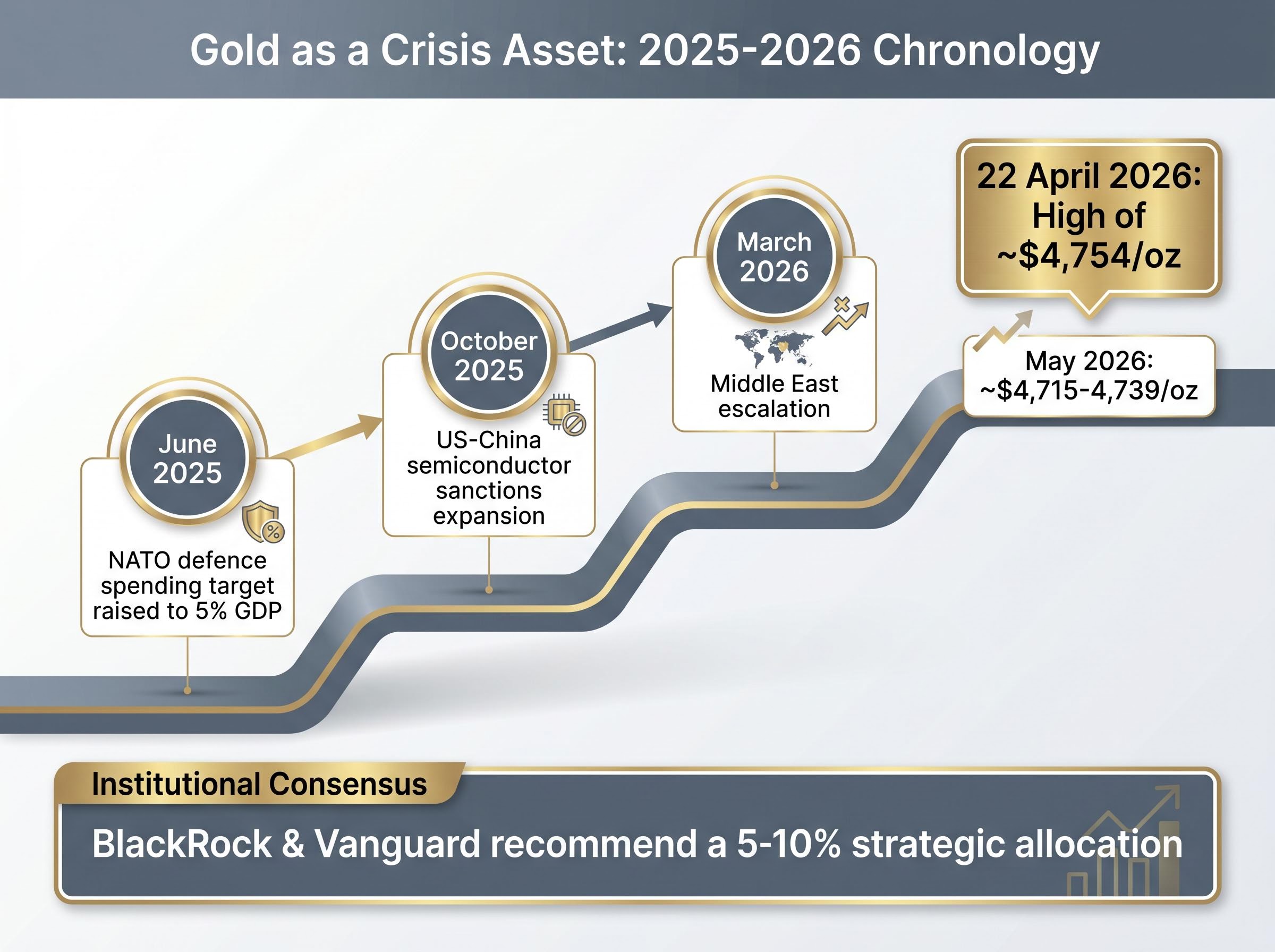
Gold’s safe-haven role is often asserted in general terms. The 2025-2026 period offers something more useful: a chronological record of how the metal responded to each specific geopolitical shock, event by event.
| Event | Date | Gold Price Context | Associated Market Move |
|---|---|---|---|
| NATO defence spending target raised to 5% GDP | June 2025 | Upward trajectory accelerated | STOXX 600 and US equities declined; VIX spiked |
| US-China semiconductor sanctions expansion | October 2025 | Safe-haven flows intensified | Nasdaq closed ~22,521-22,694; US 10-year yields +25bps |
| Middle East escalation | March 2026 | Continued climb toward record levels | Oil ~$95-98/bbl; MSCI World -2.8% |
By May 2026, gold reached approximately $4,715-4,739 per ounce, with a recent high of around $4,754 recorded on 22 April 2026. Each shock reinforced the same directional pattern: risk-off episodes drove capital into gold, and the metal held its gains between events rather than reverting.
Institutional positioning reflects this evidence. BlackRock’s Q1 2026 Outlook recommends a 5-10% portfolio gold allocation with quarterly rebalancing. Vanguard similarly favours gold ETFs such as GLD and advocates holding through volatility rather than attempting to time geopolitical events.
Institutional gold price forecasts from Goldman Sachs, JPMorgan, and State Street now target a range of $5,000-6,300 per ounce by end-2026, with central bank accumulation projected at 750-850 tonnes providing a structural price floor that reinforces the case for treating gold as a permanent allocation rather than a tactical crisis trade.
“Geopolitical alpha comes from discipline, not prediction.” — BlackRock Q1 2026 Outlook
The distinction between holding gold as a strategic allocation and trading it as a speculative position matters. The institutional consensus supports the former: a permanent 5-10% allocation, rebalanced quarterly, that serves as structural insurance rather than a directional bet on the next crisis.
Understanding safe-haven assets and why markets run to them
When equity markets sell off sharply, capital does not disappear. It moves. Safe-haven assets are the destinations investors choose when their priority shifts from growth to preservation: assets that tend to retain or gain value precisely when broader markets are falling.
The logic is intuitive. During a geopolitical shock, uncertainty rises and investors seek shelter. They want assets that are liquid, widely recognised, and historically resilient during periods of stress. Gold occupies this role because it carries no counterparty risk and its supply cannot be expanded by a central bank. The US dollar functions similarly, as the world’s reserve currency tends to strengthen during risk-off episodes because global obligations are denominated in it. Short-duration government bonds offer a third channel: they return principal quickly, limiting exposure to the yield movements that erode longer-dated bond values.
Brookings Institution research on the dollar’s safe-haven role documents how geopolitical trade shocks consistently drive capital into USD-denominated instruments, reinforcing the dollar’s structural function as the world’s reserve currency during periods of elevated global risk.
Most investors think of safe havens as gold and cash. The toolkit is broader than that.
- Gold (GLD and physical): The most widely recognised crisis hedge, with institutional backing for a 5-10% strategic allocation.
- USD instruments (UUP): Dollar-strength ETFs that capture the currency’s tendency to appreciate during global risk-off episodes.
- Energy commodities (USO): Oil ETFs that demonstrated resilience during the March 2026 Middle East escalation, with crude confirmed around $95-98 per barrel.
- Volatility hedges (VXX): Instruments linked to the VIX, which averaged approximately 17-18 year-to-date in 2026 with confirmed spikes above 20 during major geopolitical events.
Beyond gold: currencies, commodities, and volatility tools
UUP (Invesco DB US Dollar Index Bullish Fund) tracks the dollar against a basket of major currencies, providing a direct hedge for investors whose portfolios are denominated in non-USD currencies during risk-off moves. USO (United States Oil Fund) offers exposure to crude oil price movements, capturing the supply-premium dynamics that accompany conflict in energy-producing regions.
For investors with equity-heavy portfolios, options strategies such as protective puts provide defined-risk hedges, meaning the maximum loss is limited to the premium paid. VXX offers a more direct volatility exposure, though it is best understood as a short-term tactical tool rather than a permanent holding due to the structural cost of rolling futures contracts.
These instruments are supplementary to, not substitutes for, a diversified core portfolio. They address specific risk vectors that gold alone does not cover.
Rebalancing versus panic: why discipline is the quantifiable edge
The most costly single error investors make during geopolitical crises is selling into the drawdown and forfeiting the recovery that follows. The pattern is remarkably consistent: geopolitical shocks produce sharp but short-lived market declines, and the investors who lock in losses at the bottom are the ones who underperform over the subsequent months.
Following the 14 October 2025 US-China semiconductor sanctions decline, the Nasdaq recovered within approximately 10 days.
That timeline is not unusual. Historical data shows that geopolitical drawdowns tend to recover within approximately three months. The speed of the October 2025 recovery was notable, but the direction was not: markets absorbed the shock and moved on, as they have done consistently through prior geopolitical episodes.
This is where rebalancing becomes not a passive administrative task but an active strategic edge. Quarterly rebalancing to a target allocation (such as 60/40 equity/bond) automatically performs the function that panic prevents: it buys into weakness and trims into strength. Both BlackRock and Vanguard converge on quarterly rebalancing as their primary tactical recommendation for navigating geopolitical volatility.
A practical rebalancing process during a geopolitical shock involves four steps:
- Assess the current portfolio allocation against the pre-set target.
- Identify which positions have become overweight (typically cash and safe havens after a flight to safety) and which are underweight (typically equities after a drawdown).
- Compare deviations against a threshold (commonly 5% from target) to determine whether action is warranted.
- Execute adjustments incrementally rather than in a single trade, particularly during periods of elevated volatility when the VIX remains above its year-to-date average of approximately 17-18.
The source research illustrates this in practice: increasing gold allocation while reducing fixed-interest government bond exposure represents a disciplined rebalancing decision, not a wholesale exit from any asset class. The difference between that approach and panic selling is the difference between strategy and impulse.
Investors wanting to explore the behavioural research behind this pattern in greater depth will find our dedicated guide to geopolitical risk investing covers the specific cognitive biases at work, including recency bias, herd behaviour, and the disposition effect, alongside historical data from three prior oil price episodes that quantify the cost of reactive trading against a buy-and-hold baseline.
Navigating Defence Industry Exposure in Your Portfolio
Defence sector stocks have performed strongly through the 2025-2026 geopolitical cycle, and most passive index investors already hold them, whether they realise it or not.
| Company / ETF | Approximate Price (May 2026) | YTD Performance Context | Structure |
|---|---|---|---|
| RTX (Raytheon Technologies) | $149.25-176.09 | Near record levels | Stock |
| Lockheed Martin (LMT) | $506.51-512.41 | Near record levels | Stock |
| BAE Systems | 1,933-2,300 pence | Near record levels | Stock |
| ITA (iShares U.S. Aerospace & Defence ETF) | — | +3.71-4.10% YTD 2026 | ETF |
The structural demand backdrop is significant. NATO’s June 2025 decision to raise the defence spending target from 2% to 5% of GDP by 2035 provides a multi-year procurement pipeline. The World Bank has noted that defence spending increases are both inflationary and sectorally opportunistic, meaning the spending itself supports demand for defence contractors while contributing to the broader inflation dynamics discussed earlier.
NATO’s June 2025 Hague summit defence commitments formalised the shift from the longstanding 2% GDP benchmark to a 5% target by 2035, establishing a multi-year sovereign procurement cycle that defence contractors and their supply chains have been pricing into forward earnings guidance ever since.
The ethical question is real and increasingly relevant. Investors tend to fall into one of three positions:
- Exclusion screeners: Investors who actively remove defence holdings from their portfolios through ESG screening or negative filters.
- Neutral passive holders: Investors who hold defence exposure indirectly through broad index ETFs and accept it as part of market-cap-weighted diversification.
- Active tilters: Investors who deliberately increase defence allocation during elevated spending periods, viewing it as a sector rotation opportunity.
FCLTGlobal has observed that long-term investors are increasingly engaging with this question proactively rather than discovering their defence exposure after the fact. There is no single correct position. The relevant point for portfolio construction is that the decision should be deliberate, whatever it is.
Beyond sector-level allocation decisions, defence contractor fundamentals such as backlog size, book-to-bill ratios above 1.0x, and the distinction between funded and unfunded obligations provide a framework for evaluating individual companies within the sector, particularly relevant given the multi-year procurement pipeline that NATO’s 5% GDP spending target is expected to generate.
Building a geopolitical resilience plan that does not require predicting the next crisis
The preceding sections cover mechanisms, assets, discipline, and ethics. What remains is synthesis: a single framework that reduces the number of decisions required during the next geopolitical shock.
The goal is not a perfect portfolio constructed in advance. It is a pre-committed plan that removes emotional decision-making from the equation when headlines are worst. The following five components, drawn from the institutional guidance of BlackRock, Vanguard, and the IMF, form a geopolitical resilience checklist:
- Gold allocation: Maintain a 5-10% strategic allocation to gold (via GLD or locally available equivalents), rebalanced quarterly. This is not a crisis trade; it is a permanent portfolio component.
- Bond duration awareness: Understand the duration profile of fixed-income holdings and how they respond to yield changes. In the current environment (US 10-year at approximately 4.38-4.41%), shorter-duration bonds offer less rate sensitivity.
- Rebalancing cadence: Set a quarterly rebalancing schedule and commit to it in advance. Do not wait for a crisis to decide whether to rebalance.
- Sector exposure review: Audit the portfolio for unintended concentrations in geopolitically exposed sectors (including indirect defence holdings through index ETFs) and decide deliberately whether to maintain, reduce, or increase that exposure.
- Volatility tool awareness: Know which hedging instruments (protective puts, VIX-linked products, currency ETFs) are available and understand their mechanics before they are needed. The time to learn about a fire extinguisher is not during a fire.
The IMF has urged steady, forward-looking monetary policy rather than reactive adjustments in response to geopolitical shocks. The same principle applies to individual portfolio management: a steady framework, established in advance, outperforms ad hoc reactions during a crisis.
A note for global investors on regional variations
ETF availability, currency denomination, and local bond yield environments vary significantly by region. Investors outside the United States should verify that equivalent instruments are accessible in their local markets before building a plan around US-listed products such as GLD, UUP, or VXX.
The emerging markets dimension warrants specific attention. Investors with significant allocations to emerging market equities face additional complexity from US-China friction, currency volatility, and trade fracturing that this guide’s framework does not fully address. Dedicated EM risk frameworks, such as those published alongside the MSCI Emerging Markets Index, should supplement the five-component checklist for those portfolios.
The case for staying the course is stronger than it looks right now
The convergence of institutional guidance from BlackRock, Vanguard, and the IMF points to a single conclusion: disciplined, pre-committed portfolio management outperforms reactive crisis response. This is not a temporary observation. Geopolitical uncertainty is a permanent feature of investing, not an anomaly to survive before returning to normal. The frameworks in this guide are not crisis-mode tools to be shelved when headlines improve; they are permanent portfolio practices.
The practical next step is specific. Review the current gold allocation against the 5-10% benchmark. Check whether the bond duration profile aligns with the current yield environment. Set a quarterly rebalancing reminder. Audit sector exposure for unintended concentrations. These are actions available this week, not aspirational principles for some future date.
The five-component checklist (gold allocation, bond duration awareness, rebalancing cadence, sector exposure review, and volatility tool awareness) is designed to function as a standing framework, not a single-use response. Geopolitical shocks will continue. The portfolio that absorbs them is the one built before they arrive.
This article is for informational purposes only and should not be considered financial advice. Investors should conduct their own research and consult with financial professionals before making investment decisions. Past performance does not guarantee future results. Financial projections are subject to market conditions and various risk factors.
—