
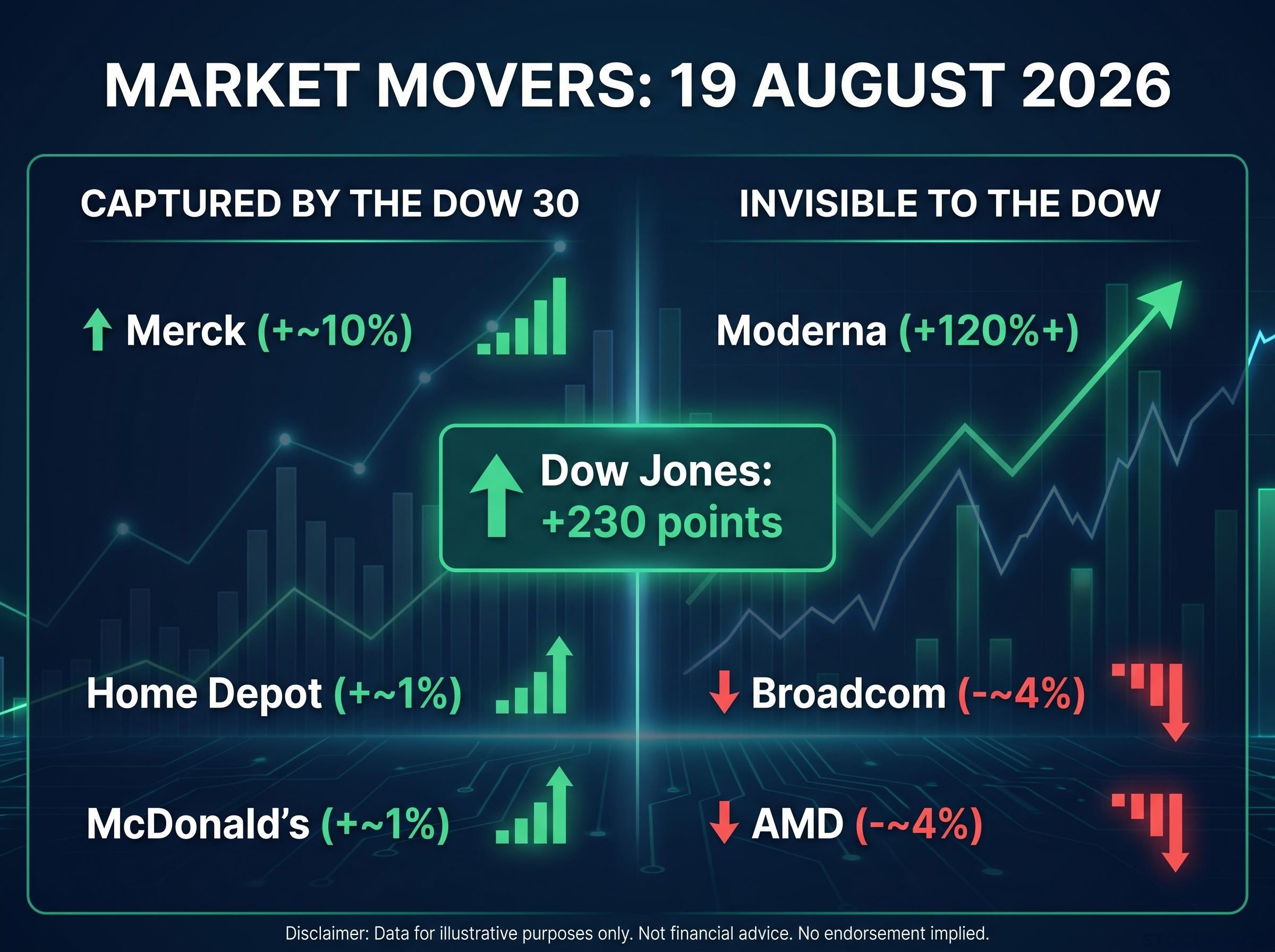
Moderna just had one of the greatest single-session stock moves in market history, surging more than 120% on 19 August 2026. The Dow Jones Industrial Average rose 230 points. Those two facts are not in tension. They are a perfect illustration of how the Dow actually works.
Most investors treat the Dow’s daily point move as shorthand for how the market performed. Today, that shorthand failed completely. The Dow rose, Moderna’s breakthrough never touched it, and the index drew its gains instead from Merck’s roughly 10% advance, with Home Depot and McDonald’s each contributing around 1% to the move. Understanding why requires looking at the Dow’s price-weighted structure rather than its headline number.
Here is how the Dow’s mechanics, membership rules, and weighting method produced today’s result, and what it tells you about which benchmarks to trust for which questions. After reading, you will know exactly why the Dow said what it said today, and how to read it more accurately going forward.
A 120% gain that never touched the index
Moderna (MRNA): surged more than 120% in a single session, with intraday gains reaching the 120-160% range, driven by positive Phase 3 melanoma vaccine trial data released today.
That number deserves a moment. A stock more than doubled in a day. And the Dow, the number most quoted as a proxy for how “the market” performed, registered none of it.
The reason is structural: Moderna has no place among the Dow’s 30 component stocks, which means its price never enters the index calculation. Merck, Moderna’s partner on the melanoma vaccine and the owner of Keytruda, holds a seat in the Dow. That ~8-11% advance from Merck fed into the index. Moderna’s historic move did not.
The blind spot extended further. Broadcom and AMD both posted losses of around 4% tied to AI-sector weakness, yet because neither company sits in the Dow’s membership list, those declines left no mark on the index.
| Stock | Dow member? | Session move | Impact on DJIA |
|---|---|---|---|
| Moderna (MRNA) | No | +120%+ | Not reflected |
| Merck (MRK) | Yes | +~10% | Reflected |
| Home Depot (HD) | Yes | +~1% | Reflected |
| McDonald’s (MCD) | Yes | +~1% | Reflected |
| Broadcom (AVGO) | No | -~4% | Not reflected |
Three of the day’s biggest equity stories, Moderna’s historic surge, Broadcom’s decline, and AMD’s slide, were all invisible to the Dow. That tells you the index’s daily number describes a narrow slice of the market, not the market itself.
When big ASX news breaks, our subscribers know first
What “price-weighted” actually means in practice
If you watched Merck’s roughly 10% gain add significantly more Dow points than a larger company’s 1% move, you were seeing the price-weighting mechanism at work. The arithmetic behind it is straightforward, and once you see it, the Dow’s behaviour today stops being confusing and starts being predictable.
In a price-weighted index, the raw share prices of all member stocks are totalled and then divided by a single figure known as the divisor. A stock’s influence on the index is determined entirely by its nominal share price, not by its market capitalisation or the size of the underlying business.
Here is how the calculation works:
- Sum the share prices of all 30 Dow component stocks.
- Divide by the Dow divisor, which currently stands at approximately 0.152.
- Compare the result to the prior session’s close to determine the day’s point change.
Key arithmetic: A $1 move in any single Dow component’s share price adds roughly 6.6 points to the index (1 divided by 0.152). That multiplier applies equally regardless of which company it is.
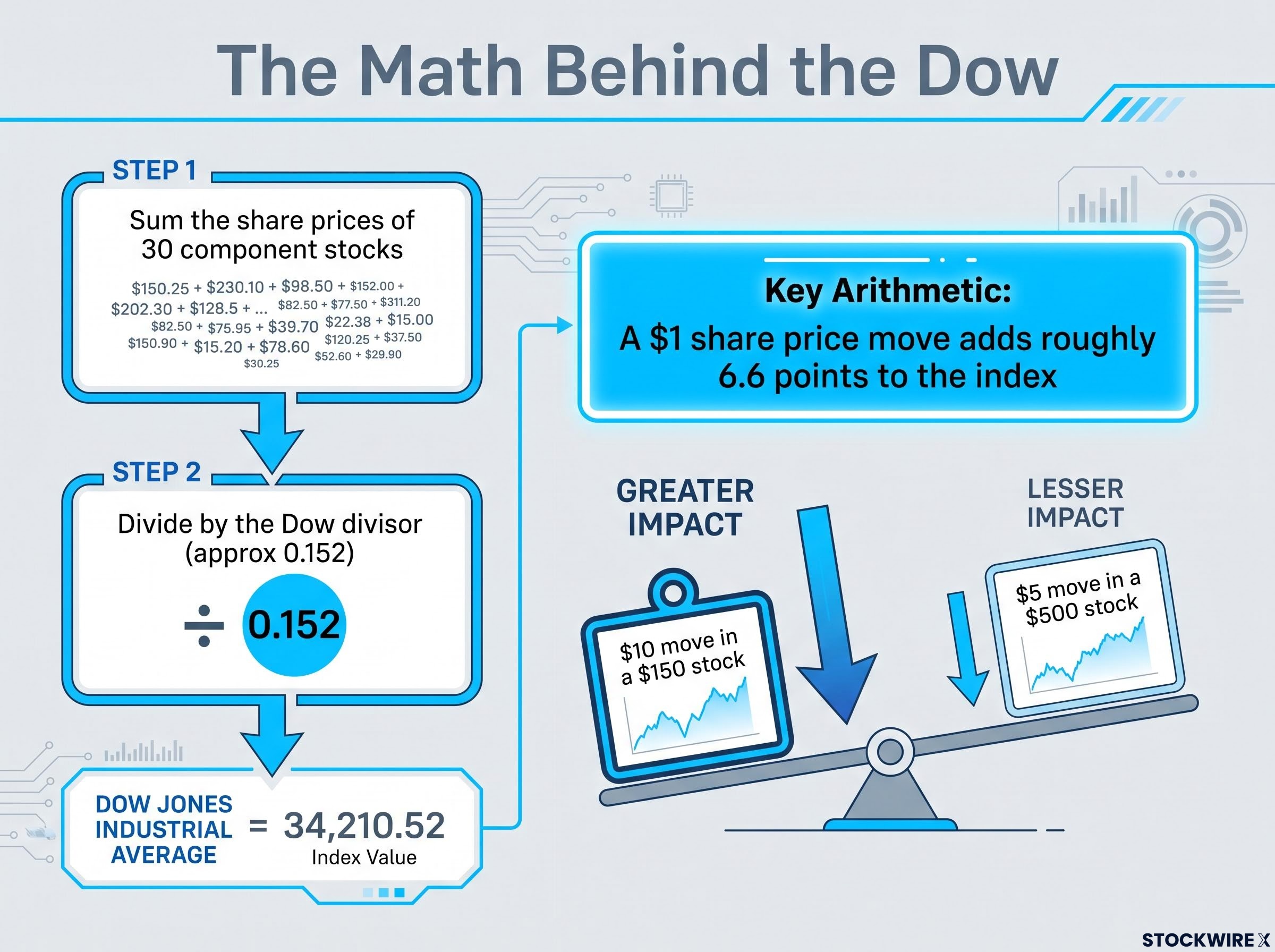
The practical consequence is significant. A $10 move in a $150 stock outweighs a $5 move in a $500 stock in terms of Dow points, even if the $500 stock belongs to a far larger company. Price-weighting means a company with a high share price but a smaller economic footprint can consistently move the Dow more than a genuinely larger business. That is a structural quirk worth understanding before you anchor your market view to this index.
Why the S&P 500 saw it when the Dow did not
The S&P 500 and Nasdaq Composite are market-cap-weighted. That means a company’s influence on those indexes scales with its total market value, not its share price. Moderna carries sufficient market capitalisation that its 120%+ gain would have meaningfully moved both of those benchmarks today.
Cap-weighting scales influence to economic size, which makes broader indexes a more representative picture of what is happening in equity markets. The Dow’s price-weighting does not, and today that gap was as visible as it gets.
Why 130 years of history created this quirk
Charles Dow, who also co-founded the Wall Street Journal, established the Dow Jones Industrial Average in 1896. At the time, averaging stock prices was the only arithmetically practical approach to building a market benchmark. There were no computers to calculate market-cap weights across hundreds of securities. Adding up prices and dividing by the number of stocks was what a person with a paper ledger could do.
The divisor came later, introduced as an adjustment mechanism to prevent stock splits and other corporate actions from creating artificial jumps in the index. Without it, a 2-for-1 stock split would have halved one component’s contribution overnight, sending the Dow plunging for reasons that had nothing to do with market conditions. The divisor preserves continuity across decades.
Three design choices define the Dow’s historical character:
- Established in 1896, giving it a longer continuous track record than virtually any other equity benchmark still in use today
- Originally a simple price average across a small number of industrial stocks, built for an era of manual calculation
- The divisor (currently approximately 0.152) adjusted whenever a component splits or is replaced, so the index level remains continuous across more than a century of changes
Knowing the Dow was built for an era of paper ledgers helps you see it for what it is: a durable historical artefact that tells you something useful about 30 specific blue-chip stocks, not a comprehensive measure of the U.S. economy. It was never designed to capture a day like Moderna’s.
The Dow Jones history stretches back to an era when Charles Dow was calculating averages by hand, and the structural decisions made in 1896 for practical convenience have never been unwound, leaving a benchmark that institutional investors at Morgan Stanley, J.P. Morgan, and Fidelity treat as a legacy media fixture rather than a rigorous economic proxy.
How the committee chooses which 30 stocks make the cut
Dow component membership is determined by a committee, not by a formula. There is no automatic threshold of market capitalisation, trading volume, or sector weight that earns a stock inclusion. The committee makes a qualitative judgment about which 30 companies represent major U.S. industries among the most actively traded names in the country.
Today’s session illustrates the implication clearly. Regardless of Moderna’s market capitalisation, valuation, or the historic scale of its price move, the company is simply not on the committee’s current list of 30. Its 120% surge had zero mathematical impact on the Dow.
What gets a stock into the Dow, and what does not:
- Included in selection criteria: Committee judgment, blue-chip status, representation of a major U.S. industry, active trading
- Not determinative of entry: Market-cap rank alone, single-day percentage performance, sector dominance without committee endorsement
Because membership is a committee decision rather than a formula-driven screen, the Dow’s daily number reflects the judgment of that committee about which companies matter. Any day where an excluded company dominates the news is a day when the index’s blind spot is visible.
Dow component selection has historically followed a clear substitution logic, swapping legacy representatives for companies that better reflect the current economy, a pattern the committee applied when it replaced AT&T with Apple in 2015 and Intel with Nvidia in 2024.
What happens to the divisor when a component changes
When one stock is swapped out for another, the divisor is recalculated so that the index level on the day of the change is identical before and after the substitution. The swap itself does not add or subtract points.
This is why the Dow’s long-run level remains meaningful for trend comparison even across decades of component changes. The continuity is mathematical, preserved through the divisor, not broken by turnover.
What the Dow is actually good at (and what it is not)
The Dow does some things well. It gives you a fast, high-signal read on sentiment among 30 prominent blue-chip U.S. companies. It has 130 years of historical continuity, which no other equity benchmark can match. And because it is so widely quoted, its moves affect headlines and sentiment in ways that create real market feedback loops.
What it does not do is equally important. It does not capture the performance of non-member companies, even those experiencing historic moves. It does not weight companies by economic size. And it does not represent the broad U.S. equity market.
| Index | Components | Weighting method | Captured Moderna’s move? | Best use case |
|---|---|---|---|---|
| DJIA | 30 | Price-weighted | No | Blue-chip sentiment snapshot |
| S&P 500 | 500 | Market-cap-weighted | Yes | Broad U.S. equity market performance |
| Nasdaq Composite | 3,000+ | Market-cap-weighted | Yes | Tech and innovation-heavy market read |
On 19 August 2026, the Dow rose 230 points while Moderna surged 120%+, Broadcom fell 4%, and AMD fell 4%. None of the non-member moves appeared in the Dow’s number. For your own market monitoring, the practical implication is straightforward: use the Dow as one signal among several, and on any day when a major non-member stock is dominating the news, check the S&P 500 and Nasdaq to understand what the broader market is actually doing.
Dow-Nasdaq divergence sessions, like the one on 24 June 2026 when the Dow gained 184 points while the Nasdaq fell 110, offer some of the clearest real-world demonstrations of how price-weighting and cap-weighting produce different signals from the same underlying market activity.
Three habits that help:
- Check the S&P 500 alongside the Dow daily. The two indexes will agree most of the time, but when they diverge, the divergence itself is information.
- Before attributing a headline move to the Dow, confirm whether the company driving the story is actually a Dow component. Today’s session is the proof of why that matters.
- Use sector-specific indexes when a particular industry is in focus. On a day driven by biotech breakthroughs or AI earnings, the Dow’s 30 names may include few or none of the relevant companies.
Reading the Dow more clearly after a day like this
Today’s session distilled three structural lessons about the Dow into a single trading day:
- Membership matters more than performance. If a stock is not in the 30, its move is invisible, regardless of scale.
- Share price drives influence, not company size. The dollar magnitude of a component’s price change, amplified through the divisor (approximately 0.152), determines its Dow point contribution, not the company’s market capitalisation or percentage gain.
- The Dow is a narrow historical snapshot, not a full market barometer. Its 30-stock, price-weighted structure, unchanged in its fundamentals since 1896, was designed for a different era.
The next time the Dow’s move seems inconsistent with a market story you are reading, the first question to ask is whether the company driving that story is in the Dow’s 30. Today, the answer was no for three of the session’s most significant movers.
The Dow’s 230-point gain is not misleading if you know what it is measuring. It tells you exactly what happened to 30 specific blue-chip stocks, and that is a useful piece of information as long as you do not ask it to tell you more than that. Understanding the Dow’s design constraints does not make you a sceptic of all indexes. It makes you a more accurate reader of market data, someone who knows which benchmark to consult for which question.
For investors wanting to apply today’s weighting lesson to their own portfolio holdings, our dedicated guide to cap-weight versus equal-weight ETFs explains how the choice between these two structures produces meaningfully different real exposure across sectors and individual names.
This article is for informational purposes only and should not be considered financial advice. Investors should conduct their own research and consult with financial professionals before making investment decisions.