More than 9 million. That is roughly how many ways one AI platform found to pair existing drugs with each other and with cancer cell lines. Combining drugs can sometimes do more than either drug alone, but no laboratory on earth could test every option.
The scale is not unusual. The American Association for Cancer Research (AACR) described in its 2025 cancer progress report a machine-learning approach in paediatric cancer that started with about 1.4 million possible pairs drawn from 206 drugs. Researchers tested only about 4% of them.
Laboratory work is slow and costly, so testing everything by hand is impractical. Something has to decide what gets tested first.
Here is how an AI platform narrows that field, how its predictions are checked at the bench, and which questions to ask of any company making AI drug combination claims. Your worked example is Algorae Pharmaceuticals (ASX: 1AI).
How does AI narrow millions of drug combinations to a short list?
How a model ranks combinations
A combination model learns from data about drugs and cells it has already seen. Typical inputs include:
- chemical structures of each drug
- drug targets and how each drug acts
- gene-expression profiles of cancer cells (which genes are switched on)
- single-drug dose responses
- results from earlier combination experiments
The model’s output is a ranked list of pairs most likely to beat what each drug does alone. Reviews of combination-prediction methods describe these models as tools for prioritising what to test, not substitutes for experiments. That framing matters to you: an “AI-predicted” combination is a prioritised hypothesis, a shortlist waiting for a laboratory test.
What synergy means in a lab
Synergy is when the measured combined effect is larger than a mathematical expectation of what the drugs would do without helping each other. Bliss independence assumes the two drugs act separately. Loewe additivity asks whether the pair behaves as if one drug were simply substituting for the other.
Researchers expose cells to a dose matrix, a grid of different concentrations of each drug, and compare results with the chosen reference. The score therefore depends on the reference model and dose design. A positive score shows the effect beat the expectation; on its own, it does not establish clinical usefulness.
Why patent and commercial filters come first
A review in the British Journal of Cancer explains that reused drugs normally cannot gain a new active-ingredient patent. Protection is usually sought through a new use, formulation, dosing schedule or combination. Developers also need freedom to operate (no blocking patents) and reliable supply, so filtering before testing keeps lab time focused on combinations that could actually be developed.
Reused drugs rarely carry fresh molecule patents, so you should also understand how the pharmaceutical reformulation model works, where competitive durability rests on formulation IP, manufacturing know-how and regulatory position rather than on the molecule itself.
When big ASX news breaks, our subscribers know first
What happens between an AI prediction and a clinical trial?
Once a shortlist exists, the combinations go into the laboratory. Cancer cell lines, which are cancer cells grown in dishes, are treated across a dose matrix. Researchers measure viability, growth or cell death, then compare each pair with each drug alone.
That step sits early on a long road. Drawing on the US Food and Drug Administration (FDA) and Therapeutic Goods Administration (TGA) frameworks, the stages run:
- Discovery: identifying candidates and how they might work.
- Preclinical research: laboratory and animal studies of activity and safety.
- Phase 1: human pharmacology and safety.
- Phase 2: therapeutic exploration in patients.
- Phase 3: larger confirmatory studies.
- Regulatory review: the regulator assesses the full evidence package.
- Post-market monitoring: safety tracking after approval.

Cancer Australia sets out a matching five-stage Australian pathway, from discovery through to post-marketing monitoring.
Worth remembering Preclinical screening is not a clinical trial. Cell lines leave out the tumour’s surroundings, the immune system and how the body processes a drug.
Precedent shows the gate can lead somewhere. The US National Cancer Institute’s ALMANAC screen tested about 5,000 combinations of more than 100 FDA-approved drugs, and two combinations progressed to Phase 1 studies. A cell-line screen tells you whether a combination did something measurable in a laboratory model. It is the first gate, and an inexpensive one.
For readers wanting to judge which evaluative body stands behind each signal, our full explainer on ASX biotech clinical milestones shows how to read them.
Inside the Algorae Pharmaceuticals (ASX: 1AI) and Peter Mac screening programme
Algorae’s programme puts each of those steps into real numbers. According to the company’s ASX announcement on 16 October 2026, its AlgoraeOS platform feeds a preclinical laboratory screen run by the Victorian Centre for Functional Genomics at the Peter MacCallum Cancer Centre (Peter Mac).
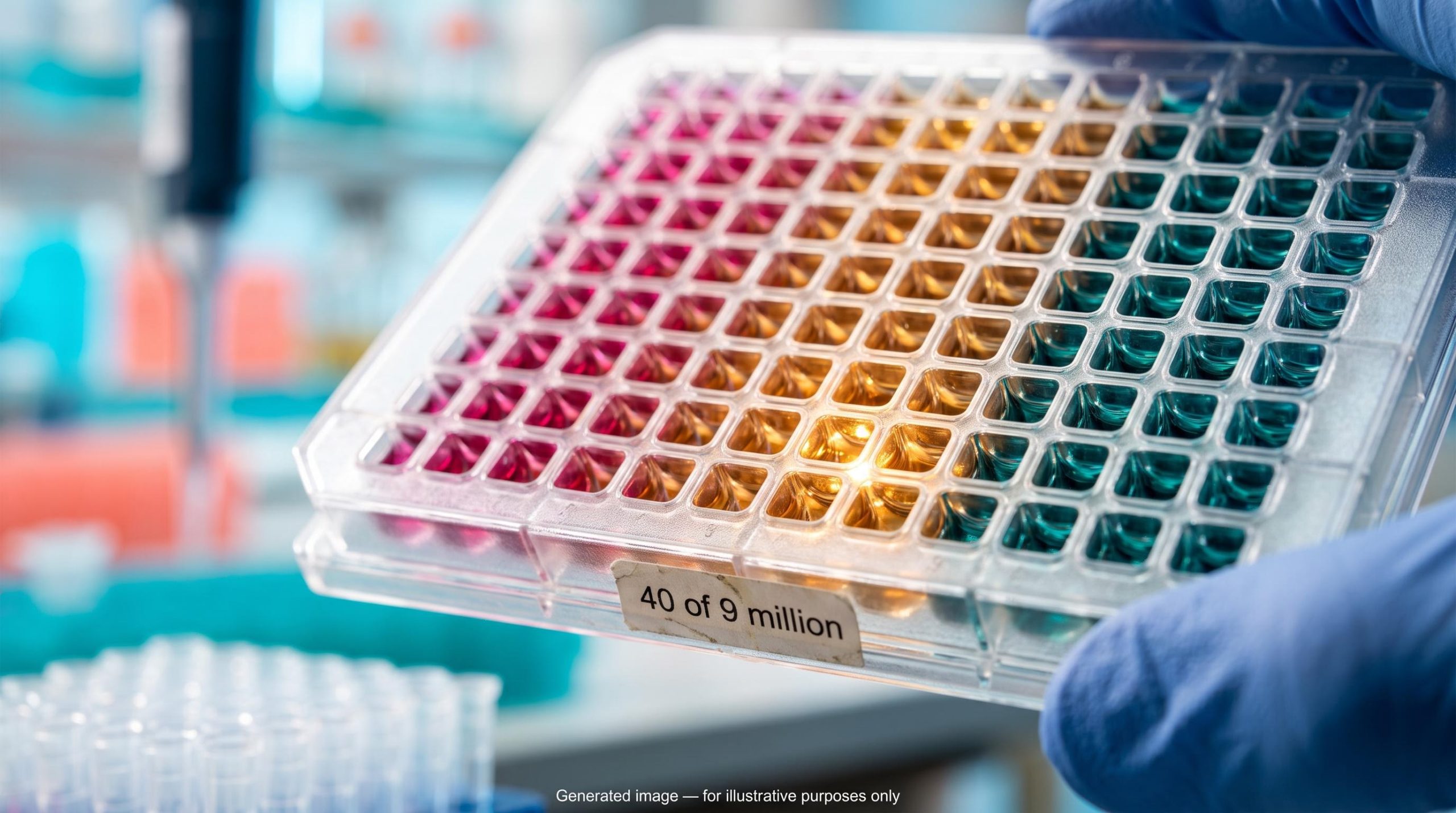
- Search space: a dataset of more than 9 million potential drug, drug and cell-line combinations.
- Shortlist: 40 high-priority combinations, chosen after commercial and intellectual property analysis.
- Test: screening across four cancer cell lines representing glioblastoma, non-small-cell lung, colorectal and bladder cancers.
- Timing: the full dataset is expected within six months of 16 October 2026.

The 9 million figure is the computational search space, not the number of experiments. The physical work is the 40-combination screen, which is exactly the narrowing the earlier sections described.
The 9 million figure comes from the way Algorae expanded its platform from a single anchor drug to 18, and Algorae AI synergy predictions of this size show why a computational filter has to come before any laboratory work.
The programme is backed by a $49,109 Therapeutic Innovation Australia Pipeline Accelerator voucher, awarded in a competitive round where 13 of 28 applicants were funded, the company reported. It also builds on earlier Peter Mac work: Algorae reported on 2 July 2026 that its second-generation platform, AOS2, identified synergistic combinations at about 2.5 times the rate of its predecessor, AOS1.
Management’s message (Algorae, 16 October 2026) The company described the programme as independent validation of AlgoraeOS v2’s multi-anchor predictions, designed to identify experimentally validated, commercially actionable drug combinations rather than computer predictions alone.
For you, the value is the shape: a computational ranking, an independent laboratory, a defined test and a stated timeframe. That is the pattern to look for in any AI drug discovery claim.
Separate commercial activity: AlgoraeRx and Umedica
Apart from the lab programme, Algorae announced on 19 October 2026 that its subsidiary AlgoraeRx signed a non-binding memorandum of understanding (MOU) with Umedica Laboratories, which would make AlgoraeRx the exclusive Australian importer and distributor across eight molecules. Under a separate binding Licence & Supply Agreement, a product dossier has been submitted to the TGA.
Four questions to ask of any AI drug discovery company
You can carry this checklist into any announcement:
- How many candidates did the model start and end with? The narrowing should be stated in numbers.
- Who tests the predictions, and where? A named laboratory gives you something to follow.
- What does the test measure? Look for a defined endpoint, such as synergy in specific cell lines.
- When are the results due? A date turns a promise into a checkpoint.
Algorae’s 16 October 2026 announcement answers all four: more than 9 million narrowed to 40; the Peter MacCallum Cancer Centre; synergy across four cancer cell lines; and a full dataset within six months. When a company answers this plainly, you can track it from announcement to result without leaning on the AI label.
The milestones Algorae has announced, and when to expect them
Algorae has set out a defined lab programme with a dated output, plus commercial next steps. Three markers to follow:
- Peter Mac dataset: full results expected within six months of 16 October 2026.
- TGA outcome: on the dossier submitted, as announced on 19 October 2026.
- Definitive Umedica agreements: the next step the company has set out under the non-binding MOU.
These give you a simple way to compare what Algorae reports next with what it has already announced.
This article is for informational purposes only and should not be considered financial advice. Investors should conduct their own research and consult with financial professionals before making investment decisions.
Disclosure: Algorae Pharmaceuticals (ASX: 1AI) is a commercial client of StockWire X. This article was commissioned by the company.