
A biotech with five programmes looks safer than one with a single drug. More shots on goal should mean more chances that something works. Yet the BioSpace Layoff Tracker entries for October 2026 show a growing list of companies doing the reverse: trimming programmes and staff so that all their effort sits behind a single lead asset.
That matters to you because a narrowed pipeline can mean two very different things. It might be a disciplined decision about where scarce capital does the most good. It might be a forced retreat after something went wrong.
In a headline, the two look almost identical.
After this, you will be able to tell why a company narrowed, where its lead asset came from, and what it is now funding toward. Start with the obvious question: why would any company deliberately give up its other options?
What does pipeline narrowing actually look like?
The mechanics repeat across companies. Secondary programmes are paused or discontinued, headcount falls, and the remaining capital is redirected to the lead asset. The October entries in BioSpace’s tracker show that pattern repeatedly, though the motives behind it differ.
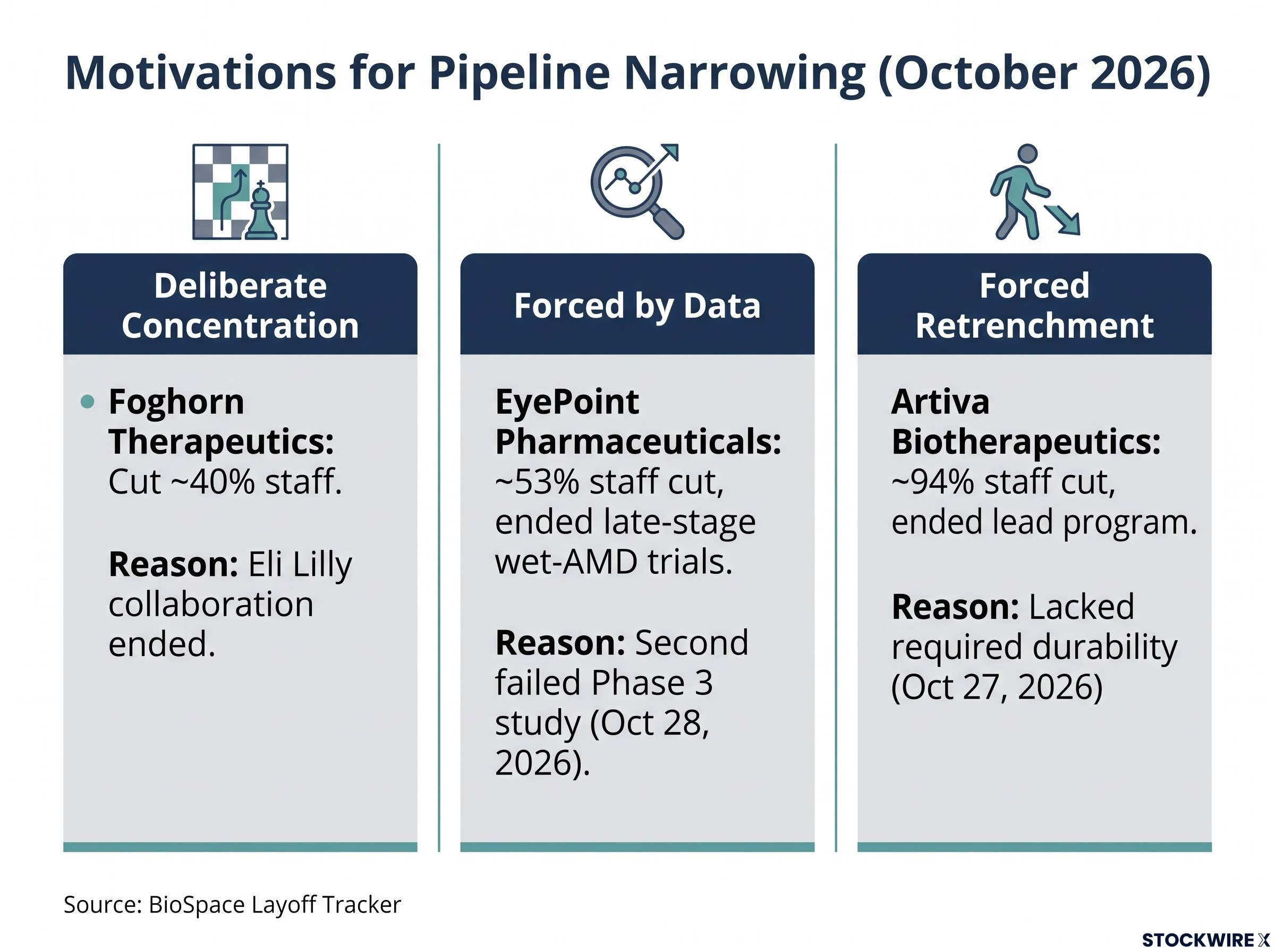
| Company | What it did | Stated reason | Type of narrowing |
|---|---|---|---|
| Foghorn Therapeutics | Cut about 40% of staff | Eli Lilly collaboration ended; refocus on its own programmes (BioSpace, October 2026) | Deliberate concentration |
| EyePoint Pharmaceuticals | Planned about a 53% workforce cut and an early end to late-stage wet-AMD trials | Followed a second failed Phase 3 study (BioSpace, 28 October 2026) | Forced by data |
| Artiva Biotherapeutics | Ended its lead programme; planned to cut about 94% of staff | Programme did not show the required durability (BioSpace, 27 October 2026) | Forced retrenchment |
Wet-AMD refers to wet age-related macular degeneration, an eye disease that causes vision loss. In Europe, Innate Pharma management described a cut from eight clinical-stage assets to three priority programmes in September 2026, a choice framed as deliberate rather than forced.
The same logic at Sanofi’s scale
According to Labiotech.eu, Sanofi has been reviewing and prioritising its pipeline under new leadership. In its Q2 2026 results on 30 July 2026, the company said resources freed from discontinued programmes would not automatically return to research; they could flow wherever expected growth and returns looked strongest, including commercial opportunities.
The numbers are bigger, but the decision is the same. Seeing the move at companies of every size tells you a shrinking pipeline is not, on its own, a sign of failure. The reason behind it is what you need to find.
When big ASX news breaks, our subscribers know first
Why would a company back one programme over several?
Your instinct that more programmes means more safety is reasonable. It just leaves out how drug development creates value.
A programme only becomes valuable when it reaches a readout, meaning the point where trial results answer a real question about whether the drug works. Getting there requires the programme to be fully funded the whole way.
Knowing which clinical milestones sit ahead of a lead asset, and which evaluative body stands behind each one, lets you name the next readout a narrowed company is funding toward.
Now picture a small company with enough money to carry one programme to that point. Spread the same money across four, and every one of them may stall short of a meaningful answer. Concentration can carry one all the way.
Eversana, writing in 2022, made the related point that small biotechs often lack the capital and specialist staff to run several programmes on their own. Innate Pharma said it was concentrating resources on the programmes it judged to have the best chance of success.
Focus also brings secondary benefits:
- Attention: management makes fewer competing decisions and aligns everything around one path.
- Staff: specialist people work on one asset rather than being stretched thin.
- Partnerability: larger companies license or buy specific assets, and a single clear asset is easier for them to assess.
- Trackability: you can follow progress against one plan instead of several.
The transferable lesson A company built around one programme has placed a clear wager on the source of its next readout, and you should be able to name that wager for any company you follow.
Where do lead programmes come from? The in-licensing model
You might assume biotechs invent their own lead drugs. Many do not. A common model is in-licensing: a small company takes the rights to a clinical-stage programme from another company or a research institution, then pays to develop it.
| Deal element | What it means | Who it benefits |
|---|---|---|
| Upfront payment | Money or shares paid when the deal is signed | The original owner, which gets value immediately |
| Milestones | Payments triggered when the drug hits development, regulatory or sales goals | The licensee, which pays only once risk has fallen |
| Royalties | A percentage of future sales paid to the original owner | The original owner, which shares in any success |
L.E.K. Consulting’s 2023 analysis found buyers tend to push more value into milestones while sellers want more upfront. BlueStar BioAdvisors notes that an asset is often licensed after an early proof-of-concept result, letting a better-funded company carry later development.
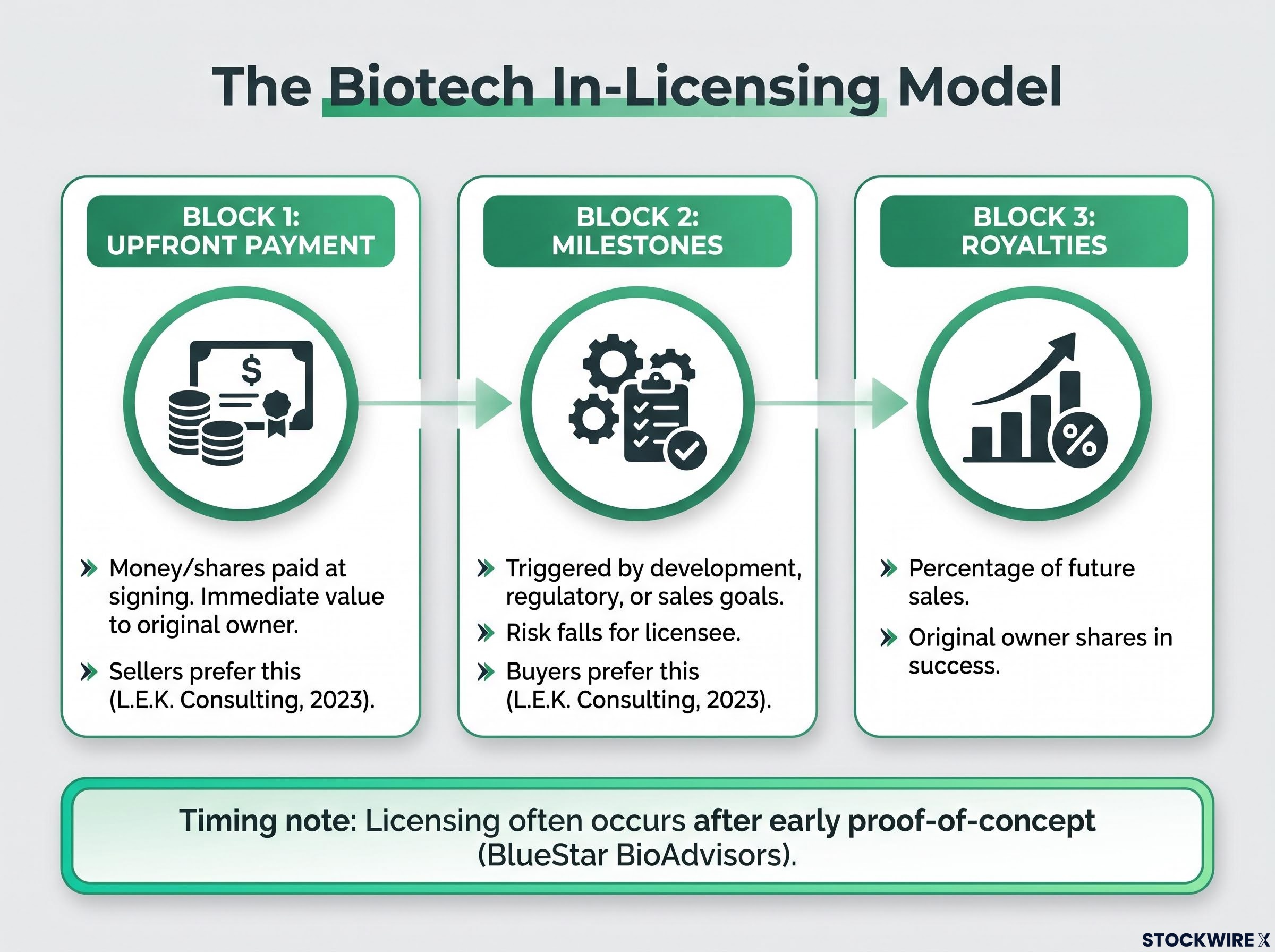
The exchange is plain. You get an asset with clinical history from day one, and in return you share part of any future value. To check which model applies, look at the company description in the annual report or search ASX announcements for a licence agreement. Whether the lead asset was built or bought tells you how much of its future value the company actually keeps.
Licensing structures built on upfront payments, milestones and royalties also work in the other direction, as Dimerix licensing deals for DMX-200 show, with a US$10 million upfront payment from Everest Medicines and tiered royalties on future sales.
What does focus cost, and what should you ask of any narrowed biotech?
Concentration is not free. Its costs come with the strategy rather than signalling trouble at any particular company.
What focus costs
- No fallback: without a second asset, every development decision carries more weight.
- Licence obligations: milestones and royalties stay attached to an in-licensed asset.
- More capital: a narrowed company may still need further funding before its next readout.
- Unproven benefit: no settled independent evidence shows that cutting to one programme improves clinical success rates.
“Focused” can also describe a lack of alternatives. Artiva ended its lead programme and said it would consider options including a transaction, licensing, dissolution or liquidation, according to BioSpace on 27 October 2026. That is retrenchment after a disappointing assessment, not a strategic bet.
Questions to ask of any narrowed biotech
- Was the narrowing a strategic choice, a response to data, or a response to financing conditions?
- Was it announced before or after a failed study or a partner’s exit?
- What happened to the dropped programmes: paused, out-licensed or stopped?
- Was the lead asset built in-house or in-licensed, and what obligations come with it?
- What next readout is the company now funding toward?
Focus changes how capital is used, not the underlying science. Judge the reason and the plan, not the programme count. This is general information only.
One ASX example: running the five questions over Imugen
Imugene (ASX: IMU) shows both ideas in one company, and it is a useful example because the five questions above can each be answered from its disclosures. Its 2026 annual report describes azer-cel, an investigational allogeneic CAR-T cell therapy for blood cancers, as its lead and sole clinical programme, following a strategic shift to focus future clinical development on it.
Question one, why it narrowed. The concentration on azer-cel was announced as a strategic reallocation rather than in the wake of a failed trial or a partner withdrawal. On the spectrum set out earlier, that places it at the deliberate concentration end rather than alongside the data-driven and retrenchment cases. The ordering of events is what separates the two, and it is checkable in the announcement record.
Question three, where the asset came from. Azer-cel was in-licensed from Precision BioSciences (NASDAQ: DTIL) under an agreement effective 15 August 2023, according to Imugene’s ASX announcement. It is the in-licensing model described above rather than an internally discovered asset.
Question four, what obligations came with it. The licence carries milestone payments, and one has already been triggered. In October 2025 Precision received an $8 million milestone comprising $3 million in cash and $5 million in Imugene ordinary shares, tied to Imugene’s clinical and regulatory progress. That is the upfront-milestones-royalties structure in the table above working in practice, and the share component shows how an in-licensing obligation can be settled in equity rather than cash.
Question five, what readout it is funding toward. Imugene has reported receiving written FDA guidance on the registrational pathway for azer-cel, with alignment described across dosing regimen, patient population, endpoints and manufacturing readiness to support advancement into a pivotal study. Azer-cel holds Fast Track designation in diffuse large B-cell lymphoma, with further Fast Track designations granted during 2026 in relapsed or refractory chronic lymphocytic leukaemia and marginal zone lymphoma. It was selected for oral presentation at the 2026 ASCO Annual Meeting, held 29 May to 2 June in Chicago. The Phase 1b programme has been expanded, including a second cohort and a new cohort combining azer-cel with a BTK inhibitor.
Regulatory alignment on a registrational pathway is the kind of answer question five is asking for, because it names what the next readout has to deliver and who assesses it. StockWire X has covered the company’s background separately.
Seeing both strategies here shows you what to look for in disclosures, not what to expect from the company.
Disclosure: StockWire X has a commercial relationship with Imugene (ASX: IMU).
What changes once you see why a biotech narrowed
Having more programmes does not automatically make a company safer, and cutting back to one is a considered capital allocation decision that numerous biotechs are making in 2026. You can now ask why a company narrowed, where its lead asset came from and what it is funding toward.
A single-programme strategy is neither a good nor a bad sign on its own. The selection rationale, the obligations attached to the asset and the plan if it does not progress are what separate one case from another.
Because a narrowed biotech has no earnings to judge, you are left with milestone-based analysis: trial progression, regulatory designations and conference outcomes become the evidence you use to judge whether its single wager is working.
This article is for informational purposes only and should not be considered financial advice. Investors should conduct their own research and consult with financial professionals before making investment decisions.
General information only, not a recommendation.
—