Imagine your stop triggers early on 29 October 2026, closing your Carvana position for a small loss. A few hours later, the stock is up roughly 15-17% on record third-quarter results. Your first thought is probably that the stop failed you.
It did not. The stop did exactly what it was built to do, and that is why it matters for any stop loss strategy you rely on.
Sudden moves expose the gap between having a plan and following one. Sometimes a single stock jumps on earnings. Sometimes a whole index swings, as the Nasdaq did when it fell 3.62% on 18 December 2024. If you rely on a promise to act later, you risk letting a manageable loss grow. Rules you set in advance protect you from that.
This guide covers three things. You will learn how to place a real stop at a logical level and how to size a position so a bad fill is survivable. You will also see why holding 20 to 40 positions changes how any single surge or collapse feels.
Why mental stops fail when you need them most
Most traders carry a rule like “I’ll sell if it breaks”. It feels like discipline, but the rule is only in your head.
A mental stop is a sell decision you have not yet made. You have to make it at the exact moment you most want to delay. When the price reaches your level, several pressures arrive at once:
- Loss aversion and the disposition effect: You avoid locking in a loss. The CFA Institute describes the disposition effect as selling winners too soon and holding losers too long.
- Anchoring: Your entry price becomes the number that matters, even though the market does not care what you paid.
- Confirmation bias: After a decline, you look for news that supports your original thesis. The broken level gets reframed as “noise”.
- Regret-driven paralysis: You fear selling just before a rebound, so you keep postponing.
Position size makes all of this worse. The larger the holding relative to your portfolio, the harder it is to accept the loss.
Your doubts about automatic stops have some basis. FINRA, the US broker regulator, acknowledges that a stop can trigger during a brief volatile spell before the market settles. That is a real cost. It is not evidence that people follow mental stops more reliably.
An automatic stop enforces a rule; a mental stop turns the rule into a judgment call.
The weakness in a mental stop is not your intelligence. The problem is the timing of the decision. The fix is to make that decision before the pressure arrives, while you can still think clearly.
Professional prop desk discipline shows the same principle at institutional scale: firms limit position size and enforce rules structurally, because behavioural failure rather than bad setups is the main cause of blown accounts.
When big ASX news breaks, our subscribers know first
How stop orders actually execute, and what the Carvana stop-out teaches
Once you commit to a real order, you need to know what it will actually do. The details matter more than most traders expect.
What the order types do
| Order type | How it works | Benefit | Main risk |
|---|---|---|---|
| Stop-market | When the price trades at or below your stop, it becomes a market order | High probability of execution | Fill can be well below the stop in fast markets |
| Stop-limit | Once triggered, it becomes a limit order at your chosen price or better | Price protection | May not execute if the stock gaps past your limit |
| Trailing stop | The stop level moves up with the price by a fixed amount or percentage | Locks in gains while leaving room for upside | A temporary dip can trigger it before a rebound |
Both FINRA and the US Securities and Exchange Commission (SEC) warn that a triggered stop can fill well away from the stop price.
A stop price is a trigger, not a guaranteed execution price.
Once your stop becomes a market order, it joins the queue and is filled by order matching engines that rank orders by price first and arrival time second, which is why a fast market can hand you a worse price.
Use a stop-market order when getting out matters more than the exact price. Use a stop-limit order only if you would rather keep the position than accept a bad fill.
Placement matters as much as order type. Set your stop at a logical technical level, or at the price that proves your thesis wrong. Avoid arbitrary round numbers. Average True Range (ATR) measures how far a stock typically moves in a session. Placing your stop a multiple of ATR away helps keep it outside ordinary noise.
What Carvana shows about the trade-off
The Carvana episode comes from a market commentator’s own account. No verified source documents any trader’s stop-out beyond his, so treat it as an illustration rather than a documented case.
The commentator noted that a diamond pattern pointed lower. A diamond pattern is a chart formation that often signals a reversal. Then a fundamental catalyst overrode it. Carvana reported record revenue of $8.04 billion, even though earnings per share of $0.39 missed the $0.44 estimate.
Barron’s reported shares up 15% to $68.05, and StockStory recorded a 17.3% morning gain. These intraday figures were still provisional at the time of writing.
A stop that fires before a rebound is a known cost of the tool. It is not proof the tool failed. If the earnings reaction had turned negative, the same stop would have protected the commentator’s capital. Broad markets behave the same way: after the global sell-off on 5 August 2024, US indices rebounded about 1% the next day.
Gaps add another risk. If a stock closes above your stop and opens below it after overnight news, a stop-market order fills near the open. No stop can cap your loss through that kind of gap.
Position sizing and 20 to 40 holdings: the protection a stop cannot give you
If a stop cannot guarantee your exit price, something else has to limit the damage. That job falls to the size of each position and the number of positions you hold.
Sizing from the stop backwards
The formula is: position size = (portfolio equity × allowed risk fraction) ÷ (entry price − stop price). Here is a worked example with round numbers:
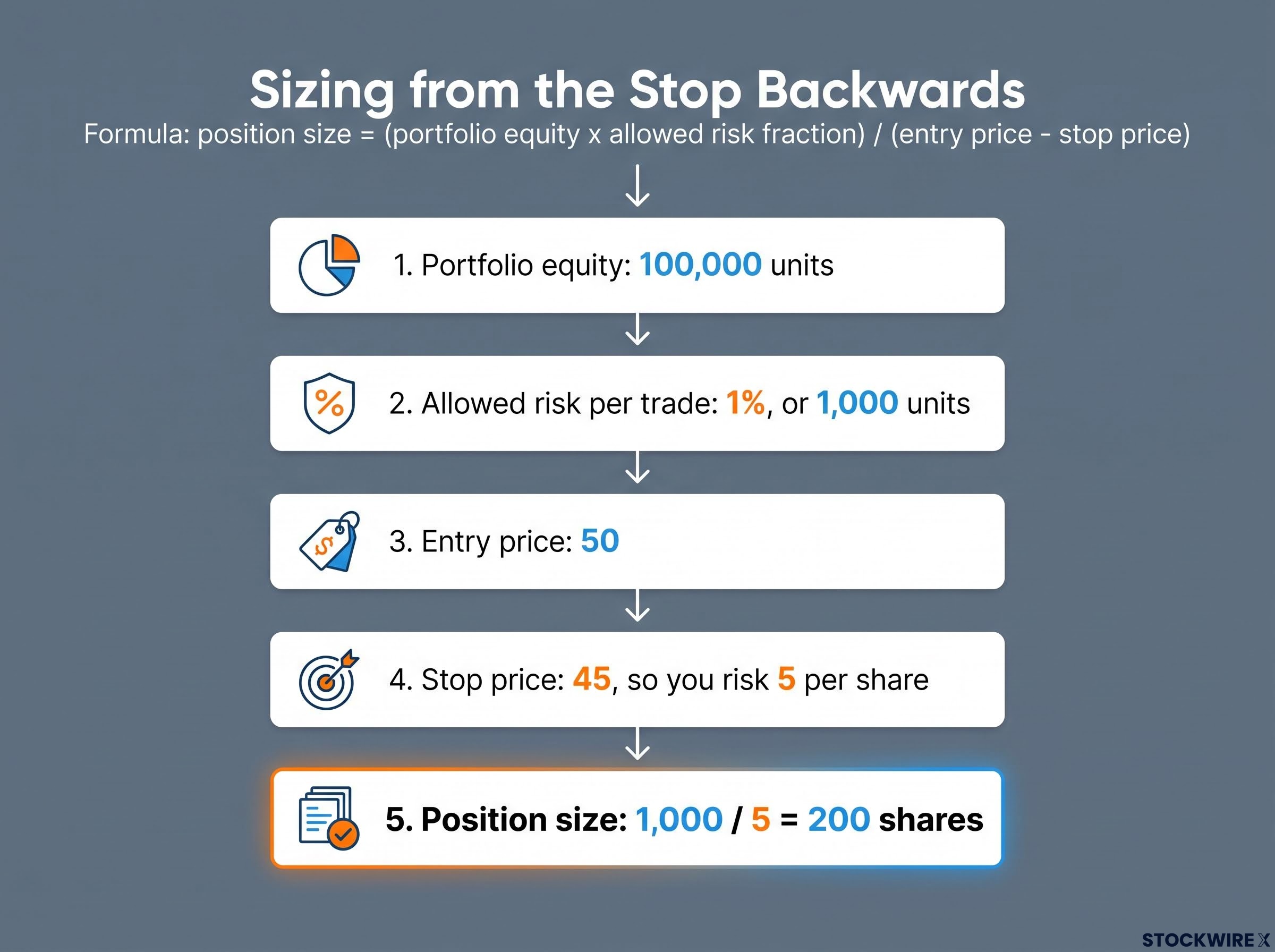
- Portfolio equity: 100,000 units
- Allowed risk per trade: 1%, or 1,000 units
- Entry price: 50
- Stop price: 45, so you risk 5 per share
- Position size: 1,000 ÷ 5 = 200 shares
“Risk 1-2% per trade” refers to your planned loss from entry to stop. It does not mean investing 1-2% of your portfolio in the position. The figure is a practitioner rule of thumb, not an optimum endorsed by regulators.
Gaps, trading costs, and thin liquidity should all push your size lower. How much you hold in each name decides whether a bad fill is survivable. Get sizing right before you choose any stop level.
Working backwards from the stop is the core of fixed dollar risk sizing, where shares equal dollar risk divided by the gap between entry and stop, so a wider stop automatically shrinks the position.
How many positions is enough
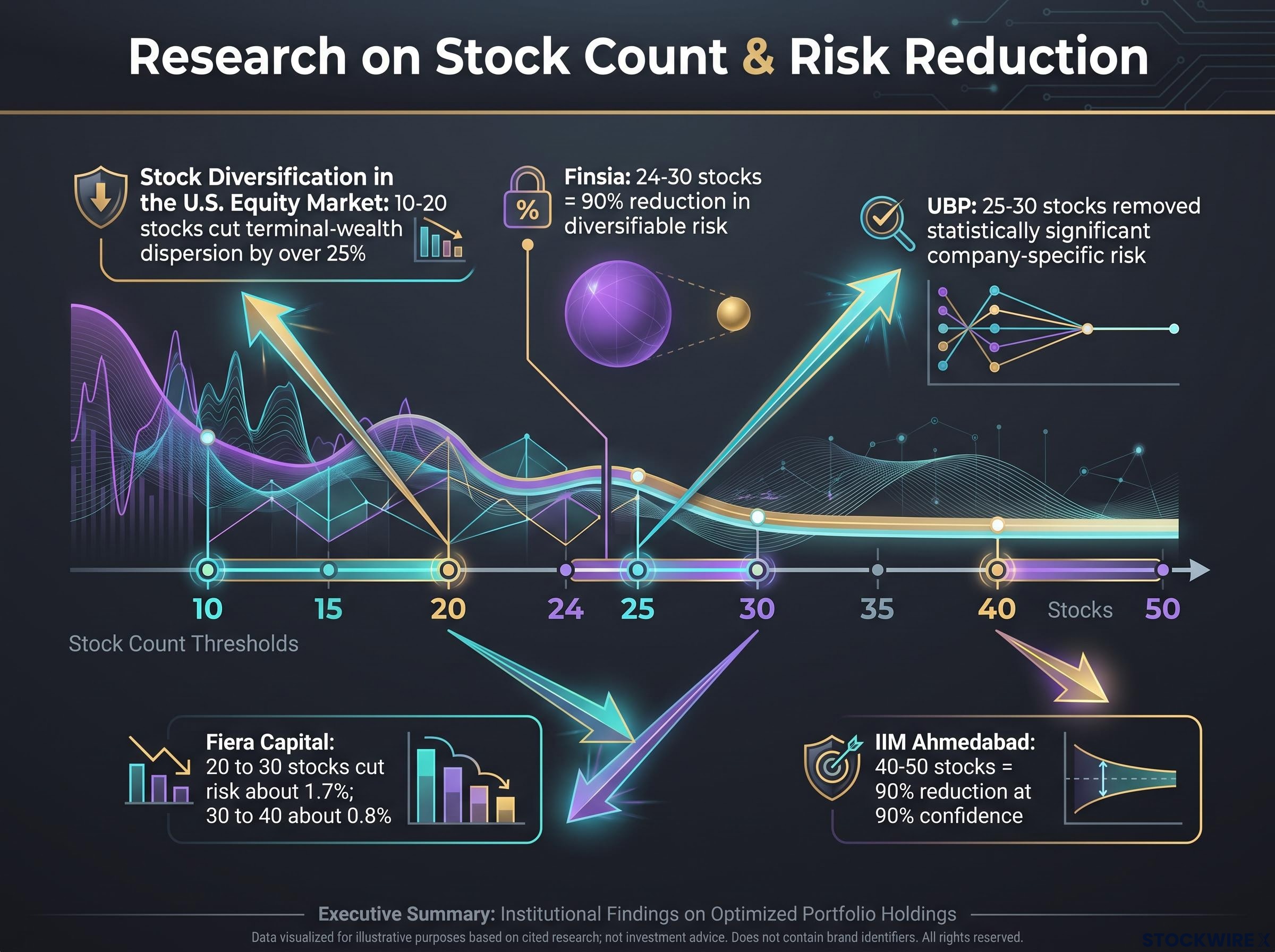
The commentator holds roughly 20 to 40 positions at times. His reasoning is that no single collapse is ruinous, and no single surge makes or ruins his day. The research broadly supports this view.
| Source | Finding | Stock count | Takeaway |
|---|---|---|---|
| Fiera Capital | 20 to 30 stocks cut risk about 1.7%; 30 to 40 about 0.8% | 20-40 | Returns diminish quickly |
| UBP | Removed statistically significant company-specific risk | 25-30 | Limited benefit above 30 |
| Finsia | 90% reduction in diversifiable risk | 24-30 | Substantial protection |
| IIM Ahmedabad | 90% reduction at 90% confidence | 40-50 | Higher confidence needs more names |
| Stock Diversification in the U.S. Equity Market | Terminal-wealth dispersion cut by over 25% | 10-20 | Small benefits beyond 50 |
The evidence supports the intuition, but it does not prove that exactly 20, 30, or 40 positions is optimal. Adding more is not automatically better. Too many holdings can dilute your best ideas and hide sector or factor concentration. They can also leave you with more names than you can monitor.
Holdings that move together act like one position. And diversification does nothing to protect you against a broad market decline.
A repeatable stop loss strategy for sudden market moves
You now have the pieces. Here is how to combine them into a sequence you can run on your next trade:
- Define your thesis and the price that invalidates it.
- Place the stop beyond ordinary noise, using price structure and, where useful, ATR.
- Size the position so the planned loss is tolerable. Treat 1-2% as a starting point to adjust, not a fixed rule.
- Assume an overnight gap can deliver a worse result than your stop price.
- Choose stop-market for certainty of exit, or stop-limit for certainty of price.
- Check how many positions you hold and how closely they move together.
Consider the 18 December 2024 sell-off, when the S&P 500 fell 2.96% and the Nasdaq fell 3.62%. A sensibly placed stop limited the damage. A stop set too tight, inside normal volatility, turned a policy shock into a permanent exit.
Stops are not right for every investor. Long-term investors in broad index funds often avoid them, because a stop can turn temporary volatility into a permanent sale. That sale can also trigger tax and trading costs. For these investors, valuation and sizing may do the job better.
| Approach | Fit | Reasoning |
|---|---|---|
| Short-term trades | Strong | A clear invalidation level is worth enforcing |
| Leveraged or concentrated positions | Strong | Stops keep a manageable loss from becoming an uncontrolled one |
| Long-horizon, broad-index investing | Weak | Sizing and valuation may serve these investors better than forced exits |
You may hear claims that brokers or market makers hunt stops. They remain unproven. The risks you can actually observe are thin liquidity and stops clustered at the same price levels.
The real choice is precommitted risk control versus discretionary hope, with slippage, whipsaws, and missed rebounds accepted up front.
The question is not whether stops are good or bad. It is whether your time horizon and position structure give you a clear invalidation level worth enforcing.
Accepting small stop-outs only makes sense if the strategy has positive trading expectancy, because a low win rate with larger average wins than losses can still compound, while a high win rate with big losses cannot.
What a stop can promise, and what only sizing can
A stop enforces your rule. Sizing and diversification decide how much that rule costs you when it is tested.
The Carvana stop-out was a defined, acceptable cost. In a portfolio built from many modestly sized positions, the surge that followed was a missed opportunity rather than a damaging event.
Before your next trade, write down three things: the invalidation level, the order type, and the position size. Then place the order. Past performance does not guarantee future results, and price behaviour around events can differ sharply from what you expect.
This article is for informational purposes only and should not be considered financial advice. Investors should conduct their own research and consult with financial professionals before making investment decisions.