The single most common mistake new Australian investors make is putting all their money into one or two stocks. It feels like investing. It feels decisive. But what you have actually done is place a concentrated bet on two specific outcomes, and you have done it before building the foundation that protects you when one of those bets goes wrong.
The mistake persists because the environment encourages it. Low-cost brokerage apps make buying shares feel frictionless, and social media stock tips create the impression that picking winners is a skill you can absorb through a feed. In 2026, the barrier to opening a trading account is lower than it has ever been, which is genuinely good, but it also means more people are skipping the structural step that matters most: diversification.
Here is what you will know after reading this. You will understand how exchange-traded funds (ETFs) structurally protect you from the most common beginner errors, what a real low-cost Australian ETF looks like in practice, with actual fees, returns, and holdings, and the exact steps to go from zero to your first purchase. This is not theory. It is a practical orientation for getting started the right way.
The mistake most new investors make before they know enough to avoid it
You open a brokerage account, deposit $10,000, and buy shares in two companies you recognise. Maybe a miner. Maybe a bank. Maybe both. The purchase feels logical: you know the names, you have seen them in the news, and they are big companies. That confidence is real, but the risk you have just taken is larger than you think.
When your entire portfolio is two companies, you are not investing in the market. You are making a binary bet on two specific businesses. If one drops 30% in a quarter because of a profit downgrade or a commodity price shock, half your portfolio drops with it, and no other holding exists to absorb the damage.
The practical distinction between stocks vs ETFs comes into focus when you look at real downside scenarios: single-stock declines of nearly 70% in 2025 wiped out most of a concentrated investor’s capital, while the same decline in a stock representing 1% of an ETF produced only a 0.69% portfolio drag.
The stocks new investors tend to gravitate toward follow a pattern:
- Major miners like BHP or Rio Tinto
- Big four banks: Commonwealth Bank, Westpac, NAB, ANZ
- Familiar consumer brands they use personally
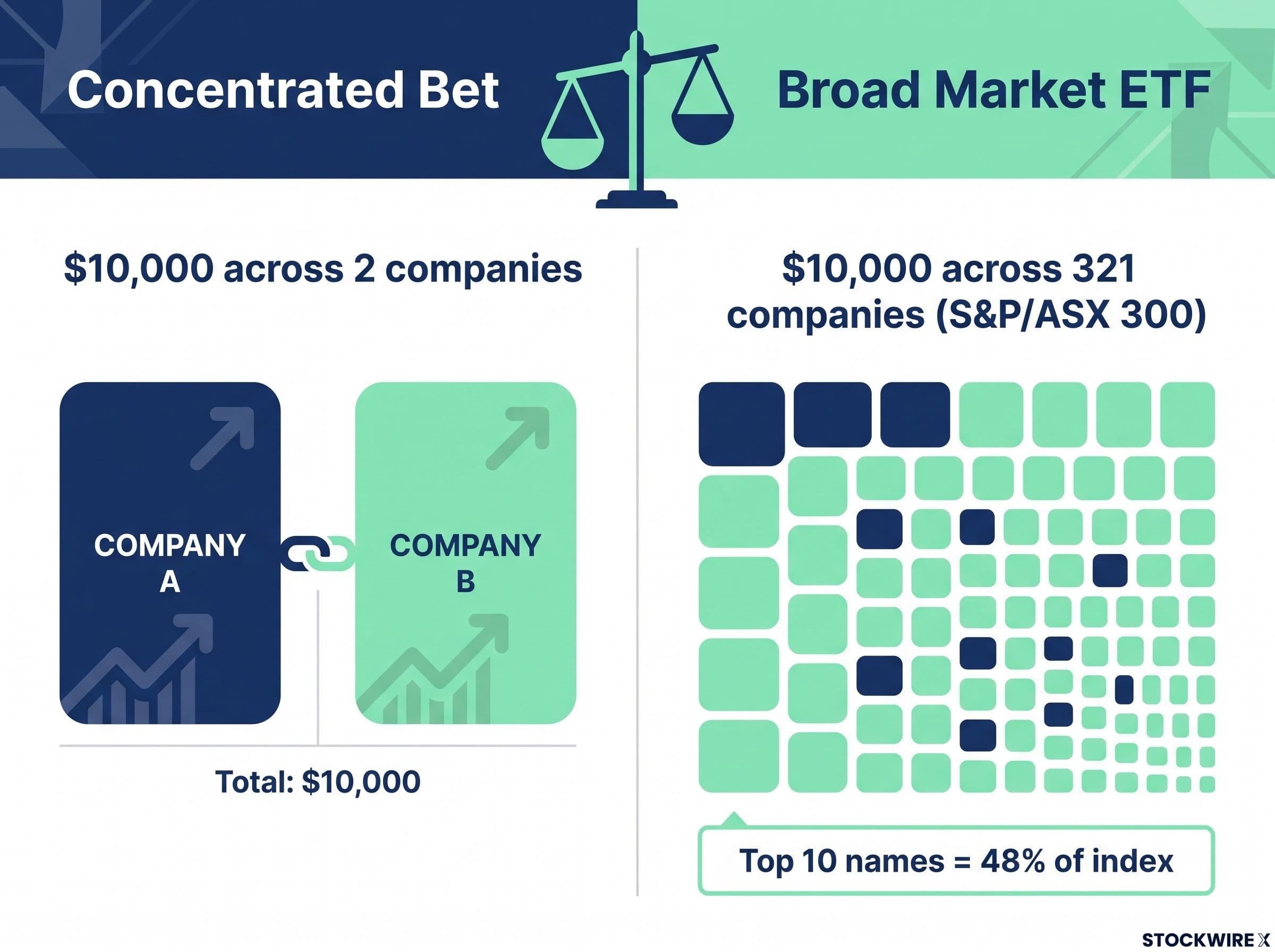
Here is the concentration problem in concrete terms. If you put $10,000 across two mining stocks, your entire financial outcome depends on commodity cycles, project delivery, and management decisions at two companies. If you put the same $10,000 into a broad ETF tracking the S&P/ASX 300, your money spreads across 321 companies. Even the ASX 300 index itself concentrates roughly 48% of its market capitalisation in just the top 10 names, so a two-stock portfolio is dramatically more concentrated than the index it sits within.
This is not a character flaw. It is a structural problem. The investing environment rewards understanding diversification, and most new investors simply have not had the chance to learn it yet. Recognising it now, before it costs you, is worth more than any individual stock tip.
When big ASX news breaks, our subscribers know first
What an ETF actually is, and why the structure changes everything
An ETF, or exchange-traded fund, is a single security you buy on the ASX that holds a basket of underlying assets, typically mirroring an index. A single ticker is all you need to search in your brokerage platform, and completing that one transaction gives you proportional ownership across dozens to hundreds of underlying companies.
The ETF vs index fund distinction matters less than most beginners assume: both labels come from different classification systems, with one describing how a fund trades and the other describing its investment strategy, a two-axis framework that clarifies why a passive index ETF and an active ETF are fundamentally different products sharing the same wrapper.
Three structural features make ETFs fundamentally different from buying individual stocks:
- Diversification in one trade. Your capital spreads across every company in the index the ETF tracks. No single company’s failure can destroy your portfolio.
- Automatic rebalancing. When companies enter or leave the index, the ETF adjusts its holdings without you making any decision. You do not need to monitor index changes or decide when to sell a declining stock.
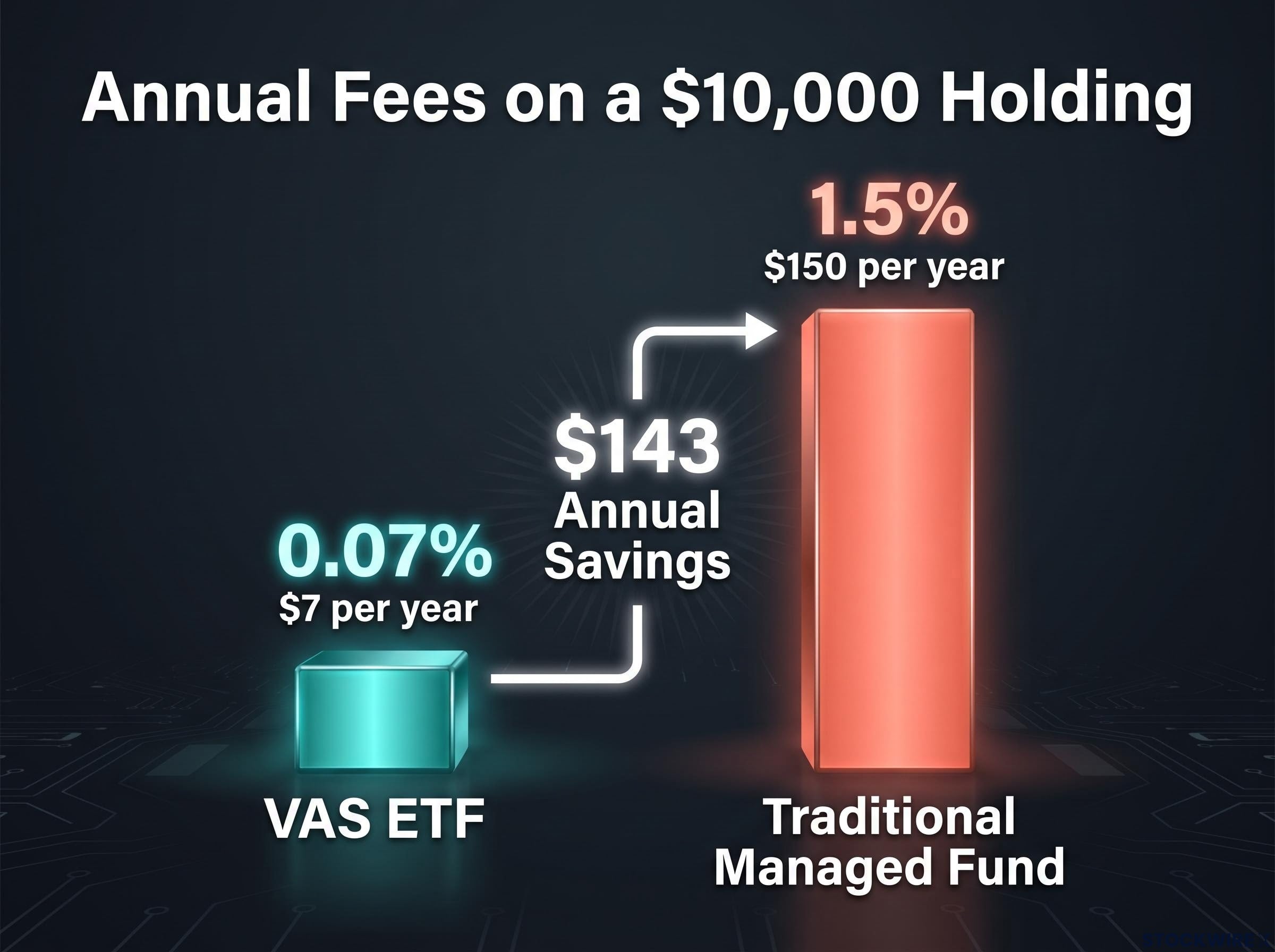
- Low cost. Typical Australian broad-market ETFs charge management expense ratios (MERs) of 0.04-0.27% per year. Traditional managed funds commonly charge 1-2%. On a $10,000 holding, that difference can mean paying $7 instead of $150 every year.
Why the structure matters for you
Transacting in an ETF works through any standard ASX broker account, following the same straightforward steps you would use to acquire any listed security. There is no special access required, no minimum expertise threshold, and no ongoing management burden on your end.
The ASIC MoneySmart guidance on ETFs outlines what to look for in a product disclosure statement before you buy, including how to compare fees, understand the risks, and know your options if something goes wrong with your investment.
For you as a beginner, this means something specific. You are not just buying a cheaper product. You are removing two of the most common sources of investing error, concentration risk and the emotional pressure of managing individual positions, from the equation at the same time. The structure does the work that experience has not yet taught you to do yourself.
VAS in practice: what 321 companies for $7 a year actually looks like
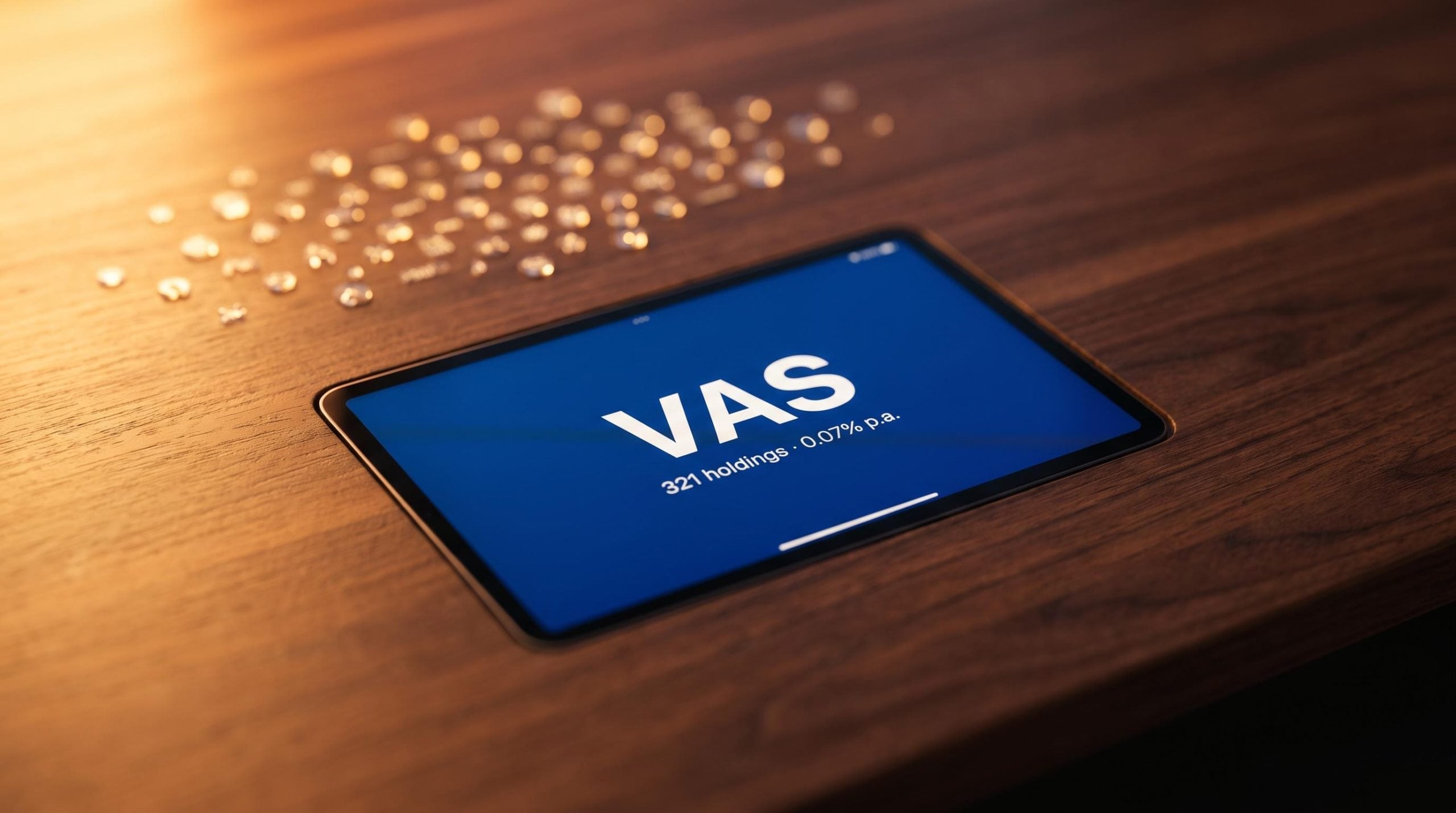
With roughly $26.2 billion in assets under management as at 31 July 2026, the Vanguard Australian Shares Index ETF (VAS) ranks as the ASX’s largest and most widely held fund. It tracks the S&P/ASX 300 Index across 321 individual securities, spreading your capital through the core of the Australian sharemarket in a single transaction.
The annual management fee is 0.07%, reduced from 0.10% in July 2023. On a $10,000 holding, that equates to approximately $7 per year.
What do those 321 holdings actually look like? The major positions include BHP, Commonwealth Bank, Westpac, NAB, ANZ, Wesfarmers, Macquarie, Rio Tinto, and Goodman Group. The top 10 holdings represent approximately 48% of assets, meaning you get heavy exposure to Australia’s largest companies while still holding hundreds of smaller names that provide genuine breadth.
| Metric | Figure | Notes |
|---|---|---|
| Management fee | 0.07% per year | Reduced from 0.10% in July 2023 |
| Funds under management | ~$26.2 billion | As at 31 July 2026 |
| Number of holdings | 321 | Tracks S&P/ASX 300 Index |
| One-year total return | 5.79% | To 31 July 2026 |
| Ten-year annualised return | 8.92% | To 31 July 2026 |
| Distribution yield | 3.1% | As at 31 July 2026 |
| Franking level | ~80% | 2026; varies year to year |
The cost comparison in dollar terms: VAS charges approximately $7 per year on a $10,000 holding. A traditional managed fund charging 1.5% takes $150 per year on the same amount. That is $143 in annual savings that stays invested and compounds in your favour.
The ten-year annualised return of 8.92% is not an advertisement. It is evidence that holding the market patiently and cheaply has historically produced meaningful wealth-building outcomes without requiring any stock selection skill. Past performance does not guarantee future results, but the pattern is worth understanding.
VAS is not the only suitable ETF, but it is the most concrete and widely cited example of what low-cost, broad-market Australian ETF investing looks like in practice.
Franking credits and why Australian ETF income is worth more than it looks
There is an income dimension to Australian ETFs that beginner content often skips past too quickly. It involves franking credits, and it makes the real return on domestic ETF income materially higher than the headline yield suggests.
Here is how it works. When Australian companies earn profits, they pay company tax before distributing dividends. A franking credit is the receipt for that tax, and it passes through to you as the investor. You can use it to reduce your personal tax bill, which means the cash distribution you receive is not the full picture of what the income is worth.
Franking credits represent a structural after-tax advantage that raw yield comparisons consistently understate: on the same gross dividend income at the 45% marginal rate, a fully franked Australian dividend produces meaningfully more after tax than an equivalent foreign dividend, a gap that applies every year regardless of market conditions.
ETFs like VAS pass these franking credits through to unitholders. Because VAS distributions carry a 3.1% yield and have run at around 80% franked throughout 2026, the actual after-tax value of that income exceeds what the headline yield figure alone conveys.
The 3.1% distribution yield is only part of what VAS income delivers. Franking credits make the real after-tax return materially higher for most Australian taxpayers.
The benefit is largest if you are on a lower marginal tax rate, which includes many beginner investors who are early in their careers. But even higher-income investors receive a meaningful offset.
Three things to remember about franking credits:
- They represent company tax already paid on your behalf, reducing what you owe at tax time
- They flow through an ETF to you as a unitholder, just as they would if you held the underlying shares directly
- They are worth proportionally more to lower-rate taxpayers, which is where many beginning investors sit
Franking levels vary year to year, with recent years showing levels in the 60-80% range. The 80% figure is confirmed for 2026. For you as an Australian beginner investor, this means the income from a domestic ETF is structurally more tax-efficient than income from many alternative investments, and that efficiency compounds the longer you hold.
How to actually start: five steps from zero to your first ETF
Everything above is useful only if you act on it. Here is the exact sequence, in order, so there is no ambiguity about what to do next.
- Open a low-cost ASX brokerage account. Several Australian platforms offer access to ASX-listed ETFs with brokerage fees in the $0-$10 range per trade. The process is online and typically takes less than a day.
- Decide your starting amount. There is no minimum holding size for most ASX-listed ETFs beyond the brokerage minimum order value. You do not need a large sum to begin. Even $500 is a legitimate starting point.
- Choose one or two broad ETFs. VAS for Australian shares is a straightforward starting choice. Some investors add a global ETF for international exposure. You do not need more than two to start.
- Place your buy order using the ticker. Buying an ETF is identical to buying a share. Search the ticker (e.g., VAS) in your broker’s platform, enter the number of units or dollar amount, and confirm.
- Set up regular automatic contributions if your platform allows. This is dollar-cost averaging: making regular, smaller purchases over time rather than investing a lump sum at a single price point. It reduces the anxiety of trying to time the market and builds the investing habit that matters more than any single purchase.
Making your first purchase and building the habit
The steps above are simple enough that the real obstacle for most new investors is not knowledge. It is inertia. You have the information. The accounts are free to open. The products are accessible. What separates people who build wealth from people who intend to is starting, even with a small amount, and then showing up again next month.
What your first year of ETF investing should actually look like
Your primary goal in year one is not to outperform the market. It is to stay invested through normal volatility without making reactive decisions.
Markets will decline at some point during your first year. A 5% drawdown in a quarter is ordinary market behaviour, not a crisis. Your job is to understand that this is expected, not a signal to sell. The investors who build long-term wealth are not the ones who avoid every dip. They are the ones who stay invested through the dips and keep contributing.
Three behaviours define a successful first year:
- Staying invested through dips rather than selling when your portfolio shows a temporary loss
- Making regular contributions regardless of whether the market is up or down that month
- Keeping costs low by avoiding unnecessary trading, which generates brokerage fees and tempts you into the stock-picking behaviour you started by avoiding
VAS’s ten-year annualised return of 8.92% did not come in a straight line. It included years of drawdowns, recovery, and stretches of flat performance. The return rewarded those who held through all of it. And with the Australian ETF MER range sitting at 0.04-0.27%, fees are not eroding the compounding advantage the way higher-cost products do.
Your most important investing decision in year one is not which ETF to pick. It is whether you can resist the urge to react to short-term market movements. That is a learnable skill, not a personality trait.
This article is for informational purposes only and should not be considered financial advice. Investors should conduct their own research and consult with financial professionals before making investment decisions. Past performance does not guarantee future results.
Starting right, not starting fast
The ETF approach is not the cautious choice or the boring choice. It is the structurally sound choice for a beginner who has not yet built the skills, time, or research capacity that successful individual stock selection demands.
The mechanics bear repeating because they are real, not abstract: $7 a year in fees, 321 companies in a single holding, a ten-year annualised return of 8.92%, and partially franked income that is worth more after tax than the headline yield suggests. These are the specifics of a product any Australian can access today through a standard brokerage account.
As your knowledge, confidence, and capital grow, you can layer in other strategies. Individual stocks, sector-specific ETFs, international exposure. But the foundation you build with broad, low-cost ETFs does not need to be replaced. It becomes the base everything else sits on.
For readers wanting to understand why common investing strategies promoted in financial media often do not apply to their own balance sheet, our full explainer on wealth-building strategies for retail investors covers survivorship bias, leverage risk, and five diagnostic questions to test whether a strategy actually fits your situation.