
Most comparisons between Australian and global shares focus on raw returns. They line up total return indices, adjust for fees, and declare a winner. What they rarely adjust for is the one variable that changes the outcome most dramatically for Australian residents: the tax treatment of the income those shares produce.
Australia operates one of a small number of dividend imputation systems in the world. That structural fact, combined with the reality that most Australian investors earn, spend, and retire in Australian dollars, creates a financial case for domestic shares that standard performance tables cannot capture. This is not about patriotism or familiarity. It is about after-tax returns and liability matching.
Here is the mechanism that determines how much of a dividend you actually keep, why it does not apply to foreign dividends, and what that difference means when you are building a portfolio. The arithmetic is straightforward. The implications are significant.
Why Australia taxes dividends differently from almost everywhere else
Before 1987, Australia taxed corporate profits the same way most countries still do: the company paid tax on its earnings, and then shareholders paid personal income tax on the dividends they received from those same earnings. The same dollar of profit was taxed twice, once at the corporate level and once at the individual level.
The problem was obvious. Dividend imputation, introduced in 1987, was the legislative fix. The core principle: when a company pays Australian company tax on its profits, shareholders who receive dividends from those profits get credit for the tax already paid on their behalf. The credit is called a franking credit.
Most large markets never adopted this approach. The United States, for example, still applies what is known as classical double taxation. Corporate profits are taxed at the company level, and dividend income is taxed again in the shareholder’s hands, with no offsetting credit. Australia’s system is genuinely uncommon globally; only a small number of countries operate anything comparable.
That rarity matters more than you might expect. It means that when you compare the yield on a fully franked Australian dividend with the yield on a US or European dividend, you are comparing two fundamentally different after-tax outcomes:
- Classical double taxation (US model): Company pays corporate tax on profits. Shareholder then pays personal income tax on the dividend received. No credit for tax already paid at the company level.
- Dividend imputation (Australian model): Company pays corporate tax on profits. Shareholder receives a credit (the franking credit) for that tax already paid. The credit offsets the shareholder’s personal tax on the dividend income.
Raw yield figures placed side by side do not capture this structural difference. For an Australian resident, they are not a like-for-like comparison.
A grossed-up yield comparison between two ASX-listed stocks can shift relative attractiveness significantly, because a company paying a lower face dividend but a higher franking ratio may deliver more after-tax income than a higher-yielding unfranked competitor.
When big ASX news breaks, our subscribers know first
How franking credits actually work: the gross-up and tax offset mechanism
The mechanics are best understood through a single worked example, because the arithmetic reveals the logic.
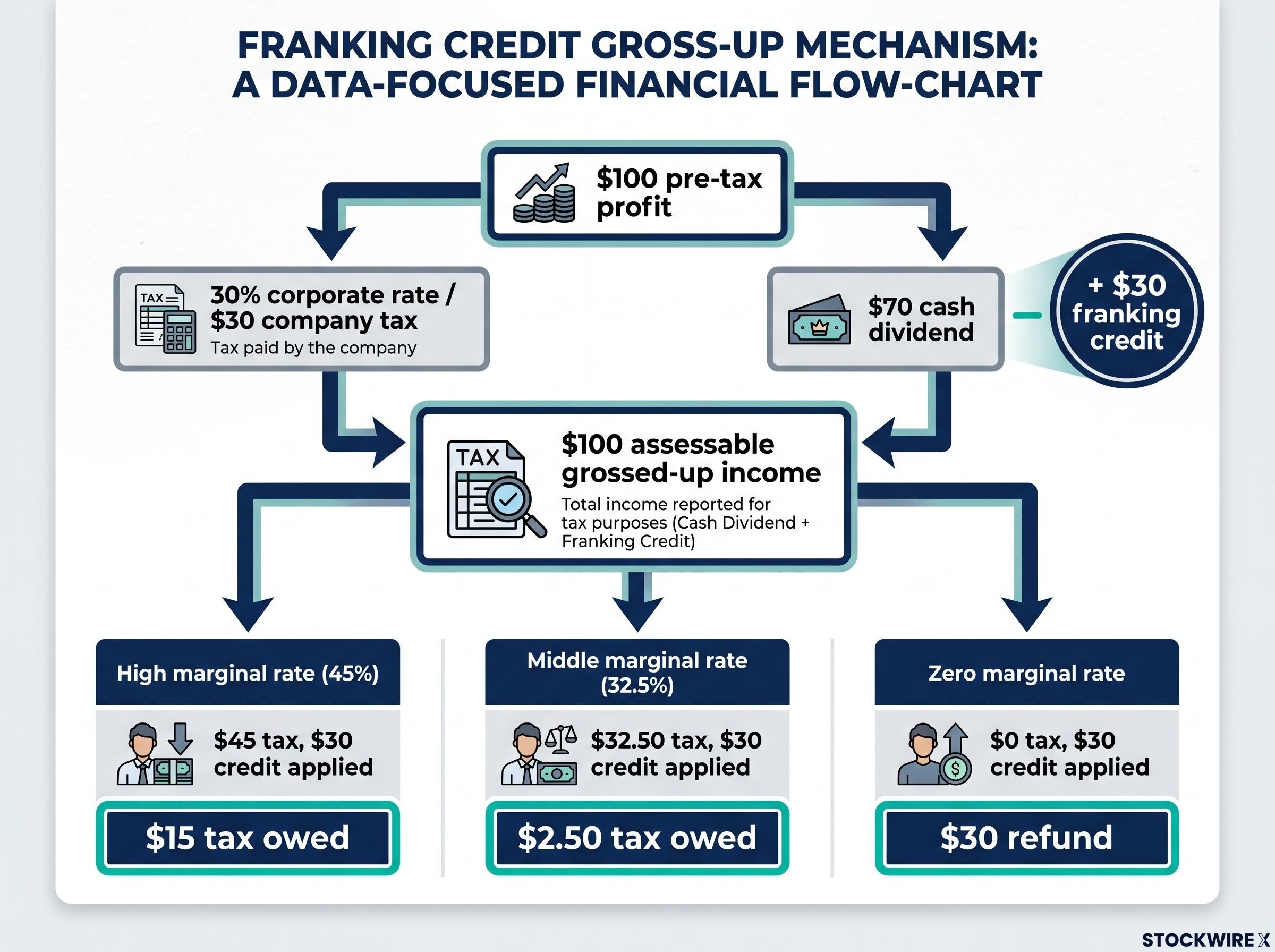
The core example: A company earns $100 in pre-tax profit. It pays $30 in company tax at the 30% corporate rate. It distributes the remaining $70 as a cash dividend, with a $30 franking credit attached.
When you receive that $70 cash dividend, you do not simply declare $70 as income. You are required to gross up the dividend by adding back the franking credit. So you declare $100 as assessable income, representing the company’s full pre-tax profit. Your tax is then calculated on that $100 figure at your personal marginal rate.
Here is where the credit does its work. The $30 franking credit is applied as a tax offset against whatever tax is calculated on that $100. The net result depends entirely on your marginal tax rate.
| Investor type | Cash dividend | Franking credit | Grossed-up income | Tax on grossed-up income | Credit applied | Net tax owed / refund |
|---|---|---|---|---|---|---|
| High marginal rate (45%) | $70 | $30 | $100 | $45 | $30 | $15 tax owed |
| Middle marginal rate (32.5%) | $70 | $30 | $100 | $32.50 | $30 | $2.50 tax owed |
| Zero marginal rate (below threshold) | $70 | $30 | $100 | $0 | $30 | $30 refund |
For a 45% marginal rate investor, the franking credit covers the 30% already paid at the company level, leaving only 15% additional tax to pay on the grossed-up income. The credit does not eliminate your tax obligation entirely, but it dramatically reduces the additional liability compared with receiving an unfranked dividend at the same gross yield.
Fully franked, partially franked, and unfranked: what the distinction means in practice
Not every ASX dividend carries a full 30 cents-in-the-dollar credit. Dividends can be fully franked, partially franked, or unfranked, depending on how much Australian company tax the company actually paid on the profits being distributed.
Partial franking reflects the proportion of corporate tax paid. If a company earned some of its income offshore (where Australian company tax was not levied), or if it is a base rate entity paying the lower 25% corporate rate, the credits attached to its dividends will be proportionally smaller.
Unfranked dividends carry no credit at all. You include the cash amount in your assessable income at your full marginal rate with no offset available. The difference in after-tax income between a fully franked and an unfranked dividend at the same cash amount is substantial.
One compliance point worth noting: the 45-day holding-period rule requires you to hold shares “at risk” for at least 45 days (excluding purchase and sale dates) to be eligible to claim the franking credits. This matters most for active traders and investors receiving large credit amounts.
The 45-day holding-period rule is one of several compliance conditions that shape your franking credit entitlements, alongside residency requirements and the distinction between personal and superannuation tax environments.
The refund nobody talks about: what happens when credits exceed your tax bill
Here is the part of the imputation system that surprises most people when they first encounter it. If the franking credits attached to your dividends exceed your total tax liability, the Australian Taxation Office (ATO) does not simply zero out your tax bill. It pays you the difference in cash.
This refundability feature has been in effect since 2000, and no material legislative change to this mechanism has occurred between 2000 and August 2026.
The ATO guidance on franking credit refunds sets out the eligibility conditions for individuals and superannuation funds, including the 1 July 2000 commencement date for refundability and the specific criteria that determine whether excess credits convert to a cash payment rather than simply reducing your tax bill to zero.
The investor profiles for whom this benefit is largest are specific:
- High marginal-rate taxpayers (e.g. 45%): The franking credit reduces the additional tax owed on dividend income from 45% to 15% on the grossed-up amount. Substantial, but no cash refund.
- Individuals below the tax-free threshold: The entire franking credit converts to a cash refund from the ATO, because there is no tax liability to offset against.
- Pension-phase complying superannuation funds (including SMSFs): These entities are taxed at 0% on earnings under current rules as at August 2026. Fully franked dividends generate franking credits that convert fully to ATO cash refunds.
For a retiree drawing from a pension-phase SMSF, a fully franked dividend is not merely tax-efficient income. Part of the return is a direct cash payment from the ATO. That changes the economics of Australian dividend-paying shares relative to any foreign income-producing asset held in the same fund.
This refund mechanism is the most underappreciated dimension of the imputation system. It reframes high-yielding, fully franked Australian shares as a combined income-and-government-payment instrument for investors in the right tax environment.
Foreign dividends and the tax gap: why overseas income is treated differently
Franking credits arise solely from Australian company tax paid. They do not attach to dividends from foreign companies, whether those companies are listed in the United States, Europe, or anywhere else. They do not attach to distributions from foreign-domiciled funds. If the company did not pay Australian corporate tax on the profit, there is no credit.
For you as an Australian resident, this means foreign dividends are included in your assessable income at your full Australian marginal tax rate, with no offsetting credit equivalent to the franking system.
Tax treaties and foreign income tax offsets (FITOs), which are credits for withholding tax already paid in the source country, provide some mitigation. If 15% was withheld on a US dividend under the Australia-US tax treaty, you can claim an offset for that amount against your Australian tax liability. But FITOs are structurally different from imputation. They reduce double taxation in some cases, but they do not replicate the clean alignment between company-level tax and shareholder-level tax that imputation achieves.
The practical difference is visible in the numbers.
| Scenario | Gross dividend | Tax before credits | Credit / offset applied | Net tax | After-tax income |
|---|---|---|---|---|---|
| Fully franked Australian dividend (45% marginal rate) | $100 (grossed up) | $45 | $30 franking credit | $15 | $85 |
| Equivalent foreign dividend (45% marginal rate, 15% FITO) | $100 | $45 | $15 foreign tax offset | $30 | $70 |
On the same $100 of gross dividend income at the top marginal rate, the Australian franked dividend leaves you with $85 after tax. The foreign dividend, even after claiming the foreign tax offset, leaves you with $70. That $15 gap is not cyclical. It is structural. It persists regardless of market conditions, interest rate environments, or currency movements, and it applies every single year you hold the position.
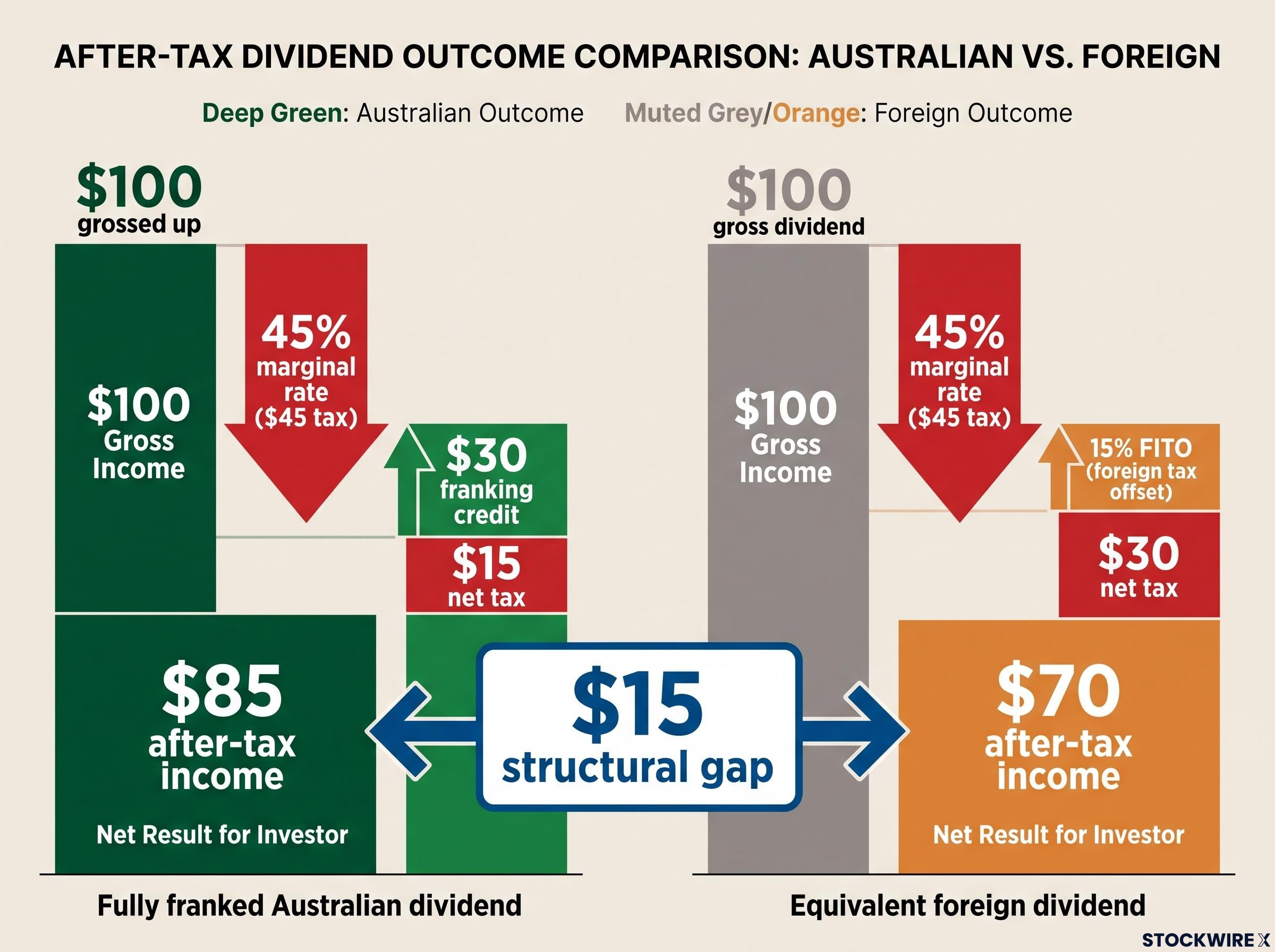
A yield comparison between an Australian dividend-paying stock and a US equivalent that ignores this treatment is not a genuine like-for-like comparison for an Australian resident taxpayer.
This article is for informational purposes only and should not be considered financial advice. Investors should conduct their own research and consult with financial professionals before making investment decisions.
The currency argument: why spending in Australian dollars changes the portfolio equation
The tax gap is one structural argument for domestic shares. Currency is the second, and it operates independently.
If your future spending obligations are predominantly in Australian dollars, and for most Australian residents they are, then holding unhedged foreign assets introduces a second variable that is entirely absent from domestic holdings. Your AUD return from an unhedged international investment depends on two separate factors:
- The underlying performance of the foreign asset in its local currency
- The movement of the AUD exchange rate against that foreign currency
Domestic Australian shares depend on only one: the performance of the asset itself. There is no currency translation step between the return and the dollars you spend.
Currency-hedged global funds reduce this mismatch. They neutralise much of the foreign exchange risk, but hedging is not free; it carries costs and retains some basis risk. The cleanest natural alignment between your portfolio and your spending obligations remains domestic equity.
An international shares allocation introduces both the geographic diversification benefits the current article acknowledges and the foreign exchange translation step that domestic holdings avoid, with the precise weighting depending on an investor’s existing domestic concentration through property, employment income, and superannuation.
Three approaches sit along this spectrum:
- Fully domestic equity: No currency risk. Full franking benefit. Concentration risk in a single market.
- Unhedged global equity: Full currency risk. No franking credits. Maximum geographic diversification.
- Currency-hedged global fund: Reduced currency risk. No franking credits. Hedging costs and residual basis risk.
Separating rational domestic tilt from emotional home bias
The legitimate counter-argument is that most Australians already carry substantial domestic exposure through property, local employment income, and compulsory superannuation contributions. Adding more domestic equity compounds that concentration.
That is a fair point, but it does not eliminate the currency mismatch problem in the financial portfolio. Owning a house in Sydney does not hedge the foreign exchange exposure on your international equity fund. The two risks operate in different asset classes.
When the franking credit tax advantage and the currency liability-matching argument are taken together, maintaining a deliberate domestic equity allocation, some investors position this at 30-40% of their equity portfolio, is a conclusion you can reach through financial reasoning. It is not a failure of diversification discipline. It is a considered portfolio construction choice that accounts for how you are actually taxed and what currency you actually spend.
What a franking-aware portfolio strategy actually looks like
Understanding the mechanics is the first step. The second is placing yourself on the franking benefit spectrum, because the value of these credits is not uniform. It scales inversely with your marginal tax rate.
The benefit is strongest for:
- Identify your marginal tax rate and super phase. A pension-phase SMSF at 0% captures the maximum benefit: full cash refund of every franking credit. An individual below the tax-free threshold does the same. A high marginal-rate investor still benefits substantially, with franking credits covering the first 30 percentage points of tax on grossed-up income.
- Assess your existing domestic exposure. If you own property in Australia and earn local employment income, you already carry significant non-financial domestic concentration. Your equity allocation should account for this.
- Evaluate whether your current equity weighting reflects the franking and currency arguments, or simply defaults to raw return comparison. If you have been comparing Australian and global share returns on a pre-tax, pre-currency basis, you have been using the wrong scorecard.
Key scope conditions apply:
- The franking benefit is available to Australian tax residents only
- It applies in both taxable accounts and superannuation
- Non-residents are excluded and face different withholding arrangements
- The 45-day holding-period rule applies; active traders need to satisfy it to claim credits
The same fully franked dividend is worth materially more to a pension-phase retiree than to a high-income earner. Your tax position should inform how much domestic equity weighting is warranted, not just your view on relative market performance.
The choice of income investing structure, whether direct shares, an ETF, or a listed investment company, determines how franking credits reach you and whether credits generated on international holdings can be passed through at all, since only an LIC that pays Australian corporate tax can attach franking credits to distributions from foreign assets.
The case for a domestic allocation that earns its place on the spreadsheet
Two structural arguments run through this piece, and they are complementary rather than duplicative. The franking credit advantage scales with your tax position, rewarding lower-rate and zero-rate investors most generously but remaining meaningful across the income spectrum. The currency liability-matching argument applies to any Australian resident spending in Australian dollars, regardless of tax rate.
Neither argument is a performance prediction. Nothing here suggests Australian shares will outperform global shares on a raw return basis. The point is different and more precise: identical pre-tax returns produce different after-tax, after-currency outcomes for Australian residents. The comparison is asymmetric by construction.
The imputation system has been in place since 1987. Refundability of excess credits has operated since 2000. These are not temporary policy settings; they are structural features of the Australian tax system with nearly four decades of continuity.
The relevant comparison for an Australian resident is not pre-tax yield. It is after-tax, after-currency return. A domestic equity allocation earns its place in your portfolio when evaluated on that basis.
What you now have is a framework for assessing your domestic equity weighting on terms that reflect how you are actually taxed and what currency you actually spend. The next time you see a chart comparing Australian and global returns, you will know which variable is missing, and how much it changes the answer.
Past performance does not guarantee future results. Financial projections are subject to market conditions and various risk factors.