The global AI trading platform market is on course to grow from roughly $11 billion in 2024 to nearly $70 billion by 2034, according to Precedence Research. Yet regulators from the SEC to ESMA have flagged that most retail traders using these tools do not understand how they work or what risks they carry. That gap between access and understanding is widening. Interactive Brokers, Robinhood, eToro, and Saxo Bank have all integrated AI features directly into retail platforms over the past two years. The technology is no longer exclusive to hedge funds and proprietary desks; it is sitting inside the same interface retail traders use to place a market order. This guide explains exactly how AI stock trading systems function at the mechanical level, what they can genuinely offer retail traders, and where they reliably fail. Readers who finish it will have a clear, honest picture of what these tools are, how to use them without being misled by their own interface, and what the world’s major financial regulators think the real risks look like.
What separates AI trading from traditional algorithmic systems
The distinction that matters most is not that AI is “smarter.” It is that AI trading systems learn and adapt, while traditional algorithmic systems follow fixed rules.
A conventional algorithmic trading programme executes pre-set conditions: if price crosses a moving average, buy; if volatility exceeds a threshold, sell. The logic is hard-coded. It does not change unless a human rewrites it. AI trading systems, by contrast, update their own behaviour based on incoming data. They draw on machine learning, natural language processing (NLP), and deep learning to process inputs that span historical price records, live market feeds, news coverage, and earnings transcripts, then adjust their models continuously.
That difference has real consequences. A rule-based algorithm behaves predictably; when it fails, the failure is traceable to a specific rule. An AI system’s failure mode is less transparent, because the system may have adapted in ways its user did not anticipate, particularly when market conditions shift outside the data the model was trained on.
The AI trading platform market was valued at approximately $11.26 billion in 2024 and is forecast to reach approximately $69.95 billion by 2034, reflecting a compound annual growth rate of roughly 20% from 2025 onward, according to Precedence Research. That growth reflects how rapidly these tools have moved from institutional exclusivity to broad retail availability, a structural shift in who has access to adaptive trading technology.
High frequency trading infrastructure, including co-located servers and custom execution platforms, represents the institutional baseline from which AI retail tools have descended; notably, leading HFT firms deliberately avoid generative AI in their core execution systems due to latency constraints and the risk of unverified code, a reminder that even the most sophisticated algorithmic operators draw explicit boundaries around AI autonomy.
| Attribute | Traditional Algorithmic Trading | AI Trading Systems |
|---|---|---|
| Logic type | Fixed, rule-based (if/then) | Adaptive, data-driven (machine learning) |
| Adaptability | Static until manually reprogrammed | Updates behaviour from incoming data |
| Data inputs | Price, volume, technical indicators | Price, volume, news, sentiment, earnings transcripts |
| Failure mode | Traceable to a specific rule | Often opaque; model may adapt unpredictably |
| Primary user base (historically) | Institutional and retail | Institutional (now expanding rapidly to retail) |
Understanding this distinction prevents the most common mistake retail users make: treating AI outputs as rule-following certainties rather than adaptive, probabilistic suggestions.
When big ASX news breaks, our subscribers know first
How the building blocks of AI trading fit together
A useful way to understand these systems is to follow the path a signal actually travels, from raw data input to trade execution. Four mechanisms work in sequence, and each shapes what happens next.
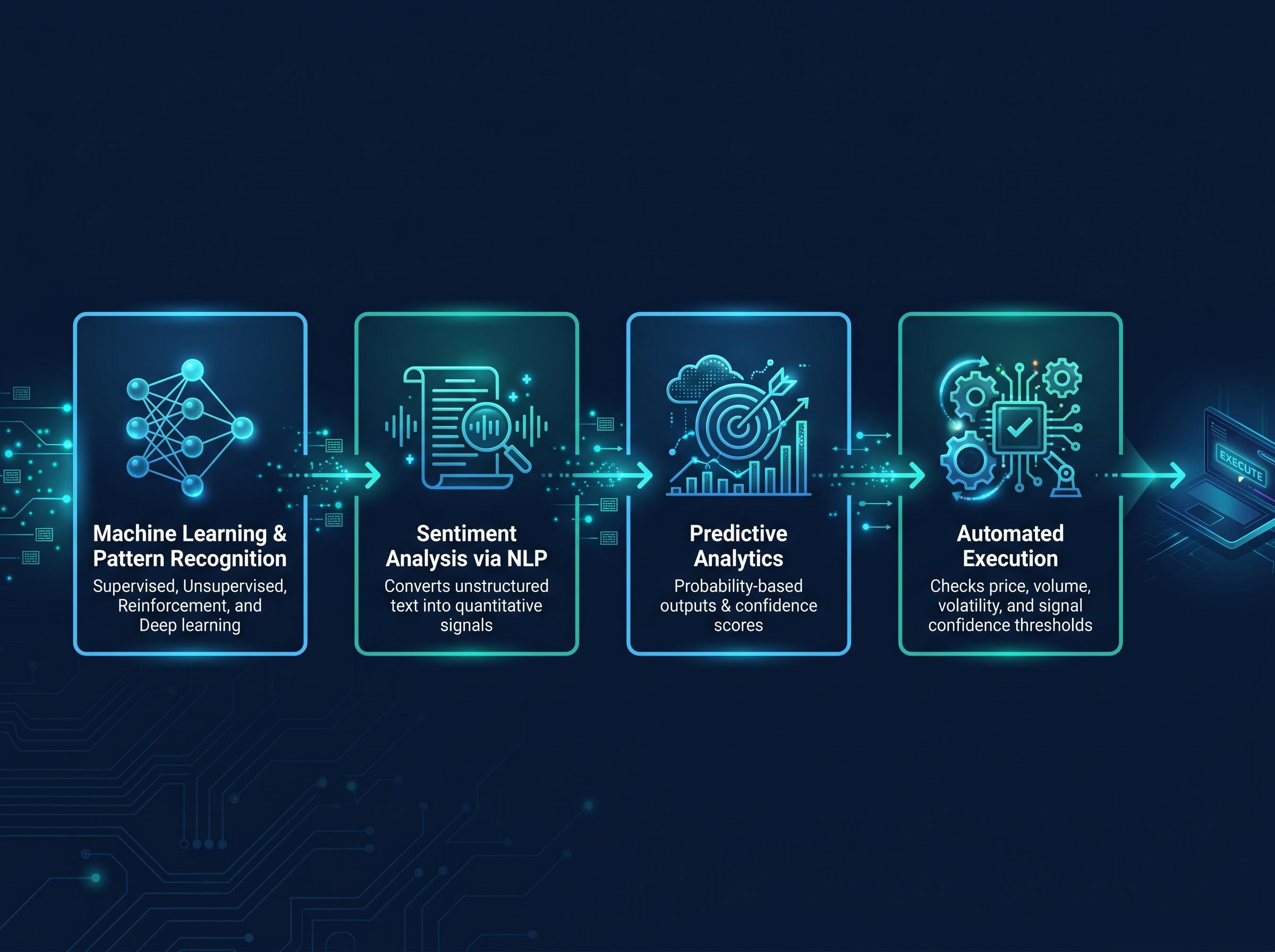
- Machine learning and pattern recognition. This is the foundation. Machine learning models ingest historical market data and search for patterns linked to future price behaviour. Supervised learning applies labelled historical data, studying how past price movements unfolded after specific conditions. Unsupervised learning seeks hidden patterns or anomalies in market behaviour without labelled inputs, identifying relationships humans may not have specified. Reinforcement learning evaluates actions within simulated trading environments, refining its approach through reward and penalty feedback over thousands of iterations. Deep learning extends all three by employing neural networks that can handle non-linear relationships, the kind of complexity that conventional statistical models often fail to capture.
- Sentiment analysis via natural language processing. NLP converts unstructured text into quantitative signals. AI systems process news articles, earnings call transcripts, regulatory filings, analyst reports, and social media content at scale, generating sentiment scores that feed into broader trading models as supplementary data. This layer is particularly effective for event-driven strategies responding to earnings announcements or macroeconomic news, though sentiment models remain susceptible to noise from low-quality or misleading sources and require ongoing calibration.
Research examining close to one million US financial news articles found that finance-focused large language models were able to identify statistically meaningful predictive signals derived from news sentiment data.
Predictive analytics and execution
- Predictive analytics. AI-driven predictive models combine technical indicators with fundamental metrics and alternative data sources to generate probability-based outputs. These are typically expressed as ranked opportunities with associated confidence scores, reflecting statistical tendencies rather than definitive buy or sell calls. Backtesting against historical data allows strategies to be assessed before live deployment, though past backtesting results do not guarantee future performance and are vulnerable to overfitting (a risk explored in detail below).
- Automated execution. The final layer places orders only when multiple pre-defined conditions are simultaneously satisfied: price, volume, volatility, and signal confidence thresholds must all align. The trader defines the underlying rules and risk boundaries; the system executes within those parameters. Automated execution can reduce the direct influence of emotional decisions on trade entry and exit, though it does not eliminate the inherent risk of the underlying strategy.
A trader who understands these four mechanics can interpret AI tool outputs accurately. They know what kind of signal they are looking at, how it was generated, and where its limits are. Without this foundation, even well-designed tools are easy to misuse.
Where AI tools add genuine value for retail traders
The case for AI trading tools is real, but it is narrower than platform marketing suggests. Each advantage maps to a specific use case, and each carries a qualifier that honest assessment requires.
- Market scanning and screening. AI screeners identify instruments displaying unusual price movement, elevated volume, or recognisable technical patterns such as breakouts or moving average crossovers. The qualifier: scanning speed does not produce an edge if the underlying strategy for acting on those scans is flawed.
- Sentiment monitoring. Tools flag meaningful shifts in market tone around specific instruments following earnings releases, product updates, or regulatory developments. The qualifier: sentiment signals are supplementary inputs, not standalone trading triggers, and are susceptible to noise from low-quality sources.
- Strategy backtesting. Systematic traders can assess how a given strategy would have behaved across different market regimes, including bull markets, bear markets, and high-volatility periods. QuantConnect’s improved cloud-based ML backtesting tools offer one example of this capability reaching retail quantitative traders. The qualifier: strong backtesting results do not guarantee future performance and are vulnerable to overfitting.
Automated execution and risk modelling
- Automated execution. Rules-based systems place orders only when specified conditions are simultaneously met, with the trader defining the parameters. The qualifier: consistent execution of a poor strategy does not improve its results.
- Portfolio risk modelling. Tools simulate how a portfolio might respond to scenarios such as rising interest rates, declining equity markets, or sector-specific weakness. The qualifier: models are only as good as the scenarios they are fed, and novel conditions fall outside their range.
- Research assistance. Tools extract key points from earnings call transcripts, compare them against prior quarters, and highlight changes in management tone or forward guidance. Interactive Brokers’ IBKR AI assistant, launched in April 2024, enables natural-language queries about markets and account information. eToro’s AI Smart Portfolios use ML-driven clustering of user behaviour and thematic auto-rebalancing. The qualifier: AI-generated summaries may miss context or nuance that a human reading the full transcript would catch.
Strategic decisions, risk parameters, and accountability for outcomes remain with the trader. The most useful reframing this article can offer is the shift from “AI decides” to “AI assists.”
The risks that platform marketing does not emphasise
Platform documentation tends to present AI trading tools through the lens of speed, efficiency, and data processing power. The failure modes receive less attention, and they are the ones most likely to appear in a trading account.
- Herding and systemic amplification. When large numbers of traders employ similar AI-driven strategies, their systems may generate aligned signals concurrently. During periods of market stress, this synchronisation can amplify price movements rather than dampen them. Crowded exits disproportionately affect retail users through slippage and poor execution quality, because retail orders are typically smaller and later in the queue.
SEC Chair Gary Gensler warned in January 2024 that widespread use of similar AI models across brokers, advisers, and trading firms could lead to herding behaviour and correlated trading errors, exacerbating market volatility.
The Flash Crash and its legacy
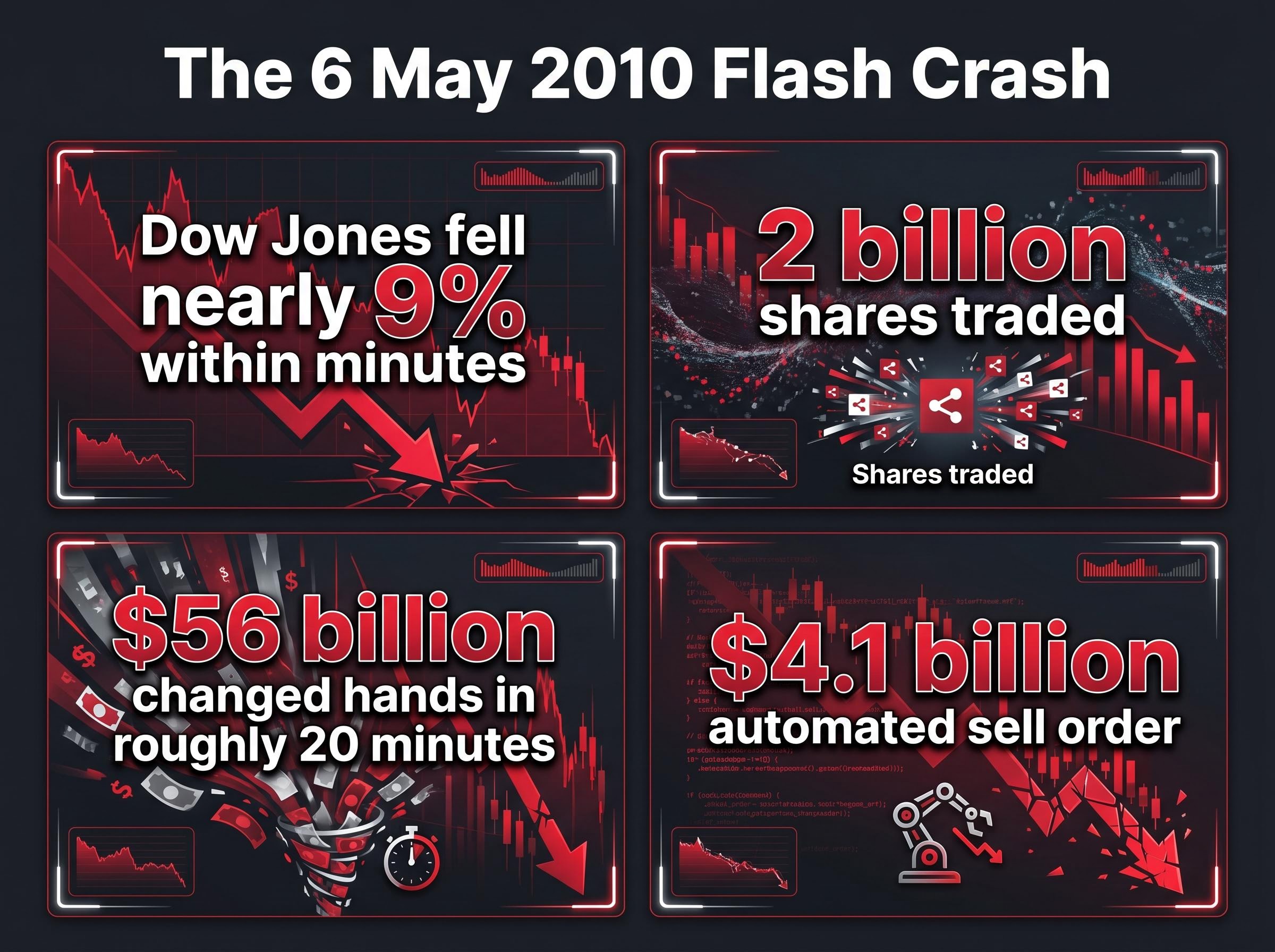
The 6 May 2010 Flash Crash remains the foundational case study.
The Dow Jones Industrial Average fell nearly 9% within minutes. Approximately 2 billion shares worth around $56 billion changed hands in roughly 20 minutes, with some transactions executed at extreme prices before markets stabilised. US regulators attributed the disruption in part to a $4.1 billion automated sell order that triggered cascading selling.
The dynamics visible in the Flash Crash have reappeared in different forms. The January 2021 meme-stock episodes (GameStop, AMC) demonstrated feedback loops between social-media sentiment processed by algorithms and retail order flow, amplified by algorithmic market makers. The March 2020 COVID-era crash saw systematic and model-driven funds, including those using ML signals, deleverage simultaneously as volatility rose, contributing to liquidity stress in Treasuries and credit markets. BIS and central-bank research describes this as a real-world illustration of model herding and pro-cyclical risk.
- Overfitting. Overfitting occurs when a model learns noise from historical data rather than durable patterns. The result is a strategy that performs brilliantly in backtesting and deteriorates in live trading. According to OECD research published in 2024, retail users systematically misinterpret backtested performance and underestimate overfitting and data-snooping biases.
- Sensitivity to novel market conditions. AI models trained on historical data may produce unreliable signals during events outside their training range: sudden geopolitical shocks, abrupt policy shifts, or structural market changes. A 2024 BIS Bulletin specifically warned that AI models tend to be overfit to calm historical regimes, leaving stress scenarios under-represented and exposing retail portfolios to unexpected drawdowns.
The connection between AI models and tail risk runs deeper than overfitting alone: large language models are structurally biased toward median outcomes due to instruction-tuning and reinforcement learning from human feedback, meaning the very AI tools retail traders rely on for market signals are least reliable precisely during the extreme conditions where accurate signals matter most.
- The black-box opacity problem. Many advanced AI trading models, particularly deep learning systems, produce outputs without clearly indicating the reasoning behind them. Academic analysis published in the Journal of Financial Regulation in 2024 concluded that explainability in LLM-based advisory tools is significantly weaker than in rules-based robo-advisors, complicating suitability assessment and dispute resolution for retail users who experience losses.
These are the risks that retail traders are least likely to encounter in platform documentation and most likely to encounter in practice. Understanding them does not require avoiding AI tools; it requires using them with a clear picture of how they can fail.
How regulators around the world are responding
Five major financial regulators moved on AI trading in 2024. That convergence is itself a signal: when the SEC, ESMA, the FCA, ASIC, and MAS all act on the same technology within a single year, it indicates where the serious risk concentrations are.
| Regulator | Jurisdiction | Document / Action | Key Concern |
|---|---|---|---|
| SEC | United States | Rulemaking on conflicts of interest in predictive data analytics (2024) | Broker-dealer AI must not place firm interests ahead of retail clients |
| ESMA | European Union | Statement on AI in investment services under MiFID II (April 2024) | Firms using AI remain fully responsible for suitability and governance |
| FCA / BoE / PRA | United Kingdom | DP24/2: AI and Machine Learning in Financial Services (February 2024) | Model risk, data bias, herding from similar AI models across retail platforms |
| ASIC | Australia | Updated INFO 255 guidance on AI-driven advice tools (March 2024) | Over-reliance on historical data and inadequate model testing |
| MAS | Singapore | Updated FEAT principles and Veritas framework (2024) | Fairness, ethics, accountability, and transparency in AI advisory tools |
The common thread across UK and Asia-Pacific responses
The thread connecting all five responses is the same: firms using AI remain fully responsible for suitability, governance, and model oversight regardless of the AI’s autonomy. The FCA’s joint discussion paper with the Bank of England and PRA specifically addresses herding risk when retail platforms deploy similar AI models. ASIC’s guidance flags over-reliance on historical data and inadequate model testing. MAS’s FEAT principles emphasise transparency and accountability.
The SEC rulemaking on predictive data analytics conflicts, proposed in July 2023, established that broker-dealers and investment advisers must not deploy AI or machine learning tools in ways that place firm interests ahead of retail investor interests, a standard that applies directly to the AI features now embedded in mainstream retail platforms.
For retail traders, the regulatory pattern carries a practical implication. The areas drawing the most concentrated regulatory attention, opacity, model risk, behavioural nudging, and herding, are the areas where genuine risk is concentrated. Regulatory responses are the most reliable independent signal of where AI trading risks are real rather than theoretical.
For investors wanting to understand how these regulatory concerns play out at the institutional level, our deep-dive into AI vendor concentration risk examines APRA’s formal identification of single-provider dependencies as a systemic vulnerability across the $9.8 trillion asset base it oversees, illustrating how the governance gaps regulators are flagging at the retail level are mirrored by structural risks at the institutional level.
Building a framework for critical use of AI trading tools
The analytical arc of this article leads to a single practical principle: AI is the analytical layer, the trader is the decision layer, and conflating the two is the most common source of preventable loss.
AI trading systems identify statistical tendencies derived from historical data and apply them to current market conditions. They do not predict the future. They do not eliminate market uncertainty. The access decision has already been made for most traders, with Interactive Brokers, Robinhood, Charles Schwab, and eToro all integrating AI features into their platforms. The urgent question is not whether to use these tools but how to use them critically.
Evaluate any AI trading tool before committing capital by asking these questions:
- What data does the model use, and how current is it?
- How was backtesting conducted, and what protections exist against overfitting?
- How does the tool behave during volatile market conditions within its available history?
- Can the logic behind a specific signal be explained, even at a high level?
A practical framework for incorporating AI tools into a defined trading process:
- Define strategy and risk parameters independently of the AI, before engaging the tool.
- Use AI outputs as one signal among several, not as the sole basis for a trade.
- Interrogate backtesting methodology for overfitting. Strong historical results should prompt scepticism, not confidence, as OECD research in 2024 found that retail users systematically underestimate data-snooping bias.
- Test the tool’s behaviour during the platform’s available history of volatile periods; BIS research warns that AI models tend to be overfit to calm regimes, leaving stress scenarios under-represented.
- Set a regular review cadence. Ongoing recalibration is a normal operating requirement, not an optional upgrade.
- Maintain human override at all times. The trader, not the model, is accountable for outcomes.
Crowded AI sentiment creates a second-order problem that the article’s risk framework does not resolve: when a large enough share of market participants acts on similar AI signals, the informational edge those signals once provided is arbitraged away, leaving retail adopters exposed to the costs of crowded positioning without the speed advantage institutional participants use to exit it.
During novel conditions, geopolitical shocks, abrupt policy changes, sudden volatility spikes, AI outputs warrant extra scepticism, not more reliance.
AI has changed how retail traders can operate, but not the rules they operate under
AI trading tools have genuinely expanded what retail traders can do. The speed of market scanning, the breadth of sentiment monitoring, and the rigour of backtesting have all improved. The market growth figures, from roughly $11 billion in 2024 toward $70 billion by 2034, signal commercial momentum and rapid adoption.
They do not signal guaranteed performance. And the fact that five major global financial regulators moved on AI trading risk within a single year signals where the real concentrations of concern are: opacity, model herding, overfitting, and the gap between what platforms market and what retail users understand.
The fundamental obligations have not shifted. Strategy clarity, risk management, and outcome accountability remain with the trader. As AI tools become more capable and more widely adopted, the traders who benefit will be those who understand the mechanics well enough to use them critically, not those who use them most.
This article is for informational purposes only and should not be considered financial advice. Investors should conduct their own research and consult with financial professionals before making investment decisions. Past performance does not guarantee future results. Financial projections are subject to market conditions and various risk factors.
Readers looking to deepen the foundation established here may find related guides on algorithmic trading mechanics, backtesting methodology, and risk management frameworks useful next steps.