
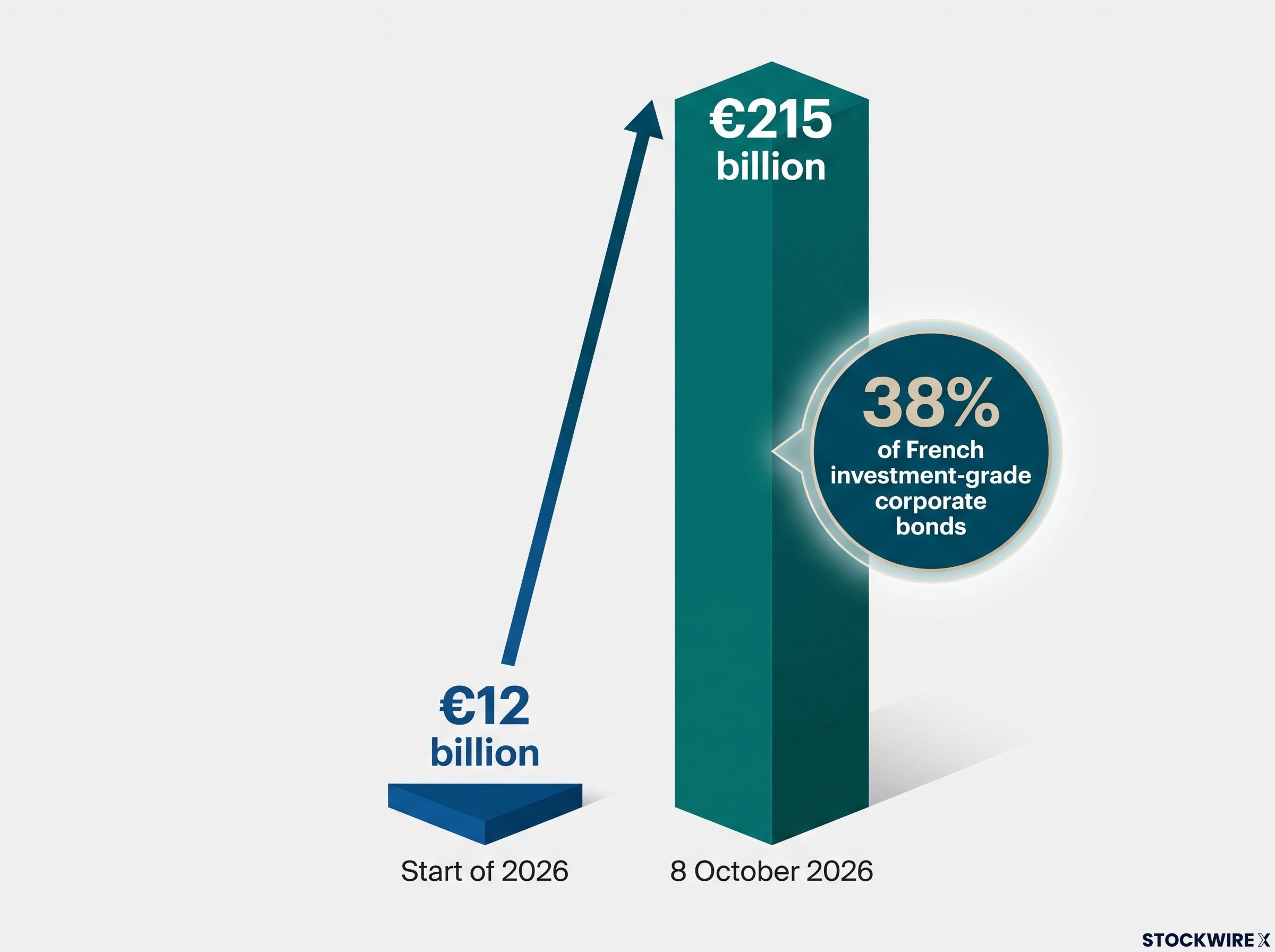
Roughly 38% of French investment-grade corporate bonds now yield less than French government debt. That is about €215 billion of company paper that markets treat as safer than the state, up from roughly €12 billion at the start of 2026. If you assumed a government is always the safest borrower in its own country, the French bond spread is challenging that assumption.
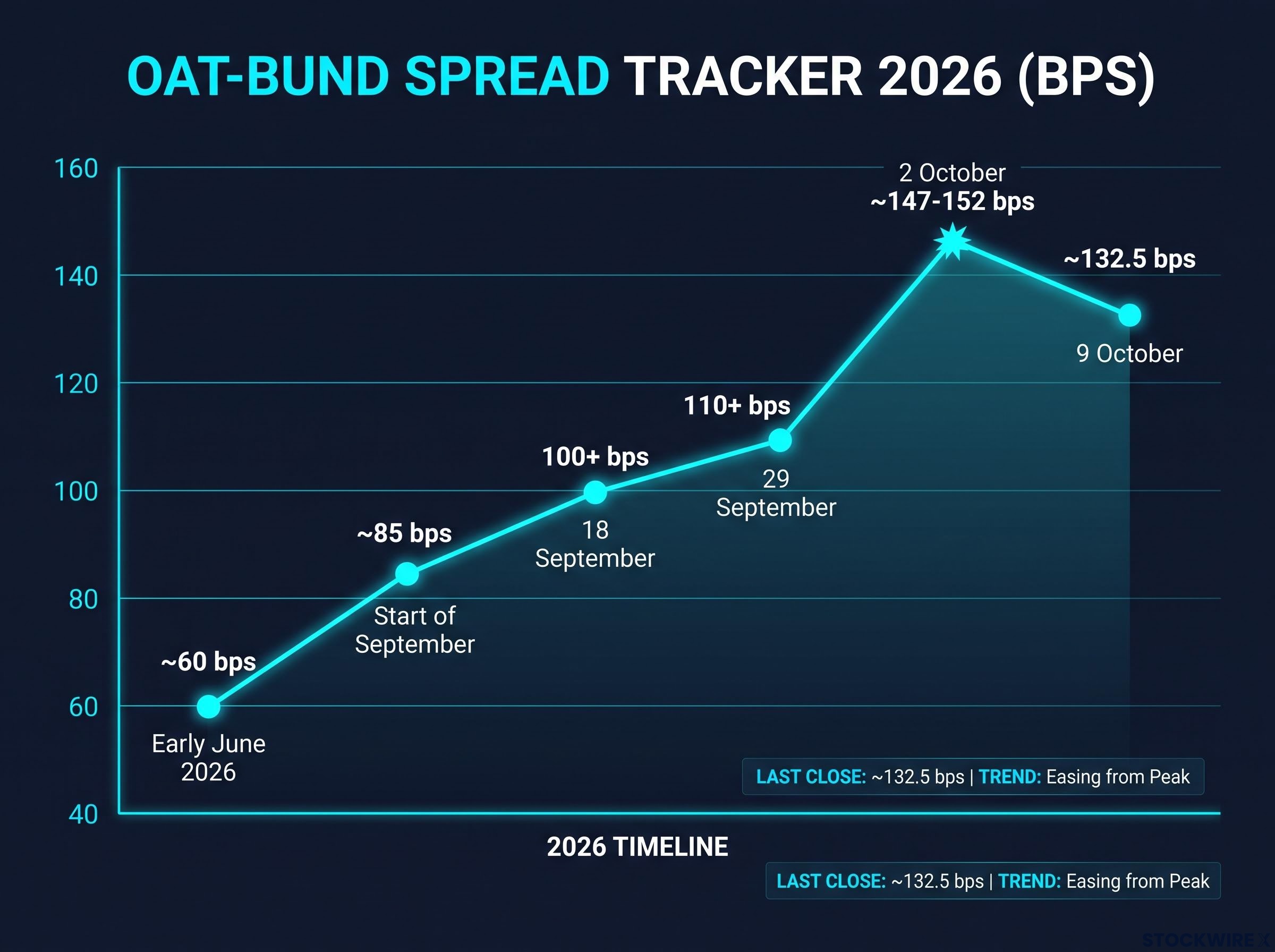
The spread between French and German 10-year yields reached roughly 147-152 bps in early October 2026, the widest gap since the 2011 eurozone debt crisis. By today, 9 October, it had eased to about 132.5 bps.
Whether that easing is a blip or the start of something calmer matters if you hold European bonds, euro-exposed funds or French equities. A regime shift would change how you price risk across the whole region.
After this, you will know what drives the gap, what the European Central Bank’s three backstops actually require, and why Rabobank thinks the worst may already be behind you.
What is the spread measuring, and what pushed it so wide in 2026?
What the spread measures
On a trading screen, the OAT-Bund spread looks like a single number. An OAT is a French government bond, and a Bund is its German equivalent. The spread is the extra yield you demand to hold French 10-year debt instead of German, and markets treat it as a gauge of perceived sovereign risk.
Basis points (bps) measure that gap, where 100 bps equals one percentage point. At 100 bps, investors want an extra 1% a year to lend to Paris rather than Berlin. At 147 bps, they want nearly half as much again, which signals real doubt rather than a mild preference.
There is one wrinkle in the peak reading. Yahoo Finance reported about 152 bps on 2 October (OAT at 4.989%), while data-platform figures showed 146.9 bps (OAT 4.90%, Bund 3.43%). The safest statement is a range of roughly 147-152 bps.
| Date | Source | Spread (bps) | Context |
|---|---|---|---|
| Early June 2026 | Natixis | ~60 | Pre-stress baseline |
| Start of September | Deutsche Bank | ~85 | Widening under way |
| 18 September | Deutsche Bank / Reuters data | 100+ | First breach of 100 bps since 2012 |
| 29 September | Deutsche Bank | 110+ | Fiscal concerns intensify |
| 2 October | Yahoo Finance / data platform | ~147-152 | Widest since 2011 crisis |
| 9 October | Market data | ~132.5 | OAT 4.80%, Bund 3.47% |
Over the past year the spread has ranged from about 59 to 147 bps.
Why it widened
Several pressures stacked on top of each other:
- Fiscal: Deutsche Bank blames a worsening French fiscal outlook, while Natixis points to fiscal and ratings headwinds.
- Political: Morningstar notes five prime ministers in almost as many years, with investors watching closely ahead of next year’s presidential election.
- Technical: ABN AMRO cites worries about future bond supply and reduced official buying through quantitative tightening (QT), where the central bank lets its bond holdings shrink.
- Default risk: Commentary citing Omar Wizman puts France’s 5-year credit default swap, a form of insurance against default, at 81 bps.
ABN AMRO adds a twist. Its “unexplained spread component” jumped after the June 2024 political shock and never fully came back, suggesting a possible regime shift beyond fundamentals.
France’s spread now sits above Italy’s (about 90 bps) and Greece’s (about 76 bps). Italy has long been treated as the eurozone’s weak link, so you should read this as a real change in how markets rank sovereigns.
The old core-periphery hierarchy rested on Italy and Spain running the larger deficits, but both now project shortfalls near 2-3% of GDP while France runs closer to 5.5%, which explains why the ranking has flipped.
When big ASX news breaks, our subscribers know first
Why are French corporate bonds yielding less than the government?
That re-ranking shows up somewhere stranger than the sovereign market itself. Large French companies are now borrowing more cheaply than the French state.
The inversion in numbers About €215 billion (roughly US$241 billion) of French high-grade corporate bonds, around 38% of the pool, yielded less than comparable government bonds as of 8 October 2026, according to Bloomberg data.
At the start of the year, that figure was roughly €12 billion. It has grown almost eighteen-fold in nine months.
It looks like a contradiction. Companies operate inside the French economy and pay French taxes, so how can they be the safer credit?
The answer is that corporates have not become safer. The sovereign sell-off pushed government yields up so far that much of the corporate universe now trades “through” the sovereign curve, meaning at lower yields. Investors see large French firms as less exposed to fiscal and political risk, and the distortion is cyclical, driven by stress rather than a permanent rewiring.
There is a feedback loop to watch. When markets price the state as riskier than its biggest companies, scrutiny of the fiscal path may sharpen, and the gap can close in two ways:
- A sovereign rally: government yields fall back, pulling the curve below corporates again.
- Corporate widening: company yields rise towards the sovereign.
If you hold or follow French credit, the government benchmark is no longer a reliable floor for corporate pricing. A sovereign rally could drag corporate yields down with it, while further stress could reverse the picture. The research did not cover effects on bank balance sheets or corporate funding, so treat those as open questions.
What are the ECB’s backstops, and what would France need to qualify?
If the state is the weak point, the natural question is who catches it. The euro area built three tools after the debt crisis, and they work very differently.
The three tools in plain English
The European Stability Mechanism (ESM) is the heaviest. It lends to governments in trouble, but you only get the money after a formal programme request, a negotiated adjustment plan and a debt-sustainability assessment.
Outright Monetary Transactions (OMT), announced in 2012, lets the ECB buy short-dated government bonds in the secondary market, meaning from other investors rather than the government directly. It only switches on if the country is already in an ESM programme.
The Transmission Protection Instrument (TPI), launched in 2022, is the most flexible. It targets “unwarranted, disorderly” market moves that stop ECB interest rate decisions from passing through evenly across the euro area.
| Tool | Launched | Trigger | Conditionality | Likelihood for France |
|---|---|---|---|---|
| ESM | Post-debt crisis | Request for assistance | Formal programme, adjustment plan | Remote |
| OMT | 2012 | Acute stress plus ESM programme | Strict, tied to ESM | Remote |
| TPI | 2022 | Unwarranted, disorderly moves | Fiscal compliance, sustainable debt | Only realistic option, high bar |
ESM and OMT would require France to accept a rescue programme, which looks remote short of a solvency-type crisis. That leaves TPI.
What would trigger TPI for France
TPI eligibility rests on four tests: compliance with EU fiscal frameworks or a credible corrective plan, no severe macroeconomic imbalances, a sustainable debt trajectory and sound policies.
Experts disagree on whether France passes. One camp argues that spreads far beyond what fundamentals justify count as “unwarranted” by definition, letting the ECB act without a programme. The other says France’s fiscal-rule breaches make TPI politically difficult until a credible consolidation plan exists.
Officials have kept their distance. Rabobank notes that Christine Lagarde has restated the ECB’s capacity to respond to market swings it considers unjustified, whereas Governing Council member Moulin and finance minister Lescure have both said the bar for stepping in directly has not been reached. Rabobank also notes that investors see France as too large to fail.
Lagarde’s public warning on French debt at roughly 120% of GDP broke with the ECB’s convention of avoiding criticism of individual sovereigns, and the act of naming France was itself the signal investors reacted to.
If action came, the likely order would be:
- Verbal intervention from ECB officials.
- A pause in QT.
- Possible direct action, most likely through TPI.
Precedent tempers expectations. Italy’s 2022 TPI announcement steadied markets but left spreads volatile, and the Bank of England’s temporary gilt purchases that year calmed markets while yields stayed higher.
Treat the backstop as a ceiling on tail risk that depends on French budget credibility, not as a guarantee that a rescue is coming.
Is the worst over? The September minutes, rising yields and the risks ahead
That conditional backstop is part of why some analysts are turning more relaxed. Maartje Wijffelaars, Senior Economist at Rabobank, has the most reassuring read on the table.
Rabobank’s judgement Wijffelaars argues that most of the recent jump in French spreads has likely played out, and that buyers of French debt may now find the yield premium attractive.
The ECB’s own signals add context. The account of its 9-10 September meeting, released in early October, shows the deposit rate raised to 2.50%, a level officials view as neutral.
Danske Bank commentary on 9 October described the tone as broadly neutral and not supportive of the three further hikes markets had priced. Officials also flagged that rising long-term yields could hurt growth, and those yields have climbed since the meeting.
ING sees 90-120 bps as the likely near-term range, narrowing to 50-80 bps if a credible consolidation path emerges. That is a forecast, not a promise, and it hinges on Paris.
Several risks could re-widen the spread:
- ABN AMRO’s persistent unexplained spread component.
- Harsher credit ratings from the agencies.
- Political events that undermine confidence in the budget.
- Tighter euro-area conditions if long-term yields keep rising.
History adds caution. During 2011-12, spreads overshot and partially retraced through multiple waves of stress before OMT and the wider EU response anchored expectations.
You should read the easing to about 132.5 bps as a pause rather than a resolution. The next budget and political headlines, more than the ECB, will decide which way it goes.
Past performance does not guarantee future results. Forecasts cited here are speculative and subject to change with market developments.
What to watch before the backstop question becomes real
The French bond spread prices fiscal and political risk, with a layer of technical distortion on top. The corporate inversion is a symptom of that stress, not proof that companies have become safer, and the ECB’s safety net comes with conditions France does not clearly meet today.
Three variables will tell you which way this breaks:
- A credible French budget, which unlocks both narrower spreads and TPI eligibility.
- Rating agency moves, which could either confirm or ease the stress.
- The ECB’s response to rising long-term yields, which sets the backdrop for every euro-area bond.
Watch those three, and you will be reading the same signals the bond market is.
For readers wanting the wider picture, our detailed coverage of global bond market stress separates verified figures from commentary, including why Japan’s 30-year yield and French spreads are moving together.
This article is for informational purposes only and should not be considered financial advice. Investors should conduct their own research and consult with financial professionals before making investment decisions.
—