
Resonance Health outlines $6.0M placement to fund three growth programmes
In its October 2026 investor presentation, Resonance Health outlined a $6.0M placement to institutional, professional and sophisticated investors, designed to fund three growth programmes from a profitable, cash-generative base. The capital raising was launched with a trading halt on Fri 23 Oct and a bookbook that closed on Mon 26 Oct, and was presented alongside preliminary results from a liver fibrosis MRI device study.
The placement is priced at 7.2c per share, a 12.2% discount to the last close of 8.2c on 22 Oct 2026. It comprises approximately 83.3M new shares, equal to 14.9% of enlarged capital, and lifts pro forma cash to $10.4M and net cash to $7.9M.
The offer sits within existing Listing Rule 7.1 and 7.1A capacity, so no shareholder approval is required. Bell Potter Securities is the lead manager.
When big ASX news breaks, our subscribers know first
Profitable, cash-generative base behind the raise
Management framed the raise around FY26 results, which showed a business already operating profitably:
- Revenue of $15.8M, up 42% on FY25
- Normalised EBITDA of $2.6M (non-IFRS)
- Statutory NPAT of $1.5M
- Operating cash inflow of $2.9M, positive in all four quarters
- Staff costs at 41% of revenue, down from 51%
Revenue has grown from $4M in FY23 to $15.8M in FY26. FY27 guidance is $17-22M revenue and $2.6-3.6M EBITDA, which excludes revenues that may accrue from the fibrosis device, new acquisitions, new TrialsWest sites and geographic expansion.
By segment, Resonance Clinical contributed $7.5M, with $20.1M of contract wins since August 2023, while TrialsWest contributed $4.1M. Segment figures are before $3.0M of intersegment eliminations. The presentation also noted an alliance with Image Analysis Group (IAG), announced in September 2026, intended to make Resonance Health endpoints accessible through IAG’s global imaging customer base.
The Image Analysis Group alliance is non-exclusive with no minimum volume commitments, so any revenue depends on work orders executed, with two pilot studies as the starting point for placing Resonance endpoints into IAG’s global trial platform.
For investors, the presentation pointed to operating leverage, with the fall in staff costs as a share of revenue and a SaMD (software as a medical device) forward orders and tendered pipeline above $13M. The company held $2.3M net cash at 30 June 2026, versus $0.1M a year earlier.
Liver fibrosis: what the preliminary EPoC study showed
The presentation detailed preliminary results from the extended proof-of-concept (EPoC) study of the company’s liver fibrosis MRI device. The device is investigational and not cleared for clinical use in any jurisdiction, and the results are not yet independently verified.
What AUC, sensitivity and specificity mean
Sensitivity is the proportion of biopsy-positive subjects the model correctly identifies. Specificity is the proportion of biopsy-negative subjects it correctly excludes.
AUC (area under the ROC curve) measures overall ability to distinguish two groups, where 0.5 is chance and 1.0 is perfect. The company says the device works on standard MRI with no hardware or software added at the scanner.
| Threshold | AUC | Sensitivity | Specificity |
|---|---|---|---|
| Significant fibrosis (≥F2) | 0.820 | 75.0% (30/40) | 80.0% (8/10) |
| Advanced fibrosis (≥F3) | 0.788 | 57.9% (11/19) | 93.5% (29/31) |
The figures come from an interim analysis of 50 of 68 enrolled subjects at a single China site, using 3T MRI and a first-pass model. Management cautioned that the cohort is small and confidence intervals are wide: only 10 subjects fall in the F0-1 group, so ≥F2 specificity rests on few patients. The validation study is sized to narrow these intervals.
Benchmarks, indicative only
The presentation set the results against published figures in a cross-study comparison:
- ≥F2 (AUC): MRE 0.92, FibroScan 0.82, Resonance 0.82
- ≥F3 (AUC): MRE 0.91, FibroScan 0.86, Resonance 0.79
Management said lifting advanced-fibrosis performance towards elastography is the current development focus.
Zero-capex access
The presentation compared added site costs for each technology. The Resonance device requires US$0 in added hardware or software at the imaging site, against US$75k-150k per scanner for MRE and US$70k-125k per device for FibroScan. It cited approximately 50,000 MRI scanners worldwide versus approximately 1,800 sites offering MRE.
Where the $6.0M goes and the path to market
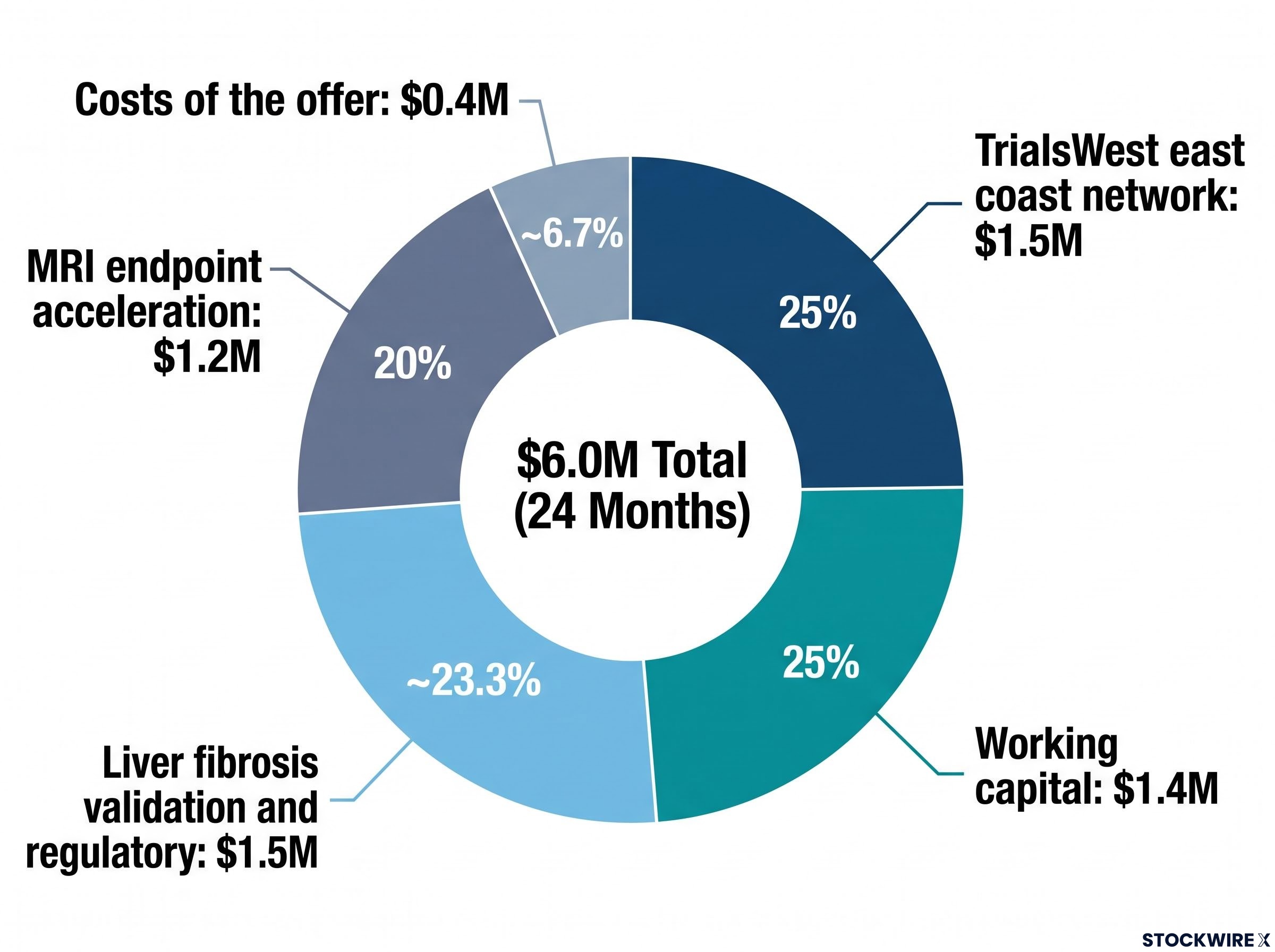
Each programme is funded over 24 months, according to the presentation.
| Use | $M |
|---|---|
| MRI endpoint acceleration | 1.2 |
| TrialsWest east coast network | 1.5 |
| Liver fibrosis validation and regulatory | 1.5 |
| Working capital | 1.4 |
| Costs of the offer | 0.4 |
| Total | 6.0 |
Management outlined a three-stage strategy for the fibrosis device:
- Stage 1, clinical trials: investigational use in pharma MASH and obesity trials, paid by sponsors at US$900-1,500 per scan.
- Stage 2, clinical diagnostics: launch post-clearance.
- Stage 3, reimbursed diagnostics: post-coverage, with payer coverage and a Category I CPT code.
Stage timing depends on FDA clearance and payer decisions. Illustrative trial economics were shown, such as a Phase 3 MASH trial at US$3.6M-6.0M, but these are illustrative assumptions, not forecasts, and FY27 guidance includes no fibrosis device revenue.
For readers wanting the commercial backdrop to the fibrosis programme, our deep-dive into Resonance Health’s liver fibrosis device strategy covers the DEVIMLA study, the MASH and GLP-1 trial demand driving non-invasive endpoints, and the planned path from investigational use to broader launch.
On a pro forma basis, net cash moves from $2.3M at 30 June 2026 to $7.9M. Shares on issue post-placement total 560.4M, and the NAB facility matures on 31 Mar 2027.
What happens next for Resonance Health
The presentation set out an indicative timetable, with all dates in AWST:
- Placement announced and trading resumes: Wed 28 Oct.
- Settlement of new shares: Fri 6 Nov.
- Allotment and new shares trade: Mon 9 Nov.
- Catalysts over the next 12 to 24 months: FDA Pre-Submission feedback, the full 68-subject EPoC analysis and first investigational-use sponsor contracts, with no firm dates.
- East coast TrialsWest sites: two a year from H2 FY27, along with the appointment of an East Coast General Manager.
- NAB facility renewal process commencing early in 2027.
The timetable is indicative and subject to change, and the presentation stated that catalysts and timing are not guaranteed.
Get Healthcare News Before the Market Moves
Join 20,000+ investors receiving FREE breaking ASX alerts within minutes of release, complete with in-depth analysis and the full announcement. Click the “Free Alerts” button at Big News Blast to stay ahead on healthcare and other non-resource sectors the moment market-moving news breaks.