
Clarity’s CLARIFY Phase III trial reaches its 383 participant target for 64Cu-SAR-bisPSMA
Clarity Pharmaceuticals (ASX: CU6), a clinical-stage radiopharmaceutical company, has announced that its registrational Phase III CLARIFY trial (NCT06056830) has dosed the planned target of 383 participants. The trial is testing 64Cu-SAR-bisPSMA in prostate cancer imaging.
CLARIFY is Clarity’s first Phase III registrational trial and is being conducted in the United States and Australia. Two registrational Phase III trials with 64Cu-SAR-bisPSMA have now completed recruitment and are in patient follow-up, in line with the trials’ protocols.
For investors, completed recruitment moves the company toward a topline data readout. The final CLARIFY results are intended to support an application to the US Food and Drug Administration (FDA) for approval.
Dr Alan Taylor, Executive Chairperson
“This milestone is a significant achievement from our team and collaborators as we progress our optimised 64Cu-SAR-bisPSMA product towards trial completion and subsequent US FDA New Drug Application (NDA) submission. We now have two registrational Phase III trials with 64Cu-SAR-bisPSMA that have successfully completed recruitment and are in the process of patient follow-up, in line with the trials’ protocols…”
When big ASX news breaks, our subscribers know first
What the CLARIFY trial is testing
CLARIFY is a non-randomised, open-label study of 64Cu-SAR-bisPSMA in participants with untreated, histopathology-confirmed prostate cancer with high-risk features. All are proceeding to radical prostatectomy (removal of the prostate) with pelvic lymph node dissection (removal of lymph nodes from the pelvic region).
The primary endpoints of the study are the sensitivity and specificity of 64Cu-SAR-bisPSMA to detect prostate cancer within the pelvic lymph nodes compared to the standard of truth (histopathology), assessed independently for Day 1 (1-4 hours post-administration, same-day imaging) and Day 2 (approximately 24 hours post-administration, next-day imaging).
Dr Taylor said CLARIFY is the first study to determine the sensitivity and specificity of the SAR-bisPSMA product. It does so by assessing true positive, true negative, false positive and false negative lesions using histopathology specimens.
Phase I PROPELLER evidence behind the trial
CLARIFY builds on the Phase I PROPELLER study, a first-in-human multi-centre trial involving 30 participants. It demonstrated improved diagnostic performance of same-day 64Cu-SAR-bisPSMA positron emission tomography (PET) compared with 68Ga-PSMA-11 PET in the pre-prostatectomy setting.
| Metric | 64Cu-SAR-bisPSMA vs 68Ga-PSMA-11 |
|---|---|
| Lesion detection | Approximately 30% greater |
| Tracer uptake and contrast | 2-3 times higher |
| Participants with more lesions identified (average across readers, participants with discordant lesion findings) | 73% vs 27%, respectively |
The improved performance of next-day versus same-day 64Cu-SAR-bisPSMA PET seen in the COBRA and Co-PSMA trials in biochemical recurrence (BCR) supports the hypothesis that next-day imaging may also offer incremental benefits in the pre-prostatectomy setting. That hypothesis is to be assessed in CLARIFY.
Investors wanting the peer-reviewed detail behind the biochemical recurrence comparison can read our full explainer on the Co-PSMA publication, which covers the lesion counts, patient-level detection rates and the 44% treatment management change figure.
One illustrative case in the announcement involved a 6 mm pelvic lymph node. It was detected by both readers on the 64Cu-SAR-bisPSMA scan but not on the 68Ga-PSMA-11 scan, and was later confirmed as prostate cancer via histopathology.
Why sensitivity matters in prostate cancer imaging
PSMA PET is an imaging method that targets prostate-specific membrane antigen, a protein found on prostate cancer cells. Sensitivity measures how often a test detects disease that is truly present, while specificity measures how often it correctly rules out disease that is absent.
Histopathology, the laboratory examination of surgically removed tissue, is the standard of truth because it confirms which lesions are cancer. In CLARIFY, that tissue is the pelvic lymph nodes removed during prostatectomy.
Currently approved PSMA PET agents have reported sensitivities of 27%-40% in their Phase III pivotal studies, based on detecting pelvic lymph node metastases prior to prostatectomy (verified by histopathology). According to Dr Taylor, none of these agents achieved the prespecified primary endpoint thresholds for sensitivity in their respective pivotal trials.
Dr Taylor said this means the approved agents did not detect prostate cancer in the pelvic lymph nodes in more than half of the study participants in whom such metastases were confirmed by histopathology.
Accurate staging matters because treatment pathways differ. Dr Taylor noted they may include removal of the prostate, with considerable long-lasting morbidities in some cases, or more conservative approaches personalised to each patient and potentially preserving quality of life post-treatment.
The announcement also provided prostate cancer context:
- Prostate cancer is the second most common cancer diagnosed in men globally.
- It is the fifth leading cause of cancer death in men worldwide.
- The American Cancer Institute estimates about 333,830 new US cases in 2026 and around 36,320 deaths.
The SAR technology advantage
SAR-bisPSMA connects two PSMA-targeting agents to Clarity’s proprietary sarcophagine (SAR) technology. The technology securely holds copper isotopes inside a cage-like structure called a chelator, and the announcement states it prevents copper leakage into the body, unlike other commercially available chelators.
SAR-bisPSMA is a Targeted Copper Theranostic (TCT), used with copper-64 for imaging and copper-67 for therapy. Dr Taylor said the aim includes making radiopharmaceuticals more accessible through centralised product manufacture and broad distribution to any imaging centre with a PET camera, with flexibility in the timing of the scan.
What happens next for Clarity
The announcement sets out the following steps:
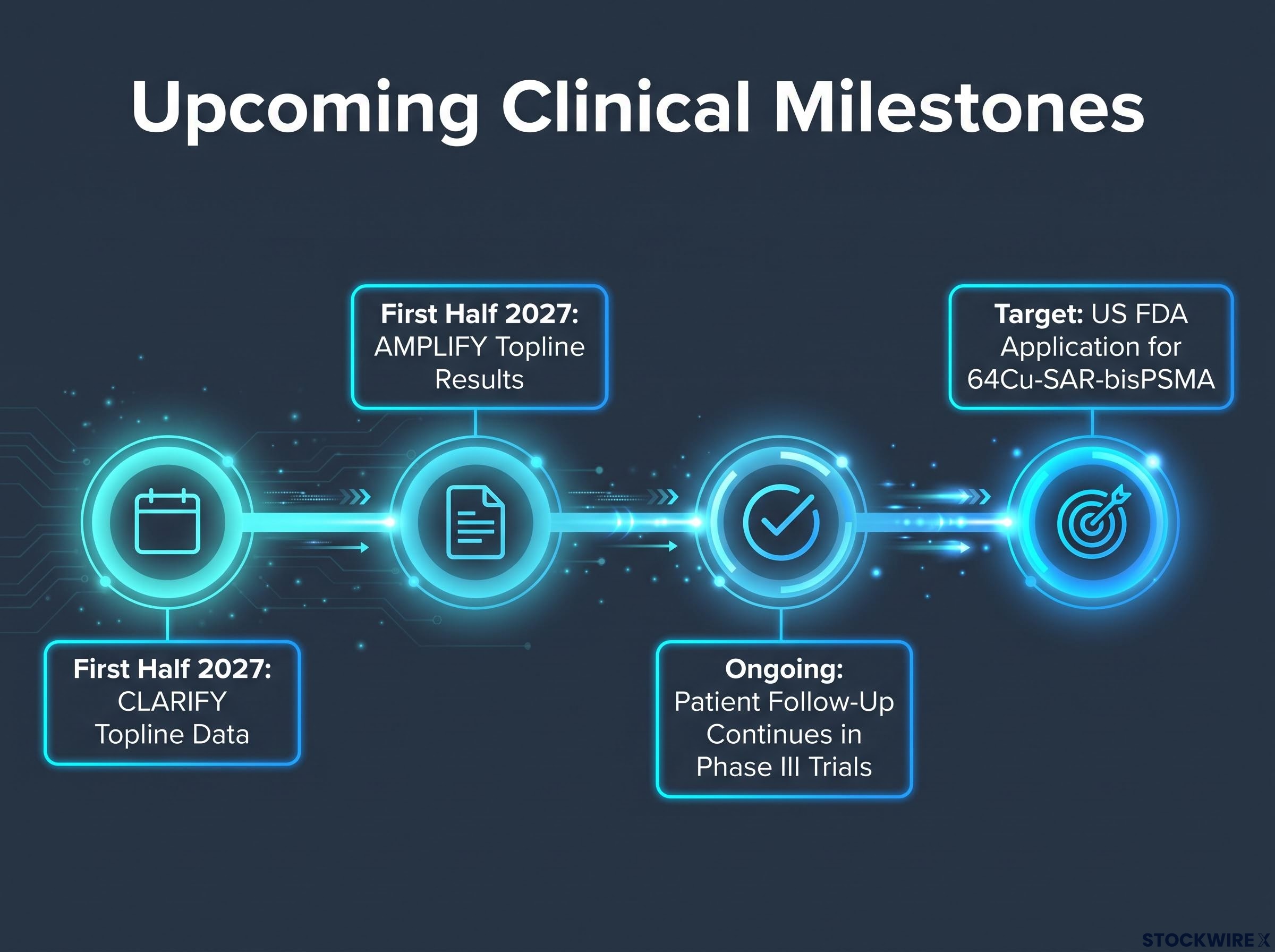
- CLARIFY topline data: anticipated in the first half of calendar year 2027. CLARIFY will provide sensitivity and specificity estimates for same-day and next-day imaging.
- AMPLIFY topline results: anticipated in the first half of calendar year 2027, released along with CLARIFY. AMPLIFY (NCT06970847) is investigating 64Cu-SAR-bisPSMA in patients with BCR of prostate cancer.
- Patient follow-up: continues in both completed Phase III trials, in line with the trials’ protocols.
- US FDA application: as a pivotal trial, the final CLARIFY results are intended to provide sufficient evidence to support an application for approval of 64Cu-SAR-bisPSMA as a new diagnostic imaging agent in prostate cancer patients prior to undergoing definitive therapy.
For investors, two pivotal readouts are anticipated in one shared window. 64Cu-SAR-bisPSMA and 67Cu-SAR-bisPSMA are unregistered products, and there is no guarantee that they will become commercially available.
AMPLIFY completed enrolment in about nine months, a pace that reflects strong clinician and patient interest in 64Cu-SAR-bisPSMA despite several PSMA PET products already being commercialised by competitors.
Don’t Miss the Next Healthcare Breakout
Get FREE breaking ASX healthcare news delivered to your inbox within minutes of release, complete with in-depth analysis and the full announcement. Join 20,000+ investors already receiving real-time alerts from Big News Blast. Click the “Free Alerts” button to stay ahead of the market when the next major announcement lands.