
Resonance Health targets blockbuster MRI liver fibrosis device amid $40 billion diagnostics market
In its June 2026 investor presentation, Resonance Health (ASX: RHT) outlined development progress on its multi-parametric MRI device for liver fibrosis assessment, designed to compete directly with invasive liver biopsy as a diagnostic standard. The company is targeting commercial launch during FY27/28 to address a $40.5 billion global liver disease diagnostics market treating 58 million+ new chronic liver disease cases annually.
Management highlighted that development is being funded by a profitable platform business reporting $16.0 million revenue guidance for FY26 (up 44% on prior corresponding period) with $2.6 million EBITDA guidance at a 14% margin. Managing Director and CEO Andrew Harrison and Chief Scientific Officer Dr Wenjie Pang hosted the presentation, detailing how Resonance Health’s existing Software-as-Medical-Device (SaMD) infrastructure serving 400+ active MRI clinical sites across 48 countries positions the company to deploy the liver fibrosis device into a market experiencing regulatory and commercial demand acceleration.
The presentation positioned the device as arriving precisely when approved MASH therapeutics (Resmetirom in 2024, semaglutide for MASH in August 2025) and expanding GLP-1 trials require non-invasive endpoints to identify patients and measure treatment response at population scale.
When big ASX news breaks, our subscribers know first
Why liver biopsy’s limitations create the opportunity
Management outlined how the current diagnostic gold standard presents fundamental limitations that create commercial opportunity for non-invasive alternatives. Percutaneous liver biopsy examines less than 0.002% of liver tissue through an invasive needle procedure that carries bleeding risk, cannot be repeated for longitudinal monitoring, and costs significantly more than imaging-based alternatives. The procedure’s sampling error and inter-observer variability in histology grading further limit its utility for clinical trial recruitment and population screening programmes.
The presentation detailed how Resonance Health’s MRI-based approach addresses these limitations through a painless 15-minute scan requiring no contrast agent and no special hardware beyond standard MRI equipment already installed in radiology departments globally. The device provides whole-liver assessment on any modern MRI scanner across vendors, enabling repeatable monitoring for disease progression and treatment response.
A critical design feature highlighted by management is the device’s “confounder-resistant” architecture, engineered to overcome iron overload, fat accumulation, body size variation, and signal non-uniformity — factors that affect the accuracy of competing technologies including ultrasound elastography (FibroScan), MR elastography (MRE), and blood biomarkers such as FIB-4 and Enhanced Liver Fibrosis (ELF) scores.
Existing alternatives and their limitations
The presentation compared the Resonance Health device to established non-invasive options:
- FibroScan (Vibration-Controlled Transient Elastography): Point-of-care ultrasound technology measuring liver stiffness rather than fibrosis directly. Fails in obesity, ascites, iron overload, and inflammation.
- MR Elastography: Currently offers the best non-invasive accuracy but requires proprietary hardware and software installed on the MRI scanner, restricting access and increasing cost. Also affected by iron and inflammation confounders.
- Blood Biomarkers (FIB-4, ELF): Cheap and widely accessible in primary care settings but affected by numerous non-fibrosis factors and demonstrate poor accuracy in non-advanced fibrosis staging.
- Multi-parametric MRI (LiverMultiScan cT1): Vendor-agnostic single-scan approach measuring fibro-inflammation signal indirectly, but non-specific and confounded by iron, fat, and other factors.
Management positioned Resonance Health’s device as the only approach combining vendor-agnostic standard MRI sequences with proprietary analytics designed to neutralise the confounders that limit existing methods.
DEVIMLA clinical study reaches full recruitment
The presentation detailed progress on the “Development and Validation of Multiparametric MRI for Non-Invasive Measurement of Liver Fibrosis and Activity” (DEVIMLA) clinical study, which has reached full recruitment and entered the analysis stage. The study enrolled 68 patients with verified or scheduled percutaneous liver biopsy serving as the reference standard.
DEVIMLA study parameters
- Patient population: 68 subjects with verified or scheduled biopsy (fully recruited)
- Reference standard: Percutaneous liver biopsy
- Primary endpoint: Diagnostic accuracy versus significant fibrosis
- Secondary endpoint: Quantitative monitoring capability and inflammation detection
- Duration: 12–24 month study timeline
- Current status: Recruitment complete, analysis stage underway
- Proof-of-concept outcome: Strong fibrosis signal confirmed; device differentiates F0 (no fibrosis) from F1+ (mild fibrosis or greater)
Management outlined the regulatory pathway targeting FDA Center for Drug Evaluation and Research (CDER) Biomarker Qualification, which would enable the device to serve as a regulatory-accepted endpoint in pharmaceutical trials. This qualification pathway is designed to establish the device as a regulatory standard for measuring liver fibrosis progression and treatment response in drug development programmes.
The presentation noted that initial proof-of-concept work involving 30 subjects successfully confirmed the fibrosis signal, with the DEVIMLA study representing extended validation across a larger cohort with multi-site MRI data collection.
GLP-1 drug boom and MASH therapeutics drive endpoint demand
The company outlined converging market tailwinds creating accelerating demand for non-invasive liver assessment. Regulatory approval of MASH therapeutics — Resmetirom in 2024 and semaglutide for MASH in August 2025 — requires non-invasive screening at population scale to identify appropriate patients and monitor treatment response.
Management highlighted that every approved therapy in the metabolic and liver disease space needs non-invasive imaging endpoints to measure efficacy, creating regulatory demand that traditional biopsy cannot satisfy due to its invasive nature and inability to support repeated monitoring. The presentation positioned this regulatory dynamic as particularly favourable for Resonance Health’s device, which is designed for longitudinal assessment without patient risk.
The presentation detailed how GLP-1 receptor agonist trial expansion is driving additional demand for liver fibrosis assessment alongside body composition endpoints. Semaglutide, tirzepatide, retatrutide, survodutide, orforglipron, and combination therapies such as CagriSema are expanding into MASH, heart failure with preserved ejection fraction (HFpEF), chronic kidney disease (CKD), and obstructive sleep apnoea (OSA) indications, with every trial requiring MRI-based liver fat, fibrosis, visceral adipose tissue (VAT), subcutaneous adipose tissue (SAT), and muscle quality quantification.
Regulators and pharmaceutical sponsors now require MRI-based VAT, SAT, and muscle-quality endpoints alongside weight loss measurements to ensure quality-of-weight-loss and preservation of bone and muscle health during metabolic therapy trials. Management noted that pharmaceutical sponsors demonstrate preference for a single global vendor model, which suits Resonance Health’s combined SaMD and clinical research organisation (CRO) offering across 400+ active MRI sites in 48 countries.
The presentation positioned the liver fibrosis device as launching into peak demand created by this convergence of approved therapeutics and expanding clinical trial requirements.
Multi-endpoint MRI platform beyond fibrosis
Management outlined Resonance Health’s full device portfolio spanning fibrosis, fat, iron, inflammation, body composition, and muscle quality assessment. The presentation detailed how the liver fibrosis device represents one component of a multi-parametric MRI platform already generating commercial revenue through regulatory-cleared products.
| Product | Status | Application Area | Description |
|---|---|---|---|
| FerriScan | Commercial | Liver Iron | Gold standard for liver iron concentration (LIC) assessment via MRI |
| HepaFatScan / HepaFatSmart | Commercial | Liver Fat | Non-invasive MRI assessment of liver fat in fatty liver disease |
| CardiacT2* | Commercial | Heart Iron | Widely accepted MRI method for assessing cardiac iron loading |
| LiverSmart | Commercial | Liver Iron + Fat | AI-trained multi-parametric device combining iron and fat assessment |
| VAT/SAT Central-Read | Commercial | Body Composition | Visceral and subcutaneous adipose tissue quantification service |
| Liver Fibrosis | Late Development | Fibrosis Assessment | Multi-parametric MRI device targeting biopsy-grade accuracy |
| Muscle Quality | Priority Development | Sarcopenia Risk | MRI endpoint addressing muscle preservation in weight-loss trials |
The presentation noted that the platform has completed 90,000+ analyses to date, with infrastructure already achieving regulatory clearances through multiple pathways including FDA (United States), TGA (Australia), and EU MDR (European Union). All devices are manufactured under ISO 13485 certification for medical device design and quality management.
Management highlighted the “Resonance Bridge” two-way PACS (Picture Archiving and Communication System) integration, which auto-routes imaging jobs, strips protected health information (PHI), and encrypts records to enable zero-effort customer onboarding. The first deployment of this integration was underway at the time of the presentation.
The company outlined that automation and artificial intelligence integration into the modern technology stack is expected to lift SaMD processing capacity by up to 10× at marginal cost, providing platform infrastructure for rapid deployment of new endpoints as regulatory and commercial demand evolves.
Profitable platform funds device development
The presentation detailed how Resonance Health’s existing business segments are generating the cash flow and profitability to fund liver fibrosis device development without requiring additional capital. FY26 guidance projects $16.0 million revenue (up 44% on prior corresponding period) with $2.6 million EBITDA at a 14% EBITDA margin, representing a 16 percentage point margin improvement year-on-year.
Management highlighted approximately 45% revenue compound annual growth rate (CAGR) from FY23 to FY26 guidance, with first-half FY26 delivering $1.6 million EBITDA at a 20% margin. Critically, the presentation noted that no contribution from the liver fibrosis device is included in FY26 guidance, meaning any commercialisation or investigational-use deployment during FY27 represents pure upside to the guided financial trajectory.
The FY26 profit guidance upgrade in May 2026 lifted underlying EBITDA guidance by 30% to approximately $2.6 million while expanding margins to 16.3%, with management attributing the improvement to SaMD segment growth, automation efficiencies, and a strengthening clinical trial pipeline.
Three business segments funding development
-
SaMD (Software-as-Medical-Device): Generated approximately $5.0 million segment revenue in FY25, with an order and bid pipeline exceeding $10 million at FY26. This segment includes FerriScan, HepaFatScan, LiverSmart, and the VAT/SAT central-read service.
-
CRO (Resonance Clinical): Managing a $13.8 million major clinical trial currently in progress, with $20.1 million in total contract wins since 2023. This segment provides end-to-end clinical trial management services leveraging the company’s MRI imaging expertise.
-
TrialsWest: Operates 3 clinical trial sites in Australia serving blue-chip pharmaceutical customers including GSK, Pfizer, Novartis, Sanofi, and MSD. The presentation noted that site management operations generate recurring revenue from sponsored trials.
Management outlined “Project 50:28” as a mid-term ambition targeting $50 million annual revenue by the end of FY28, representing more than 3× growth from FY26 guidance through a combination of organic growth across existing segments, new endpoint deployment, and potential acquisitions.
The presentation emphasised that the profitable operating platform de-risks device development by eliminating dependence on capital markets to fund clinical studies and regulatory submissions.
Development roadmap targets FY27 pharma trials
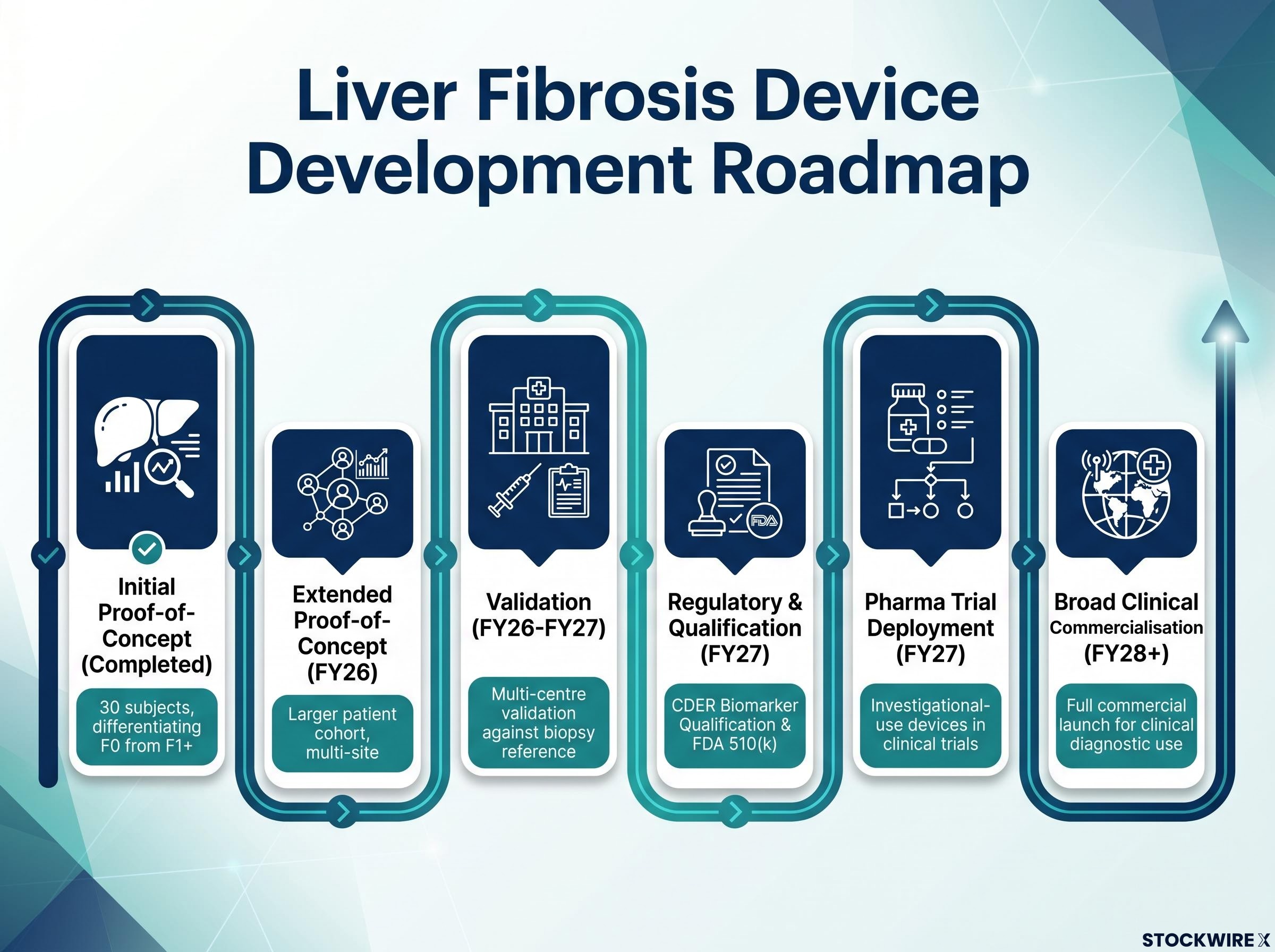
The company detailed a staged development pathway designed to progressively de-risk the device while building the clinical evidence base required for regulatory qualification and commercial launch.
-
Initial Proof-of-Concept (Completed): Enrolled 30 subjects and confirmed that the multi-parametric MRI approach generates a detectable fibrosis signal capable of differentiating no fibrosis (F0) from mild or greater fibrosis (F1+).
-
Extended Proof-of-Concept (FY26): Expanding to a larger patient cohort with multi-site MRI data collection to validate signal consistency across different MRI hardware and imaging protocols.
-
Validation (FY26–FY27): Multi-centre validation study across diverse patient populations and geographic regions to establish diagnostic accuracy benchmarks against the percutaneous liver biopsy reference standard.
-
Regulatory & Qualification (FY27): Pursuing CDER Biomarker Qualification to establish the device as a regulatory-accepted endpoint in pharmaceutical trials, alongside FDA 510(k) clearance pathway for clinical diagnostic use.
-
Pharma Trial Deployment (FY27): Planned deployment of investigational-use devices into pharma-sponsored clinical trials during the regulatory qualification process. This stage is expected to generate early revenue whilst expanding the clinical validation dataset supporting future regulatory submissions.
-
Broad Clinical Commercialisation (FY28+): Full commercial launch for clinical diagnostic use following regulatory clearances and biomarker qualification.
Management outlined that the strategy of deploying investigational-use devices into pharmaceutical trials during the regulatory process serves dual purposes: generating revenue to offset development costs whilst simultaneously building the real-world evidence base that strengthens regulatory submissions.
Investment thesis and upcoming webinar
The presentation summarised six investment pillars supporting Resonance Health’s equity thesis:
-
Blockbuster device in late-stage development: Multi-parametric MRI liver fibrosis device addresses a clear gap in non-invasive diagnostic options and is designed to compete directly with the invasive biopsy gold standard in a $40.5 billion global diagnostics market.
-
Profitable operating engine: First-half FY26 delivered $1.6 million EBITDA at 20% margin, with three established business segments (SaMD, CRO, TrialsWest) cross-selling to global pharmaceutical customers and funding device development from operating cash flow.
-
Direct GLP-1 trial exposure: Existing VAT/SAT, muscle quality, and liver fat endpoints align precisely with regulatory requirements emerging from GLP-1 receptor agonist trial expansion, positioning the company to capture share in a rapidly growing segment.
-
Regulatory moat: ISO 13485 certification plus FDA, TGA, and EU MDR cleared SaMD platform represents multi-year regulatory infrastructure investment already completed, creating barriers to competitive entry.
-
Global pharmaceutical reach: 400+ active MRI sites across 48 countries serving blue-chip customers including AstraZeneca, GSK, Pfizer, Novartis, Sanofi, and MSD provides established distribution for new endpoints and devices.
-
Significant upside potential: Liver fibrosis device commercialisation, new GLP-1 endpoints, additional TrialsWest site acquisitions, and potential platform acquisitions all represent incremental growth opportunities beyond FY26 guidance.
Management invited investors to attend a live webinar and Q&A session on Tuesday 9 June 2026 at 10:00am Australian Western (Perth) Time (AWST), hosted by Andrew Harrison and Dr Wenjie Pang. The webinar registration is available at the Resonance Health investor centre, with a video recording to be made available within 24 hours following the presentation.
Management Perspective
Investors are invited to join Managing Director & CEO Andrew Harrison and Chief Scientific Officer Dr Wenjie Pang for a detailed discussion of liver fibrosis device development progress, DEVIMLA study outcomes, and the strategic positioning of Resonance Health’s multi-endpoint MRI platform in the evolving GLP-1 and MASH therapeutics landscape.
Want the Next Healthcare Breakthrough in Your Inbox?
Join 20,000+ investors receiving FREE breaking ASX healthcare news within minutes of release, complete with in-depth analysis. Click the “Free Alerts” button at Big News Blast to get market-moving announcements the moment they break, with expert coverage already done.