
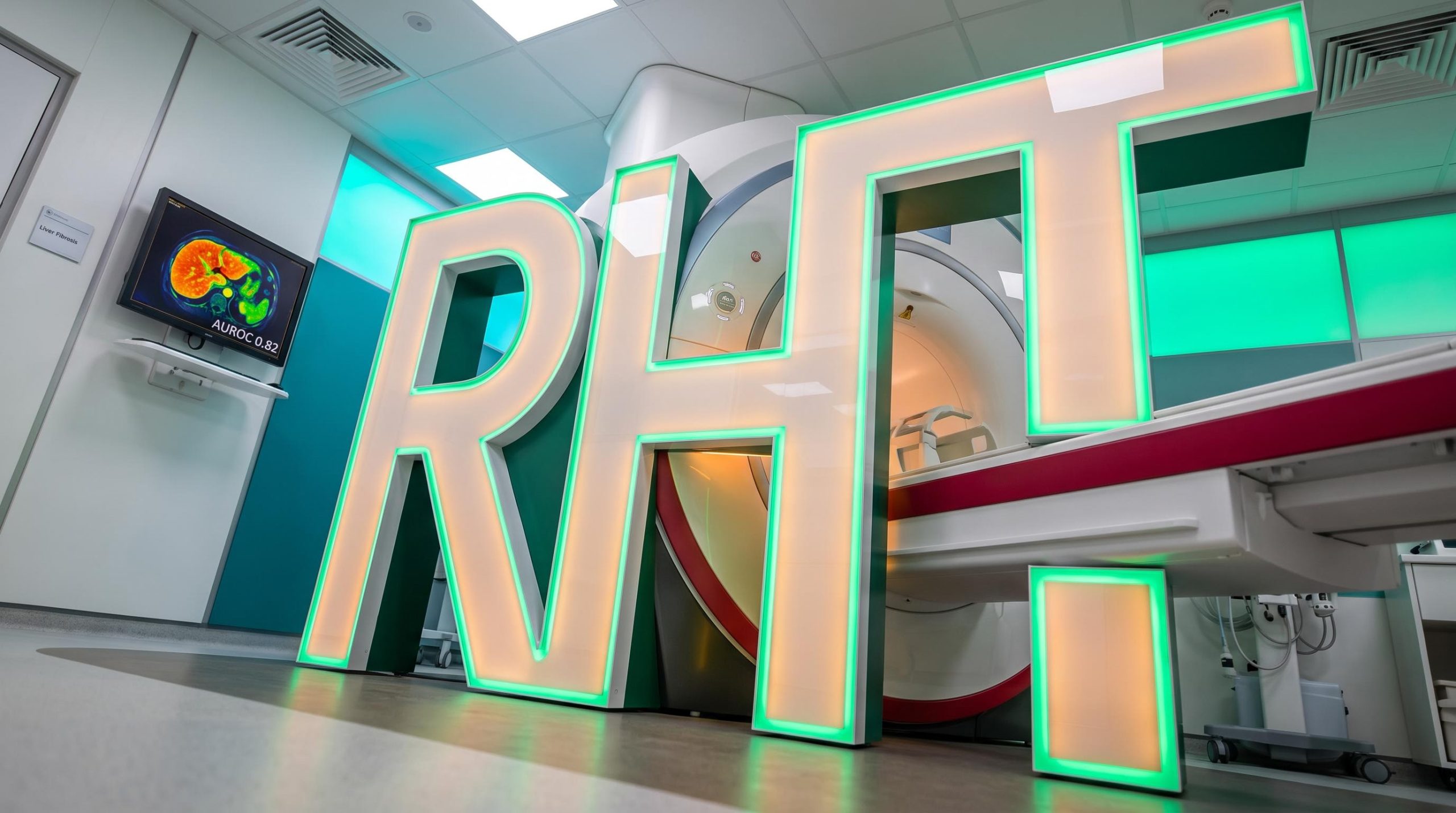
Liver fibrosis results open GLP-1 biomarker opportunity for Resonance Health
Resonance Health (ASX: RHT) has released preliminary results from the extended proof-of-concept (EPoC) stage of its DEVIMLA study, showing its FibrosisAssessment MRI software measured liver fibrosis with an AUROC of 0.82 for significant fibrosis (≥F2) and 0.79 for advanced fibrosis (≥F3). The results were released alongside the company’s $6 million placement announcement and investor presentation.
For significant fibrosis, the accuracy is in line with the widely used FibroScan ultrasound device (US$150K). FibrosisAssessment aims to measure liver fibrosis using MRI sequences without expensive hardware or invasive contrast injections.
The company points to a US$1.3 billion market opportunity to sell FibrosisAssessment into pharma trials, building on 20 years of developing and commercialising Software as a Medical Device (SaMD).
Andrew Harrison, CEO & Managing Director
“These preliminary results are a very encouraging step towards commercialising the FibrosisAssessment device in GLP-1 clinical trials…”
When big ASX news breaks, our subscribers know first
What the EPoC results showed
Study design
The EPoC stage enrolled 68 adults with biopsy-confirmed chronic liver disease. The preliminary results come from a subset of the cohort.
- Sites were in Malaysia (University of Malaya), China and India (Indian Institute of Liver and Digestive Sciences).
- The preliminary results are from the 50 subjects recruited at the China site.
- All MRI examinations were performed on 3 Tesla (3T) machines.
- The cohort represented a broad spectrum of clinical conditions, including liver cancer.
Analysis at 3T is more technically challenging than at 1.5T, the field strength used in the company’s 2022 proof-of-concept study, because magnetic susceptibility artefacts are more prevalent at higher field strengths. The 2022 study also used a homogeneous population and reported an AUROC of 0.92 across 27 subjects, whereas the EPoC cohort covers a substantially wider range of clinical presentations.
Diagnostic performance
Two initial classification models were developed: one separating F0-1 from F2-4, and another separating F0-2 from F3-4. Results were measured against liver biopsy (n = 50, China site, 3T).
| Endpoint | AUROC (95% CI) | Specificity | Sensitivity |
|---|---|---|---|
| Significant fibrosis (≥F2) | 0.82 (0.67 to 0.94) | 80% | 75.0% |
| Advanced fibrosis (≥F3) | 0.79 (0.63 to 0.91) | 93.5% | 57.9% |
The results were generated using a first-pass model with intentionally limited parameters from one type of image analysis outcome. They are preliminary, have not been independently verified and may change after independent pathology review, model refinement and the final study report.
The device is investigational and not cleared for clinical use. Confidence intervals are wide because the groups are small, particularly the 10 subjects with F0-1 fibrosis.
Dr Wenjie Pang, Chief Scientific Officer
“A clear fibrosis signal was identified at 3T, the more demanding field strength, in a broad and clinically diverse cohort, using a first-pass model with intentionally limited parameters…”
How it stacks up against benchmarks
For significant fibrosis, the first-pass AUROC of 0.82 is in line with the 0.82 reported for FibroScan by Cassinotto et al. For advanced fibrosis, MR elastography (MRE) leads, with an AUROC of 0.91 in the LITMUS Imaging Study.
Lifting advanced-fibrosis performance towards MRE is the current development focus. The comparison is cross-study and indicative only, and no head-to-head study has been performed.
Unlike MRE and FibroScan, the company’s LiverAssessment device requires no additional hardware or software at the imaging site. Resonance states that matching MRE without the material MRE hardware investment is the opportunity.
Reworking the model does not require additional data or another study, as it draws on data already collected in DEVIMLA. The company believes it can further enhance performance through ongoing analysis and methodological refinements, with improvements evaluated on independent datasets.
Why fibrosis matters in GLP-1 trials
Liver fibrosis is scarring of the liver tissue. Sponsors of GLP-1 and related therapies increasingly need to measure the effect of treatment on the liver, not just on body weight.
Semaglutide was approved by the FDA for MASH in 2025, and 951 obesity and overweight trials are listed on ClinicalTrials.gov, as summarised by Data Lookout in March 2026.
Many of these trials already scan the liver with MRI to measure liver fat, an endpoint Resonance provides through its regulatory-cleared HepaFatScan® and HepaFatSmart® products. Because the fibrosis device analyses standard MRI sequences, a non-invasive fibrosis biomarker could be added to those same assessments, with no additional hardware at the imaging site.
It would be delivered through the company’s ISO 13485-certified core laboratory, complementing the existing TrialsWest business, where Resonance is running multiple GLP-1 and metabolic disease trials. The company intends to offer the device for investigational use in pharma sponsors’ clinical trials, building the paired MRI-biopsy dataset needed for regulatory validation.
For readers wanting the broader commercial picture, our deep-dive into Resonance Health’s liver fibrosis device strategy sets out the FY27 investigational-use timeline, the planned FY28 launch and how MASH therapeutics are driving demand for non-invasive fibrosis endpoints.
Regulatory track record and what happens next
Over 20 years, Resonance has developed and obtained regulatory clearances in the USA, Europe, the UK and Australia for:
- FerriScan®
- FerriSmart®
- HepaFatScan®
- HepaFatSmart®
- LiverSmart®
- CardiacT2*
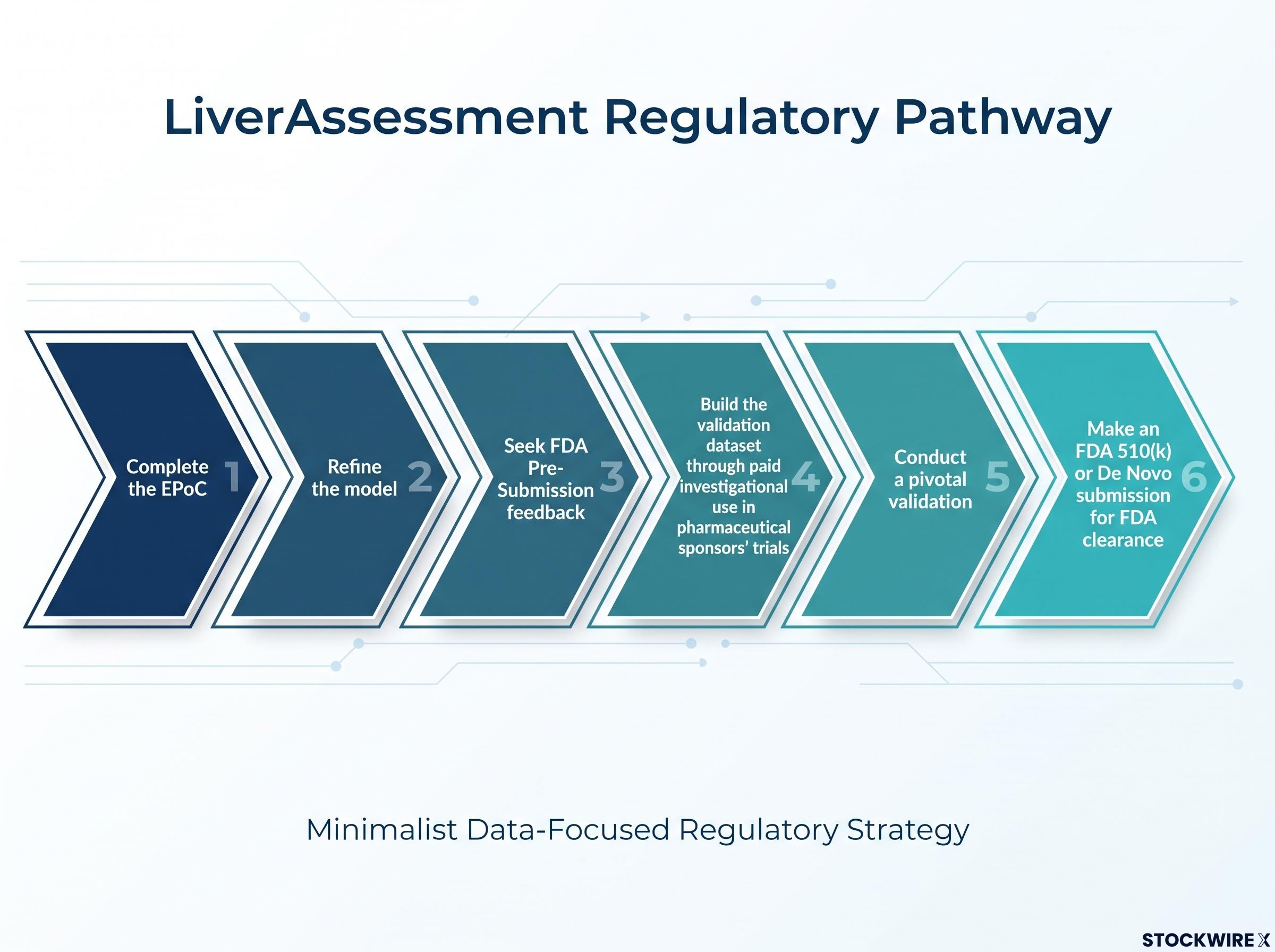
The company states that LiverAssessment follows the same pathway:
- Complete the EPoC.
- Refine the model.
- Seek FDA Pre-Submission feedback.
- Build the validation dataset through paid investigational use in pharmaceutical sponsors’ trials.
- Conduct a pivotal validation.
- Make an FDA 510(k) or De Novo submission for FDA clearance.
What to watch
The investor presentation, also released on ASX on 26 October 2026, sets out catalysts for the next 12 to 24 months. Catalysts and timing are not guaranteed.
- Full EPoC analysis: results for all 68 enrolled subjects.
- Model refinement: the reworked model, built on data already collected and evaluated on independent data.
- FDA Pre-Submission feedback: on intended use, regulatory pathway, reference standard and validation design.
- First investigational-use contracts: paid analysis of fibrosis in pharmaceutical sponsors’ clinical trials.
- Muscle quality endpoints to market and VAT/SAT automation live, completing the obesity-trial imaging protocol.
- First Image Analysis Group (IAG) work orders: pilot studies through the company’s global imaging partner (see ASX release 17 September 2026).
For investors, the picture is a baseline from a deliberately limited first-pass model, a route to improvement using data already held, and a fit with the GLP-1 trial work Resonance already performs. The outcome still depends on independent validation and regulatory steps that remain ahead.
Resonance’s FY26 full year results showed a return to profit on $15.8M of revenue, and FY27 guidance of up to $22M excludes any contribution from the fibrosis device, leaving it as unpriced optionality.
Get Healthcare News Before the Market Moves
Join 20,000+ investors receiving FREE breaking ASX news from Big News Blast within minutes of release, complete with in-depth analysis already done. Click the “Free Alerts” button to get healthcare and biotech announcements in your inbox the moment they break, and stay ahead of the market.