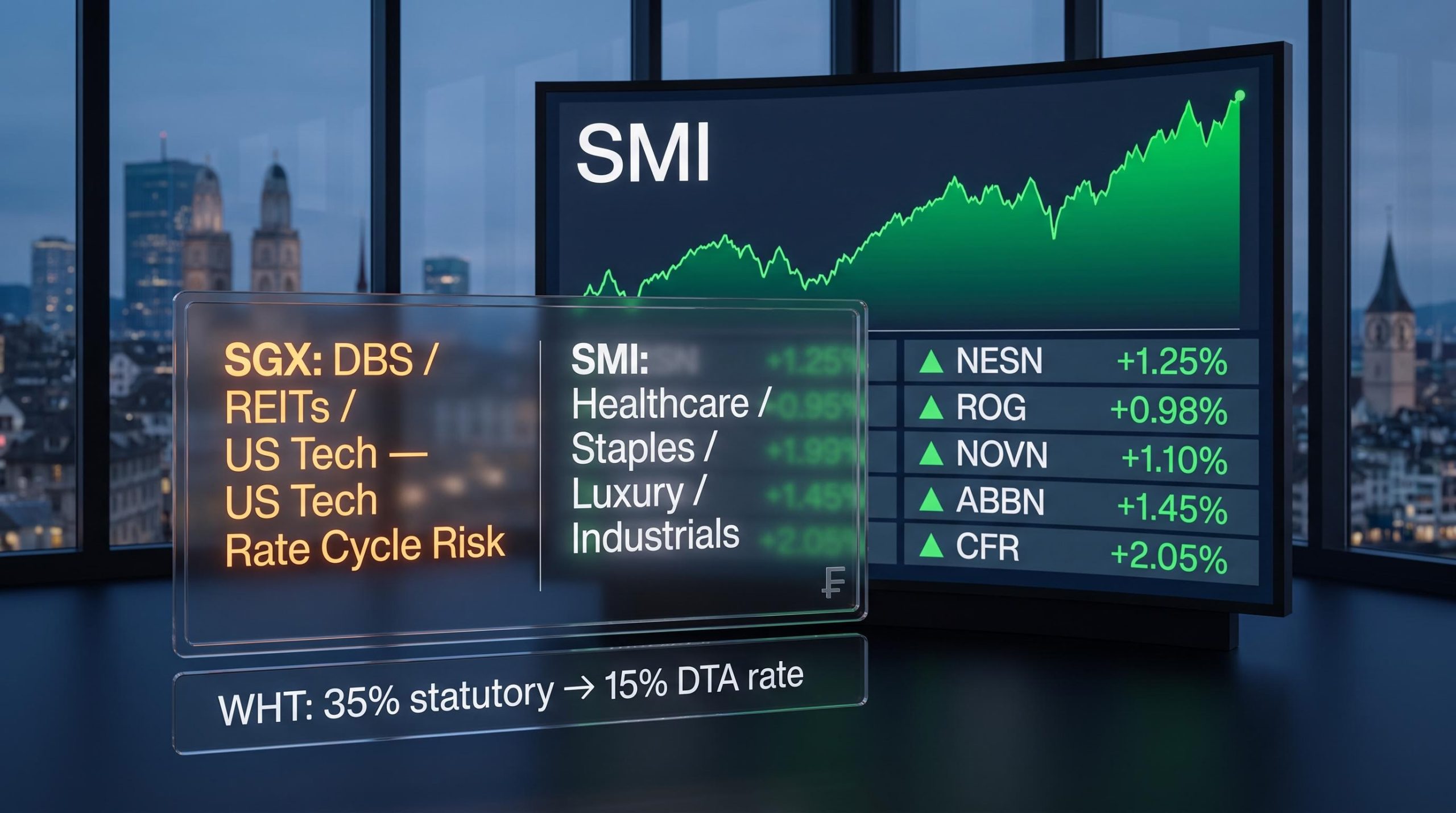
A Singapore investor holding DBS, a couple of REITs, and a US technology ETF probably looks at their portfolio and sees three distinct positions. The reality is less comfortable. Singapore banks move with regional credit cycles. REITs move with interest rates. US tech moves with Federal Reserve expectations. All three respond to the same macro conditions, just through different instruments.
Switzerland offers something structurally different: a small exchange that hosts a handful of globally dominant businesses in healthcare, consumer staples, luxury goods, and industrial automation. The Swiss Market Index (SMI) tracks roughly 20 of the largest, and most of them generate the majority of their revenues outside Switzerland. This is not exotic diversification. It is global exposure through a stable domicile.
Here is the framework for deciding whether Swiss blue-chip stocks belong in your portfolio as a genuine complement, covering the structural case, the real risks, the currency dimension, and the practical entry points available from Singapore.
Why the typical Singapore portfolio has less diversification than it looks
The three-bucket portfolio that feels diversified, Singapore financials, REITs, and US tech, actually shares a common vulnerability. Each bucket responds to the same macro variable: the direction and speed of interest rate cycles.
- Singapore banks (DBS, OCBC, UOB): earnings driven by regional interest rates and credit growth
- Singapore REITs (CapitaLand Integrated Commercial Trust, Ascendas REIT, Mapletree trusts): valuations and distributions sensitive to interest rates and property cycles
- US tech ETFs (S&P 500 or Nasdaq trackers): pricing tied to Federal Reserve policy expectations and growth multiples
That means a Singapore investor who believes they have three distinct exposures may effectively be running a concentrated bet on regional and global rate cycles. A rate shock hits all three at once.
The structural logic here connects directly to what Dalio formalised as the Holy Grail of Investing: genuine diversification requires uncorrelated return streams, not merely different asset labels, and the correlation must be assessed on structural drivers rather than recent price history.
Adding another regional equity ETF does not solve this. Regional equities still move largely in line with global risk sentiment. Swiss blue chips introduce a structurally different sector mix.
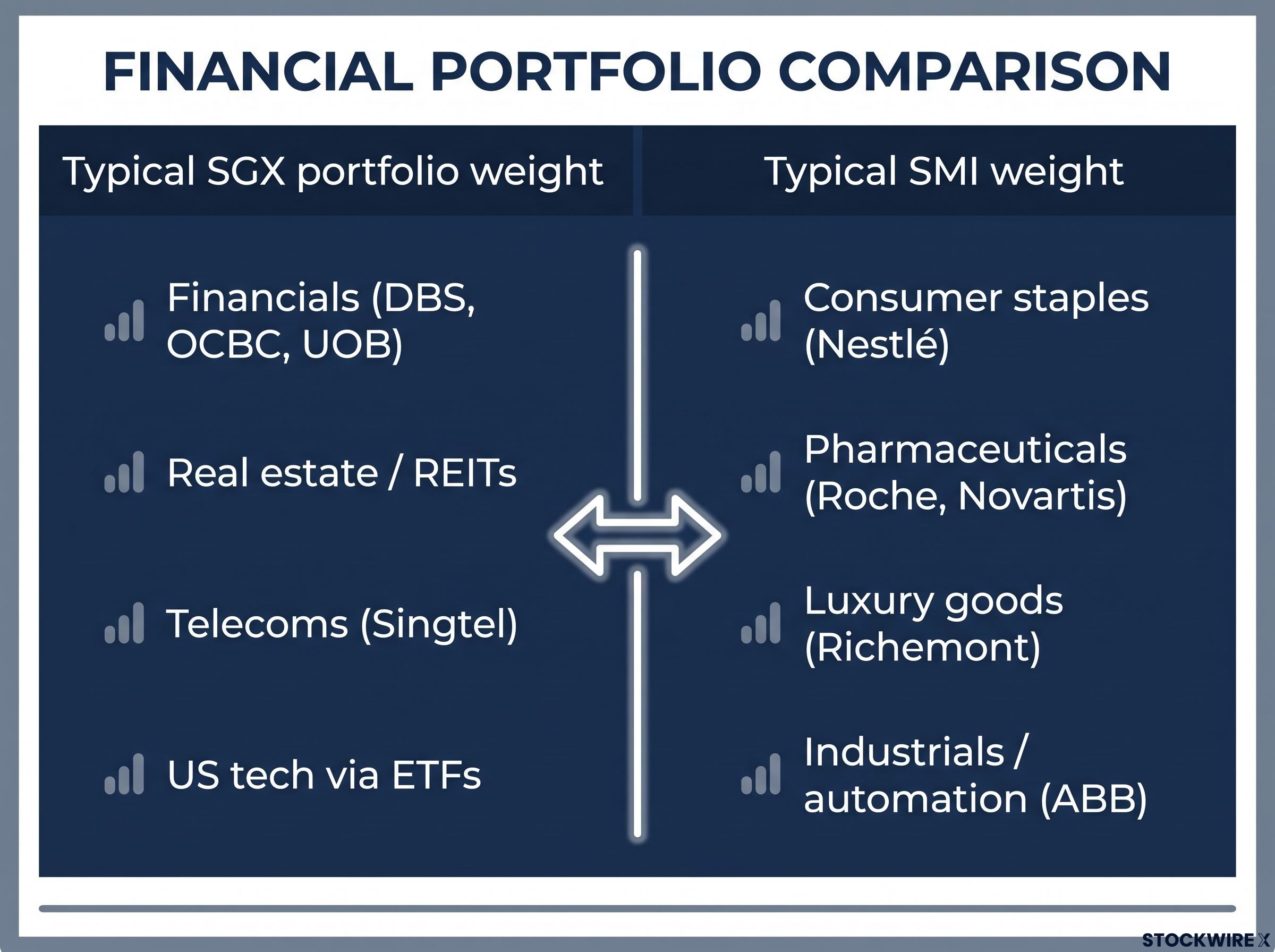
| Typical SGX portfolio weight | Typical SMI weight |
|---|---|
| Financials (DBS, OCBC, UOB) | Consumer staples (Nestlé) |
| Real estate / REITs | Pharmaceuticals (Roche, Novartis) |
| Telecoms (Singtel) | Luxury goods (Richemont) |
| US tech via ETFs | Industrials / automation (ABB) |
The sector overlap between these two columns is close to zero. That is the diversification case in a single table.
When big ASX news breaks, our subscribers know first
What makes the Swiss market structurally different from other European bourses
The SMI is not a representative cross-section of a domestic economy. It is a concentrated collection of globally dominant businesses that happen to be listed on one exchange in Zurich. The SIX Swiss Exchange ranks among the top 20 globally by market capitalisation, and Nestlé, Roche, and Novartis each rank among the most heavily capitalised businesses on the European continent.
What matters is where these companies earn their money. SMI constituents collectively derive most of their revenues from international markets rather than the Swiss domestic economy. Purchasing SMI exposure is therefore less a wager on Switzerland as a country and more a means of accessing worldwide healthcare, consumer, and industrial demand through companies anchored in a highly stable regulatory environment.
By 2026, the SMI had climbed to successive record highs and monthly trading turnover had expanded steadily, a combination that reflects both the index’s defensive qualities and genuine market interest.
| Company | SIX ticker | Sector | Key revenue geography | Global demand theme |
|---|---|---|---|---|
| Nestlé | NESN | Consumer staples | 180+ countries | Defensive global consumer spending |
| Roche | ROG | Pharmaceuticals | US, Europe, Asia-Pacific | Global healthcare and oncology demand |
| Novartis | NOVN | Pharmaceuticals | US, Europe, emerging markets | Global drug pipeline across immunology and therapeutics |
| UBS Group | UBSG | Banking / wealth management | Global | Ultra-high-net-worth private banking |
| ABB | ABBN | Industrial automation | Global | Electrification, robotics, energy transition |
Richemont (SIX: CFR) adds luxury goods exposure through brands including Cartier and Van Cleef & Arpels, while Zurich Insurance (SIX: ZURN) broadens the index into global insurance. Switzerland places at or near the top of global innovation rankings each year, underpinned by deep R&D activity across pharmaceuticals, biotechnology, and precision engineering sectors, which feeds directly into the capabilities and competitiveness of its listed companies.
The benchmarks: SMI, SPI, and beyond
The SMI covers the top 20 large-cap names. The Swiss Performance Index (SPI) provides broader exposure including mid- and small-caps. The UBS 100 Index sits between the two, covering a larger portion of the Swiss market beyond the SMI’s concentrated top tier.
For investors with a diversification goal rather than a specific stock thesis, index-level access via ETFs tracking MSCI Switzerland may be the most practical starting point.
The Swiss franc dimension: a different kind of currency exposure
Holding Swiss equities means holding Swiss franc exposure, and the CHF behaves differently from the two currencies most Singapore investors already carry.
- SGD (domestic): Managed float, relatively stable, moves with regional trade flows
- USD (US tech, ETFs): Strengthens during some risk-off episodes but also responds to Federal Reserve policy shifts
- CHF (Swiss equities): Tends to strengthen during global market stress, driven by Switzerland’s political stability, low public debt, and financial reputation
The CHF has built a strong track record as a refuge currency during periods of global uncertainty, a status underpinned by Switzerland’s fiscal discipline and long-standing political neutrality. In risk-off episodes where global equities fall but CHF strengthens, some of the equity drawdown can be partially offset by currency gains. This dynamic is not available through USD or SGD positions in the same way.
The role of currency diversification within portfolio design has become more contested since 2022, when the stock-bond correlation turned positive and the traditional assumption that two asset classes would behave as genuine offsets was exposed as regime-dependent rather than structural.
In risk-off episodes, CHF strength can partially offset equity drawdown. That is a different kind of cushion from what USD or SGD exposure provides, and it is exactly the sort of non-correlated variable that genuine diversification is built from.
The downside is equally real. If CHF weakens against SGD, that currency movement compounds any equity losses. This is not a one-directional relationship, and no one should treat it as one. But for a Singapore investor already concentrated in SGD and USD, adding a currency whose historical behaviour in market stress has been meaningfully different from both introduces a genuinely distinct risk variable.
The real risks in Swiss blue chips that the quality narrative can obscure
The premium-quality profile is real. So are the risks that come with it. Swiss equities are differently risky, not risk-free, and the distinction matters.
Swiss equities are differently risky, not risk-free. The distinction matters more than the quality narrative suggests.
The three primary risk categories, in order of structural significance:
- Index concentration. Nestlé, Roche, and Novartis together account for a very large share of SMI index weight. A serious setback in any one of the three, a drug trial failure, a regulatory shock, a structural shift in consumer demand, can move the entire index materially. The 20-company headline overstates how diversified the index actually is.
- Valuation premiums. Swiss blue chips carry price-to-earnings multiples that have historically sat above those of equivalent businesses elsewhere. That premium is a rational market response to strong competitive positions, durable earnings, and defensive sector characteristics. The risk is that paying up for quality compresses your margin for error: when a high-priced stock disappoints on earnings, the downside can be sharper than the headline quality story implies.
- Sector-specific regulatory and execution risks. US drug pricing policy represents a material regulatory risk for Roche and Novartis, which derive significant revenues from the US healthcare market. UBS carries integration and execution risk following its Credit Suisse acquisition. Richemont and other luxury names are sensitive to high-net-worth consumer confidence in China.
The concentration risk is the most important one for ETF buyers to understand. An investor buying an SMI-tracking ETF is not as diversified within that allocation as the 20-company count suggests. Understanding where the weight actually sits is the prerequisite for sizing the position correctly.
Index concentration risk is not unique to the SMI: the cap-weighted S&P 500 exhibits a comparable structure, with five mega-cap names controlling approximately 23% of the index, a dynamic that amplifies volatility in both directions and reinforces why headline company counts overstate effective diversification in any concentrated index.
Withholding tax and access: the practicalities Singapore investors need to resolve first
Switzerland applies a withholding tax of 35% to dividends at the point they are paid out. The Singapore-Switzerland double taxation agreement (DTA) provides a pathway for Singapore-resident individual investors to access a reduced rate of 15%, provided they satisfy the relevant residency and beneficial-ownership requirements.
The Singapore-Switzerland DTA ratified text-(1-aug-2012).pdf?sfvrsn=4698b251_5), published by the Inland Revenue Authority of Singapore, explicitly caps dividend withholding tax at 15% for Singapore-resident portfolio investors under Article 10, Paragraph 2(b), confirming the reduced rate is available provided beneficial-ownership and residency conditions are met.
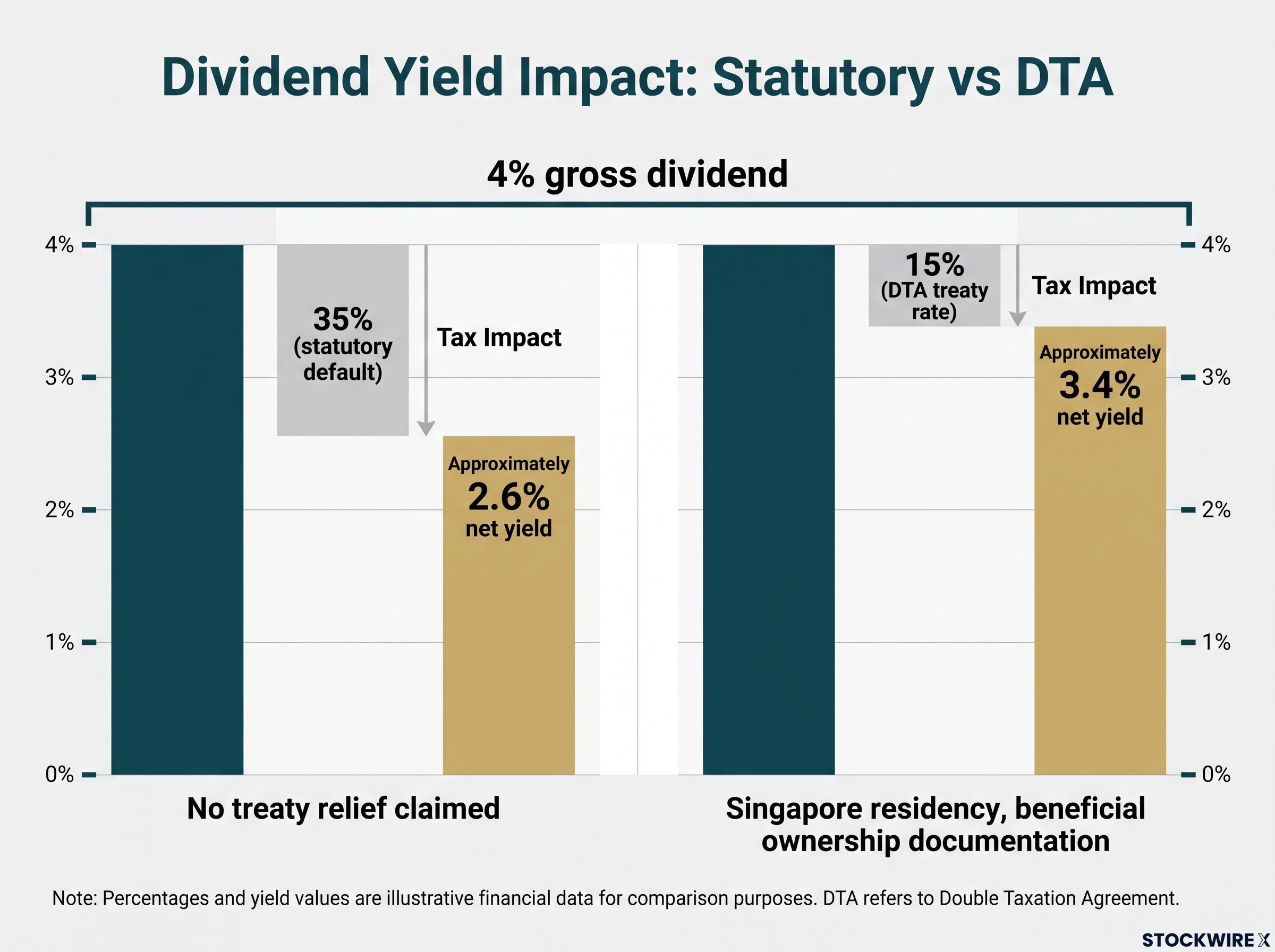
The difference is material. On a 4% gross dividend yield, the gap compounds significantly over a multi-year holding period.
| Withholding rate applied | Net yield on 4% gross dividend (illustrative) | Conditions required |
|---|---|---|
| 35% (statutory default) | Approximately 2.6% | No treaty relief claimed |
| 15% (DTA treaty rate) | Approximately 3.4% | Singapore residency, beneficial ownership documentation, broker/custodian processing |
These figures are illustrative only and assume no other deductions or fees.
In practice, many retail investors will see the full 35% withheld at source. Treaty relief requires a reclaim process that depends on the specific broker and custodian structure. Confirming treaty eligibility with your broker before investing is not an administrative detail; it is a material investment decision that directly affects your effective yield.
Several Singapore brokers including POEMS (Phillip Securities) provide access to the SIX Swiss Exchange. Many major Swiss companies are also dual-listed: UBS trades on the NYSE (ticker: UBS) and Novartis on the NYSE (ticker: NVS), providing an alternative entry route.
Before committing capital, ask your broker these four questions:
- Does your platform provide direct access to the SIX Swiss Exchange?
- What are the settlement currency and FX transaction costs?
- Does the 15% DTA withholding rate apply automatically to your specific account structure, or is a reclaim process required?
- What documentation do you need to submit for treaty relief?
Building a position: how to approach Swiss equities as a complement, not a replacement
Swiss blue chips are not a replacement for existing Singapore bank and REIT holdings. They fill specific sector gaps. That framing should inform how much capital goes in.
The evaluation sequence is straightforward:
- Identify your current sector gaps. If your portfolio is heavy on financials, real estate, and US tech, you are underweight healthcare, consumer staples, luxury, industrials, and global insurance.
- Examine revenue geography and correlation for target Swiss names. Nestlé, Roche, and Novartis generate the majority of their revenues outside Switzerland. Check how their earnings cycle correlates with your existing holdings.
- Choose your access method: direct SIX Swiss Exchange purchase, an ETF tracking MSCI Switzerland, or NYSE-listed ADRs for dual-listed names.
- Confirm broker access and tax treaty position before executing.
- Size the position as a complement, not a core holding. A large allocation to a concentrated index carries its own concentration risk.
Direct stock, ETF, or ADR: choosing the right access route
The three access methods differ on cost, concentration, and tax treatment. Direct SIX purchases give you the most control over individual names but require SIX Exchange access and Swiss franc settlement. ETFs tracking MSCI Switzerland offer the most straightforward entry for investors who want diversified Swiss exposure without stock-specific research. NYSE-listed ADRs (UBS, Novartis) simplify access but may be subject to US withholding rules rather than Swiss treaty rates, a distinction that needs broker confirmation.
The SPI offers broader exposure beyond the top 20 for investors who want to avoid replicating the SMI’s top-heavy structure.
What this analysis actually changes for a Singapore investor’s portfolio decision
The structural case rests on three additions Swiss equities make to a Singapore-concentrated portfolio:
- Sector diversification into healthcare, consumer staples, luxury goods, industrials, and global insurance, none of which are well represented on the SGX. This works only if these are genuine gaps in your current holdings.
- Currency diversification via CHF, a currency whose safe-haven behaviour in market stress has historically differed from both SGD and USD. This works only if you accept the two-way risk.
- Treaty-reduced withholding tax at 15% versus the 35% statutory rate, turning a 2.6% net yield into approximately 3.4%. This works only if your broker and account structure support the DTA claim.
The SMI’s record highs as of 2026 mean premium valuations are a live consideration, not a historical footnote. The quality of these businesses is not in question; the price you pay for that quality is.
The Swiss diversification case is compelling for a specific investor profile: someone with significant SGX financials, REIT, and US tech concentration who is deliberately seeking sector and currency gaps. An investor already broadly diversified across global sectors may find the marginal benefit smaller. Knowing which profile matches your own is the only question that matters.
For investors wanting to apply this sector-gap and currency-diversification logic across a broader asset allocation framework, our comprehensive walkthrough of building a resilient portfolio covers how to structure allocations across economic environments rather than asset-class labels alone.
This article is for informational purposes only and should not be considered financial advice. Investors should conduct their own research and consult with financial professionals before making investment decisions. Past performance does not guarantee future results.