A Singapore investor with a couple of STI bank positions, two or three REITs, and a US tech ETF probably assumes they are diversified. They are not. Three asset classes anchored to two geographies is concentration dressed as diversification, and the gap it leaves is specific: global healthcare, consumer staples, luxury goods, and international wealth management barely feature.
Swiss equities sit at an unusual intersection for Singapore investors looking to fill that gap. The SMI has reached record levels in 2026, the Swiss franc has a long-established reputation as a currency investors turn to during periods of global uncertainty, and a bilateral tax treaty cuts the 35% statutory dividend withholding rate to 15% for qualifying Singapore residents. The companies themselves are globally dominant multinationals whose revenues have little to do with Swiss GDP.
Here is a framework for deciding whether Swiss stocks belong in your portfolio: the market structure, the investable names, the tax mechanics that most investors do not model, and the risks that need to be weighed before you size a position.
What the Swiss market actually is (and what it is not)
The SMI tracks approximately 20 of the largest and most liquid Swiss-listed companies. That is deliberately concentrated. It is not trying to represent the Swiss economy; it is a curated index of globally dominant multinationals that happen to be headquartered in Switzerland.
This distinction matters. Buying the SMI is not a bet on Swiss GDP growth. It is a bet on the global revenues of companies like Nestlé, Roche, and Novartis, three corporations that regularly feature among Europe’s biggest businesses when ranked by market capitalisation. The SIX Swiss Exchange holds the top position on the continent across pharmaceuticals, food products, and life sciences.
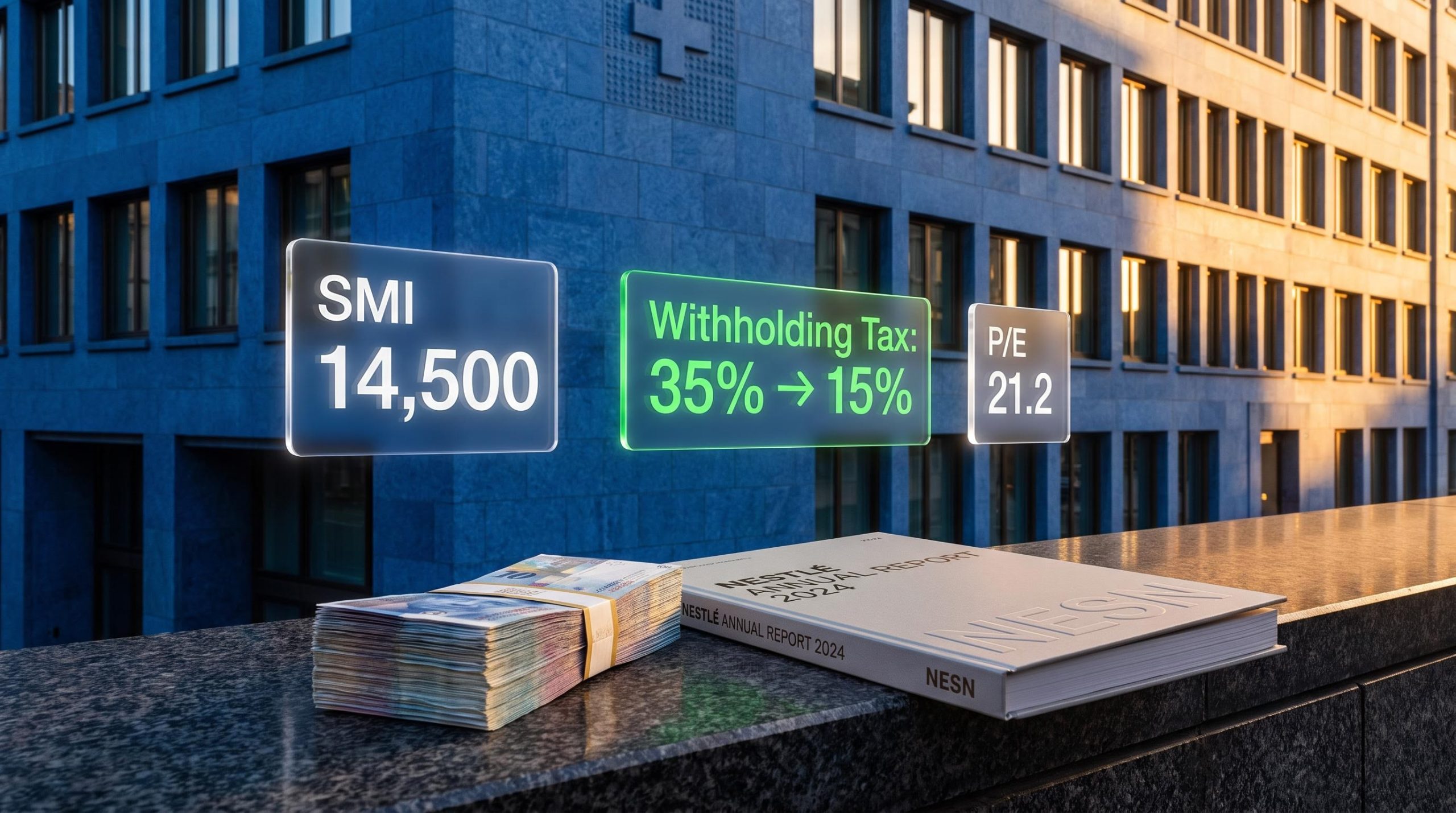
As of late July 2026, the SMI traded around 14,500 points, having reached record levels near 14,426 earlier in the year. Those records are not a Swiss domestic story. They reflect the global earnings power of the index’s dominant constituents, which reshapes how you should think about the risk you are actually taking on with a Swiss allocation. You are buying sector and currency exposure in a politically stable, fiscally conservative jurisdiction.
Sectors represented by the SMI’s dominant constituents
The SMI’s composition gives you access to a specific set of global sectors through individual names:
- Global consumer staples (Nestlé)
- Pharmaceuticals and diagnostics (Roche, Novartis)
- International wealth management (UBS)
- Luxury goods (Richemont)
- Industrial automation and electrification (ABB)
- Global insurance (Zurich Insurance)
When big ASX news breaks, our subscribers know first
Seven core Swiss companies worth understanding before you invest
Each of these names fills a distinct role in a portfolio. The table below is designed to let you see the composite picture of what a Swiss allocation actually delivers, not just a list of tickers.
| Company | SIX Ticker | Sector | Primary Investment Characteristic | Key Risk |
|---|---|---|---|---|
| Nestlé | NESN | Consumer Staples | Defensive global consumer profile with a long dividend history | Organic growth pressure in mature categories |
| Roche | ROG | Pharmaceuticals / Diagnostics | Diagnostics division generates recurring revenue independent of therapy cycles | Pipeline concentration in oncology and immunology |
| Novartis | NOVN | Pharmaceuticals | Diversified therapeutic focus with an established R&D pipeline | Patent expiry timelines on key therapies |
| UBS Group | UBSG | Wealth Management / Banking | World’s leading wealth manager by assets; scale increased via Credit Suisse takeover | Live integration execution risk from Credit Suisse absorption |
| Richemont | CFR | Luxury Goods | Cartier and Van Cleef & Arpels ownership; tied to high-net-worth and Chinese consumer spending | Cyclical luxury demand and China exposure |
| ABB | ABBN | Industrial Automation | Exposure to energy transition capital expenditure and industrial productivity | Capex cycle dependency |
| Zurich Insurance | ZURN | Insurance | Broadens sector diversity beyond pharma, consumer, and financials | Catastrophe loss volatility |
Viewed as a composite, these seven names give you exposure to healthcare demand, global consumption, luxury spending, the energy transition, and international wealth management. Those are the sectors a STI-and-US-tech portfolio systematically underweights. Understanding what each name provides lets you identify which specific gaps in your own holdings a Swiss allocation would fill.
The tax treaty benefit that most investors do not model
Switzerland’s statutory dividend withholding tax is 35%, one of the highest among developed markets. That number alone deters many international investors. It should not deter you if you are a Singapore resident.
Under the Singapore-Switzerland double taxation agreement, qualifying Singapore-resident individual investors are generally eligible for a preferential rate of 15% on Swiss dividends. That is a 20-percentage-point reduction from the statutory rate.
The same logic applies to US equity exposure: Singapore investors holding IVV or VOO face a 30% dividend withholding tax on every distribution, while Ireland-domiciled UCITS alternatives like CSPX reduce that rate to 15% via the US-Ireland treaty, a structural gap that compounds across the same multi-year horizons relevant to Swiss income positions.
The Singapore-Switzerland double taxation agreement specifies in Article 10 that the withholding tax on dividends paid to qualifying Singapore-resident investors shall not exceed 15 per cent of the gross amount, setting the legal foundation for the preferential rate that makes Swiss dividend income materially more attractive than the statutory 35 per cent suggests.
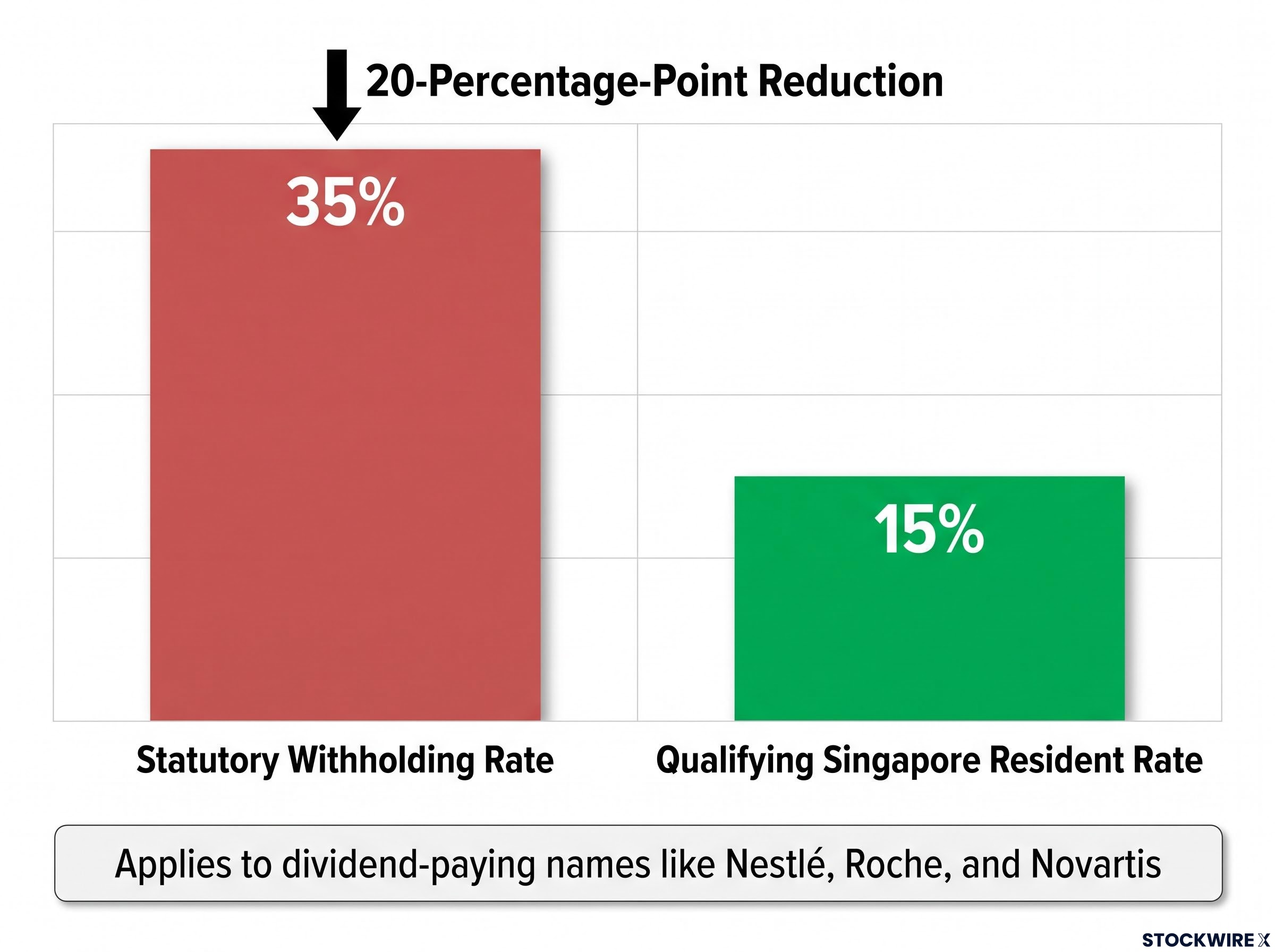
Qualifying Singapore residents are generally eligible for a 15% withholding rate on Swiss dividends, compared to the statutory 35%.
For an income-oriented investor holding Nestlé, Roche, or Novartis over a five-year or longer horizon, this differential is not a technical footnote. It is a material input into expected net yield that compounds meaningfully over time, given these companies’ established dividend track records. It should be modelled before you commit to the position.
Three practical caveats apply:
- The treaty rate is not automatic. It requires proper residency documentation and brokerage setup.
- The reduction mechanism varies by broker: some apply the 15% rate at source via upfront forms, while others require a post-distribution refund process. Confirm the specific mechanics with your broker before investing.
- Consult a tax adviser to confirm your eligibility and understand the applicable process for your situation.
What Swiss exposure actually adds to a Singapore portfolio
The diversification argument for Swiss equities is not abstract. It is specific to the three portfolio types most common among Singapore retail investors:
- STI-heavy portfolios concentrated in local banks and property developers gain global healthcare, consumer staples, and luxury goods exposure they otherwise lack entirely.
- REIT-heavy income portfolios add dividend-paying equities in non-correlated sectors (pharmaceuticals, industrials) with a different yield driver than rental income.
- US tech-heavy growth portfolios introduce defensive, lower-volatility names that behave differently during risk-off periods.
Income-oriented investors extending their holdings beyond Singapore REIT portfolios into Swiss dividend payers should note that the yield assessment framework differs significantly: REIT distributions are driven by rental income and leverage, while Swiss pharmaceutical and consumer dividends reflect free cash flow generation from global operations with limited domestic property exposure.
The CHF adds a currency dimension worth understanding. The Swiss franc carries a well-documented track record of attracting capital when global risk appetite falls, with historically notable inflows during banking crises and geopolitical shocks. In risk-off environments, it can support portfolio value when SGD or USD-denominated holdings are falling. In risk-on environments, however, CHF can weaken against higher-yielding currencies, diluting your SGD returns even when local-currency share prices rise. The currency diversification is real, but directional rather than guaranteed, and should be treated as a secondary benefit rather than the primary thesis.
How Singapore investors can access Swiss equities
Access is straightforward for retail investors using international brokerage platforms:
- Direct SIX trading via multi-market brokers that support CHF-denominated shares
- Dual listings for names like UBS and Novartis, which trade on US exchanges
- Swiss equity ETFs tracking the SMI or the broader Swiss Performance Index (SPI) for diversified exposure
- UBS 100 Index products for mid-cap exposure beyond the top 20 SMI names
Five structural risks to assess before sizing a Swiss allocation
The SMI’s defensive reputation does not mean Swiss equities are low risk. Five specific risks need to be weighed before you size a position:
- Index concentration: Approximately 20 names, with the index weight skewed heavily toward just a few constituents. A significant earnings miss from Nestlé, Roche, or Novartis is enough to shift the overall index noticeably.
- Valuation premium: Swiss blue chips have historically traded at elevated multiples. The SMI’s estimated price-to-earnings ratio (the share price divided by earnings per share, measuring how much investors pay for each dollar of profit) sat at approximately 21.2 as of late 2025.
- CHF currency risk: The franc can support your portfolio in risk-off phases and erode returns in risk-on phases. The direction is unpredictable in any given period.
- UBS integration execution: The Credit Suisse takeover expanded UBS’s scale, but the ongoing integration is a live execution risk that distinguishes it from the other six names.
- Global drawdown participation: Swiss stocks declined during the 2008 global financial crisis, the 2020 pandemic selloff, and the 2022 rate-driven downturn, albeit often with smaller drawdowns than more cyclical markets. Historical resilience does not guarantee future performance.
Swiss blue chips trade at a valuation premium within Europe, but the broader European equity universe carries a persistent valuation discount to US equities of roughly 31% on forward earnings multiples, a gap that gives the Swiss allocation a regional context for investors comparing it against their existing US tech exposure.
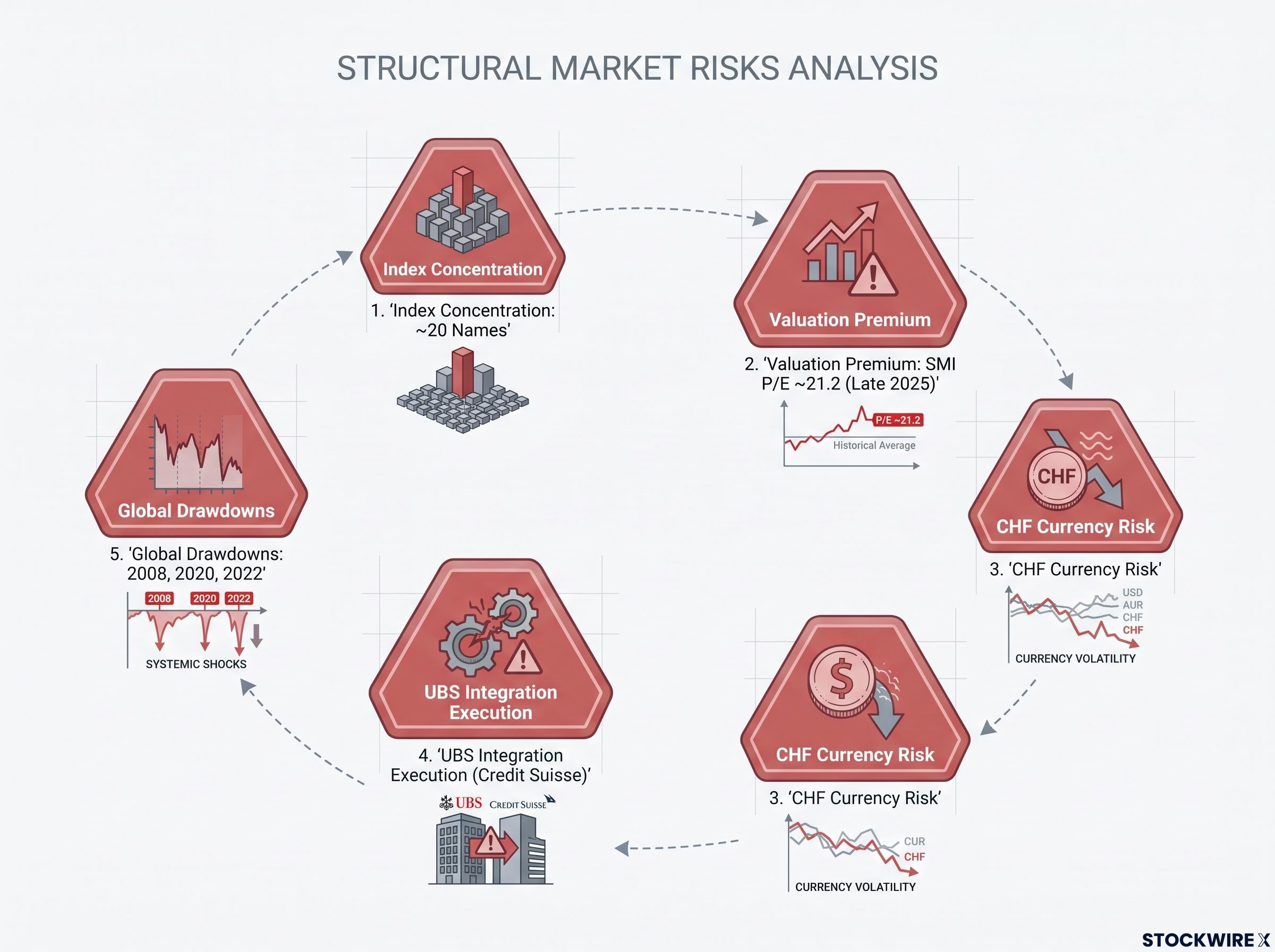
Quality at premium prices is not the same as quality at attractive prices. The SMI’s estimated P/E of approximately 21.2 as of late 2025 means future returns depend on continued earnings delivery.
What you should take away from this risk list is that a Swiss allocation trades one form of concentration (sector and geographic) for another (index name concentration and currency uncertainty). It reduces portfolio overlap with your existing holdings. It does not eliminate concentration risk.
A clear-eyed verdict on Swiss exposure for Singapore portfolios
The case for Swiss equities reduces to a simple question: does your portfolio already hold enough global healthcare, consumer staples, luxury goods, global industrials, and international wealth management? For most Singapore retail investors, the answer is no.
The concentration problem the article opens with has a specific shape in mid-2026: STI bank concentration is not merely a diversification abstraction but a live position risk, given that DBS, OCBC, and UOB now trade near all-time highs after delivering an 11.3% return in the first half of the year, making the case for adding non-correlated Swiss exposure more structurally compelling than in prior periods.
The investor profile best suited to a Swiss allocation:
- Long-term, income-oriented investors willing to hold dividend-paying names over a multi-year horizon
- Investors actively diversifying away from STI bank, REIT, and US tech concentration
- Those prepared to engage with the tax treaty documentation process and manage the CHF currency dimension
The investor profile least suited:
- Short-term traders looking for tactical momentum
- Investors specifically seeking to reduce pharma and consumer staples exposure
- Those unwilling to manage cross-border tax documentation or absorb currency volatility
The strongest case for Swiss equities is not that they outperform. It is that they do different things than what most Singapore retail portfolios already hold, and that the tax treaty makes the income argument structurally more compelling than in most other developed markets. The 20-percentage-point treaty benefit on dividends from Nestlé, Roche, and Novartis compounds meaningfully over time.
The appropriate position size is as a complement to existing holdings, not a replacement. Conduct your own research, consult a qualified financial adviser, and work with a tax professional to confirm treaty eligibility before committing capital.
This article is for informational purposes only and should not be considered financial advice. Investors should conduct their own research and consult with financial professionals before making investment decisions. Past performance does not guarantee future results.