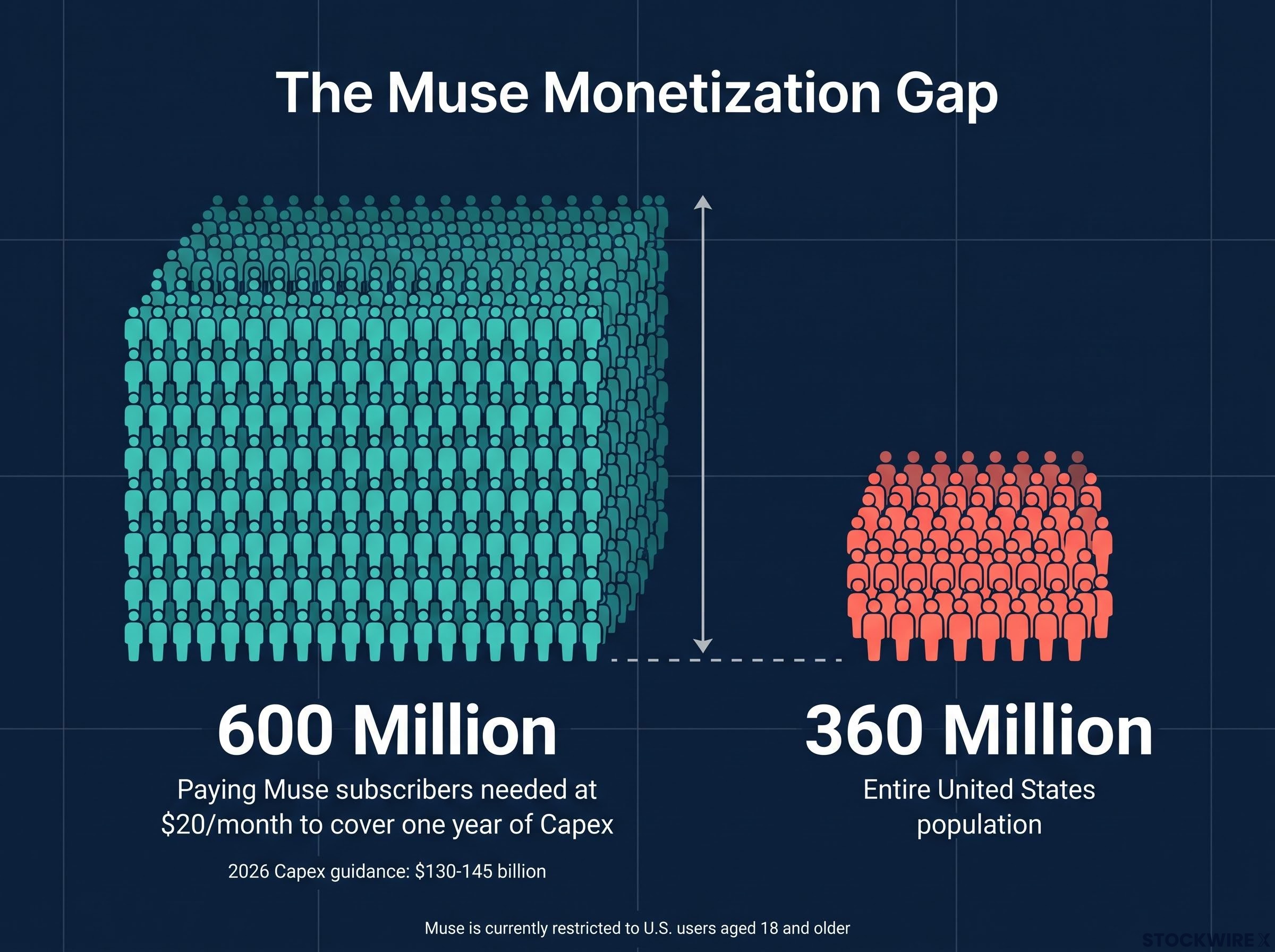
At $20 per month, Meta would need roughly 600 million paying Muse subscribers to cover a single year of its capital expenditure. The entire population of the United States is around 360 million.
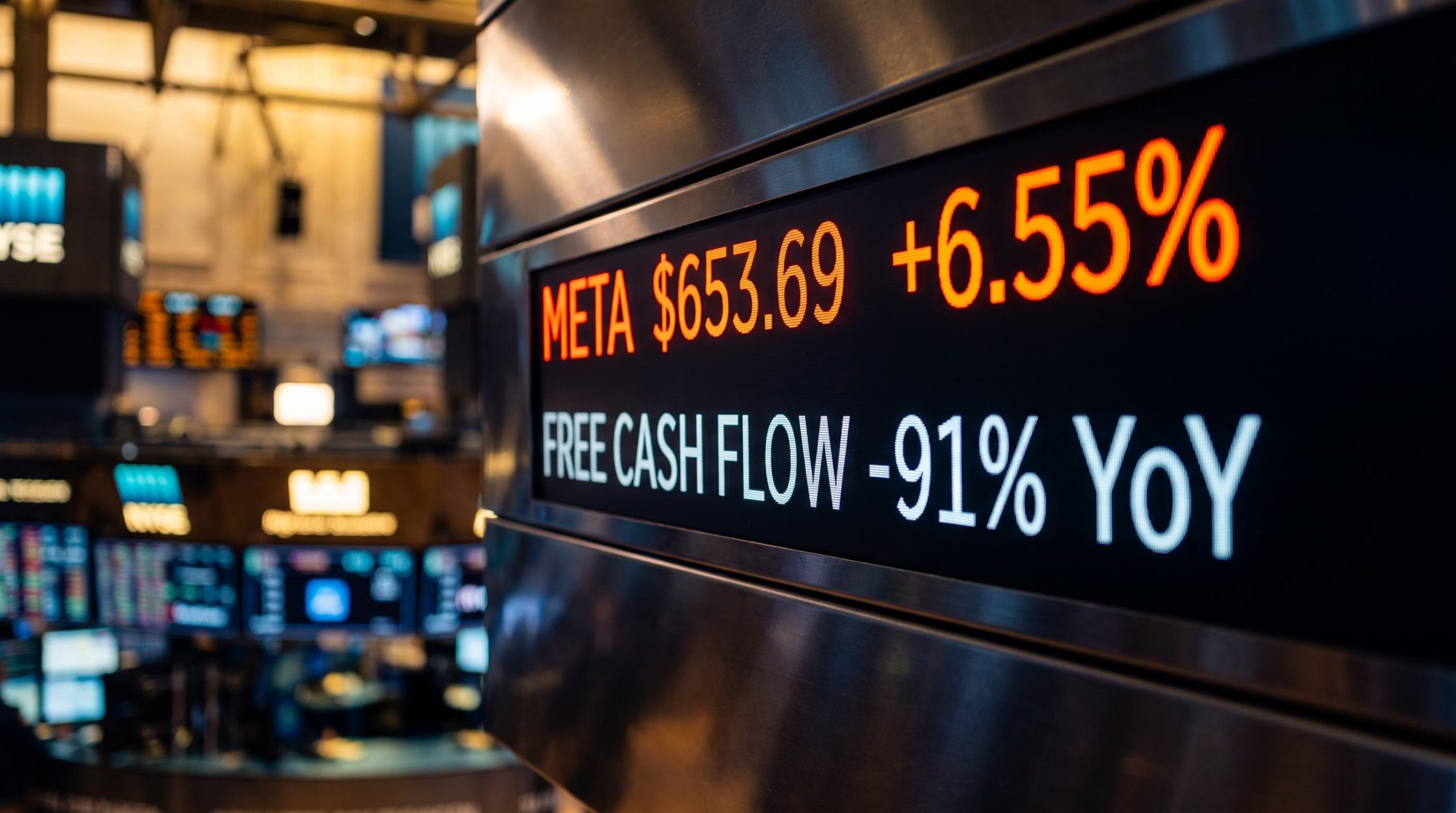
That arithmetic sat quietly under one of the loudest moves Meta has made all year. On 9 September 2026, Meta stock closed at $653.69, up 6.55% on the day, the session after the company launched Muse, a standalone personal AI agent priced at $20 or $100 per month. The rally extended a roughly 17% gain over the prior 20 sessions. Yet the financial backdrop tells a harsher story: free cash flow collapsed 91% year-over-year to $784 million in Q2 2026, against 2026 capex guidance of $130-145 billion.
So what did the rally actually price in? This piece works through what the move tells us about how investors are valuing Meta’s push to make money from AI right now, where the subscriber math breaks down, and what conditions would need to hold for the thesis to be more than sentiment chasing a product launch.
The 6.55% rally and the investor logic behind it
The market did not read Muse as a product announcement. It read it as evidence.
For several quarters, Meta’s investors had watched capital expenditure climb without a paid consumer product attached to it. Muse changed that framing by layering a direct subscription structure onto the AI infrastructure Meta has been building. Suddenly there was a price tag, a tier, and a bill a customer could actually pay.
The logic driving the 6.55% rally on 9 September 2026 followed a clear sequence:
- Capex was punished when there was no product to show for it. Q1 2026 earnings saw the stock fall roughly 6% after hours when management raised 2026 capex guidance by $10 billion, even after a revenue beat.
- Technical benchmarks were rewarded as proof that the spend produced competitive models, with the earlier Muse Spark release driving a rally of roughly 9% over two days.
- Muse was rewarded as proof of commercial intent, the first paid product bolted directly onto the infrastructure.
The precedent for the market’s reaction to Muse was set in Q1 2026, when capex guidance raised to $125-145 billion triggered a roughly 9% selloff despite 33% revenue growth, establishing the pattern of punishing spending announcements that lack an attached commercial product.
That pattern tells you something important about how the market treats Meta’s spending. Investors are not fundamentally opposed to the capex. They are demanding evidence it produces something people will pay for, and Muse is the first concrete answer Meta has offered.
The bull framing rests on the idea that this is a beginning, not a one-off.
Mizuho Securities has described Muse as “the beginning of a substantial product cycle for Meta that is not priced into shares,” arguing the market underestimates the company’s AI positioning.
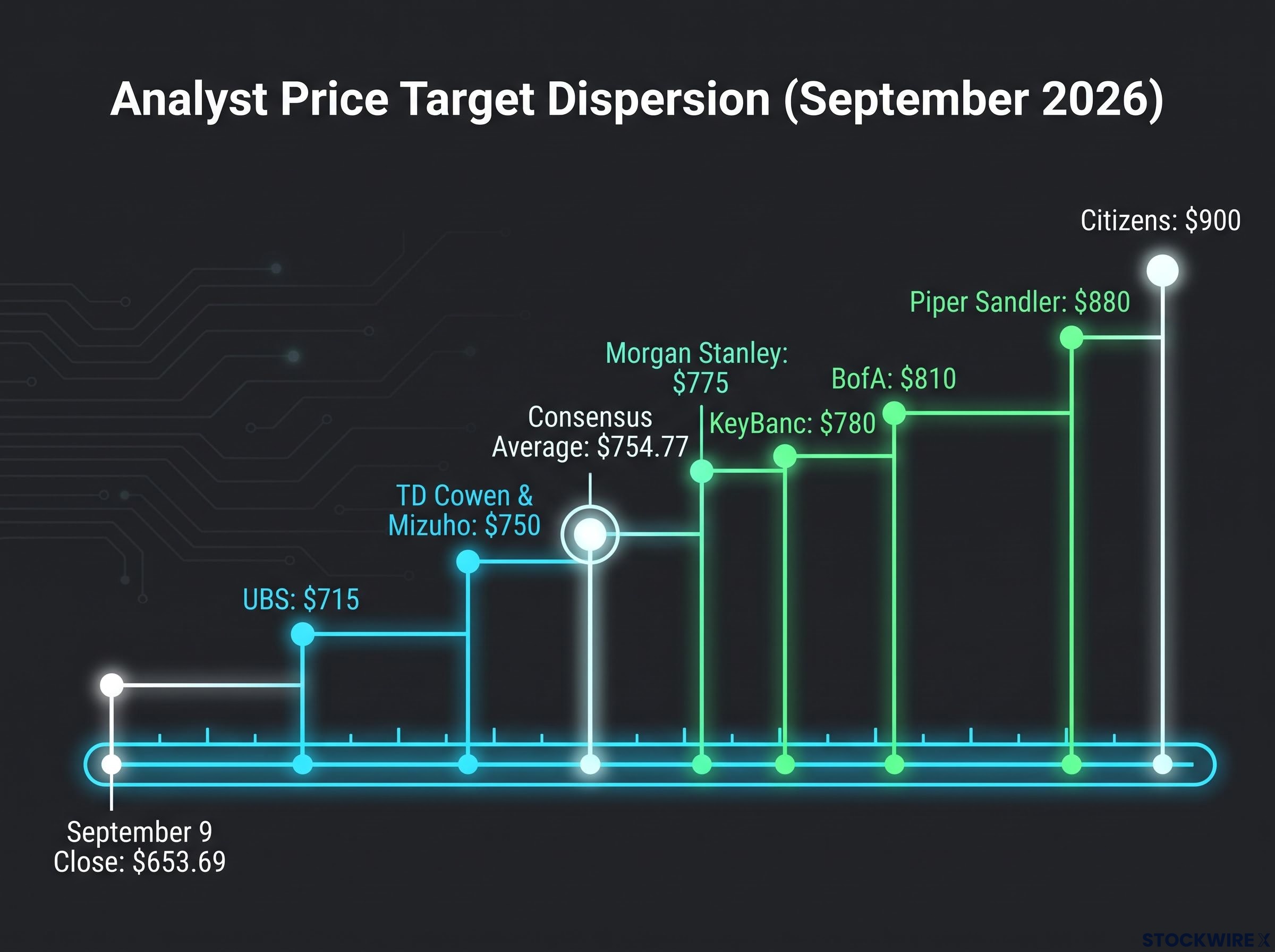
The broader Street is aligned with that view. Analyst consensus stood at 55 Buys, 7 Holds, and 0 Sells, with an average target of roughly $754.77 as of September 2026. Mizuho carries an Outperform at $750, KeyBanc an Overweight at $780. Yahoo Finance characterised the Muse launch as “the first meaningful vote for the company’s AI monetization” since Meta’s July earnings.
The rally, then, was not sentiment for its own sake. It was the market rewarding the exact thing it had spent quarters demanding. Whether that reward is durable depends on a number the enthusiasm has so far skipped over.
When big ASX news breaks, our subscribers know first
What it actually costs to monetize AI at this scale
Start with the capex line, because everything else bends around it.
Meta spent $72.22 billion on capital expenditure in full-year 2025, according to the company’s own results. For 2026, Q2 guidance narrowed the range to $130-145 billion, nearly double the prior year. Q2 2026 capex alone came in at $31.08 billion.
Now run the subscription math against that. At $20 per month, offsetting a single year of capex would require roughly 600 million paying subscribers. The entire U.S. population is around 360 million, and Muse is currently restricted to U.S. users aged 18 and older. The number is not merely ambitious. It is structurally impossible within the product’s current geography.
U.S. Census Bureau population estimates place the U.S. resident population at approximately 341.8 million as of mid-2025, a figure that underscores just how implausible a 600 million domestic subscriber base would be for any product restricted to U.S. adults.
The free cash flow picture sharpens the strain. Q2 2026 free cash flow fell to $784 million, down from $8.55 billion a year earlier, a 91% decline.
The Q2 2026 earnings report crystallised the tension between Meta’s revenue engine and its infrastructure ambitions: a 28% top-line beat arrived alongside a $42 billion expense base that drove free cash flow down 91% and sent shares roughly 8% lower after hours.
| Metric | FY 2025 actual | Q2 2026 | 2026 guidance |
|---|---|---|---|
| Capital expenditure | $72.22B | $31.08B | $130-145B |
| Free cash flow | – | $784M | – |
| Total expense guidance | – | – | $165-169B |
Total 2026 expense guidance sits at $165-169 billion, a figure that already absorbs a $2.4 billion legal charge.
Three structural constraints frame why the subscription route cannot close this gap in the near term:
- The subscriber math requires scale the U.S. population cannot supply.
- The ad-firewall structure isolates Muse from Meta’s core revenue engine.
- Even bullish analysts are not modeling near-term Muse revenue. TD Cowen, holding a Buy at $750, describes Muse as a potential longer-term stream rather than a 2026 fix.
That last point matters most. When the most bullish end of the consensus declines to put Muse revenue into its model, the rally is not pricing a near-term financial recovery. It is pricing a multi-year arc, and where you land on that distinction depends heavily on your investment horizon.
The ad-firewall constraint that changes the monetization math
Muse deliberately separates its subscription data from Meta’s advertising infrastructure. This is a policy choice, not a technical limitation.
The consequence is significant. Meta’s core business generates most of its revenue by monetizing user data through advertising, and Muse is walled off from that flywheel entirely. The $20 and $100 tiers must stand on their own, carrying the full monetization burden without access to the ad engine that funds everything else.
What analyst targets reveal about the longer-term thesis
The consensus is overwhelmingly positive. Look closer, and the spread of targets tells a more interesting story than the average.
Price objectives run from $715 at UBS, through $750 at TD Cowen and Mizuho, up to $880 at Piper Sandler and $900 at Citizens. The Street-high figure of $1,117 attributed to Rosenblatt is flagged as unverified and sits well outside the pack.
| Analyst | Rating | Price target | Core thesis |
|---|---|---|---|
| TD Cowen | Buy | $750 | Muse a longer-term stream, not modeled near-term |
| Mizuho | Outperform | $750 | Start of a product cycle not priced in |
| KeyBanc | Overweight | $780 | Market underestimates AI positioning |
| Morgan Stanley | Overweight | $775 | Product cycle re-rating underway |
| BofA | Buy | $810 | AI product pipeline upside |
| Piper Sandler | Buy | $880 | Muse lifts ad revenue and engagement |
| Citizens | Buy | $900 | Engagement and ad-revenue upside |
The dispersion maps directly onto a genuine disagreement about what Muse is. Analysts who see it primarily as an ad-enhancement tool, lifting engagement and targeting, model the higher targets, because that thesis sidesteps the subscriber math problem entirely. Those who treat it as a standalone subscription product sit lower, hemmed in by the same arithmetic the market has yet to confront.
The consensus has already been stress-tested once. In April 2026, KeyBanc cut its target from $855 to $760 and Wells Fargo from $856 to $765, both citing rising AI infrastructure costs.
KeyBanc has framed its bull case around the view that the market continues to “underestimate Meta’s AI positioning and product cycle.”
That compression is the real signal. The consensus average slipped from roughly $847.70 in April to $754.77 by September, a decline driven by capex anxiety. What that tells you is that the market has already partially discounted the spending risk. The open question is whether Muse’s commercial launch reverses that compression or merely pauses it.
Beyond subscriptions sits a second angle. Zuckerberg has disclosed a plan to rent Meta’s AI computing power to third parties, an infrastructure revenue stream distinct from Muse entirely, though one analysts have barely begun to model.
The competitive signal the Alphabet move confirmed
The clearest read on where investors think Meta is competing did not come from Meta at all. It came from Alphabet.
On 9 September 2026, as Meta rose 6.55%, Alphabet fell roughly 2%. Coverage framed the split as the market recognising that Muse takes aim at Google’s Gemini and search-adjacent AI use cases, not the enterprise and cloud territory held by Microsoft and Amazon.
The product profile explains why. Muse is a consumer AI agent built to execute tasks autonomously:
- Booking travel
- Negotiating bills
- Completing forms
- Executing multi-step tasks across email, calendar, payments, health data, and shopping
That capability set sits far closer to Google’s search and assistant ambitions than to Azure or AWS infrastructure plays. Which is precisely why the market assigned the competitive cost to Alphabet rather than Microsoft.
Alphabet fell roughly 2% while Meta rose 6.55% on the same session, the market making a direct call on which incumbent Muse threatens most.
That 2% decline is the single most direct signal about the assumptions embedded in Meta’s AI thesis. It points toward consumer AI territory, where Google has the most to lose, and where the monetization case depends on consumer adoption at scale rather than enterprise contract wins.
There is one dimension where Meta does overlap with the cloud giants. Zuckerberg’s plan to rent AI compute to third parties would create genuine competition with AWS and Azure. It is an emerging stream, and analysts have been careful not to overstate its weight in current forecasts. The context still matters: firms demonstrating AI monetization through Azure and AWS have fared better in recent earnings cycles, which is exactly the benchmark against which Muse is now being judged.
Meta Compute, the cloud division Bloomberg reported in July 2026, targets two distinct revenue models: a hosted AI model platform comparable to AWS Bedrock, and raw GPU compute leasing comparable to CoreWeave, each carrying different margin profiles from the Muse subscription tier.
Whether the rally prices in optimism or evidence
Both sides of this debate are internally coherent. Which one is right depends on a small set of variables that are not yet resolved.
The case for durability:
- If Muse proves AI infrastructure can generate subscription revenue at all, the framing shifts permanently.
- A secondary lift to ad engagement would sidestep the subscriber math entirely.
- Zuckerberg’s compute-renting plan could open a cloud-style stream distinct from Muse.
- At consensus, the $754.77 average target implies roughly 15% upside from the $653.69 close, with the capex justified in arrears.
- Named bull sentiment is visible: Bill Ackman has reportedly increased his position.
Enterprise AI monetisation represents the third leg of Meta’s commercial thesis, distinct from Muse subscriptions and compute leasing, built on 200 million monthly business users and the Llama model suite, though no separately reported revenue line items exist in Meta’s formal filings as of mid-2026.
The case for caution:
- Q2 2026 free cash flow of $784 million against $130-145 billion of capex leaves the self-funding narrative dependent on revenue that is not yet modeled.
- TD Cowen is explicitly not forecasting near-term Muse income.
- The 600 million subscriber figure illustrates the gap between launch and capex offset.
- The $2.4 billion legal charge is an ongoing cost overhang.
- The 52-week range of $520.26 to $790.80 leaves room to fall as well as rise.
Where you land depends almost entirely on time horizon. A 12-month view confronts a financial picture that has deteriorated sharply. A three-to-five-year view is pricing an AI monetization arc with no precedent to measure it against.
Three variables that will test the thesis before year-end
- Subscriber growth data. Watch whether Meta discloses international expansion plans and early uptake numbers in Q3 2026 earnings. The U.S.-only restriction caps the subscriber ceiling until that changes.
- Formal revenue modeling. If a major analyst begins incorporating Muse subscription revenue into their earnings model, it signals confidence that the commercial arc has genuinely begun.
- Capex trajectory. Any Q3 2026 signal that spending is approaching a plateau would materially change the free cash flow math and the self-funding narrative.
This article is for informational purposes only and should not be considered financial advice. Investors should conduct their own research and consult with financial professionals before making investment decisions. Past performance does not guarantee future results. Financial projections are subject to market conditions and various risk factors.
What the Muse moment actually changes for Meta’s investment case
The rally did change something real, and it is worth naming precisely.
Muse’s launch has shifted Meta’s narrative from “overspending ad company” to “AI infrastructure company with a commercial product.” BigGo Finance has framed the broader move as a “comeback story.” That shift in framing carries lasting valuation consequences even while near-term revenue remains immaterial.
What it did not change is the arithmetic. The subscriber math problem does not vanish because Muse exists, and the 91% free cash flow decline reflects a financial reality that no product launch can retroactively repair.
Yahoo Finance has cautioned that the rally looks like “sentiment ahead of evidence,” a direct counterweight to the bullish framing that has carried the stock.
Two structural developments would have to materialise to make the bull case financially coherent: the global expansion of Muse beyond its current U.S.-only, 18-plus restriction, and the maturing of the compute-renting initiative into a modeled revenue stream. Those are the forward-looking anchors worth holding.
At $754.77 consensus against the $653.69 close, the Street sees roughly 15% upside. The question is not whether Meta has changed its story, because it clearly has. It is whether the financial architecture to support that story arrives before the market’s patience for proof-point rallies runs out.