
Goldman Sachs has added two European companies to its highest-conviction stock list that most investors have not been watching: Swiss construction materials group Sika and Spanish luxury fragrance house Puig. While the August 2026 update’s third addition, ASML, attracted the bulk of market attention, the Sika and Puig inclusions carry investment theses that are arguably more nuanced and less widely understood.
The Goldman Sachs European Conviction List is a curated set of the bank’s strongest ideas in European equities, where analysts hold views that diverge meaningfully from market consensus. An addition signals that Goldman’s analysts see a path to sustained outperformance not yet reflected in current prices. The simultaneous addition of Sika and Puig, two companies in entirely different sectors, points to a deliberate broadening of the list’s thematic range in this update cycle.
Here is the specific investment case Goldman is making for each company, the data behind those cases, and what the two additions share in common, giving you a clear basis for evaluating whether these are stories worth adding to your own watchlist.
What the Goldman Sachs Conviction List actually means for investors
The European Conviction List is not a standard buy-rated coverage list. It represents Goldman’s highest-conviction calls in European equities, reserved for names where the analyst sees a clear multi-year path to outperformance that the broader market has not yet priced in. A stock earning a place on this list carries a stronger claim than a routine recommendation.
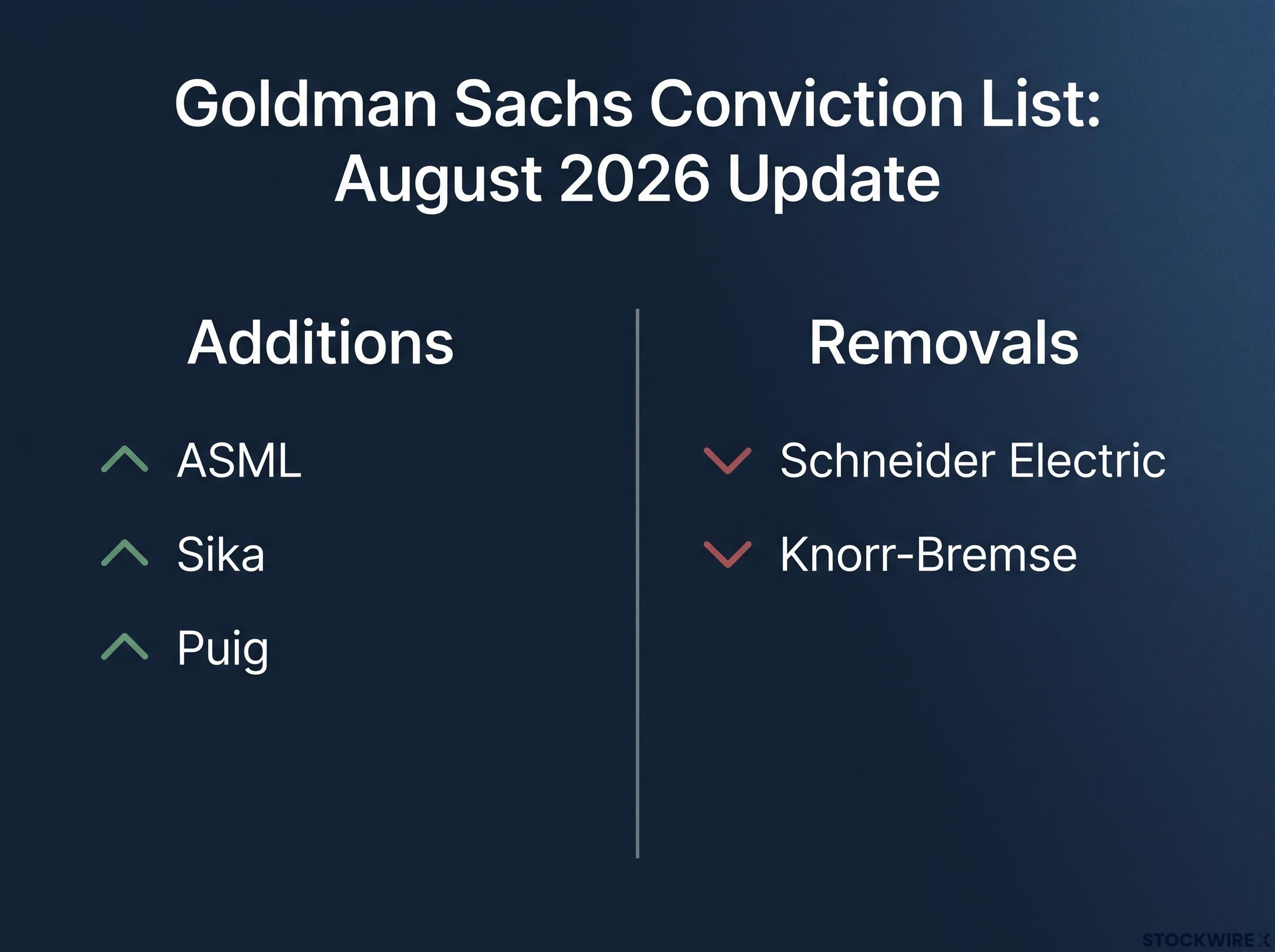
The August 2026 update signals active curation, not passive accumulation. Goldman added three names and removed two:
- Additions: ASML, Sika, Puig
- Removals: Schneider Electric, Knorr-Bremse
That rotation matters. Goldman is not simply stacking names; it is reallocating conviction capital toward companies where its forecasts sit above prevailing consensus. For anyone evaluating whether to act on a Conviction List addition, the implication is specific and testable: Goldman is betting the market has not caught up yet. If results confirm the thesis, the stock re-rates. If they do not, the conviction call was wrong.
For investors wanting to understand the broader portfolio context for European equity exposure, our full explainer on European diversification strategy covers the persistent 31% valuation discount to the S&P 500, projected STOXX 600 dividends, and how European multinationals reduce single-country concentration risk.
When big ASX news breaks, our subscribers know first
Sika’s recovery thesis: volume inflection in markets that do not move like the cycle
Goldman’s case for Sika, covered by analyst Ben Rada-Martin, starts with volumes. Rada-Martin’s view is that the demand recovery now under way at Sika has durable foundations rather than reflecting a short-lived inventory rebuild, because of the particular mix of end markets generating that demand.
He points to three end markets he regards as offering structural rather than cyclical support:
- Infrastructure: backed by long-term public investment programmes, providing multi-year demand visibility
- Renovations: typically more resilient than new-build activity during economic slowdowns
- Data centres: a structurally growing demand source as global digital infrastructure build-out accelerates
That mix is what separates the Sika thesis from a generic construction materials recovery story. These are not segments that swing sharply with housing sentiment.
Then there is the margin layer. Rada-Martin’s analysis points to a favourable cost dynamic: Sika’s earlier pricing gains remain intact, while the input cost pressures that compressed margins in prior periods are now unwinding. Those two forces together, preserved pricing alongside retreating raw material costs, lay the groundwork for margin stability and potential improvement from here.
Ben Rada-Martin, Goldman Sachs: FY 2027 EPS forecast sits approximately 5% above prevailing market consensus.
That 5% consensus gap is the number that matters most. It tells you Goldman believes the market is still underestimating either the durability of the volume recovery or the extent of margin upside. If Goldman is right, that gap is where the return opportunity lives.
Puig’s fragrance gap: why a 9-point share deficit in women’s fragrance is the growth story
The arithmetic speaks first. Goldman analyst Aron Adamski notes that Puig commands roughly 17% of the men’s fragrance market yet holds only around 8% in women’s fragrance, a category that is close to twice the size of men’s by global revenue.
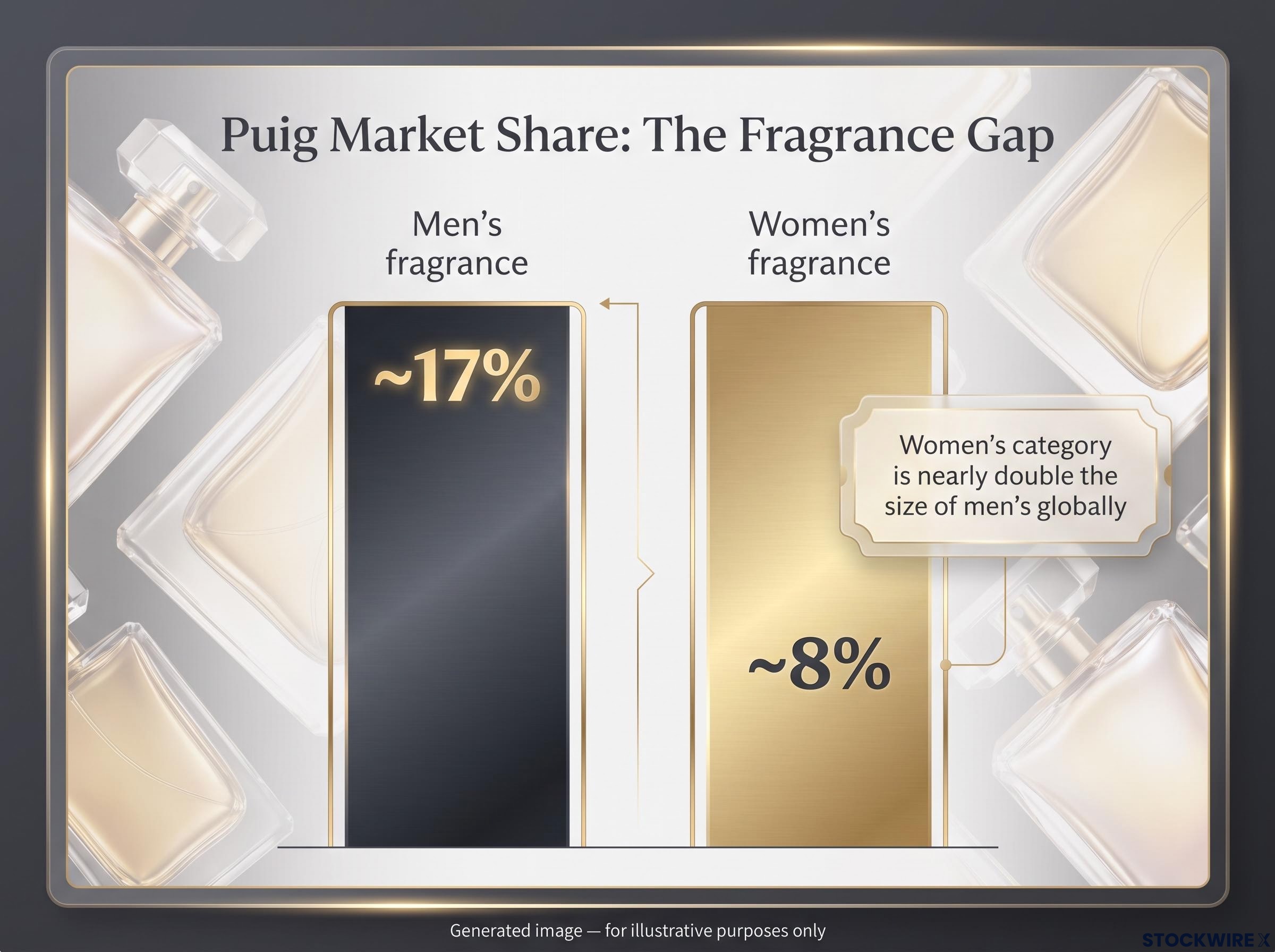
Puig’s position in women’s fragrance, at roughly 8% share in a category nearly double the size of men’s, represents a measurable and addressable growth opportunity rather than a structural weakness.
| Category | Puig Market Share | Market Size Context |
|---|---|---|
| Men’s fragrance | ~17% | Established leadership position |
| Women’s fragrance | ~8% | Nearly double the size of men’s globally |
| Makeup and skincare | Under 30% of total Puig sales | Includes Charlotte Tilbury; early in scaling curve |
Closing even a portion of that 9-point gap, in a category that large, represents a multi-year, high-margin revenue opportunity. Goldman’s near-term catalyst is the mechanism for getting there: Puig has entered a period of unusually high new product activity, with more launches in the pipeline than at any prior point in the company’s history. In luxury fragrance, successful launches can become long-duration franchises that compound revenue for years.
The investment thesis lives or dies on whether that launch pipeline can convert structural underpenetration into sustained share gains. Unlike many luxury conviction calls built on brand momentum already visible to the market, Puig’s case rests on a quantifiable opportunity you can track as launch data and market share figures arrive.
What Sika and Puig have in common despite operating in entirely different industries
A specialty chemicals company and a luxury fragrance house on the same conviction list looks eclectic. It is not. Goldman’s selection logic reveals a consistent framework across both names.
Three structural features connect the two additions:
- Clear near-term catalysts: Sika’s volume inflection is already underway in defensive end markets; Puig’s peak launch calendar creates immediate share capture activity.
- Structural advantages extending beyond a single quarter: Sika’s end-market mix supports recovery durability; Puig’s underpenetration in women’s fragrance offers a multi-year runway.
- Earnings forecasts above consensus: Goldman’s EPS expectations for both names sit above where the broader market is positioned, implying under-ownership at current prices.
| Feature | Sika | Puig |
|---|---|---|
| Sector | Industrials / Specialty Chemicals | Consumer / Luxury Beauty |
| Investment theme | Volume and margin normalisation | Innovation-led share capture |
| Near-term catalyst | Defensive volume inflection | Peak product launch pipeline |
| Structural advantage | Infrastructure, renovation, data centre demand | Women’s fragrance underpenetration |
| EPS vs. consensus | Above consensus | Above consensus |
The common thread, consensus-beating earnings forecasts in companies with structural rather than purely cyclical growth drivers, tells you Goldman is positioning these as multi-year compounders rather than short-cycle trades. That has direct implications for the investment horizon you would need to adopt to benefit.
Goldman’s July 2026 note on quality compounders and consumer experience stocks reinforces the same analytical logic visible in these conviction list additions: the bank is consistently directing attention toward companies with durable fundamentals that the market has not yet fully priced.
What the Conviction List additions signal about where Goldman sees European equity value in mid-2026
Step back from the individual names and the update reads as a positioning statement. Goldman is finding conviction in European equities through companies with identifiable fundamental drivers, not macro-sensitivity alone.
The three additions span distinct sectors:
- ASML: semiconductor equipment cycle
- Sika: defensive volume recovery in construction materials
- Puig: women’s fragrance underpenetration and launch-driven share capture
That spread is deliberate. Goldman is not making a single-sector or single-macro bet. The removals of Schneider Electric and Knorr-Bremse alongside these additions signal the bank is rotating conviction toward names where the analyst sees a clearer, more differentiated path to outperformance.
Goldman’s broader equity outlook, published in June 2026, identified AI infrastructure capital expenditure as the primary structural engine behind forward earnings growth, a framing consistent with the bank’s August conviction list additions across semiconductors, specialty chemicals, and luxury beauty.
For anyone tracking European equity positioning, the implication is that company-specific fundamental drivers matter more to Goldman right now than picking the right sector. The diversification across semiconductors, specialty chemicals, and luxury beauty supports that read.
This article is for informational purposes only and should not be considered financial advice. Investors should conduct their own research and consult with financial professionals before making investment decisions.
Two conviction calls that reward scrutiny, not just familiarity
Both Sika and Puig earned their place on the Conviction List because Goldman’s analysts see a gap between where the market has priced each company and where fundamental performance should take them. These are additions built on under-ownership, not momentum.
For readers who want to track whether Goldman’s conviction proves warranted, the evidence trail is specific. For Sika, watch volume data in infrastructure and renovation segments in upcoming results. For Puig, watch uptake metrics on new fragrance launches and women’s market share movement over coming quarters. The theses are testable, and the results will tell you whether the consensus gap was an opportunity or an overestimate.
Thematic investment evaluation becomes relevant once a conviction call lands on a watchlist: the five-question framework covering problem size, realistic total addressable market, long-term durability, valuation, and competitive moat applies directly to testing whether Sika’s infrastructure demand thesis or Puig’s women’s fragrance underpenetration story meets the bar.