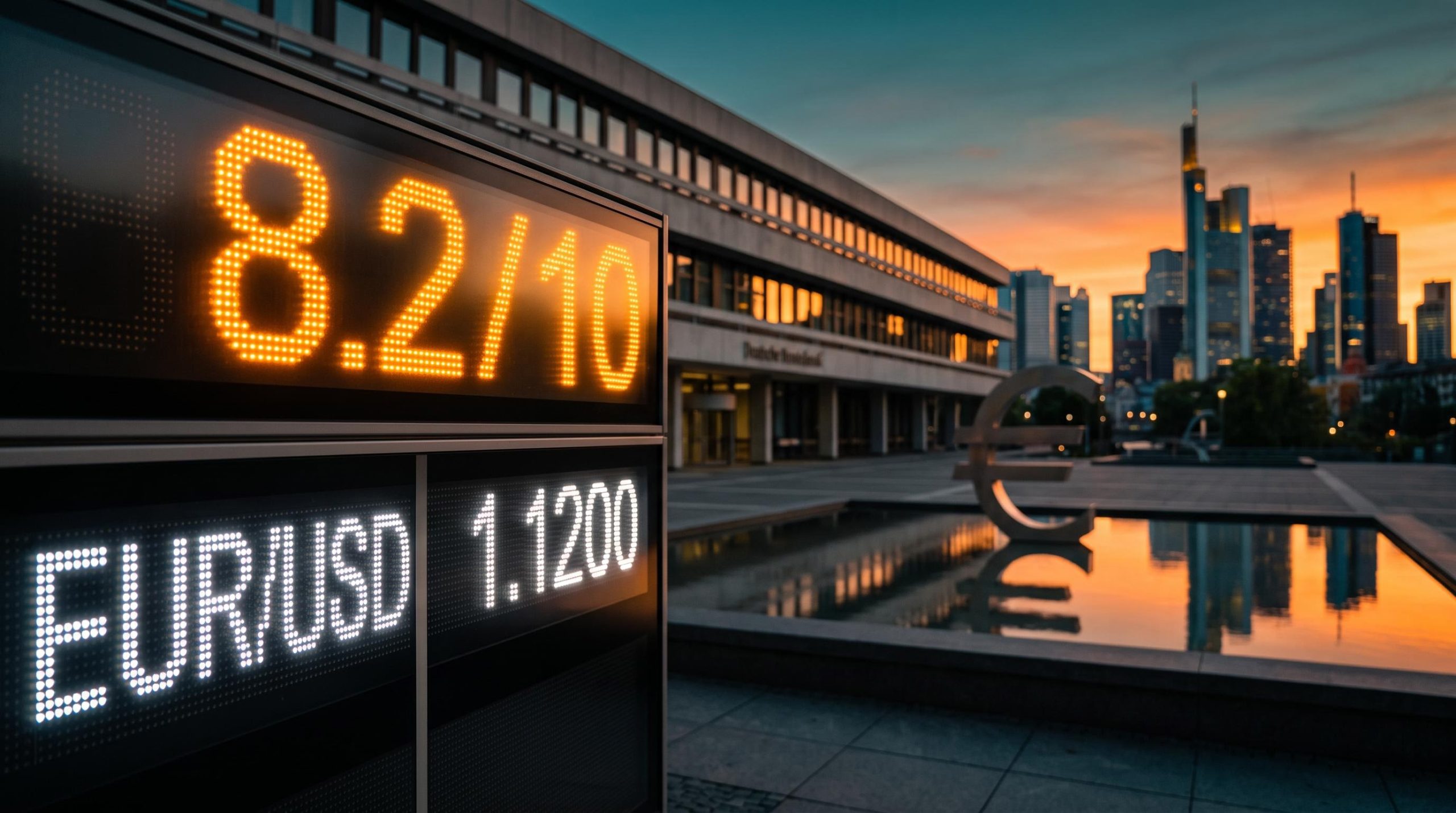
Joachim Nagel’s latest remarks scored 8.2/10 on a hawkish sentiment tracker, the firmest language he has used this month. EUR/USD barely moved and sat near 1.1200. If one of the European Central Bank’s most closely watched voices can sound this firm without moving the euro, the signal is telling you something other than what the headline suggests.
The interview landed a day after the ECB held its deposit rate at 2.50%. Euro-area inflation is running at 3.8%, pushed up by energy. Traders were already pricing roughly a 75% chance of a December hike before Nagel spoke.
So the real question about ECB rate hike expectations is whether this speech counts as news, or whether it simply confirms what markets had already priced.
This piece gives you a way to judge how much weight one central banker’s words deserve when you form a view on December and the months after it.
What did Nagel actually say, and why did the signal score so high?
The words themselves were plain. In a Bloomberg interview published on Friday, 30 October 2026, the Bundesbank president said consumer prices had re-accelerated and that further increases in the coming weeks could not be ruled out. He named higher energy costs as a major driver.
The core message Nagel signalled that the ECB stands ready to act decisively, if necessary, to bring inflation back to its 2% target.
That is firmer than his tone earlier in the month. In his earlier October speech he warned that upside risks dominated and that uncertainty called for flexibility rather than inaction. He also said there were no clear wage-price effects, which softened the message.
The 8.2 score only means something once you set it against Nagel’s own history. FXS Speechtracker is a tool that rates the tone of a speech against the speaker’s usual language. His average is 6.9, so this interview sat 1.3 points above his norm. His earlier October speech scored 7.2 against a 6.6 average, a gap of only 0.6.
| Speech | Score vs his average | Gap | Key message | FXStreet reading |
|---|---|---|---|---|
| Earlier October 2026 | 7.2 vs 6.6 | +0.6 | Upside risks dominate, flexibility needed, no clear wage-price effects | Modest hawkish shift |
| Bloomberg interview, 30 October 2026 | 8.2 vs 6.9 | +1.3 | Prices re-accelerating, ready to act decisively | Hawkish, keeps further tightening open |
FXStreet, in analysis by Sagar Dua, read the comments as hawkish, keeping further tightening on the table and potentially supportive for the euro. Even so, EUR/USD was up only about 0.22% near 1.1200 at the time of writing, with no immediate reaction.
Nagel stressed optionality and stopping inflation from becoming embedded. He did not announce a move. The score tells you he is speaking unusually firmly by his own standards. It describes his tone, and it does not forecast a decision.
When big ASX news breaks, our subscribers know first
Why is energy-driven inflation a harder problem for rate policy than it looks?
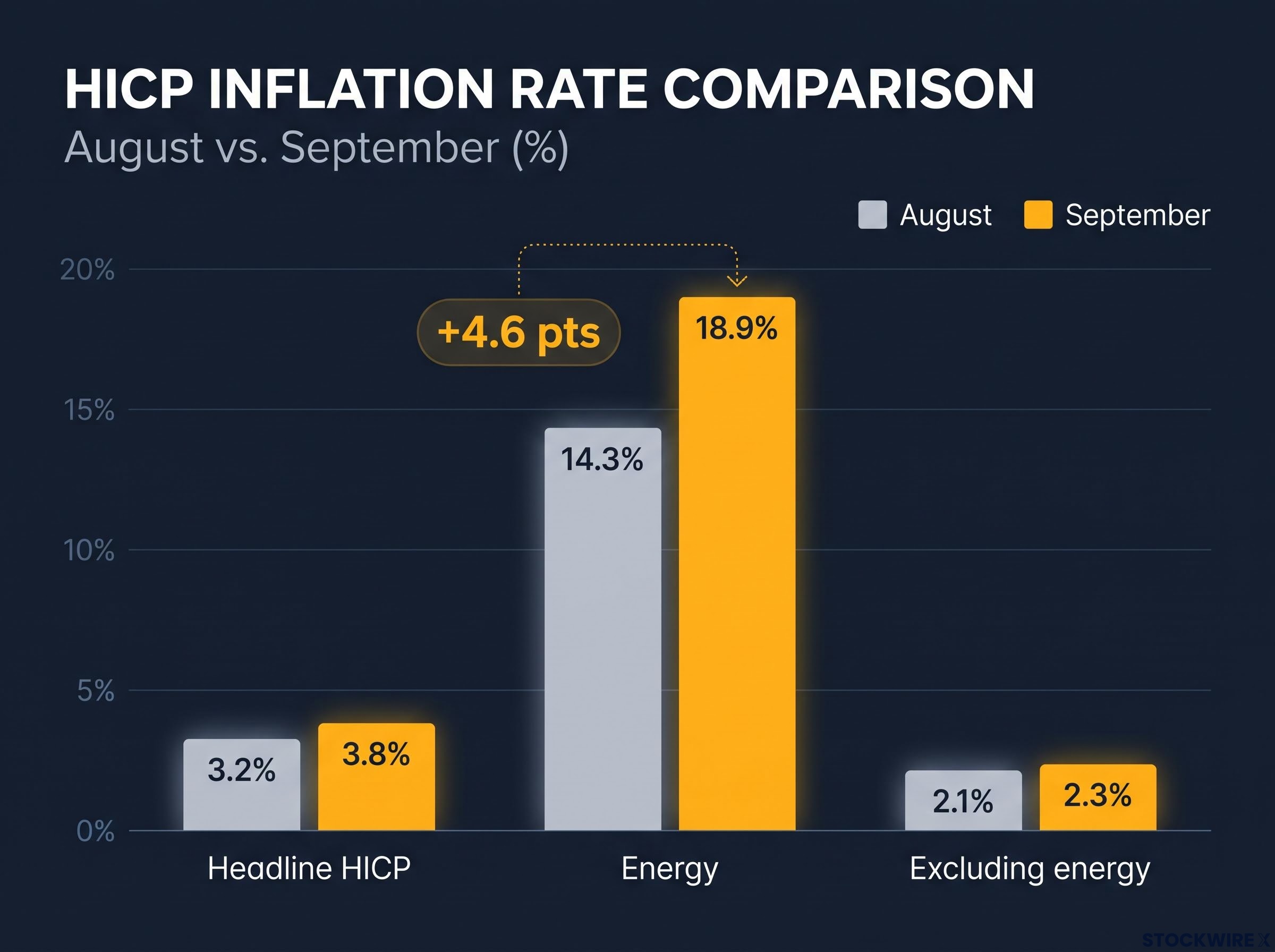
Start with the headline. Inflation measured by the Harmonised Index of Consumer Prices (HICP), the euro area’s standard consumer price gauge, reached 3.8% in September, up from 3.2% in August. That is almost twice the ECB’s target.
Break the figure apart, though, and most of the movement sits in one place.
| Measure | September | August | Change | Note |
|---|---|---|---|---|
| Headline HICP | 3.8% | 3.2% | +0.6 pts | Almost twice target |
| Energy | 18.9% | 14.3% | +4.6 pts | Main driver |
| Excluding energy | 2.3% | 2.1% | +0.2 pts | The number hawks watch |
| Services | 3.2% | 3.0% | +0.2 pts | Modest rise |
| Food, alcohol and tobacco | 1.3% | 1.1% | +0.2 pts | Modest rise |
| Non-energy industrial goods | 1.1% | 1.2% | -0.1 pts | Slight easing |
Figures come from Eurostat and the ECB’s monetary policy statement of 29 October 2026. Energy jumped by more than four points while almost everything else shifted by a fraction.
Energy reaches the wider economy in three ways:
- Direct pass-through: higher oil, gas and electricity prices lift household bills and transport costs straight away. The ECB said energy prices had moved beyond the path assumed in its September staff projections.
- Indirect and second-round effects: businesses pay more for transport and production and may eventually pass those costs to customers. Second-round effects are when higher prices feed into wages, which then push prices up again.
- Supply and geopolitical disruption: Reuters linked the rise to the Iran-related conflict, and ECB officials have pointed to possible disruption around the Strait of Hormuz.
Here is the dilemma. Raising interest rates cannot produce more oil or gas. A hike can, however, try to stop an energy shock from spreading into wages, services and expectations.
For you, the 2.3% ex-energy figure matters more than the 3.8% headline. Hawks point to that number when they argue the shock is starting to spread.
Transitory or persistent?
Chief economist Philip Lane and Olli Rehn both stress that there is no clear evidence yet of second-round effects. On their reading, the shock is imported and concentrated in energy.
The ECB’s professional forecasters have moved the other way, raising headline inflation forecasts to 3.0% for 2026 and 2.6% for 2027. They still expect a return to 2.0% over the longer term. The next check is the October flash HICP, due on 4 November.
A short shock is a one-off. A prolonged one could become a question about whether inflation has settled into a higher range.
Historically, an energy-driven headline spike resolves differently from a structural reset, because energy is only about 9% of the HICP basket and the 2022 shock normalised within months once supply adjusted.
How are markets pricing ECB rate hike expectations, and who inside the Governing Council disagrees?
The current settings are a deposit rate of 2.50%, a main refinancing rate of 2.65% and a marginal lending rate of 2.90%. On 29 October, the Governing Council held all three. It said rising energy prices created upside risks to inflation and downside risks to growth, and it declined to pre-commit to a rate path.
Markets have filled in the gap. Reuters reported roughly a 75% probability of a 25 basis point hike (a quarter of a percentage point) on 17 December, which would take the deposit rate to 2.75%. Reuters sources said policymakers saw that move as almost certain unless energy prices suddenly fell, with a pause expected afterwards.
One other Reuters report put December odds near 80%, with two to three further hikes priced. That reading was not independently verified and its timing was unclear, so treat 75% as the anchor and the wider range as indicative only.
Forecasters broadly agree. A Reuters economist poll found most expect one or two more hikes. Standard Chartered moved its call to a December hike to 2.75%, and Jack Allen-Reynolds of Capital Economics said the September data supports a December move.
Beneath that consensus, the council is split.
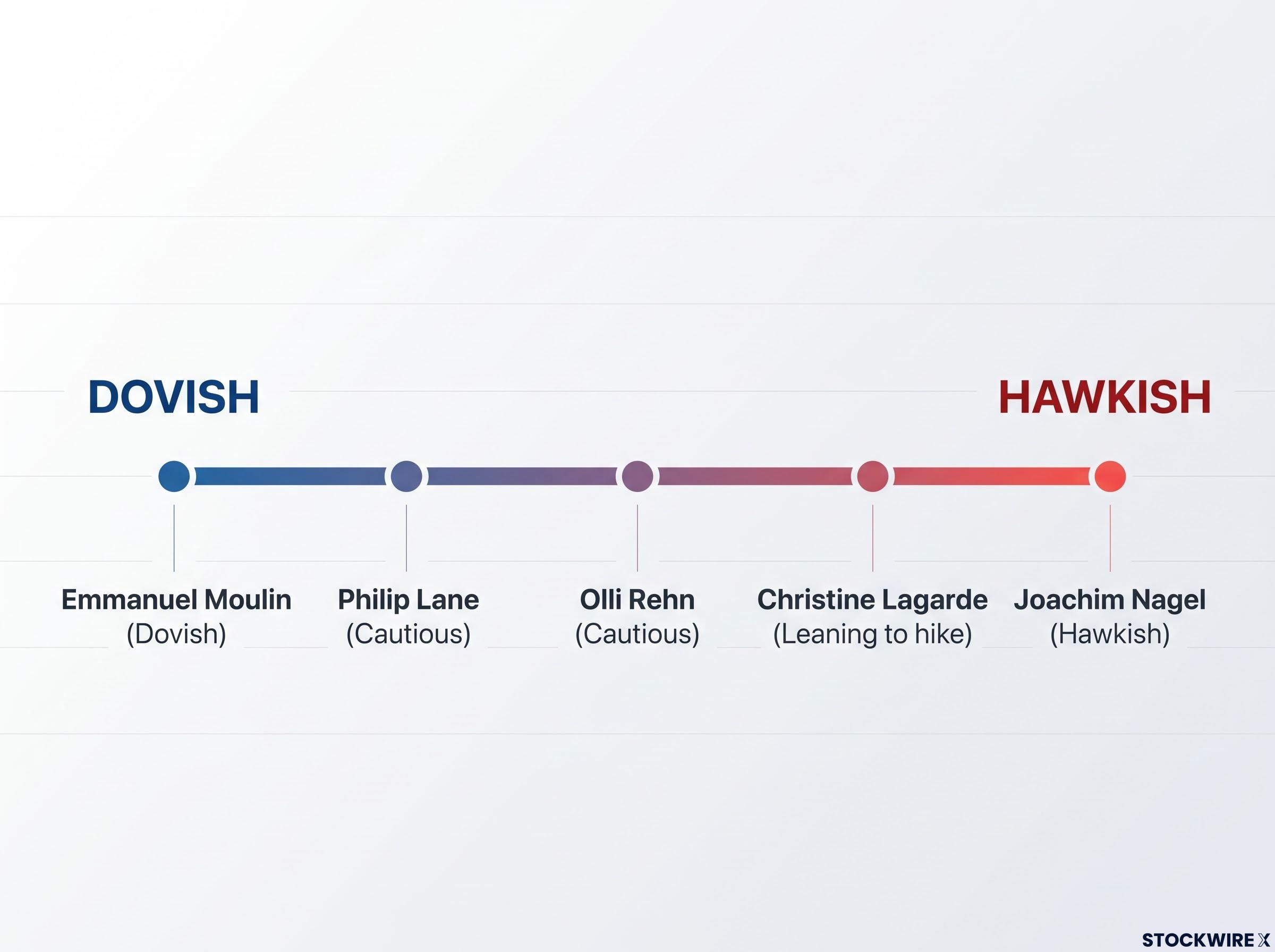
| Voice | Stance | Core argument | Source |
|---|---|---|---|
| Christine Lagarde | Leaning to hike | Direction of travel is clear; a hike was discussed | Post-meeting remarks |
| Joachim Nagel | Hawkish | Ready to act decisively | Bloomberg interview |
| Philip Lane | Cautious | Demand destruction may limit tightening needed | Reuters |
| Olli Rehn | Cautious | Little spread yet; higher yields dampen pass-through | Reuters |
| Emmanuel Moulin | Dovish | Pressure largely imported, most prices stable | Reuters |
The two camps argue from different priorities:
- Hawkish case: headline inflation near twice target, energy at 18.9%, upgraded forecasts and the risk of second-round effects.
- Dovish case: squeezed household incomes, weaker demand, and bond yields that are already tightening financial conditions without a rate move.
The compromise scenario The most plausible path in the reporting is one December hike followed by a pause, conditional on energy prices and underlying inflation.
This tells you that Nagel’s hawkishness reinforces an expected December move. On its own, it does not argue for a long hiking cycle. The path after December is still open, and that is where expectations can still shift.
How should you read central bank speak, and what did EUR/USD do with it?
Go back to the muted euro. A firm speech failed to move the currency because markets price the expected path of rates, not just today’s rate. Remarks that confirm existing pricing add little new information.
The FXS Speechtracker measures tone relative to the speaker’s own past. It does not forecast ECB action. A high score shows that the wording is unusually hawkish for that person, and nothing more.
The recent sequence shows how this mechanism works.
| Date | Event | Rate signal | EUR/USD reaction |
|---|---|---|---|
| September 2026 | Hike to 2.50% | Hawkish, surprising tone | Short-term yields rose, hike bets revived |
| 29 October 2026 | Hold; Lagarde says hike discussed | December kept in play, about 75% | Held near 1.12 |
| 30 October 2026 | Nagel interview | Hawkish confirmation | Up about 0.22%, near 1.1200 |
Why the euro barely moved
September’s hawkish surprise was genuinely new information, and short-term yields responded. Nagel’s comments repeated what the council’s guidance and market pricing had already established.
The September rate hike to 2.50%, the second 25 basis point increase in three months, is the clearest example of genuinely new information reaching markets, with BBVA Research already projecting a December move to 2.75%.
Opposing forces also cancelled out. Hike expectations and a softer dollar, linked to lower US Treasury yields and hopes for Middle East diplomacy, supported the pair. Weaker risk sentiment and French fiscal concerns capped it. According to Standard Chartered, the pair recovered from an intraday low of 1.1104 to close near 1.1180, with support at 1.1164 and resistance at 1.1199.
Treat a high speech score as one input, then test it with four questions:
- Does the speech contain new information, or does it confirm what is already known?
- Do other council members agree?
- What is already priced into markets?
- What are energy prices, growth data and the US Federal Reserve signalling?
What Nagel’s signal changes for December, and what it leaves open
Nagel’s interview confirms a hawkish tilt and strengthens the case for a December hike. It does not settle what comes after. That path depends on energy prices and on whether underlying inflation keeps climbing.
Your watch list is short:
- the October flash HICP on 4 November
- energy prices and developments in the Middle East
- whether ex-energy inflation moves beyond 2.3%
- the ECB decision on 17 December
If ex-energy inflation keeps rising, the one-and-pause scenario comes under pressure. If it stalls, the doves’ reading gains ground. Either way, the data will carry more weight than any single speech.
These statements are speculative and subject to change based on market developments and policy decisions.
This article is for informational purposes only and should not be considered financial advice. Investors should conduct their own research and consult with financial professionals before making investment decisions.