
The yuan has climbed to its strongest level against the dollar since early 2023, with Reuters reporting a fresh onshore four-year high on 26 October 2026. The dollar, meanwhile, has held firm against most other major currencies. This kind of rally looks like market momentum, but much of it is a policy choice.
On 30 October, the People’s Bank of China (PBoC) set its daily reference rate for the yuan at 6.7138 per dollar. OCBC strategists Sim Moh Siong and Christopher Wong expect the currency to keep appreciating, but gradually rather than in a disorderly surge.
That view was reinforced by China’s Fifth Plenum, a major Communist Party policy meeting. It ended this week without any new stimulus.
Here is a working method for reading a managed currency: how to pair what the central bank is signalling with the levels on the chart. You will then see that method applied to the current USD/CNH setup.
Why are firmer PBoC fixings the centre of OCBC’s constructive view?
The surface story is simple: the yuan is rising. The more useful story sits in the daily fixing, the central parity rate the PBoC publishes each morning. Onshore trading has to stay within a band around it.
The daily fixing mechanism combines the previous onshore close, overnight moves in the CFETS basket and a discretionary counter-cyclical factor, and that third input is where Beijing’s policy intent shows up most clearly.
The 30 October fixing of 6.7138 was slightly stronger than the previous day’s 6.7147. Yet it came in 590 pips weaker for the yuan than the Reuters estimate. A pip is the smallest standard price increment in a currency pair, here 0.0001 yuan.
The central bank is still nudging the yuan higher, but more slowly than traders wanted. A fixing that is stronger than yesterday but weaker than expected is the message itself.
OCBC’s base case reads it exactly that way. The stronger-fixing trend has become less one-way, and the PBoC is managing the pace. OCBC links the yuan’s strength to firmer guidance and resilient exports. September exports reached 3.03 trillion yuan, up 29.6% year on year. Barclays reads the same pattern as the PBoC limiting speed, not reversing direction.
The trade-weighted picture confirms the strength. The China Foreign Exchange Trade System (CFETS) index measures the yuan against a basket of currencies. It stood at 103.6 on 9 October, up 0.41 points from end-September. Bloomberg’s replica showed 103.9 on the same date. That gap appears to reflect differences in index source or timing.
| Institution | View | Basis | Level or range |
|---|---|---|---|
| OCBC | Gradual appreciation is the base case | Firmer fixings, resilient exports | No specific level cited |
| Barclays | PBoC limiting speed, not reversing direction | Fixings weaker than expectations | No specific level cited |
| Goldman Sachs | Yuan undervalued by roughly 20%-25% | Large trade surplus | 6.40 in one year |
| ING | Two-way risks rising | 2026 forecast range | 6.67-6.92 |
| Reuters-surveyed analysts | Moderate appreciation | Guidance, exports, corporate conversion | 6.60-6.70 by year-end |
The fixing tells you Beijing wants a firmer currency, but not a one-way rally. You should expect pauses rather than a straight line. Past performance does not guarantee future results, and these forecasts are subject to changing market conditions.
What the Fifth Plenum added to the picture
The plenum ran from 26 to 29 October. It stressed continuity and targeted support, with no new large-scale stimulus and no new standalone growth target. With Q3 growth at 4.5% against a 2026 target of 4.5%-5.0%, OCBC reads the outcome as policy comfort with gradual yuan strength.
When big ASX news breaks, our subscribers know first
How can the yuan rise while the dollar stays firm?
A firm dollar usually drags on other currencies, so the yuan’s rally looks like a paradox. It resolves once you stack the drivers in order.
- Fixing signals. Progressively stronger midpoints tell the market that gradual appreciation is tolerated.
- Exporter conversion. Exporters expecting further gains sell their dollar receipts for yuan. Hedging adds to that demand.
- Trade surplus. Export receipts create steady structural demand for yuan.
- Managed-float band. Onshore spot trades within 2% of the daily midpoint, so the PBoC can let the yuan rise against the dollar even while the dollar gains elsewhere.
- Trade-weighted objectives. Policy targets the basket, not one bilateral rate.
- Rate differentials not decisive. Higher US yields and persistent inflation normally favour USD/CNY upside. In OCBC’s view, the other drivers have outweighed them this time.
Where policy actually aims The PBoC centres policy on the CFETS basket rather than a fixed USD/CNY level, and says it does not set a fixed exchange-rate target.
These drivers reinforce each other. Each stronger fixing encourages more exporter conversion, and that conversion supports the next fixing. The same loop appeared between 2017 and early 2018, when dollar selling by Chinese companies and banks helped make appreciation self-reinforcing.
Export receipts create steady structural demand, and the record current-account surplus of US$193.7B in the second quarter shows how much of that demand is already built into the currency’s support.
Goldman Sachs’ Kamakshya Trivedi argues there is plenty of room left to run. He estimates the yuan is roughly 20%-25% undervalued and calls that figure conservative.
A strong dollar elsewhere is not a reliable reason to bet against the yuan. Before drawing conclusions, check the trade-weighted index and the flow data.
What does the USD/CNH chart say about support, resistance and rebound risk?
USD/CNH is the offshore yuan priced in dollars. When the pair falls, the renminbi is getting stronger.
OCBC’s 30 October note put spot near 6.6580. Immediate support sits at 6.65, then 6.62. Resistance sits at 6.6830, the 21-day moving average, and 6.70, the 50-day moving average. A moving average is the average closing price over a set number of days.
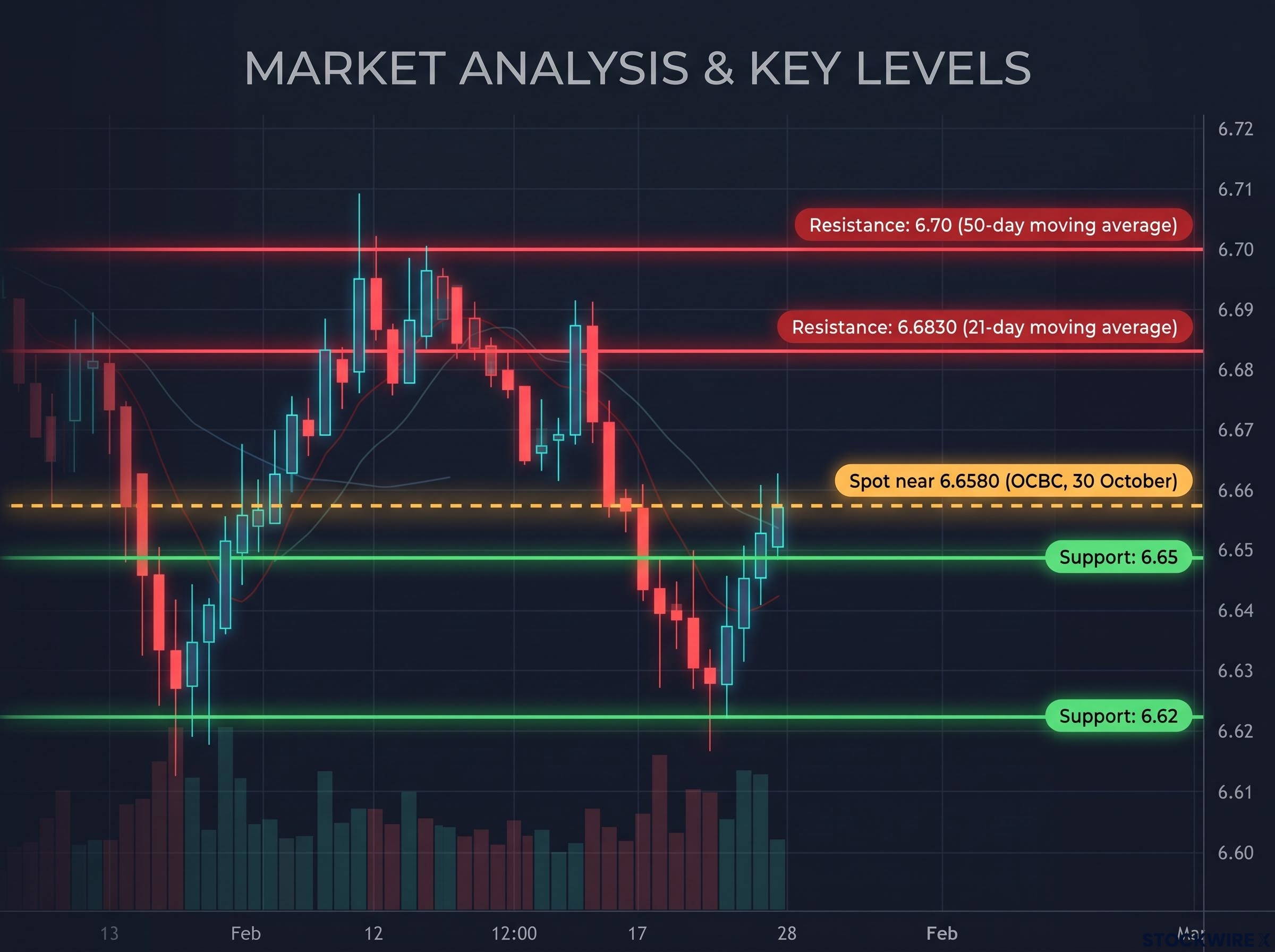
Daily momentum is mildly bearish for the pair, and the downtrend looks settled. On 21 October, OCBC had spot near 6.6830, with support near 6.67 and resistance near 6.69 and 6.7020. The levels have migrated lower as the averages followed price.
| Level | Type | Source or basis | What a break implies |
|---|---|---|---|
| 6.70 | Resistance | 50-day moving average | Recovery above would challenge the downtrend |
| 6.6830 | Resistance | 21-day moving average | First sign of a meaningful rebound |
| 6.65 | Support | OCBC, 30 October | Further yuan strength |
| 6.62 | Support | OCBC, 30 October | Extension of the appreciation trend |
There is a complication. The Relative Strength Index (RSI), a momentum gauge running from 0 to 100, has dropped into oversold territory. That raises the risk of a snapback, especially if fixing momentum stalls.
In a managed currency, though, RSI can stay oversold while fixings and corporate flows keep pushing the pair lower. A stretched reading tells you the move has run hard, not that it is over. Wait for confirmation from price action, a change in fixing behaviour or flow data before you treat a bounce as a trend change.
Why CNH levels are not PBoC levels
Offshore CNH can trade at a premium or discount to onshore CNY. Offshore liquidity, funding conditions, capital controls and intervention expectations all create that gap. The fixing and the 2% band apply onshore. Chart levels describe how the market behaves; they do not reveal what policymakers intend.
How do you combine policy signals with technical levels on a managed currency?
The sections above give you the pieces. Here is how to assemble them into a routine.
- Read the fixing against expectations. Compare each morning’s midpoint with the Reuters estimate. The gap tells you whether the central bank is pushing, slowing or resisting.
- Check the flow drivers. Track export data, exporter conversion and the CFETS index to see whether demand still supports the trend.
- Place technical levels last. Use support, resistance and momentum to time entries and set risk levels within the policy trend, not against it.
History shows why the order matters. The PBoC has adjusted its tools in both directions.
The IMF analysis of China’s exchange rate regime traces how the counter-cyclical factor introduced in 2017 shaped market expectations, which explains why the fixing works as a policy instrument and not just a daily price reference.
| Period | Event | Lesson |
|---|---|---|
| 2017 | Counter-cyclical factor introduced in May; fixing strengthened about 1% between 31 May and 9 June with the dollar broadly flat | The fixing is a policy instrument |
| 2018 | Factor reused as the yuan weakened | Tools work against moves in either direction |
| 2020-21 | Factor suspended, permitting market-driven gains | Appreciation is tolerated, but pace stays controlled |
| Late 2021 | At a multi-year high, institutions told to raise FX reserves | Extrapolating a rally is risky |
| 2026 | Firmer fixings, but weaker than expected | Resembles a controlled appreciation phase |
The late 2021 episode is the clearest warning. Policymakers acted at exactly the point where the trend looked strongest.
Several developments could undo the constructive view: weak domestic demand, lower Chinese yields, renewed dollar strength or capital outflows. Exporter competitiveness is another pressure point. Guan Tao of BOC International warned in June 2021 that persistent one-way appreciation could hurt smaller exporters and employment. A CFETS index near 104 could also provoke resistance, even if the dollar rate stays acceptable to policymakers.
Let policy signals set your direction and charts set your entry and risk levels. Treat any change in fixing behaviour as the first warning.
Gradual appreciation as the base case: the signals that would change it
The evidence points to a controlled appreciation bias. Firmer fixings, export receipts and exporter conversion are driving it. The PBoC’s preference for two-way flexibility and the risk of an oversold rebound are holding it back.
Three variables will tell you whether that balance is shifting:
- The fixing against the Reuters estimate. A narrowing gap signals acceleration. A widening one signals resistance.
- The chart. A break below 6.62 extends the trend, while a recovery above 6.6830 or 6.70 points to a rebound.
- Exporter conversion and export data. Fading flows would weaken the foundation of the rally.
This article is for informational purposes only and should not be considered financial advice. Investors should conduct their own research and consult with financial professionals before making investment decisions.