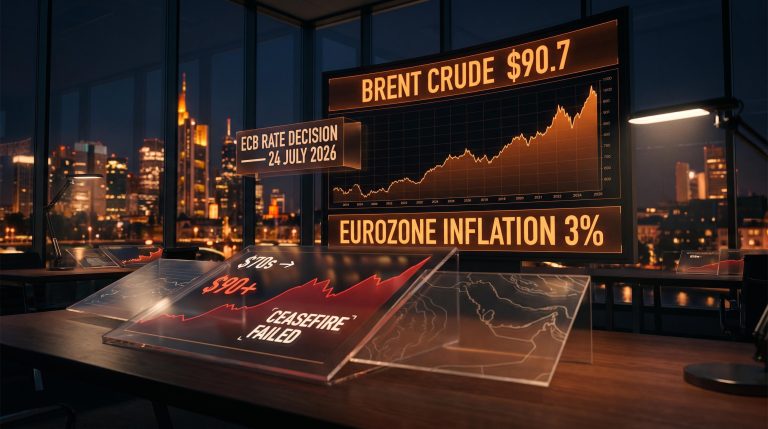
Finance creators spend their careers teaching patience, compounding, and the case against market timing. A striking number of them then build their own media businesses around the opposite instinct: chasing the 24-hour news cycle, racing to be first with a hot take on every earnings miss and every rate decision.
The platform data exposes that contradiction in measurable terms. Long-form video operates on a fundamentally different mechanic from passive-scroll content. Viewers must actively choose to commit their time, and that friction leaves traces in the analytics that are difficult to ignore. Evergreen financial education content routinely generates tens of thousands of daily impressions a full year after publication. News-driven videos, by contrast, often collapse within 24 hours of the news cycle rotating.
Here is why that gap matters beyond content strategy: YouTube analytics make the compounding argument visible in a way that spreadsheet projections often cannot. The investing logic you already understand, that patient capital allocated to durable assets outperforms reactive chasing, shows up in an entirely different data set. By the time you finish this, you will see the same principle operating across both domains, and you will have a sharper filter for evaluating the financial media you give your attention to.
Why long-form video viewers behave differently from passive-scroll audiences
Long-form video requires active selection. A viewer reads a title, evaluates a thumbnail, and makes a conscious decision to commit potentially 20-30 minutes of attention. That is a fundamentally different act from content appearing unbidden in a scroll feed.
The friction is not a limitation. It is the mechanism that produces genuine engagement depth, and it is the reason long-form digital platforms build substantially more audience trust and deliver stronger commercial outcomes than passive-scroll environments, where attention is borrowed rather than given.
International Marketing Trends Conference long-form video engagement research found that videos exceeding 20 minutes generate materially higher engagement than short-form content, a finding that reinforces why the active selection friction in long-form platforms produces a qualitatively different viewer relationship from passive-scroll environments.
The engagement data confirms this:
- On long-form platforms, viewers typically watch around 50% of a video’s total runtime before moving on
- That translates to average engagement of roughly 6-9 minutes per session
- Active selection creates a self-screening audience with materially higher consumption intent
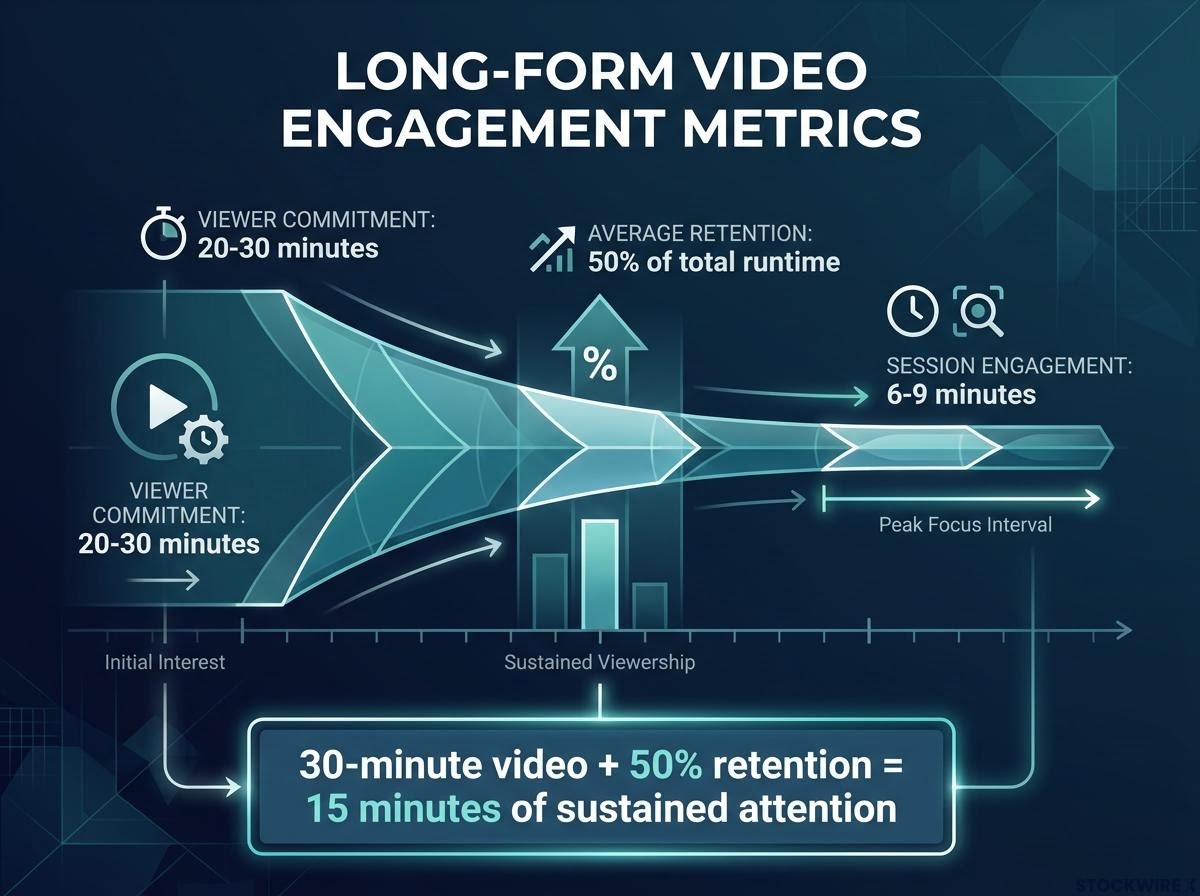
Put a number on that: a 30-minute finance video with 50% retention means 15 minutes of sustained, voluntary attention from a viewer who chose to be there. The audience arriving at long-form financial education has already made a considered bet on the content. That makes them a qualitatively different audience from one that stumbled into a 15-second clip, and that distinction matters enormously for how trust and authority compound over time. Higher-intent participants engage more deeply, return more consistently, and build the kind of audience relationship that no algorithm can manufacture from passive impressions.
When big ASX news breaks, our subscribers know first
What the data reveals about how algorithms actually reward content
Recommendation systems on long-form platforms surface content that demonstrates sustained viewer retention and consistent watch time, not initial click spikes. That distinction is worth sitting with.
A video still holding attention at the six-minute mark twelve months after publication sends a quality signal that a viral news clip with 90% drop-off at 90 seconds never can. The recommendation engine interprets thin retention as a quality failure and quietly withdraws distribution. It interprets durable retention as an endorsement and keeps routing new viewers toward the content.
The lifecycle gap between these two content strategies is stark:
| Dimension | News-driven content | Evergreen content |
|---|---|---|
| Day-one performance | Sharp spike from search traffic | Modest initial uptake |
| 30-day impressions | Severe decline as news cycle rotates | Steady accumulation via search discovery |
| 12-month impressions | Handful of views per day at best | Tens of thousands of daily impressions |
| Algorithmic status | De-prioritised once retention thins | Sustained recommendation distribution |
A news-driven video captures a surge, looks impressive for 24-48 hours, and then effectively disappears from algorithmic circulation. An evergreen video on how to read a balance sheet or what compounding interest means in practice may underperform on day one, but new investors find it via search six months later, and it is still generating tens of thousands of impressions a year after that.
The algorithm behaves like a patient capital allocator: it routes ongoing distribution to content that continues earning its audience, and it quietly withdraws from content that does not.
The implication for any finance creator or investor-viewer is that the recommendation engine mirrors value investing mechanics. It rewards what is patient, consistent, and fundamentally sound. That is not a metaphor layered on top of the data. It is what the data actually shows.
Nine years of weekly publishing as a compounding case study
Hamish Hodder, an Australian financial educator, offers one of the more compelling longitudinal data sets for studying evergreen strategy in financial media. His channel is not interesting because of any single viral moment. It is interesting because of what nine uninterrupted years of weekly publication produced in measurable, verifiable terms.
The core data points:
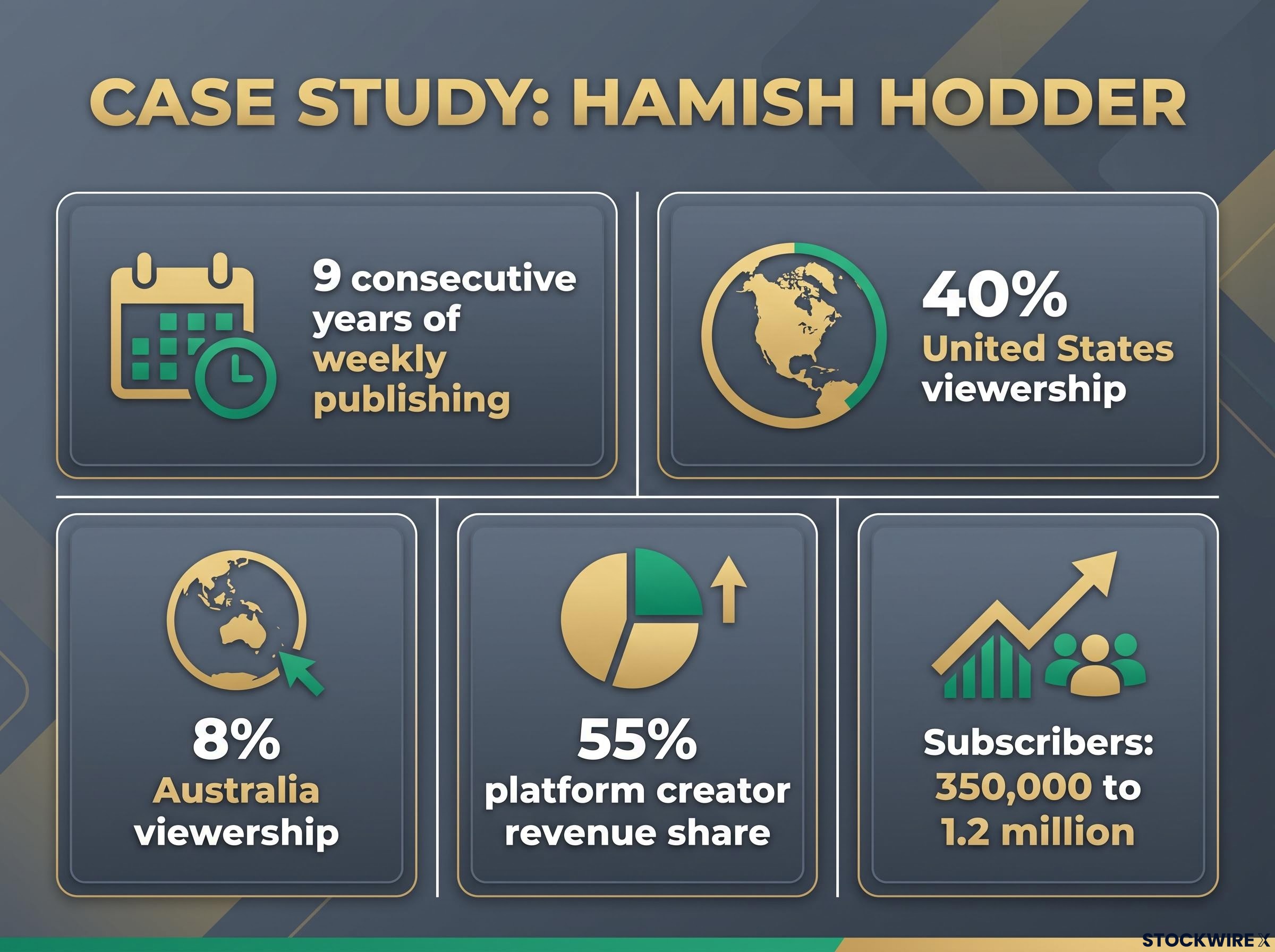
- A publishing record spanning nine consecutive years, maintaining at least one video per week throughout
- Approximately 40% of viewership drawn from the United States
- Approximately 8% of viewership originating from Australia, his home market
- The platform’s creator revenue share stands at 55% of ad income generated, meaning a large evergreen library can deliver meaningful ongoing returns, though those returns fluctuate with advertising market conditions
- Subscriber count: sources conflict materially (one reports 1.1-1.2 million, another reports approximately 350,000), so the figure is best treated as significant and growing until verified independently
What drove that outcome was not any breakthrough moment but the act of showing up week after week. The steadiness of that cadence, maintained across nine years, is what makes the cumulative result look so striking in retrospect, and any long-term investor will find that dynamic immediately familiar.
Delaying or interrupting a compounding timeline carries a cost that feels abstract until it is modelled in dollar terms: stopping contributions at year 10 cuts terminal wealth by roughly $156,000, not because of missed deposits, but because the funds are absent during the account’s peak compounding phase.
What the geographic split reveals about addressable audience
The audience distribution tells a strategic story. Reaching an audience where roughly 40% of viewers are based in the United States, for a creator working out of Australia, is not an accident. It reflects a deliberate orientation toward universal financial principles rather than country-specific commentary, which broadened the potential reach of the content well beyond any single national market.
That shift is the content equivalent of expanding a business’s total addressable market. Questions about compounding, valuation, and portfolio construction do not respect national borders. Designing content around those questions gave the library a chance to compound across geographies rather than being capped by the size of one country’s audience. Hodder later expanded into corporate media consulting to reduce exposure to the revenue volatility that comes with dependence on platform advertising rates, applying the same kind of diversification thinking that investment advisors encourage clients to act on before concentration risk becomes a live problem.
The structural trap inside news-driven financial media
News-driven content does capture real search traffic. The appeal is legitimate. Being first with analysis on a major earnings surprise or central bank decision can produce impressive day-one numbers.
The problem is not that the strategy does not work. The problem is that its return profile is structurally misaligned with sustainable media economics.
- It requires constant new input (research, scripting, production) just to maintain visibility
- It stops performing the moment the creator stops publishing, because the library has minimal ongoing discovery power
- It sends thin retention signals to the algorithm, triggering de-prioritisation
- It produces no library compounding effect; each video is an isolated event rather than an enduring asset
In practical terms, the creator is renting attention, not owning it. Every week they must pay again in time and effort just to stay in place.
This treadmill mirrors the situation of investors who attempt to time the market instead of owning quality businesses for the long term. Market timing requires continuous correct decisions with no major mistakes at key inflection points. One misjudgment, being out of the market during a sharp recovery, or publishing the wrong take on a breaking story, can erase a disproportionate amount of prior gains.
“The strategy depends on sustained near-perfect execution and offers very little margin of safety.”
Evergreen content inverts this risk profile. It requires high-quality execution once, at the point of creation, and then benefits from ongoing discovery without additional input. The margin of safety lies in the durability of the underlying question: fundamental questions about investing and financial literacy carry shelf lives measured in decades, not days. The reader evaluating any media or investment strategy should ask the same question: does this compound, or does it require constant reinvestment just to hold position?
Attention as a compounding asset: what this means for investors and creators alike
Underneath the performance gap between evergreen and reactive content sits a deeper idea. Attention itself behaves like an asset with specific accumulation properties.
Like high-quality equities, attention rewards patience and durable fundamentals. It decays when the underlying question it was built on expires. And, like the best investments, the content most likely to compound often feels least exciting at the moment of creation. A video explaining dividend reinvestment mechanics will almost never trend on social media. But if it is genuinely deep, clear, and useful, it will answer a question people keep asking indefinitely, earn search-based discovery long after release, and continue accumulating watch time and authority long after the creator has moved on to the next project.
The psychological dimension matters here. The creators who resist the pull of reactive urgency are practising the same discipline successful long-term investors practise. The instinct that makes chasing speculative momentum feel compelling in markets is the same instinct that makes chasing breaking news feel compelling in content. The remedy in both cases is the same: a deliberate, pre-committed framework that does not bend to short-term urgency.
The psychological pull of reactive urgency operates identically in both domains: the instinct that makes a speculative momentum trade feel compelling in markets is the same instinct that makes publishing a hot take on a breaking earnings story feel like the right move, and the remedy in both cases requires a pre-committed framework that does not bend to short-term pressure.
The portfolio effect of a consistent publishing cadence
The arithmetic becomes powerful when you consider library effects:
- Each evergreen video operates as an independent impression stream, generating modest but persistent daily returns
- A creator publishing one substantive video per week builds more than 50 enduring assets per year
- No single point of failure exists; the portfolio does not depend on any one video going viral
- Algorithmic authority builds over time as the library demonstrates sustained quality across many data points
The best-performing evergreen finance channels share a common trait: early internalisation of this compounding dynamic, followed by consistent refusal to let news-cycle temptation dictate strategy. Their libraries function as portfolios of compounding assets. The cumulative effect, over years, becomes something neither the algorithm nor competitors can easily displace.
What the compounding logic demands, in practice
The analytical argument closes with a practical filter. Four priorities emerge from the data:
- Question durability as a filter: Before committing to any content topic, ask whether someone will still be searching for this in three years. “How do I analyse a balance sheet?” passes. “Is this earnings miss a buying opportunity?” does not. Questions about inflation, risk, valuation, diversification, and investor behaviour carry multi-decade shelf lives.
- Consistency as a compounding mechanism: One well-researched evergreen video per week outperforms sporadic bursts chasing viral news in total cumulative impression delivery. The discipline itself is part of the edge.
- Global relevance over local specificity: Universal financial principles travel across borders far better than hyper-local commentary. Designing for global relevance is akin to expanding a business’s addressable market.
- Revenue diversification before necessity: The right time to build a second income stream is before the first one comes under pressure. Creators with deep evergreen libraries are well placed to extend into consulting, courses, or memberships, applying the same logic investors use when they rebalance away from a concentrated position before the sector turns.
That first filter, asking whether a question will still be searched in three years, is not merely a content strategy rule. It is an asset quality screen. Applying it consistently is what separates a compounding media library from a treadmill of reactive production. Investors can apply the same lens to the financial media they consume: creators who pass the question-durability test are the ones whose work will still be useful to you a year from now.
The algorithm and the market reach the same conclusion
A channel built on consistent weekly publishing over nine years offers a closing anchor. What looks remarkable from the outside is, on closer inspection, the cumulative result of many individually small decisions made over a long period: one video per week, each one addressing questions with lasting relevance, structured to reach viewers far beyond a single national market, with income diversified across multiple streams rather than left concentrated in platform ad revenue alone.
YouTube analytics are not a metaphor for investing. They are a parallel expression of the same underlying dynamic. Systems that measure sustained quality over time, whether recommendation engines or equity markets, eventually route capital (attention or money) toward what consistently earns it. The news-cycle trade produces a spike, then disappearance. The evergreen library produces a modest daily return, sustained indefinitely.
Structural regime shifts in macroeconomic conditions, like those currently reshaping inflation dynamics across major economies, provide a useful comparative lens: regimes that look like temporary deviations from a prior norm often turn out to be the opening of a new multi-decade pattern, which is precisely the reframing the article applies to algorithmic content distribution.
The most observant viewers of financial creators who have built evergreen libraries are watching a live demonstration of the principles those creators teach, which is itself an argument for the kind of patient, compounding approach that pays out long after the initial investment.
The patient, fundamentals-driven approach does not just eventually win in markets. It wins in every system where quality can compound and short-termism erodes advantage. Recognising that pattern across domains is itself a mark of sophisticated thinking, and it is a filter you can apply far beyond the content you watch or the equities you own.
This article is for informational purposes only and should not be considered financial advice. Investors should conduct their own research and consult with financial professionals before making investment decisions.