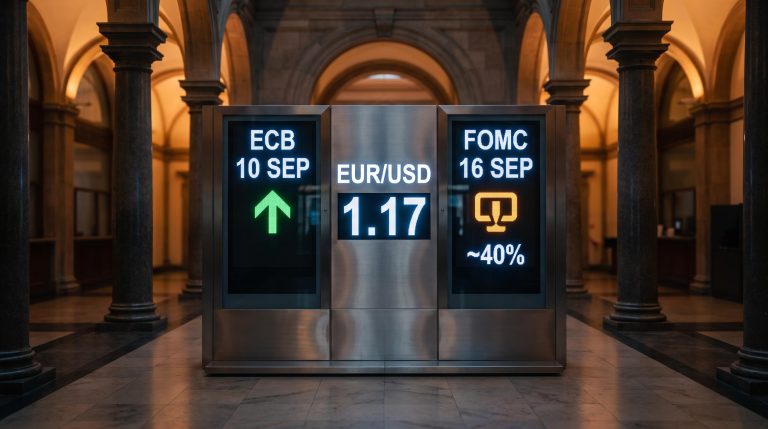
The rate hike arriving in less than two weeks is not the story. A 25 basis point increase at the 10 September ECB meeting is nearly fully priced, and every institutional voice worth tracking agrees it is coming. The real question begins the moment the deposit rate crosses 2.50%, because that is not just another increment; it is the boundary between neutral and restrictive policy.
The 10 September Governing Council meeting lands at a structural fork in euro area monetary policy. Earlier this year, markets leaned toward a hold or even a cut as disinflation progressed. That consensus is gone. Sticky inflation above 3%, an Iran-linked energy shock, and euro area growth that has refused to roll over have shifted expectations back toward active tightening. The ECB is hiking, not holding, and the question is whether it stops at neutral or pushes beyond it.
Two variables will determine the answer between now and December, and the difference between a 2.50% endpoint and a 2.75% endpoint matters far more than the September move itself. Here is the framework for reading both.
Why September is the easy call, and why that matters less than you think
A 25 basis point hike at the 10 September meeting is the dominant scenario for virtually every institutional voice tracking the ECB. Three independent signals converge on the same conclusion:
- Market-implied probabilities from OIS rate tools suggest a 90-98% chance of a hike to 2.50%
- Economist surveys show approximately four-fifths of respondents expect the move
- Named institutional forecasts, including Nomura’s euro area team, explicitly call for 25 basis points on 10 September
Nomura’s September forecast rests on two pillars: HICP inflation holding in the high-2% range and euro area growth outperforming the downturn that many feared earlier in 2026. The bank also flags upside risks of additional rate moves beyond September.
The shift in narrative is what makes the meeting consequential as a signal, not just as a rate move. Earlier in 2026, the market’s base case was a gentle glide toward cuts. The reversal back toward active tightening tells you something about how durable the inflation problem has proven. But the near-unanimity of the September consensus also tells you something else: the hike itself will not move markets much on the day.
The July Governing Council statement established the interpretive baseline for September; the ECB forward guidance signals embedded in Lagarde’s framing of Council divisions and energy language set the reference point against which September’s communication will be judged hawkish or neutral.
The price action will be found in the guidance language and updated staff projections, not the rate announcement. For anyone holding rate-sensitive assets, September is a known event. December is the live risk.
When big ASX news breaks, our subscribers know first
The 2.50% threshold and what it means to cross it
If the September hike proceeds as expected, the deposit facility rate moves from 2.25% to 2.50%. That number carries structural weight beyond its face value. The neutral rate is the level at which monetary policy neither stimulates nor restricts economic activity. Several analysts place it at approximately 2.50% for the euro area under current conditions.
ECB Governing Council member Radev went on the record with a hawkish assessment, placing the neutral rate at roughly 2.50% and indicating that the central bank could ultimately find itself compelled to take rates into territory that actively restricts activity. That statement is the most important piece of official forward guidance currently available. It tells you that at least one policymaker sees neutral not as a destination but as a waypoint.
The ECB Economic Bulletin confirms the Governing Council’s data-dependent, meeting-by-meeting approach to rate decisions, with the deposit facility rate held at 2.25% through July and energy price developments explicitly cited as a material inflation risk factor shaping the medium-term outlook.
The distinction matters because arriving at 2.50% and moving above it are two qualitatively different policy phases. The first brings policy to a position where it is no longer adding stimulus. The second deliberately restricts economic activity to bring inflation down.
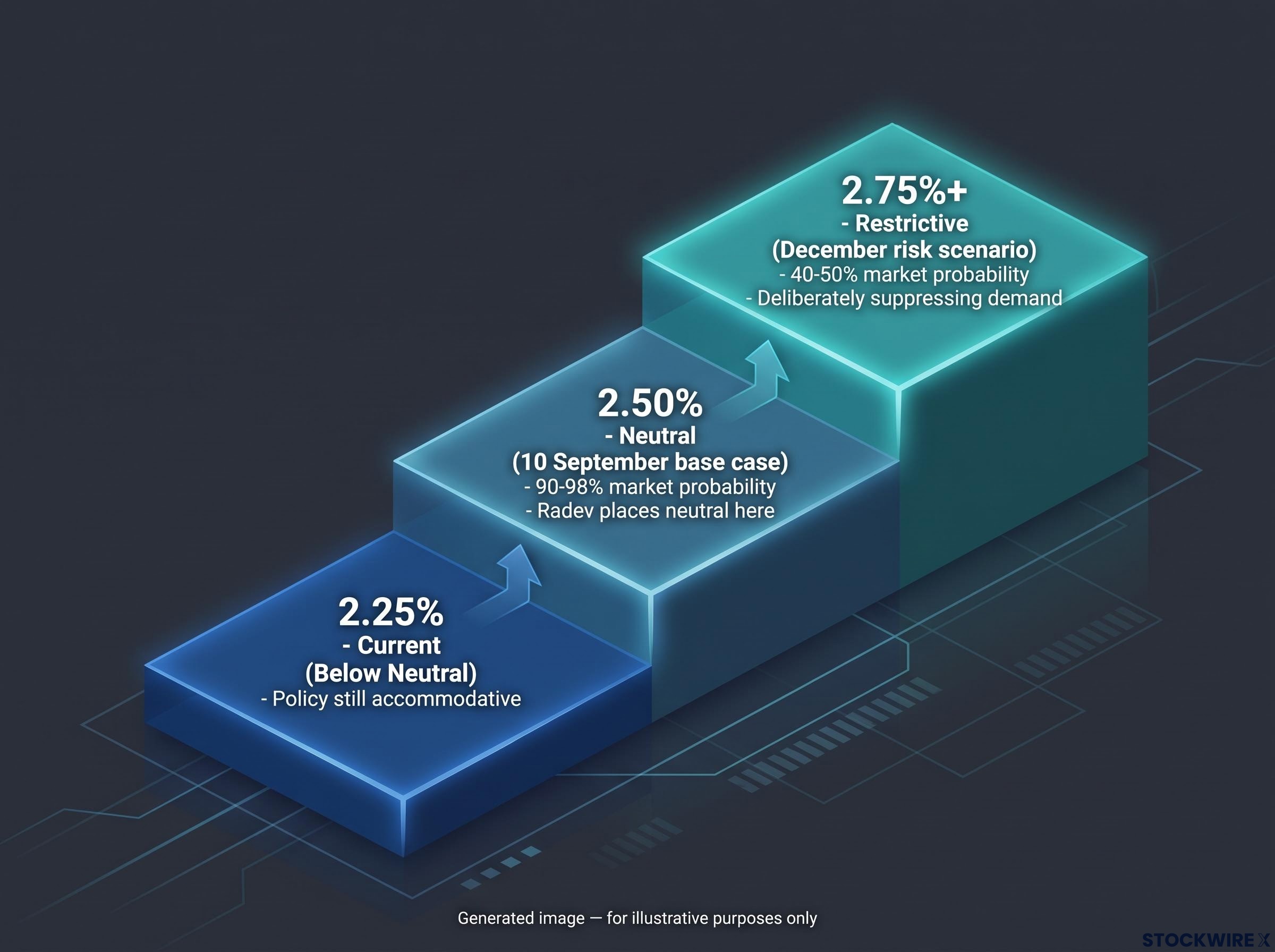
| Rate level | Policy stance | Market probability | Key implication |
|---|---|---|---|
| 2.25% | Current (below neutral) | N/A | Policy still accommodative relative to inflation |
| 2.50% | Neutral (September base case) | 90-98% | Policy ceases to stimulate; decision node for what comes next |
| 2.75%+ | Restrictive (December risk scenario) | 40-50% | ECB deliberately suppressing demand to bring inflation to target |
What a move into restrictive territory would signal
A December hike, if it arrives, would not be a mechanical continuation of the hiking cycle. It would be a deliberate policy choice to suppress demand, a qualitatively different action from reaching neutral. Anonymous ECB insider signals suggest limited appetite within the Governing Council to pre-commit to that step, reinforcing that restrictive territory is a conditional destination, not a planned one.
For anyone holding European fixed income or rate-sensitive credit, the arrival at 2.50% is not a stopping point to assume. It is a decision node where the ECB’s next communication will either confirm a pause or open the door to a materially more restrictive stance.
Two energy markets, two transmission clocks, one inflation problem
Headline euro area HICP inflation sits at approximately 3%, well above the ECB’s 2% target. Energy is a primary contributor, and the Iran conflict has renewed upward pressure on prices. But not all energy inflation travels the same path into the consumer price index, and the distinction between oil and gas transmission mechanics is what separates a reactive read of ECB policy risk from a forward-looking one.
The policy debate around supply-side inflation limits is not new to this cycle: when the ECB hiked to 2.25% in June, analysts were already questioning whether rate increases could meaningfully address an energy price surge rooted in geopolitical disruption rather than excess demand, and that structural tension has not resolved heading into September.
Brent crude works through a rapid channel. Price moves in oil translate into higher pump costs for petrol and diesel within a matter of weeks, hitting the transport and vehicle fuel sub-components of HICP almost immediately. That compressed timeline is precisely why rate expectations heading into September respond so sharply to Brent moves and Iran-related headlines. An oil price spike feeds into near-term ECB repricing because the inflationary effect arrives quickly.
Dutch TTF natural gas follows a different pattern entirely. Its price changes filter through to wholesale electricity costs and industrial input prices before eventually reaching consumers, a journey that unfolds over months rather than weeks. The resulting inflationary footprint is both stickier and more diffuse than anything Brent generates.
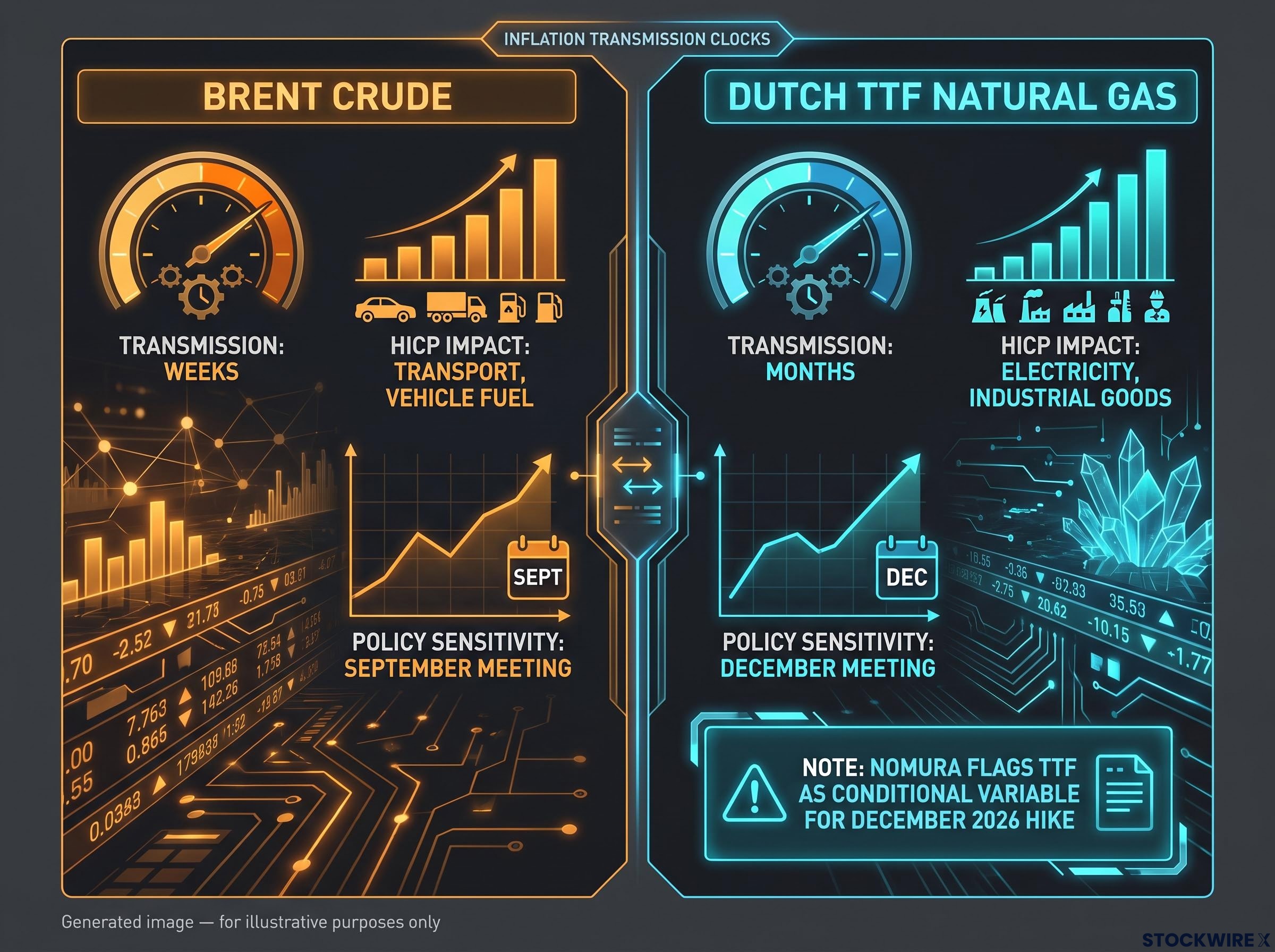
| Dimension | Brent crude | Dutch TTF natural gas |
|---|---|---|
| Transmission speed | Weeks (fast pass-through to pump prices) | Months (lagged via electricity and industrial inputs) |
| HICP components affected | Transport, vehicle fuel | Electricity, industrial goods, broader services |
| Policy horizon sensitivity | September and near-term meetings | December and medium-term trajectory |
| Key risk scenario | Iran escalation drives Brent spike | Sustained TTF elevation forces second hike |
Nomura explicitly identifies a December 2026 rate hike as a risk contingent on further increases in Dutch TTF natural gas prices, making TTF the single most important conditional variable for the second-half policy trajectory.
The asymmetry is worth stating plainly. Brent is the September variable. TTF is the December variable. If you currently watch oil prices as a proxy for ECB policy risk, that lens is incomplete. A sustained TTF move upward raises the probability of a December hike independently of what Brent does, and it is the variable with the longer policy shadow.
What December’s 40-50% probability is actually pricing
The gap between September and December is where genuine uncertainty lives. September sits at 90-98% market-implied probability. December sits at roughly 40-50%. Markets have not decided, and that indecision is where mispricing risk resides.
Two conditional paths extend from the September meeting. If the ECB delivers hawkish guidance, signalling that policy may need to move into restrictive territory, the likely market response is bear flattening in the euro yield curve, wider credit spreads, and support for the euro on major crosses. If the guidance leans neutral, emphasising that 2.50% is sufficient for now, the response runs in reverse: a relief rally in short-end bonds and tighter spreads.
Sovereign yield repricing of the kind observed across six major bond markets in May 2026, when Brent’s surge to $110 drove simultaneous sell-offs in German, French, Italian, Spanish, US, and Japanese paper, illustrates exactly how quickly an energy shock can translate into the bear-flattening scenario that a hawkish ECB outcome at September’s meeting would amplify.
Which assets face the sharpest repricing if December becomes the base case
Four market segments carry the most repricing risk if December pricing shifts materially upward:
Short- and mid-maturity euro government bonds in the 2-5 year segment tend to bear the brunt when markets add or remove one more hike from expectations. This is the highest-sensitivity zone.
The OIS curve around the December tenor is the cleanest direct read of how markets are pricing the follow-on move. Any post-September steepening here is a hawkish signal in real time.
The euro against major crosses could strengthen if the ECB stance turns more hawkish relative to the Federal Reserve, particularly if US rate expectations remain stable or ease.
Euro-denominated leveraged credit with near-term refinancing needs faces the widest spread risk. Scotiabank has flagged follow-on December hike risk if energy prices remain elevated, and that scenario would widen the risk premium for shorter-maturity leveraged issuers most acutely.
Each of these is a conditional risk, not a directional call. The 40-50% probability means genuine uncertainty: if you hold rate-sensitive European assets, you are currently sitting in a positioning environment where the next ECB communication after 10 September will be the most important data point of the year-end cycle.
Three variables to monitor between 10 September and the December meeting:
- Dutch TTF trajectory: A sustained move higher raises medium-term inflation risk and shifts December probability upward. A decline eases it.
- Post-September ECB guidance language: The distinction between “reaching neutral” and “ensuring restrictive conditions” is the single sentence that matters most.
- Updated HICP data and staff projection revisions: Upward revisions to the ECB’s inflation forecast strengthen the December case materially.
For investors wanting to track the incoming HICP releases that will determine whether the December hike becomes the base case, our full explainer on reading eurozone HICP data walks through the basket weights, core vs headline distinction, and the analytical framework for separating energy-driven spikes from structural inflation resets.
What the 10 September meeting will actually tell you
The rate announcement is already priced. The analytical value of the meeting sits in three signal layers, each more informative than the headline number.
- Staff projections on inflation and growth. An upward revision to the ECB’s inflation forecast, or stronger-than-expected growth projections, would both strengthen the case for a December follow-on and should be treated as the primary hawkish signal from the meeting.
- Guidance language on policy stance. The distinction between language aimed at “reaching neutral” and language framing “the need for restrictive conditions” is where the December door opens or closes. One sentence will carry more weight than the rate decision itself.
- Post-meeting OIS curve shape. The December tenor of the OIS curve is the cleanest single market read of how participants have interpreted the ECB’s signal. If that tenor reprices upward meaningfully, markets have judged the guidance as hawkish enough to make a follow-on hike the probable path.
Radev’s remarks placed the neutral rate at approximately 2.50% and left open the possibility that the ECB would need to move into restrictive territory to achieve its mandate. Those comments set the hawkish end of the spectrum. The question on 10 September is whether other Governing Council members align with that framing or diverge from it.
The most important minute of the meeting is not the rate announcement. It is the first sentence of guidance language that follows it. That sentence will tell you whether December is open or closed, and whether the ECB’s next phase is a pause at neutral or a push into territory that deliberately suppresses demand. Everything between now and year-end flows from that signal.
This article is for informational purposes only and should not be considered financial advice. Investors should conduct their own research and consult with financial professionals before making investment decisions. Market-implied probabilities and forward-looking statements are subject to change based on incoming data and evolving market conditions.