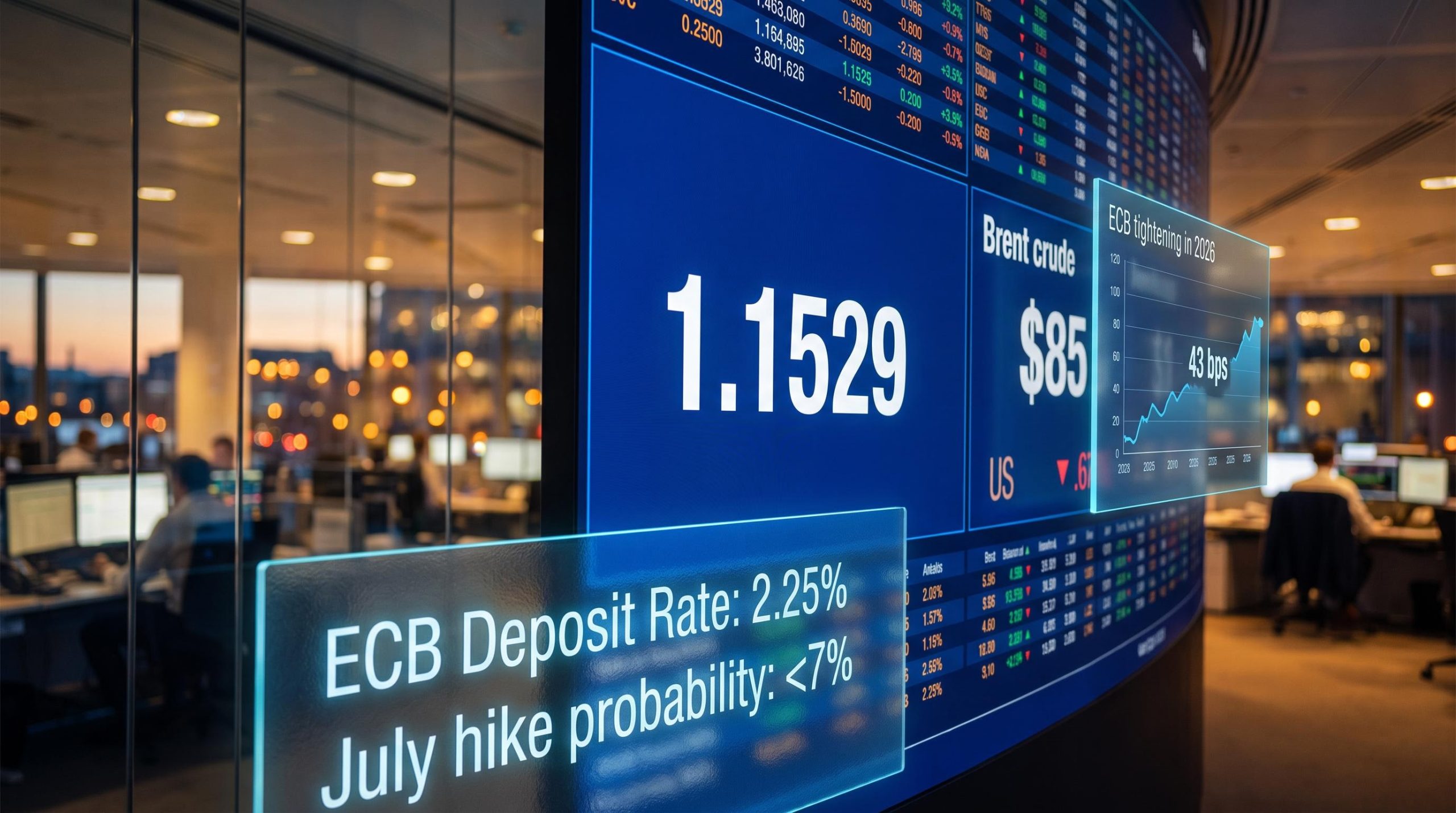
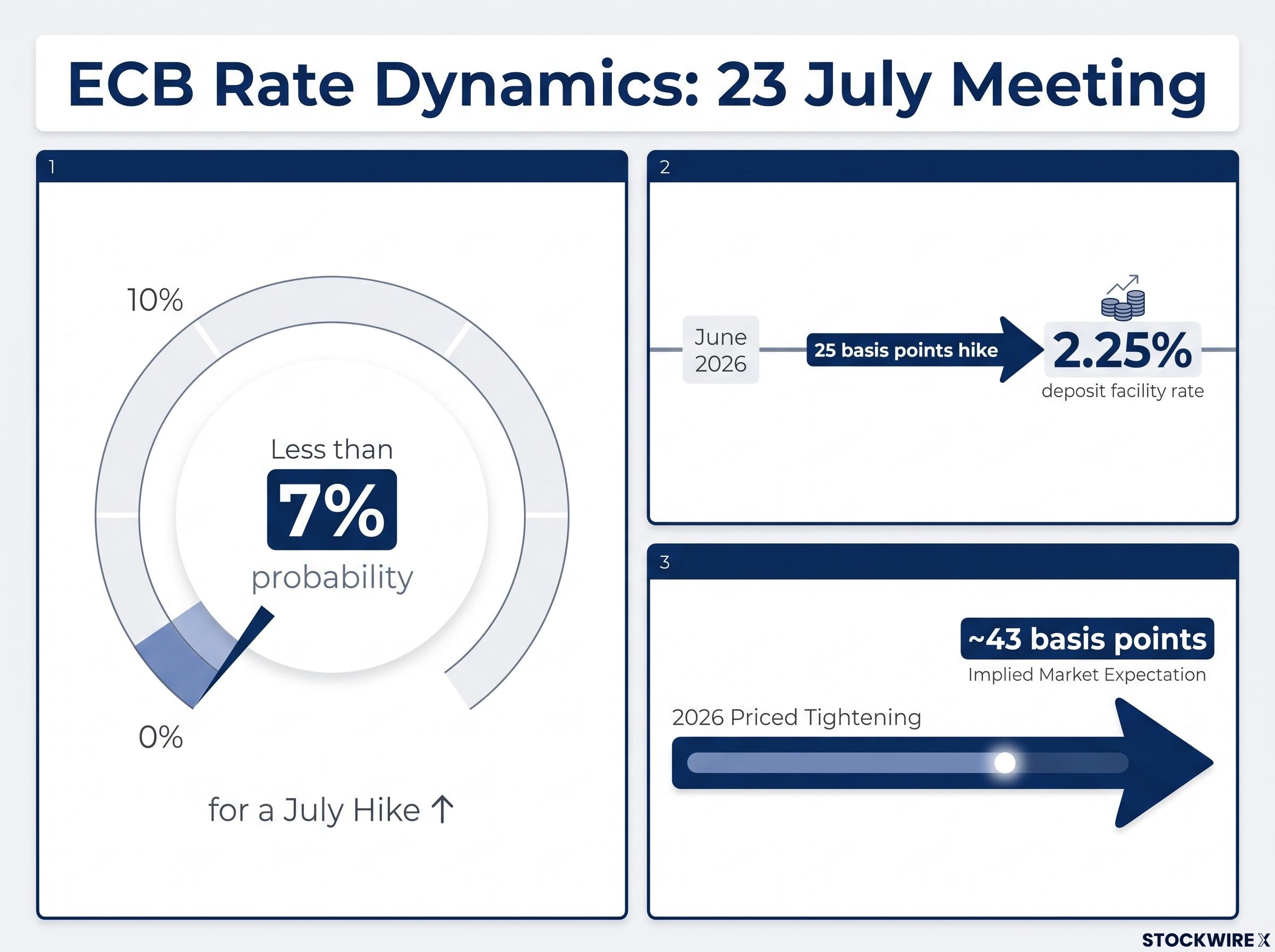
Market pricing assigns less than a 7% probability to an ECB rate hike this Thursday, yet traders across euro rates, EUR/USD, and Brent crude are watching the 23 July meeting with unusual intensity. When a decision is this close to certain, what the central bank says matters far more than what it does.
The ECB raised rates by 25 basis points in June 2026, taking the deposit facility rate to 2.25%, and immediately pivoted to a data-dependent, meeting-by-meeting stance. Since then, Middle East tensions have reignited an oil price surge, a divided Governing Council has signalled caution about pre-committing to further moves, and the euro has been in a sustained 10-week downtrend. The July meeting lands in the middle of all of this, with September already shaping as the next genuine decision point.
The ECB’s June 2026 monetary policy statement confirms the 25 basis point increase and the explicit commitment to a data-dependent, meeting-by-meeting approach, establishing the analytical baseline against which Thursday’s communication will be read.
Here is a framework for reading Thursday’s communication rather than its headline outcome: what the statement’s energy language, Lagarde’s characterisation of the Council divide, and any shift on second-round effects mean for how September odds reprice, and what investors in European rates, FX, and energy-sensitive equities should be tracking between now and the next meeting.
Why the July hold was never really in doubt
The July hold is as close to pre-determined as central bank decisions get. Markets are pricing less than a 7% probability of a move, and no major forecaster has called for one.
Less than 7% of market pricing assigns any probability to a July hike. The decision itself is settled. The communication is not.
That near-certainty reflects a specific set of conditions. Officials identified two scenarios that would have forced their hand this month:
- Brent crude rising decisively above approximately $100 per barrel, signalling a materially worse energy shock than the June baseline assumed
- An upside surprise in core inflation suggesting price pressures had broadened well beyond energy
Neither has materialised. Brent is consolidating around $85. Core inflation data has not delivered the kind of surprise that would justify moving again six weeks after the June hike. The July meeting’s accompanying staff projections are grounded in oil prices that align with where the June baseline had already assumed energy would sit, which strips away one of the few remaining grounds for acting now.
The absence of evidence for second-round effects, where higher energy costs feed through into wages and broader services prices, has been the decisive pillar of the case for restraint. But the conditions that make July a near-certainty are the same conditions that make September genuinely uncertain. If Brent moves higher through August, or if wage data starts to shift, the bar officials set for July becomes the bar they have already cleared for September.
The debate over whether rate hikes can actually address a supply-side inflation problem, where the root cause is disrupted energy supply rather than excess demand, has been a persistent tension within the Governing Council since the June hike was first telegraphed.
When big ASX news breaks, our subscribers know first
The real question: what September pricing tells you right now
Markets are not pricing stasis for the rest of 2026. Approximately 43 basis points of total ECB tightening is priced for the full year, with September as the focal point for the next potential move. That figure sits between one and two additional hikes, meaning rates markets have not fully committed to either path.
The variable that will resolve the ambiguity is oil. ECB accounts and officials’ comments explicitly link the expected number and timing of hikes to Brent crude levels. When the ECB set out its June framework, it did so on the assumption of no fewer than two rate rises in total, with core inflation holding above the 2% target throughout. If Brent stays near current levels, that baseline holds. If it pushes meaningfully higher, the September staff projections will require upward revisions to headline and possibly core inflation, tightening the case for another move.
Analyst conviction for a September hike has faded as inflation risks became more balanced, but the base case remains at least one further move. For investors holding European rate exposure, the question is not whether the ECB hikes in July. It is whether the approximately 43 basis points currently priced for the year is accurate, and the answer hinges almost entirely on where oil trades through August.
The Barclays ECB rate forecast beyond 2026 frames September not as the end of the tightening story but as a potential inflection point, with Barclays treating the conditional September hike as low-conviction while holding high conviction that a full easing cycle follows through 2027.
| Oil scenario | Brent trajectory | September hike probability | Implication for rate path |
|---|---|---|---|
| Consolidation | Stays near $85 | Moderate | One more hike likely; timing uncertain |
| Escalation | Rises above $100 | High | Multiple hikes repriced; September near-certain |
| Pullback | Falls materially below $85 | Low | Extended pause possible; tightening expectations fade |
How the ECB’s communication signals work: energy language and Council divisions
The July statement will not tell you whether the ECB hikes in September. It will tell you how the ECB is thinking about the conditions under which it would. The distinction matters, and parsing it correctly requires knowing which phrases carry signal and which are boilerplate.
Three language markers in Thursday’s statement carry the highest signal value:
- “Persistent” versus “transitory” on energy: if the statement frames the current energy shock as persistent, markets will read that as raising the probability of a September move. If it frames the shock as transitory or consistent with the existing baseline, the current pricing holds.
- “Meeting by meeting” as a patience signal: this phrase, when emphasised, tells you the Council is not ready to pre-commit, which softens September expectations.
- “Inflation extending beyond energy sectors”: this is the phrase that would signal the ECB sees domestic inflation dynamics shifting, not just an energy-driven headline. Its appearance would materially reprice the forward path.
A reader who learns to parse these distinctions can reprice their September probability estimate in real time during Thursday’s press conference, before rates markets have fully absorbed the signal.
Reading Lagarde’s press conference tone
The press conference is where the statement’s ambiguity gets resolved, or deepened. ECB President Christine Lagarde’s characterisation of the Governing Council divide is the most important signal.
The Council is split. Hawkish members highlight persistent core inflation and the risk that energy shocks spill into broader prices. Dovish members stress downside growth risks and the danger of reacting mechanically to a supply shock that monetary policy cannot directly fix.
If Lagarde leans hawkish, explicitly acknowledging that further hikes remain likely if energy stays elevated, that reinforces market pricing for a September move. If she leans cautious, stressing uncertainty and offering no forward signal beyond data-dependency, current expectations for the pace of tightening soften. Her tone on the risk balance between inflation and growth is especially important for curve positioning and peripheral spreads.
Second-round effects: the signal that would change everything
Every central bank decision since the energy shock began has rested on one analytical judgement: whether higher energy costs are feeding through into wages and broader services prices, or whether the inflation impulse remains contained within energy itself. Second-round effects (the pass-through from energy costs into non-energy prices and wages) are the mechanism that turns a temporary supply shock into a structural inflation problem.
So far, the ECB has consistently pointed to the absence of strong second-round effects as the central justification for restraint. Officials have used this absence to argue against overreacting to an energy-driven headline inflation number.
The distinction between direct and indirect oil transmission channels matters for the ECB’s second-round effects judgement: the direct channel hits headline inflation immediately, while the indirect channel, operating through logistics, agriculture, and manufacturing on a 6-12 month lag, is the mechanism through which energy costs embed into broader services prices.
The specific indicators they are monitoring, and that investors should track alongside them:
- Wage growth in sectors not directly tied to energy, the clearest signal that higher costs are embedding into the labour market
- Services inflation excluding energy-adjacent categories, which would indicate pricing power is broadening
- Any statement language referencing “inflation extending beyond energy sectors”, the watch phrase with the highest signal value
The phrase to listen for: “inflation extending beyond energy sectors.” Its appearance in Thursday’s statement or press conference would signal a structurally different inflation dynamic, not just an energy response.
If the ECB signals that second-round effects are beginning to emerge, the implication is a rate path that could extend well beyond September. Most market participants are debating one versus two more hikes. Second-round effects materialising would shift the debate to a different level entirely, and positioning ahead of that shift is where the asymmetric risk sits.
This article is for informational purposes only and should not be considered financial advice. Investors should conduct their own research and consult with financial professionals before making investment decisions.
What the euro and oil charts are already telling you
The statement and press conference are not the only signals available on Thursday. Two market variables are already expressing a view on the ECB’s policy credibility and rate path, and both will react in real time to the communication.
EUR/USD has been in a sustained downtrend since mid-June 2026, with the 50-day simple moving average sitting at approximately 1.1529 as resistance. The euro’s failure to reclaim that level in the weeks since the June hike tells you that markets are not yet convinced the ECB’s tightening path is aggressive enough relative to peers. A hawkish press conference that confirms September tightening would likely support EUR/USD and narrow rate differentials versus the US. A cautious tone keeps the euro under pressure.
The Fed-ECB rate differential is not a static backdrop for EUR/USD positioning: Bank of America’s three-hike Fed scenario through late 2026, converged on independently by J.P. Morgan, implies dollar strength that the ECB’s own tightening path must meaningfully offset for the euro’s 10-week downtrend to reverse.
Brent crude has been ranging near $85 per barrel, with technicians eyeing a push toward approximately $88 where the 50-day moving average sits as the next meaningful level to watch. It is the exogenous variable the ECB cannot control but must respond to. The level policymakers have flagged as problematic sits above approximately $100. Between here and there is the range where September’s probability distribution gets determined.
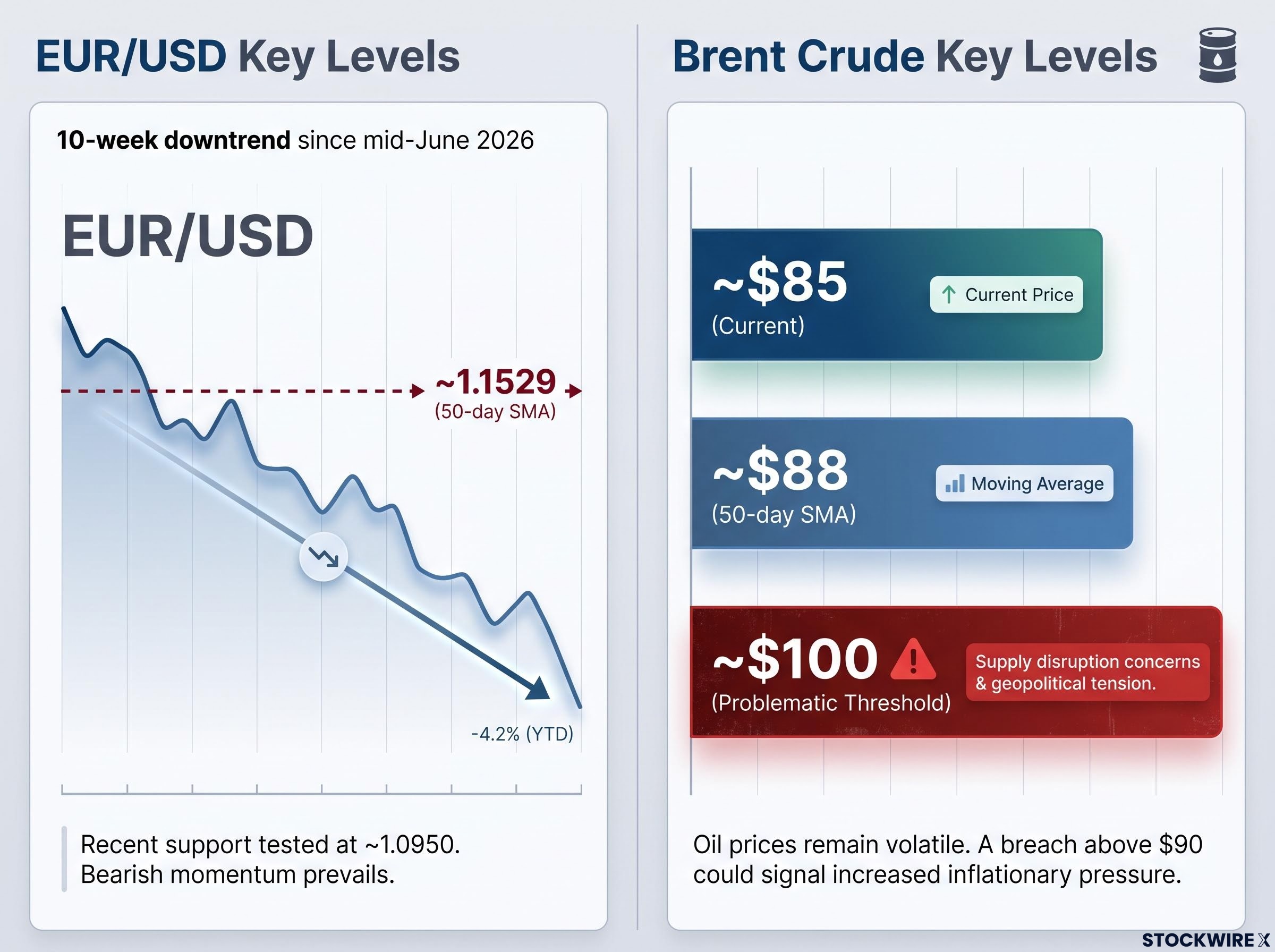
| Market variable | Current level | Key threshold | What crossing it signals |
|---|---|---|---|
| EUR/USD | Below 50-day SMA | ~1.1529 (50-day SMA) | Reclaim signals market upgrading ECB credibility; failure signals doubt persists |
| Brent crude | ~$85/barrel | ~$100/barrel | Breach raises hike count expectations and forces upward revision to ECB inflation projections |
For investors managing European equity and fixed-income positions, the euro’s reaction to Thursday’s statement is not just an FX observation. It is a real-time signal of whether the market is upgrading or downgrading the ECB’s policy credibility.
Watching the right variables between now and September
Thursday’s meeting is the starting gun, not the finish line. The September decision, and the repricing that precedes it, will be shaped by what happens over the next six weeks. The ECB itself has identified the two variables that matter most:
- Brent crude trajectory through August: this is the primary exogenous input to September’s headline inflation projections. If oil stays near $85, the current baseline holds. If it moves toward $100, the staff projections shift and the case for a hike strengthens materially.
- Euro area wage and core inflation data: the indicators that would confirm or deny the emergence of second-round effects. Watch for releases through August 2026, the month when the September probability distribution is effectively determined before the staff projections lock in.
The approximately 43 basis points of tightening currently priced for 2026 is the implicit assumption embedded in any European rate, FX, or equity position. A shift in that figure, in either direction, is the mechanism through which the ECB’s communication translates into portfolio impact.
How rate path repricing maps to portfolio exposure
Three portfolio categories carry the most direct exposure to ECB rate path revisions:
- Euro-denominated fixed income, where duration sensitivity means that additional hikes compress bond prices, particularly at the front end of the curve
- EUR/USD FX positions, where the relative rate differential between the ECB and the Federal Reserve drives directional moves
- European energy-sensitive equities in industrials, utilities, and transportation, where both the rate environment and the energy cost environment are moving simultaneously
Investors who treat the July meeting as the end of the story will be caught off-guard by September. Investors who use Thursday’s communication to calibrate their probability framework for the next six weeks will be positioned ahead of the repricing, not behind it.
Past performance does not guarantee future results. Financial projections are subject to market conditions and various risk factors.
What Thursday’s communication either confirms or begins to unwind
The July hold is settled. The approximately 43 basis points of expected 2026 tightening is not. Thursday’s communication determines whether that figure is too much, too little, or approximately right, and three signals give you the read in real time: the statement’s energy language (persistent versus transitory), Lagarde’s characterisation of the Council divide (hawkish lean versus cautious patience), and any shift on second-round effects.
Beyond the meeting itself, one variable eclipses all others. Where Brent crude trades through August is the primary input to September’s decision. It shapes the staff projections, the Council’s risk assessment, and the market’s probability pricing. That is the number to watch between now and the next meeting, and it is the one the ECB cannot control.
—