

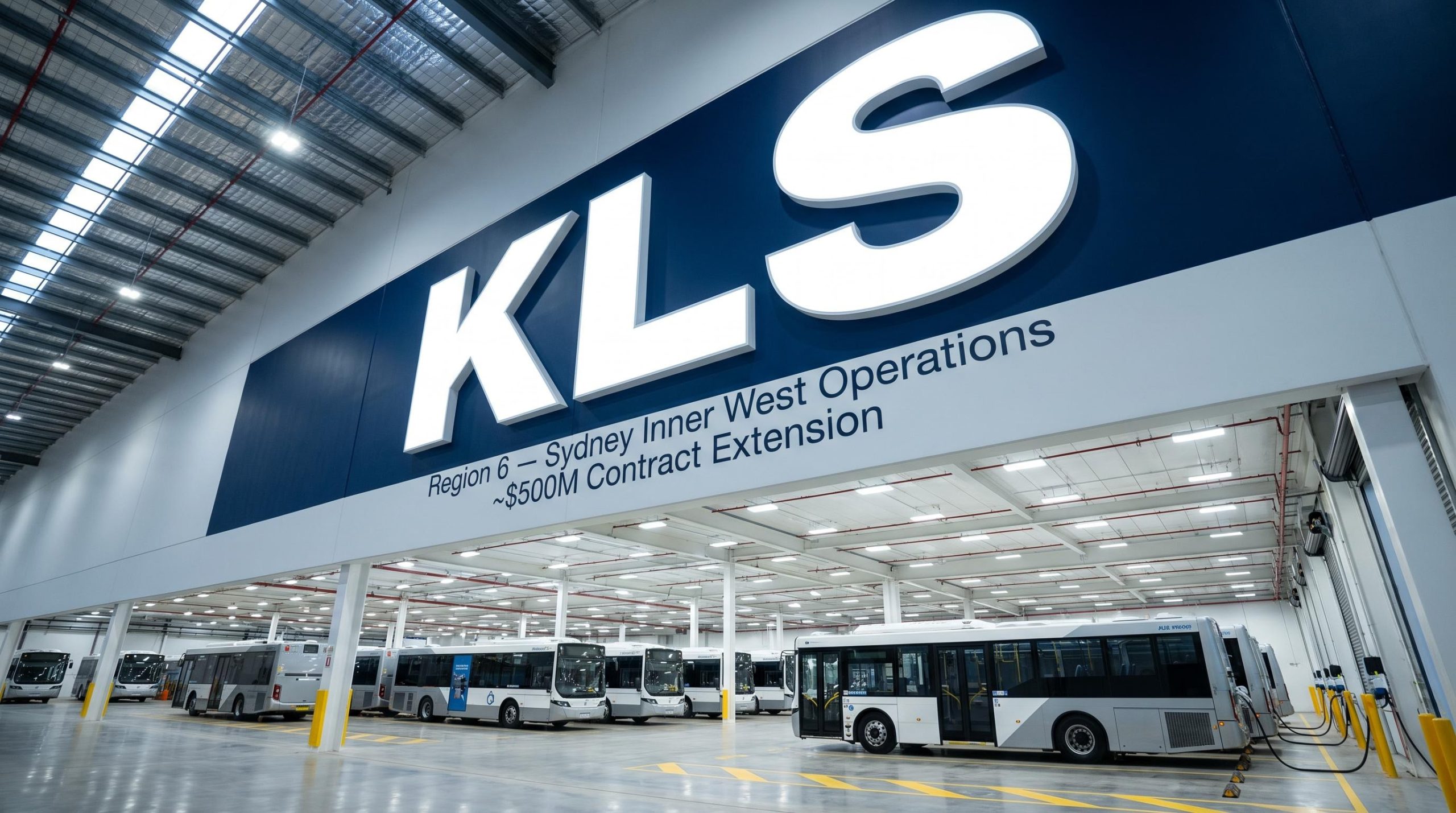
Kelsian locks in $500 million Sydney Region 6 contract extension through to June 2028
Kelsian Group (ASX: KLS), through its wholly owned subsidiary Transit Systems West 1, has signed a Deed of Variation with Transport for New South Wales (TfNSW), extending its Region 6 bus services contract for two years commencing 1 July 2026.
The extension secures approximately $500 million in additional revenue over the two-year period (estimated prior to indexation, based on contracted fleet profile), with the contract running through to 30 June 2028.
When big ASX news breaks, our subscribers know first
What the contract extension covers
Operations, fleet, and depot electrification
The Region 6 contract covers the operation and maintenance of bus services across Sydney’s inner west, one of the city’s highest-frequency public transport corridors. Key operational details include:
- Contract term: 2 years (1 July 2026 – 30 June 2028)
- Fleet size: 528 buses across four depots
- New EV additions: 151 fully electric buses supplied by TfNSW as part of a fleet replacement programme
- Depot electrification: Leichhardt and Kingsgrove depots (underway)
- Coverage: Inner west Sydney (Region 6)
Revenue protection built in
The contract includes revenue indexation mechanisms that adjust revenue over time to account for movements in key cost inputs. For investors, this provides a degree of structural earnings visibility and inflation protection across the extension period.
Graeme Legh, Group Chief Executive Officer
“As with most of our public transport contracts, there are revenue indexation mechanisms included in this contract extension, which protect the business from fluctuations in the cost base of our key cost inputs, including fuel.”
Why this contract matters for Kelsian investors
A capital-light revenue anchor
A defining feature of this extension is its capital-light structure. TfNSW is supplying the 151 new fully electric buses, meaning Kelsian gains the revenue and operational benefit of a modernised fleet without bearing the associated capital expenditure. This improves return on capital and reduces balance sheet risk during the electrification transition.
The ~$500 million revenue figure represents a meaningful contribution to Kelsian’s contracted revenue base. For context, Kelsian operates 6,115 buses globally across Australia, the UK, USA, Singapore, and the Channel Islands, positioning Region 6 as a significant domestic anchor within a diversified international portfolio.
Track record that wins renewals
TfNSW entered direct negotiations with Transit Systems West as the incumbent operator, bypassing a competitive tender process. This reflects government confidence in Kelsian’s operational performance across the region.
Graeme Legh, Group Chief Executive Officer
“It is pleasing to have reached an agreement with TfNSW for the extension of this important, capital light contract, which reflects our excellent track record providing safe and reliable bus services for the communities across Sydney’s inner west.”
Contract timeline — how we got here
The path to this extension followed a structured negotiation process over more than a year:
- March 2025 — TfNSW enters direct negotiations with Transit Systems West as incumbent Region 6 operator for a short-term extension post-30 June 2026.
- June 2025 — Kelsian announces TfNSW is seeking NSW Government approval for a two-year extension to 30 June 2028.
- 2 June 2026 — Deed of Variation signed; contract extension confirmed for two years commencing 1 July 2026.
Understanding public transport contracts — what investors should know
Government bus services contracts like Region 6 operate on a straightforward model: the operator is paid by the government to run bus services on its behalf, with revenue largely contracted and predictable over the term.
A Deed of Variation is a legally binding amendment to an existing contract. It modifies agreed terms without requiring a full competitive tender, and is typically used when both parties wish to extend or adjust an ongoing arrangement.
Revenue indexation means that the revenue Kelsian receives under the contract adjusts periodically to account for cost increases, such as fuel and wages. This provides a degree of inflation protection and reduces earnings volatility over the contract term.
Capital light, in this context, means that TfNSW (the government authority) is funding and supplying the new electric bus fleet, not Kelsian. Kelsian operates the buses and earns the associated revenue without needing to commit significant capital to fleet procurement, which reduces financial risk and supports stronger returns.
The table below summarises the key terms of the Region 6 contract extension at a glance.
| Feature | Detail |
|---|---|
| Contract party | Transit Systems West 1 (wholly owned Kelsian subsidiary) |
| Contracting authority | Transport for New South Wales (TfNSW) |
| Contract period | 1 July 2026 – 30 June 2028 |
| Fleet | 528 buses; 151 new EVs supplied by TfNSW |
| Estimated revenue | ~$500 million (pre-indexation) |
With over 12,900 employees, 6,115 buses operating globally, and more than 384 million customer journeys delivered over the past year, the Region 6 extension adds further stability to Kelsian’s contracted revenue base as the company continues to grow its presence across Australia and international markets.
Don’t Miss the Next Transport Sector Contract Win
Get FREE breaking ASX news delivered to your inbox within minutes of release, complete with in-depth analysis already done for you. Join 20,000+ investors who stay ahead of the market the moment announcements drop. Click the “Free Alerts” button at Big News Blast to start receiving alerts across ASX industrials and transport sectors today.