Waymo is expanding. Tesla is testing. Cruise is rebuilding. And every one of those headlines lands the same way for Uber shareholders: as a threat.
The anxiety is understandable. Uber is one of the most widely held names in US portfolios, and the autonomous vehicle narrative has become the single loudest risk factor attached to its valuation. If you own the stock, are considering a position, or are stress-testing a bull case, the question is unavoidable: does a world of robotaxis still need a ride-hailing platform?
Here is a structured framework for evaluating whether autonomous vehicles threaten Uber’s platform or, counterintuitively, reinforce it. The answer depends on assumptions most investors have not examined closely enough.
The bear case is compelling until you look at how platforms actually work
The standard disintermediation thesis is clean. Driver labour is Uber’s largest cost variable. Autonomous vehicles eliminate it. AV operators, once they have the fleet and the technology, can build their own consumer apps and go direct, cutting Uber out entirely.
It is a logical argument. It is also resting on a set of assumptions that deserve individual scrutiny:
- Driver cost elimination solves the economics. True in theory, but AV fleets carry their own capital intensity: sensors, specialised vehicles, maintenance, and insurance.
- AV operators can build direct-to-consumer distribution. Possible, but expensive, and unproven at scale outside a handful of cities.
- A single dominant AV operator will emerge. This is the load-bearing claim. If supply fragments, the aggregator role becomes more valuable, not less.
- Disruption arrives on a near-term timeline. Multiple analysts and long-term investors have explicitly placed large-scale Level 5 disruption at five to ten years out from 2026, preserving Uber’s network effects in the medium term.
Tesla robotaxi ambitions remain the most-watched competitive variable, with management reporting roughly 10% week-over-week mileage growth across six US cities while external observers characterise the current fleet as a nascent pilot rather than a commercial-scale operation.
That last point matters more than it appears. Regulatory and permitting friction operates city by city and state by state across the US. Uber’s own 2018 fatal crash in Arizona demonstrated how quickly safety incidents can slow deployment timelines across the entire industry. Analyst commentary consistently characterises AV headline risk as exceeding fundamental risk in the current period.
The bear case assumes a speed and consolidation that current evidence does not support. That gap between assumption and evidence is exactly where the investment thesis lives.
When big ASX news breaks, our subscribers know first
In the markets where Waymo already operates, Uber is growing faster
If AV competition were already eroding Uber’s core business, the damage should be visible first in the cities where Waymo actually operates.
According to CEO commentary on Uber’s most recent earnings call, the company saw Q2 trip growth pick up relative to Q1 across San Francisco, Los Angeles, and Phoenix, and pointed to improved year-over-year category position in each of those markets.
Uber CEO earnings call commentary: On the most recent earnings call, Uber’s CEO indicated that the company’s trip volumes in its three largest US markets with active Waymo operations grew faster in Q2 than Q1, and that Uber had strengthened its market position in each city on a year-over-year basis.
A necessary caveat: these figures originate from Uber CEO commentary and are not independently audited. Weight them accordingly. But the direction of the data, acceleration rather than erosion in AV-exposed markets, is worth registering.
What the Waymo subscription move actually signals
The picture is not entirely clean. In Phoenix, Waymo’s existing arrangement with Uber came to an end in May 2026, whereas the two companies continue to collaborate in Austin and Atlanta. Separately, Waymo has introduced a subscription offering of its own, signalling a push to build a direct relationship with consumers rather than routing exclusively through third-party platforms.
This is a risk indicator worth monitoring. But it is worth noting that Waymo’s current consumer scale remains narrow relative to Uber’s approximately 199-202 million monthly active consumers. The subscription launch signals ambition, not yet proven distribution power.
The acceleration in Uber’s AV-market cities does not prove that AVs help Uber. But it does falsify the simplest version of the disintermediation story, and that is a meaningful update for anyone calibrating this risk.
The LLM market fragmented, and so might AV supply
Consider how the artificial intelligence market evolved. Early expectations assumed a single dominant AI provider would emerge and capture the market. What actually happened was fragmentation: OpenAI, Anthropic, Google, Meta, Mistral, and a growing open-source ecosystem established distinct positions with different strengths, pricing, and deployment strategies.
Value did not accrue only to model providers. It also accrued to orchestration and aggregation layers, the platforms that route demand, manage costs, and abstract complexity for end users.
AI supply layer economics offer the closest available precedent: when Google, Meta, and Amazon began building custom silicon to reduce dependence on a single chip provider, the orchestration and infrastructure layers connecting those chips to end applications gained value rather than losing it, a dynamic structurally analogous to what Uber is positioning for in AV.
The autonomous vehicle market is structurally similar. Multiple operators, including Waymo, Cruise, Zoox, and Motional, are pursuing different technical stacks, regulatory strategies, and hardware partnerships. Given that permitting regimes differ city by city, single-provider dominance across the US appears unlikely in the medium term.
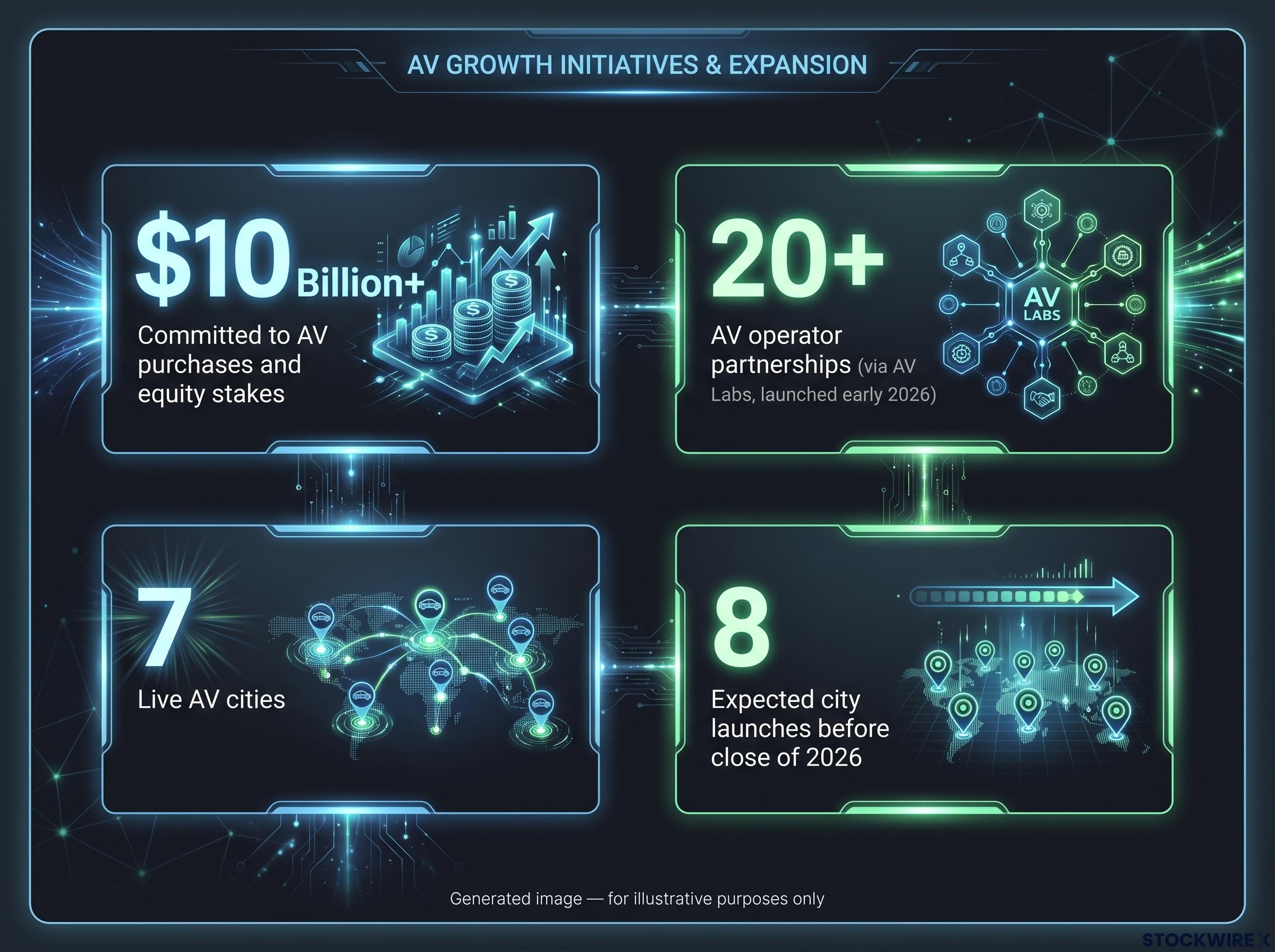
Uber launched AV Labs in early 2026, with partnerships spanning more than 20 AV operators. If AV supply fragments the way AI supply did, a platform that routes demand to whatever autonomous supply is locally available, and abstracts operator complexity from riders, becomes structurally more defensible with each new operator that enters the market.
| Market | Supply-Side Players | Aggregation Layer | Value Thesis |
|---|---|---|---|
| LLM / AI | OpenAI, Anthropic, Google, Meta, Mistral | Orchestration platforms routing to best-fit models | Fragmentation increased aggregator value |
| Autonomous Vehicles | Waymo, Cruise, Zoox, Motional, regional operators | Uber as demand routing and integration layer | Fragmented supply may reinforce platform role |
The AI market offers investors a real-world precedent: when underlying supply technology proliferates, aggregators tend to thrive rather than get bypassed.
Why AV operators need Uber more than the bear case assumes
Robotaxis are high fixed-cost assets. Their economics depend on utilisation, the percentage of time they are moving and earning revenue. An idle robotaxi is an expensive piece of metal depreciating in a parking lot.
Building consumer distribution from scratch requires heavy spending on user acquisition, brand investment, and geographic expansion, particularly during off-peak hours and in lower-density areas outside the densest urban cores. Uber already has approximately 199-202 million monthly active consumers, detailed data on temporal and spatial demand patterns, and mature dynamic pricing and matching systems.
The specific value Uber provides to AV operators includes:
- Demand routing during off-peak hours and low-density periods
- Rapid city ramp support through an existing consumer base
- Payments, dispatch, and operational tooling already built at scale
- Utilisation optimisation across fleet types and time windows
Uber is not passively waiting for this relationship to develop. The company has committed more than $10 billion to AV purchases and equity stakes, according to Financial Times reporting and Uber announcements. The Waabi partnership includes milestone-based investment and exclusive platform deployment for both self-driving trucks and robotaxis.
Uber’s capital commitment to autonomous vehicles now exceeds $10 billion in purchases and equity stakes across multiple AV developers, supporting thousands of vehicles.
AV services have gone live across 7 cities to date, with a further 8 city launches expected before the close of 2026. The exclusivity structure with Waabi tells you Uber is not hoping to remain relevant in an AV world; it is actively purchasing a position inside the supply chain.
Uber’s capital allocation priorities extend well beyond the AV supply chain: the company’s contested bid for Delivery Hero, with shareholders demanding above €40 against an indicative offer of €33, represents a parallel strategic bet on inorganic European delivery scale that competes for the same balance sheet capacity funding the AV partnerships.
What the core business numbers say about platform resilience right now
If AV competition were eroding Uber’s platform economics, the financials would show it first.
| Segment | Gross Bookings Growth (Most Recent Quarter) | Notes |
|---|---|---|
| Mobility | ~20% | Continued profitability improvement alongside growth |
| Delivery | ~25% | Acceleration from prior year levels |
| Freight | ~25% | Broader industry tailwinds a contributing factor |
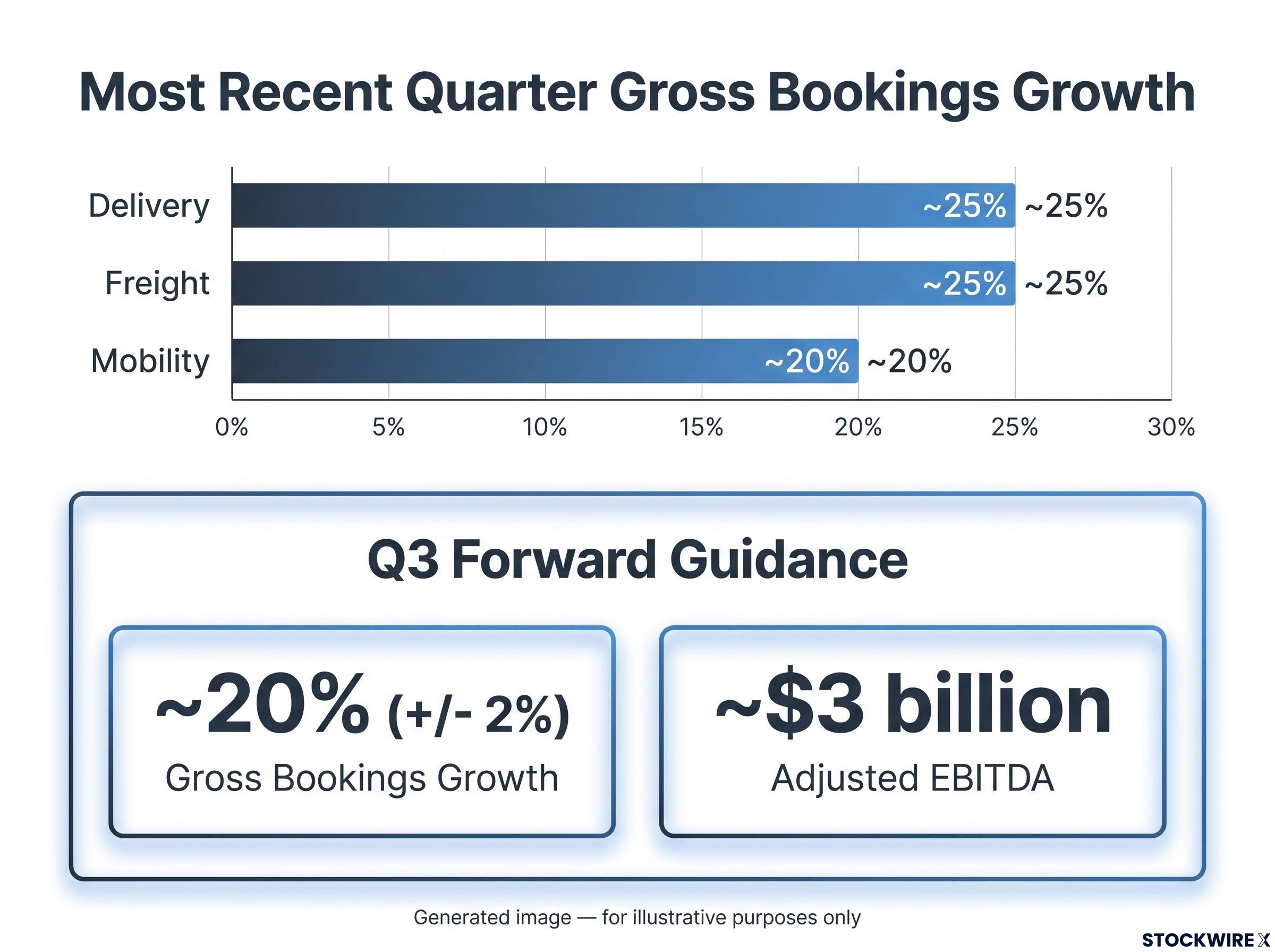
The Mobility segment, which carries the most direct exposure to AV competition, posted gross bookings growth of around 20%. Delivery came in at roughly 25%, a step up from the prior year. Freight reached a similar growth rate, though this figure warrants caution: the same quarter produced strong results across a number of other freight businesses, pointing to sector-wide tailwinds rather than anything unique to Uber’s positioning.
The forward guidance reinforces the picture:
- Q3 gross bookings growth guided at approximately 20%, plus or minus 2%
- Q3 adjusted EBITDA (earnings before interest, taxes, depreciation, and amortisation) guided at approximately $3 billion
Management’s willingness to guide 20% bookings growth and $3 billion adjusted EBITDA is inconsistent with an internal view that existential disruption is imminent. A company facing genuine near-term platform erosion would show it in these numbers, and they do not show it. That is a meaningful data point for you if you are calibrating the disruption timeline.
What does genuine AV disruption risk for Uber actually look like
None of the above means the risk is zero. An honest framework requires identifying the specific conditions under which the bear case becomes the base case.
The three scenarios worth monitoring, in priority order:
- Single-provider dominance. If one AV operator, most likely Waymo, achieves dominant consumer brand loyalty and scale across the top 10 US cities, the aggregator value proposition weakens materially. Waymo’s subscription product launch is the earliest signal of this pathway.
- Thin take-rate erosion. If AV operators use Uber purely as marginal demand fill during troughs and route peak demand through their own apps, Uber’s margin capture on AV trips could be structurally lower than on human-driver trips.
- Regulatory constraint. City-level permitting changes or classification rulings could restrict Uber’s ability to integrate AV supply, fragmenting its platform advantage at the regulatory layer.
These are not base-case outcomes given current evidence. But they are the scenarios that would change the thesis if they developed.
The signals that would change the thesis
If you own Uber or are evaluating a position, three variables deserve ongoing monitoring:
- Waymo’s US monthly active user growth, particularly in cities where Uber also operates
- Uber’s disclosed AV trip take rate versus human-driver take rate, once reporting granularity improves
- Any new city-level partnership lapses following the Phoenix precedent of May 2026
These are the early warning indicators. If disintermediation is actually developing rather than remaining a tail risk, the evidence will surface here first.
What the evidence actually supports in mid-2026
The four-part argument stacks up clearly. The bear case timeline is longer than priced. Current city-level data does not show erosion. The fragmented AV supply landscape makes the aggregator role structurally valuable. And Uber’s more than $10 billion commitment, combined with 7 live AV cities and 8 more launching by year-end, positions it as a supply-chain participant rather than a passive bypass target.
Medium-term conviction in the platform resilience thesis is well-supported. Long-term uncertainty is real: Level 5 autonomy at full scale genuinely changes the competitive landscape and deserves ongoing monitoring rather than dismissal.
The investment question is not whether AVs will disrupt Uber. Eventually, they will. The question is whether Uber has the strategic positioning and capital to remain the demand aggregation layer as AVs scale, and current evidence supports a cautious yes.
AV headlines will continue to move Uber’s stock. If the AI market is any guide, Uber has time to embed itself in the AV supply chain before a dominant operator emerges. Investors with a clear framework for evaluating platform economics and supply fragmentation have a structural edge over those reacting to each robotaxi announcement as if it were a verdict.
For investors wanting to understand how institutional analysts are pricing AV and robotics optionality into competitor valuations, our full explainer on JPMorgan’s Tesla physical AI thesis details the specific robotaxi, FSD licensing, and Optimus milestones JPMorgan identified as the next 12-18 month valuation catalysts.
This article is for informational purposes only and should not be considered financial advice. Investors should conduct their own research and consult with financial professionals before making investment decisions. These statements are speculative and subject to change based on market developments and company performance.