Global equity and bond markets fell in the first quarter of 2026. Oil spiked toward $120 per barrel. The Iran conflict, tariff uncertainty, and questions about artificial intelligence valuations landed simultaneously, producing the kind of quarter that makes retail investors question everything. Yet virtually every major institutional investor, from BlackRock to J.P. Morgan to Fidelity, is still calling the bull market intact.
The gap between what investors feel watching their portfolios and what institutions are forecasting has rarely been wider. One side of the screen shows red. The other side shows strategists reaffirming overweight equity positions and projecting mid-to-high single-digit returns over the next twelve months.
This analysis unpacks the institutional case for a continuing bull market in 2026, tests that case against the credible dissenting views, and explains what the competing signals mean for how investors should be thinking about equity positioning right now.
Why the bull market thesis still holds heading into the second half of 2026
The institutional consensus is not a vague expression of optimism. It is anchored in specific fundamental drivers that five of the world’s largest asset managers have independently identified and continue to endorse as of mid-May 2026.
BlackRock’s Investment Institute, in its 18 May 2026 weekly commentary, maintained an overweight position on developed-market equities, citing the “earnings power of AI beneficiaries” as justification for staying invested despite elevated volatility. The firm holds a five-year positive outlook on developed stocks. Russell Investments projects mid-to-high single-digit equity returns over the next twelve months in its updated global market outlook. J.P. Morgan frames equities as retaining more upside than fixed income, anchored in an improving global growth and earnings backdrop.
The consensus across these firms converges on three pillars:
- BlackRock: Overweight U.S. equities; AI-driven earnings power justifies staying invested through volatility
- Russell Investments: Mid-to-high single-digit return expectation; neutral-to-slightly-positive stance on global equities
- J.P. Morgan: Equities retain upside anchored in improving growth and earnings
- Fidelity: Bull market not over; volatility consistent with prior bull cycles; diversification reinforced
- AllianceBernstein: Equities remain a core growth engine; moderate returns expected from here
“Volatility is a feature, not a bug, of the current cycle.” — AllianceBernstein, 2026 institutional research
This is not sentiment. It is a fundamentals-based thesis built on earnings growth, AI-driven productivity, and macroeconomic resilience.
The S&P 500 closing above 7,200 during active Strait of Hormuz disruption is the clearest recent illustration of markets pricing forward earnings rather than current headlines, with Goldman Sachs attributing approximately 12% EPS growth as the primary driver of index performance even as geopolitical conditions remained unresolved.
When big ASX news breaks, our subscribers know first
What the Q1 2026 sell-off actually tells us about where we are in the cycle
The first quarter of 2026 delivered a genuine shock. The Iran conflict pushed oil prices as high as $120 per barrel. Questions about the viability of artificial intelligence investments rattled the sector that had led the market higher. Tariff uncertainty and government debt concerns added further pressure. Global equity and bond markets declined in tandem.
Commodities, by contrast, surged 24.4% year-to-date as of Q1 2026, driven by inflation expectations and geopolitical supply fears. Brent crude remained elevated near $105 as of BlackRock’s May 2026 commentary, indicating sustained but normalising energy stress.
The BEA’s advance GDP estimate for Q1 2026 recorded real economic growth of 2.0 percent, providing official confirmation that the U.S. economy was expanding in the period when equity markets were selling off, a divergence that reinforces the institutional case for treating the correction as cyclical rather than structural.
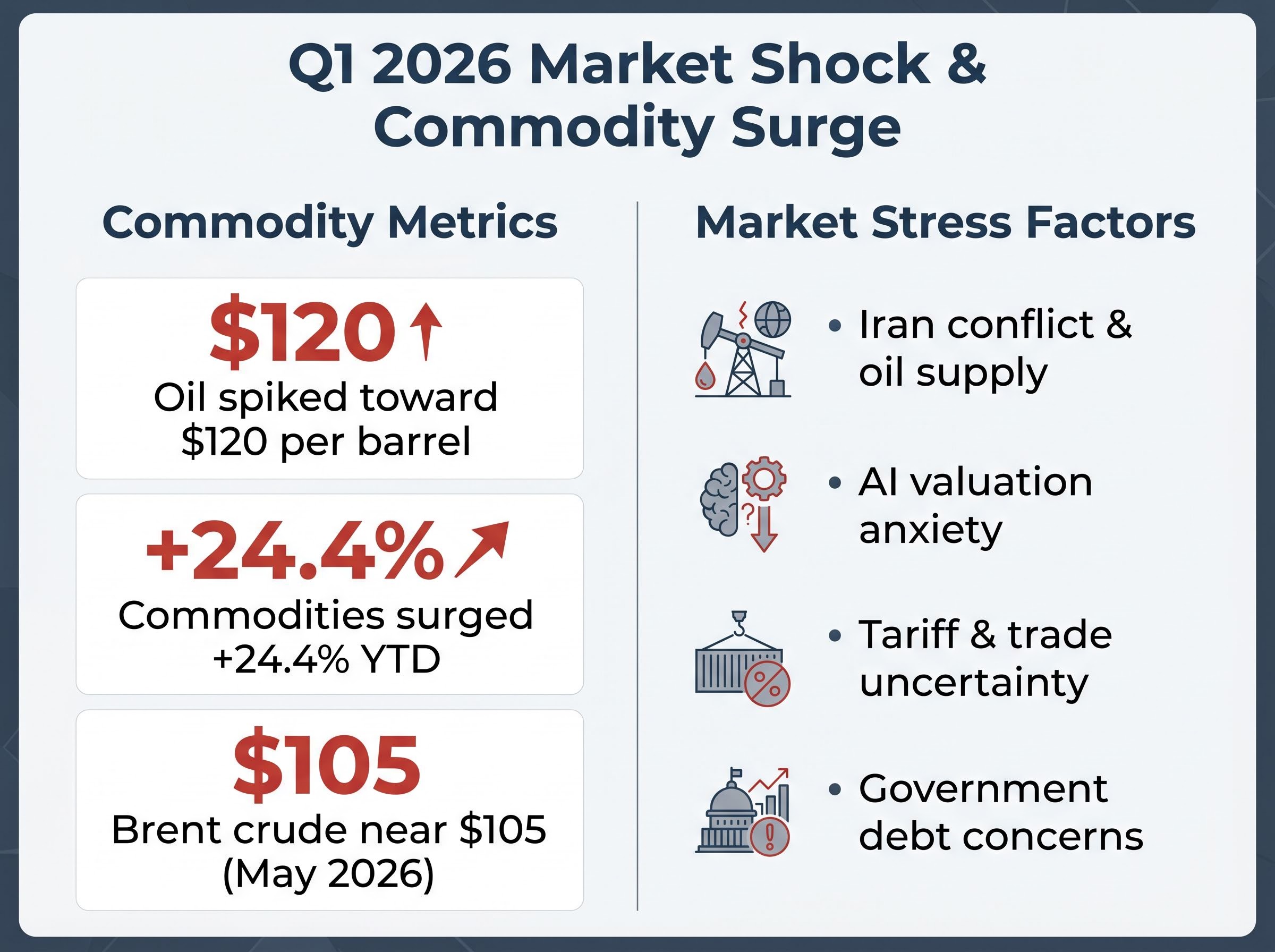
Fidelity’s quarterly market update described the correction as markets having “taken a pause” rather than a structural reversal. The drivers of the sell-off tell a consistent story:
- Iran conflict and oil supply disruption
- AI valuation anxiety and investment viability concerns
- Tariff and trade policy uncertainty
- Government debt and fiscal sustainability sentiment
- Sticky inflation across energy, services, and tariffs
The difference between a correction and a reversal
A correction is typically a 10-20% drawdown within an ongoing uptrend, driven by external shocks or sentiment shifts that do not fundamentally alter the economic cycle. A reversal is a structural shift, driven by deteriorating fundamentals that change the direction of corporate earnings, credit availability, and economic growth.
The signals that would indicate a genuine reversal include rising unemployment, earnings contraction across multiple quarters, credit market stress, and central bank policy failure. None of these structural signals were present in Q1 2026 data according to institutional commentary. The sell-off was a volatility event. The distinction matters because investors who treat corrections as reversals sell at the worst possible moment.
The correction versus reversal distinction is arguably the most important classification an investor can make during a sell-off: a correction leaves the earnings cycle intact while a reversal reflects structural deterioration in revenues, credit, and employment that changes the long-term direction of corporate profits.
Understanding bull markets and why they survive geopolitical shocks
Bull markets are sustained by three core drivers:
- Earnings growth: Corporate profits expanding quarter over quarter
- Economic expansion: GDP growth, employment, and consumer demand holding steady
- Credit availability: Lending conditions that support business investment and consumer spending
Geopolitical crises, oil shocks, and regional conflicts have historically produced corrections rather than cycle-ending bear markets, unless accompanied by fundamental economic deterioration. The 2026 macro backdrop, while stressed, continues to support the ongoing bull case. The U.S. labour market is described as “softening” but unemployment claims remain low, and Fidelity assessed recession risk as minimal in its Q1 2026 review.
“We continue to expect substantial volatility, but periods of heightened uncertainty often correspond with potential innovation and market leadership opportunities, such as advancing artificial intelligence-driven capabilities.” — Fidelity Institutional, Q1 2026 Quarterly Market Update
BlackRock acknowledged geopolitical fragmentation as a structural risk elevating inflation and volatility, yet maintained its overweight equity position because AI-driven earnings power and corporate adaptability outweigh the headline risks in its assessment.
What actually ends a bull market
Four conditions have historically ended bull markets. An earnings recession, where corporate profits contract for multiple consecutive quarters. Credit tightening severe enough to choke business investment and consumer borrowing. Central bank overtightening that pushes the economy into contraction. Sustained consumer demand collapse that feeds through to revenue and employment.
None of these conditions are present in the current institutional assessment as of mid-2026. The cycle is cooling, not stalling, and that distinction has historically coexisted with ongoing equity gains.
The case for caution: where Morgan Stanley and BofA see the cracks
The bull case deserves scrutiny, and two of the firms closest to the data are providing it. Morgan Stanley and Bank of America are not calling a bear market, but both are recommending defensive positioning that tells its own story.
Both firms frame the current environment as late-cycle. Their strategists have noted that a 10-20% drawdown in 2026 would not be surprising, even within a broader bull context. The specific vulnerabilities they identify are narrow market breadth, with AI and mega-cap names dominating leadership, and the risk that AI earnings fail to justify current valuations. Fidelity and BlackRock have both acknowledged that Q1 2026 volatility was partly driven by concerns about the viability of artificial intelligence investments.
AI valuation risk is compounded by a structural concentration problem: the top five US companies now control roughly 30% of total market capitalisation, meaning passive index investors may be carrying far more single-theme exposure than standard diversification metrics suggest.
| Institution | Stance | Primary Concern | Recommended Positioning |
|---|---|---|---|
| BlackRock | Bullish (overweight equities) | Geopolitical fragmentation, inflation | AI beneficiaries, quality large caps, shorter-duration fixed income |
| Morgan Stanley | Cautious (late-cycle) | Stretched valuations, narrow breadth | Quality balance sheets, defensive tilt within equities |
| Bank of America | Cautious (late-cycle) | Valuations, geopolitical risk | Cash-flow-rich large caps, energy and commodities as hedges |
| Fidelity | Bullish (constructive) | AI viability questions, inflation | Diversified fixed income, inflation-resistant assets, core equities |
| Russell Investments | Bullish (neutral-to-positive) | Policy and geopolitical volatility | U.S. and quality growth, fixed income and real asset diversifiers |
Academic research reinforces the caution. A study from the University of Notre Dame found that retail investor attention on individual stocks can predict marketwide underperformance.
“When everyday investors suddenly pay more attention to the market, returns over the next week tend to fall.” — University of Notre Dame research
The implication is straightforward: the stocks attracting the most attention during a bull-market surge are often the ones about to underperform.
How to position an equity portfolio for a bull market that still carries real risk
The institutional guidance converges on a framework that translates the macro analysis into concrete steps:
- Stay invested in core equity exposure. Volatility and corrections are normal features of bull markets, not automatic exit signals. BlackRock recommends staying overweight equities and using shorter-duration fixed income as a risk management tool rather than exiting equities entirely.
- Apply a quality tilt within equities. Quality means prioritising companies with specific characteristics:
- Strong balance sheets with manageable debt levels
- Reliable, recurring cash flows
- Established earnings track records across multiple cycles
- Avoidance of speculative or narrative-driven positions lacking fundamental backing
- Add diversifiers across asset classes. Fidelity reinforced diversification in fixed income and inflation-resistant assets as a key theme for 2026. Commodities were Q1’s leading asset class at +24.4% year-to-date. BofA recommends some energy and commodities exposure as inflation hedges alongside quality large-cap equities.
The University of Notre Dame research adds a behavioural dimension: avoid chasing high-attention, high-buzz stocks during bull-market surges. Retail attention predicts lower future returns. Diversified, fundamentals-driven portfolios have historically outperformed the names generating the most noise.
The temptation to sell into volatility or pile into the most talked-about names is the specific behaviour this framework is designed to counter.
Investors wanting to translate the institutional consensus into a practical decision framework will find our comprehensive walkthrough of geopolitical risk investing covers the specific behavioural traps, including recency bias, herd behaviour, and the disposition effect, that cause retail investors to underperform buy-and-hold strategies during high-attention geopolitical events.
The bull market looks intact, but the easy part may be behind us
The weight of institutional evidence points in one direction. Five of the world’s largest asset managers maintain overweight or constructive equity stances as of mid-May 2026. The risks are real, but they are not cycle-ending. No major institution has called for a global bear market in freely accessible research this year.
What has shifted is the character of the returns ahead. AllianceBernstein frames the path forward as ongoing but more moderate than the early phase of the bull market. The gains from here require more patience, more selectivity, and more tolerance for drawdowns that could reach 10-20% without signalling the cycle is over.
“Late but not done.” — Morgan Stanley’s characterisation of the current cycle
The second half of 2026 will test investor discipline. The institutions most likely to be proven right are those with frameworks that hold through volatility rather than react to it. The same applies to individual investors. Staying invested with a quality bias, diversifying across asset classes, and resisting the pull of high-attention names is not a guarantee of outperformance. It is the positioning that the broadest institutional consensus supports.
This article is for informational purposes only and should not be considered financial advice. Investors should conduct their own research and consult with financial professionals before making investment decisions. Past performance does not guarantee future results. Financial projections are subject to market conditions and various risk factors.