Alphabet just reported the most profitable quarter in its history. Its stock fell.
On the surface, Q2 2026 looked like everything a long-term Alphabet shareholder would want: $119.8 billion in revenue, 24% year-over-year growth, a 34% operating margin, and a cloud division growing faster than even optimistic models predicted. But markets are not backward-looking scorecards. By the time after-hours trading opened, the stock was down, and the reason had nothing to do with the income statement.
Here is the framework for understanding that disconnect: how free cash flow, capital structure, and forward capex guidance now carry more weight in valuation than a record Alphabet earnings beat. Whether you hold the stock or are simply trying to understand how AI infrastructure spending is reshaping the way analysts value mega-cap technology companies, these are the mechanics you need.
The quarter that should have sent the stock higher
Start with the operating results, because they were genuinely strong across every measurable dimension.
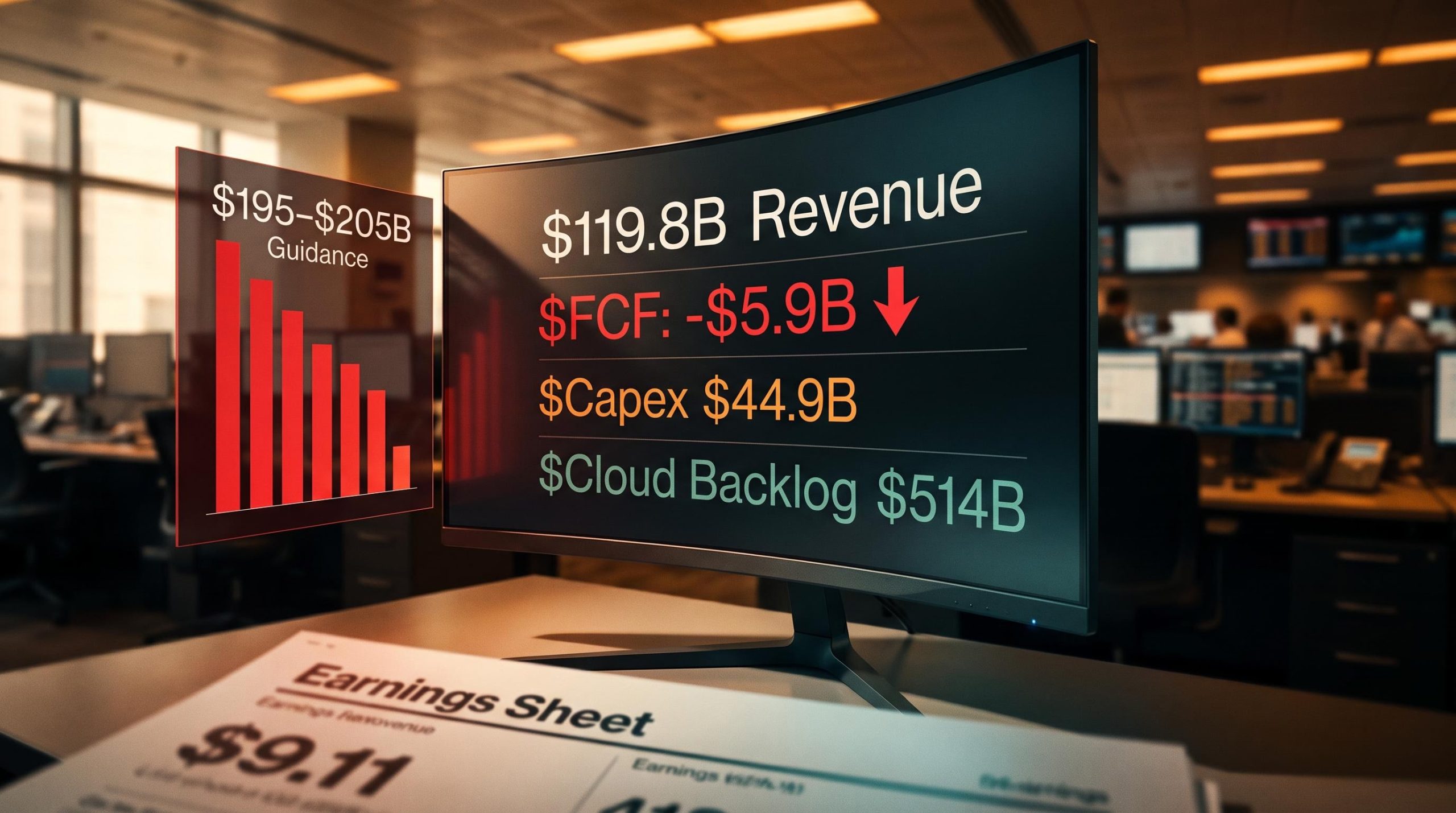
- Total revenue: $119.8 billion, up approximately 24% year over year
- Operating income: approximately $40.8 billion
- Operating margin: approximately 34%, expanding roughly 1.6-2 percentage points year over year
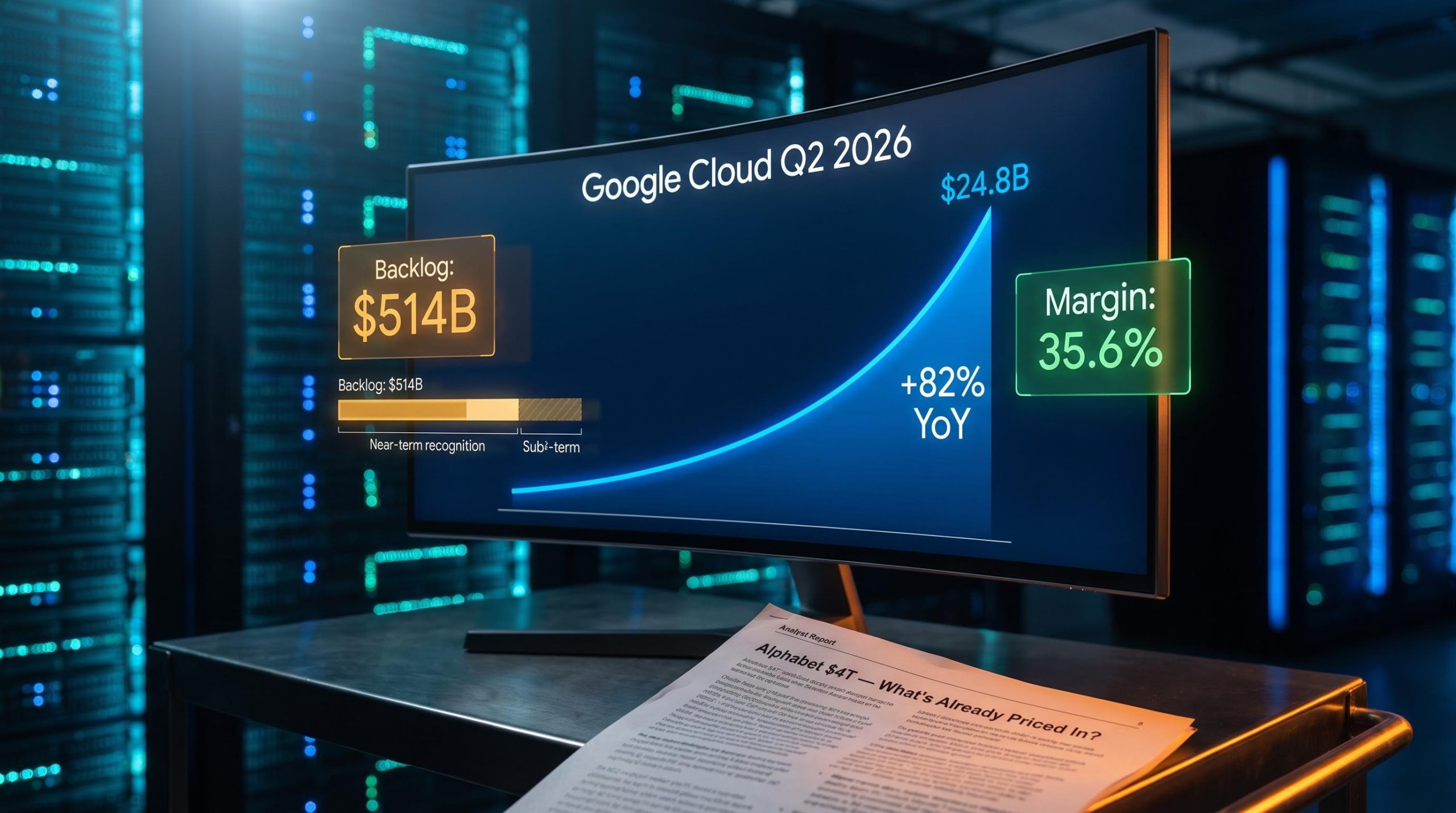
- Google Cloud revenue: approximately $24.8 billion
- Cloud backlog: $514 billion
Alphabet’s workforce grew approximately 6% while revenue expanded approximately 24%, a sign of genuine operational leverage from headcount discipline.
Google Cloud was the standout performer. The $514 billion backlog is not just a large number; it is the strongest forward demand indicator in the entire report, signalling that enterprise customers are committing to multi-year AI and cloud contracts at scale.
For readers wanting the baseline investment thesis before the Q2 capex revision, our full explainer on Alphabet’s pre-Q2 investment case covers the Q1 2026 earnings structure, Cloud margin trajectory, and analyst consensus that shaped market expectations heading into the quarter whose results this article dissects.
The Alphabet Q2 2026 earnings release confirms consolidated revenue of $119.8 billion, the capital expenditure figures cited above, and the equity financing actions management undertook during the quarter, providing the primary source data underlying this analysis.
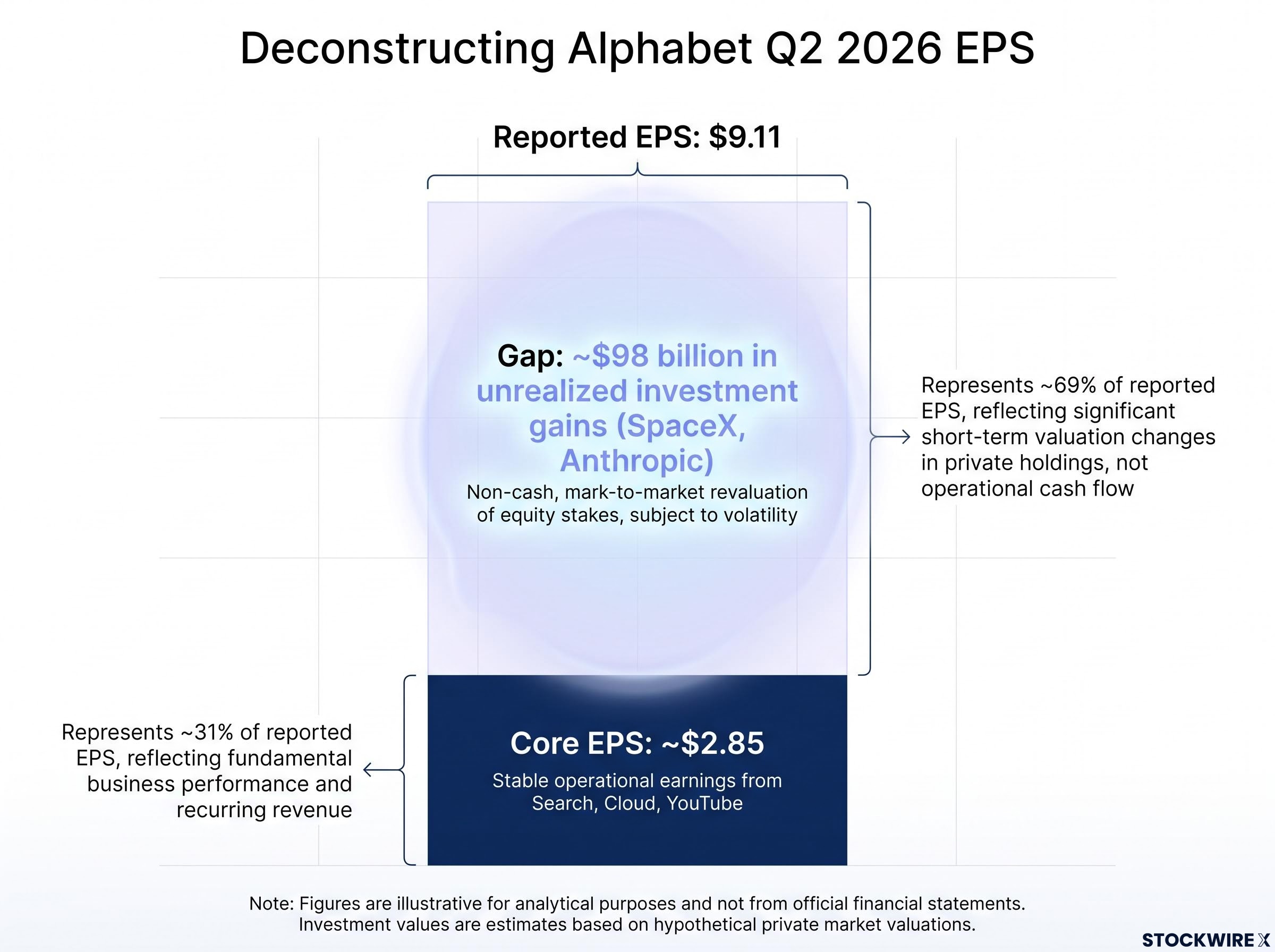
Then there is the earnings-per-share figure. Alphabet reported EPS of $9.11, a number that looks extraordinary until you examine what is inside it.
| Metric | Value |
|---|---|
| Reported EPS | $9.11 |
| Core EPS (excluding investment gains) | ~$2.85 |
| Source of gap | ~$98 billion in unrealised investment gains (SpaceX, Anthropic equity revaluations) |
The $98 billion gap between reported and core EPS is not a footnote. Those are unrealised mark-to-market revaluations, accounting entries that inflate GAAP earnings but do not provide spendable cash. If you are anchoring to $9.11, you are already starting from the wrong place.
When big ASX news breaks, our subscribers know first
How $44.9 billion in quarterly capex flipped free cash flow negative
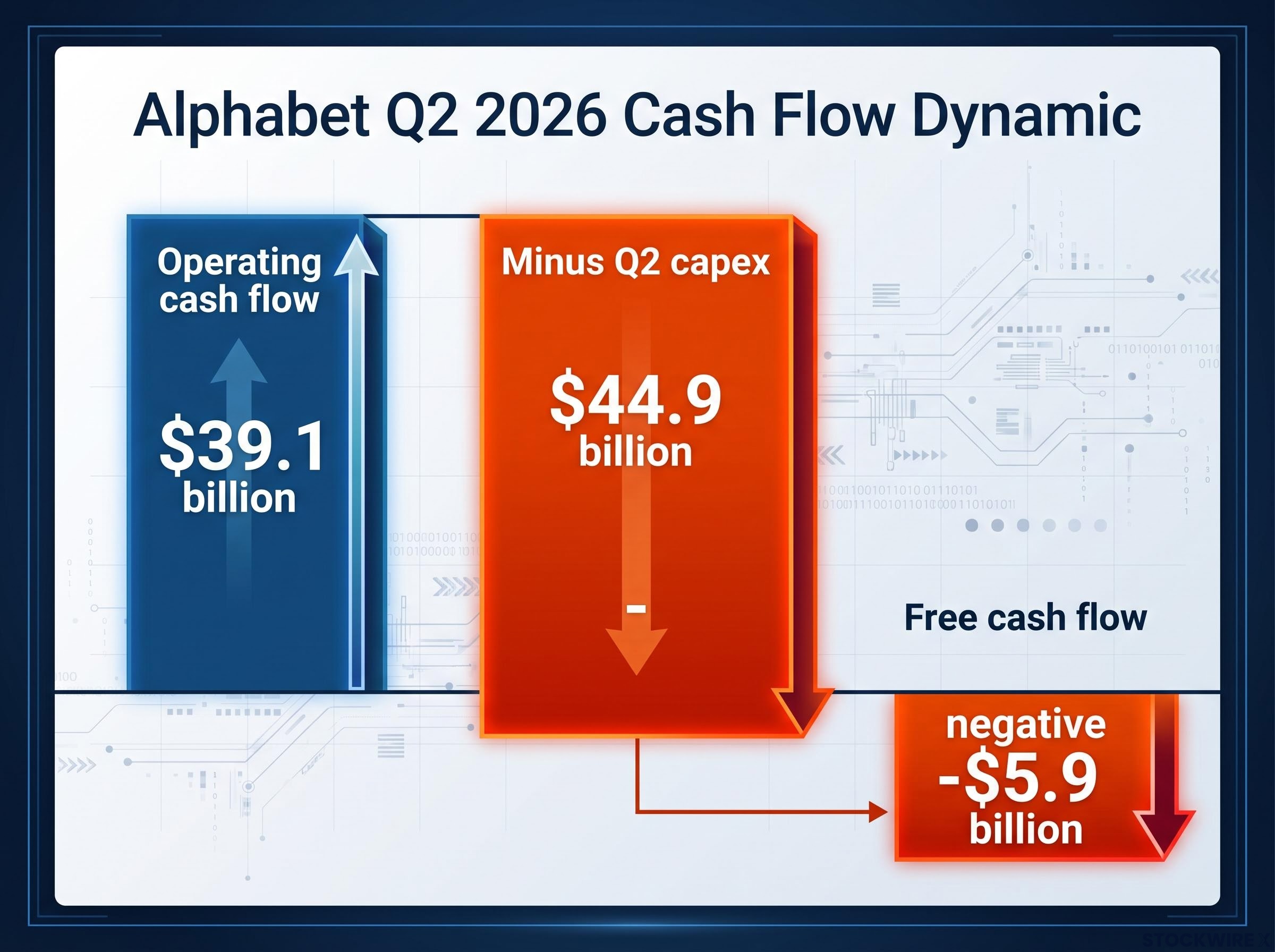
The operating results generated $39.1 billion in cash from operations during the quarter. That is an enormous figure by any measure. The problem is what came next.
- Operating cash flow: $39.1 billion
- Minus Q2 capex: $44.9 billion
- Equals free cash flow: negative $5.9 billion
That sequence is the entire story. Alphabet’s capital expenditure in a single quarter, approximately double the prior year’s level, exceeded the cash the business generated. The result was the first negative free cash flow quarter since the company’s 2004 IPO.
Free cash flow is the figure that funds buybacks, dividends, and debt reduction. It is the cash left over after a company pays for its operations and its investments. When it turns negative at this scale, every future financial decision the company makes is affected.
That free cash flow pressure is not confined to a single reporting cycle: Alphabet’s CFO explicitly guided that negative FCF will persist for multiple quarters, a structural baseline the company confirmed alongside the Q2 results.
What the capex is building
The $44.9 billion is not abstract overhead. Approximately 60% went to servers and 40% to data centres, physical infrastructure tied explicitly to Gemini and Alphabet’s broader AI buildout.
Management linked the spending directly to strong AI and cloud demand, consistent with the $514 billion cloud backlog. The investment is deliberate: this is the hardware layer that Alphabet believes its next decade of cloud and AI revenue will run on. The question is whether the cash generation can catch up before the spending accelerates further.
The guidance revision that actually moved the stock
The quarterly results were backward-looking. What moved the stock was forward-looking: management raised its full-year 2026 capex guidance to $195-$205 billion, up from a prior range of $180-$190 billion.
CFO Anat Ashkenazi confirmed that spending will rise again in 2027. This is not a one-off spike. It is the start of a multi-year AI infrastructure buildout where the exit trajectory remains undefined.
| Prior capex guidance | Revised capex guidance | Annualised core profit |
|---|---|---|
| $180-$190 billion | $195-$205 billion | ~$160 billion |
At roughly $200 billion, the revised capex guidance sits meaningfully above Alphabet’s annualised core operating profit of approximately $160 billion, and management has signalled the gap will widen further in 2027. That shortfall is what investors are pricing.
When a company’s planned capital spending exceeds its core earnings capacity, investors must reckon with where the difference is going to come from. That question reprices risk in the stock immediately, regardless of how strong the trailing quarter was. The guidance revision, not the earnings beat, was the single piece of genuinely new information this cycle.
Equity issuance, dilution, and what the buyback pause signals
The capex-to-profit gap is not theoretical. Alphabet has already begun addressing it with actions that carry direct consequences for existing shareholders.
- $49.6 billion equity raise in June 2026, comprising Class A shares, Class C shares, and mandatory convertible preferred stock
- At-the-money (ATM) programme established, an unusual financing mechanism for a mega-cap technology firm that has historically returned cash rather than raised it
- Share buyback programme paused, conserving cash for AI infrastructure
Each of these actions individually would attract attention. Together, they signal that management views the investment cycle as too capital-intensive to fund from operations alone, which directly affects the per-share claim existing shareholders hold on future earnings.
Why the possibility of further issuance matters now
Equity issuance transfers future value from existing shareholders to new ones. But the market does not wait for the next raise to happen before pricing the risk.
Even the credible possibility of additional equity issuance causes investors to discount the per-share value of future earnings today. With free cash flow negative and 2027 capex guided higher, that possibility is not speculative; it is structural.
The same capital pressure bears down on the wider hyperscaler group. Microsoft, Amazon, and Meta are each navigating a comparable tension between surging AI infrastructure commitments and the pace at which free cash flow can absorb them, and across the sector, capex growth is outrunning cash generation heading into 2027. The financing question does not belong to Alphabet alone.
What Alphabet’s TPU ambitions add to the picture
There is a secondary variable that complicates the long-term calculus in Alphabet’s favour, though its timing and scale remain genuinely uncertain.
Alphabet’s Tensor Processing Units (TPUs) were built originally for internal use, but the company is now moving to sell them directly into external customer data centres. At meaningful scale, that shift would make Alphabet a semiconductor supplier as well as a cloud operator, bringing it into closer competition with Nvidia for hardware revenue from third-party infrastructure operators.
- Confirmed: Internal TPU development is well established, and Alphabet has stated plans for external sales
- Uncertain: Commercial scale, specific revenue recognition timeline, and competitive positioning against Nvidia’s entrenched external data centre business
Broader market reporting suggests material external TPU revenue is more likely a 2027 development than a current revenue stream. The original source frames this more aggressively. The distinction is worth tracking.
The TPU story matters to investors not because it generates material revenue today, but because it introduces a potential second-order payoff on the infrastructure capex. If the timeline and scale prove out, the $195 billion capex programme looks partially like product development for a new revenue line, not purely like infrastructure cost. That optionality is real, but the timing is uncertain enough that the market is not pricing it in today.
AI supply chain positioning across semiconductors, foundries, and memory producers offers a second-order lens on the same infrastructure cycle: because every dollar of Alphabet’s $195 billion capex programme flows through hardware categories where a small number of suppliers hold structural leverage, the capex buildout creates concentrated beneficiaries that sit outside the hyperscaler reporting entirely.
Why good earnings and a falling stock are both rational at once
The Alphabet reaction follows a pattern that applies well beyond a single company’s earnings release.
Stock prices are claims on future cash, not scorecards of past performance. The $98 billion investment gain inflates GAAP earnings but does not contribute to spendable cash or to the free cash flow figures that drive discounted cash flow (DCF) valuations, where future cash flows are discounted back to today’s value to estimate what a company is worth.
When uncertainty about future outcomes widens, rational investors apply a higher discount rate, which compresses the present value of future cash flows even when current operations are strong.
Discount rate mechanics sit at the core of this dynamic: rising uncertainty widens the range of plausible outcomes, which rational investors translate into a higher required return on capital, compressing the present value of future cash flows even when the underlying business continues to grow.
The specific uncertainties investors are pricing:
- How much incremental AI revenue the infrastructure will actually generate
- Whether hyperscaler competition compresses returns on invested capital
- Whether additional debt or equity financing will be required
- Whether AI infrastructure risks becoming overbuilt relative to demand
Because the range of those outcomes is wide, the stock moves lower before any of the returns are known. This is not irrational. It is the market doing exactly what it is supposed to do: repricing risk in real time as the range of possible outcomes shifts.
The sector-wide financing challenge
The pressures shaping Alphabet’s investment narrative are playing out in parallel across its largest peers. Microsoft, Amazon, and Meta are each committed to AI infrastructure programmes of comparable ambition, and the sector as a whole is on a path where aggregate capex growth outpaces aggregate free cash flow generation into 2027.
The competitive dynamic creates a structural bind. Failing to invest carries its own risk: losing AI market position. But over-investing in infrastructure whose utilisation and return profile remain uncertain carries a different one. No hyperscaler can afford to stop, and none can afford to be wrong about the scale of demand.
What changes from here, and what does not
The Q2 report changed some things and left others intact. The distinction matters more than the headline reaction.
| What changed | What did not change |
|---|---|
| Capex trajectory raised to $195-$205 billion | Core operating margin of approximately 34% |
| Free cash flow turned negative (-$5.9 billion) | Cloud backlog of $514 billion |
| Buyback programme paused; ATM programme established | Underlying business quality and revenue growth trajectory |
The forward variables worth tracking:
- 2027 capex guidance, once formally disclosed, will set the pace for how long free cash flow remains depressed
- Cloud backlog conversion rate: whether that $514 billion pipeline translates to revenue at the expected pace
- Any further equity issuance under the ATM programme, which would signal continued external financing requirements
For an investor holding Alphabet today, the central question is not whether the business is good. It is. The question is whether the AI infrastructure bet will generate returns that justify the capital cost and dilution already incurred, and the additional capital costs still to come.
The investors best positioned from here are those tracking the right metrics: not headline EPS, but free cash flow recovery, capex-to-revenue ratios, and cloud backlog conversion in coming quarters. The income statement says Alphabet has never been more profitable. The cash flow statement says the company is spending faster than it earns. Both are true, and understanding why that is not a contradiction is the framework that separates informed positioning from headline-driven reaction.
This article is for informational purposes only and should not be considered financial advice. Investors should conduct their own research and consult with financial professionals before making investment decisions. Past performance does not guarantee future results. Financial projections are subject to market conditions and various risk factors.