Virtu Financial Posts Record Q1 With $1.1B Revenue, Doubling Estimates
29 mins ago


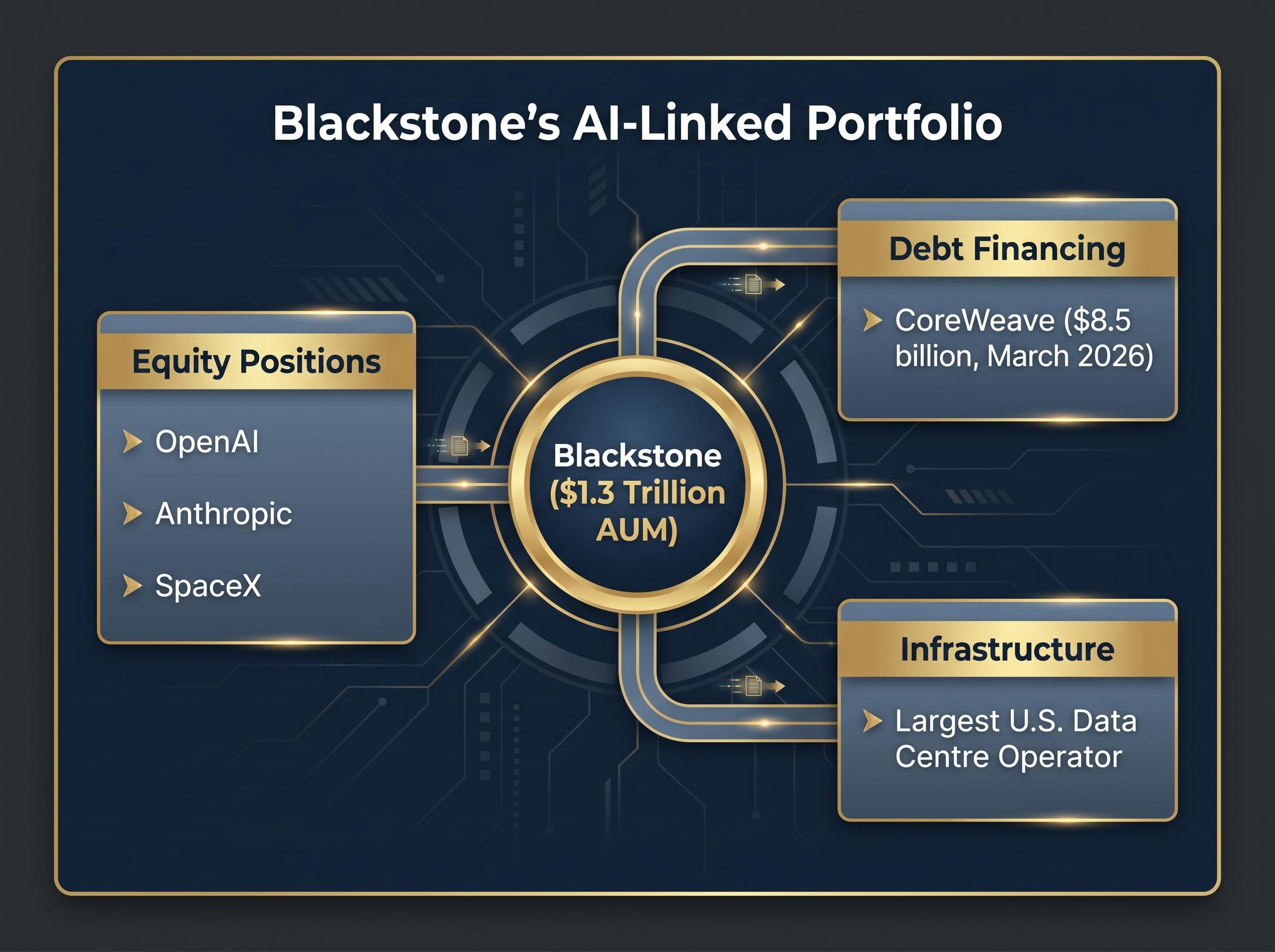
Blackstone manages over $1.3 trillion in assets. It now believes that figure is large enough to justify physically relocating one of its most senior executives to be closer to where AI startups are being built. On approximately 29 April 2026, Bloomberg reported that the firm is forming a new West Coast division called N1, based in San Francisco, with Jas Khaira departing New York to lead it. Simultaneously, Jon Korngold, who had headed Blackstone Growth, is leaving the firm entirely. The announcement arrives as Blackstone’s AI-linked portfolio spans OpenAI, Anthropic, SpaceX, and the largest U.S. data centre operator, and as the firm reported over $69 billion in quarterly inflows for Q1 2026. What follows is an examination of what the N1 restructuring and Korngold departure reveal about Blackstone’s evolving strategic logic, why Silicon Valley proximity is being treated as operationally necessary at the trillion-dollar scale, and what the reorganisation signals to investors in Blackstone-managed vehicles.
N1 is not a new fund. It is a centralised AI deal-making layer designed to operate across Blackstone’s existing platforms, functioning as what internal communications reported by Bloomberg characterised as an “AI brain” for the broader firm.
“AI brain”: Internal communications, as reported by Bloomberg, described N1’s role as a centralised intelligence layer for AI deal-making across Blackstone’s full platform, rather than as a standalone capital pool.
Khaira retains leadership of two existing segments alongside the new N1 mandate, consolidating significant allocation authority under one executive. The segments N1 integrates or directly touches include:
Khaira’s seat on the deal panel is the structural detail that elevates N1 beyond an advisory function. That seat gives the division allocation influence across the firm’s investment decisions, not merely a consulting role on AI themes.
Blackstone’s dual investment mandate across generative AI software and physical infrastructure assets, including the April 2026 IPO filing for Blackstone Digital Infrastructure Trust Inc., reflects a structural bet that neither software stakes nor data centre capacity alone provides sufficient exposure to how AI value creation will actually distribute across the technology stack.
N1 operates within Blackstone’s overall $1.3 trillion asset base. No N1-specific AUM figure has been reported or verified; the division draws its mandate from the firm’s aggregate capital rather than managing a ring-fenced pool. The distinction matters: N1 is designed to enhance deal flow and AI expertise across the platform, not to compete with existing business lines for capital allocation.
As of 30 April 2026, no official Blackstone press release or SEC filing has confirmed N1’s formation. The division’s existence has been reported exclusively through Bloomberg.
The San Francisco relocation carries a specific business argument. Blackstone President Jon Gray and CEO Steve Schwarzman, in internal correspondence cited by Bloomberg, communicated that a physical footprint near where AI enterprises are being built is operationally necessary at the firm’s scale.
According to Bloomberg’s reporting, Gray and Schwarzman told staff that proximity to Silicon Valley’s AI ecosystem is a competitive input for deal sourcing, not simply a geographic preference.
N1’s mandate emphasises early-stage AI deal flow. At the early stage, relationships with founders, access to pre-announcement funding rounds, and presence within the startup ecosystem’s informal networks carry outsized value. Blackstone’s existing infrastructure investments, including its position as the largest U.S. data centre operator, provide the foundation that makes this proximity bet viable. The firm is not entering AI cold; it is positioning an executive with deal panel authority where the next generation of portfolio companies is being formed.
AI infrastructure investment has shifted Wall Street’s capital allocation calculus in a way that directly benefits Blackstone’s existing positioning: with global IT spending on data centres projected at $530-700 billion for 2026 and US power grid demand accelerating, the firm’s status as the largest domestic data centre operator gives N1’s deal team a physical asset foundation that most venture-stage competitors cannot match.
For investors, this signals that Blackstone views AI deal sourcing as a proximity-dependent activity, a meaningful operational commitment that differs from managing AI as a thematic overlay from New York.
N1 is not an isolated decision. It fits a recognisable pattern in how alternative asset managers of this scale respond when a single technology category begins generating disproportionate returns across multiple portfolio segments.
The logic of centralised AI units at institutional scale follows a three-part sequence:
Analyst commentary has drawn parallels to prior Blackstone restructurings in credit and insurance, where the firm built dedicated platforms that eventually became among its largest business lines. The characterisation from financial analysts frames N1 as building a dedicated “AI machine” with an operating layer that enhances capabilities across the full AUM base.
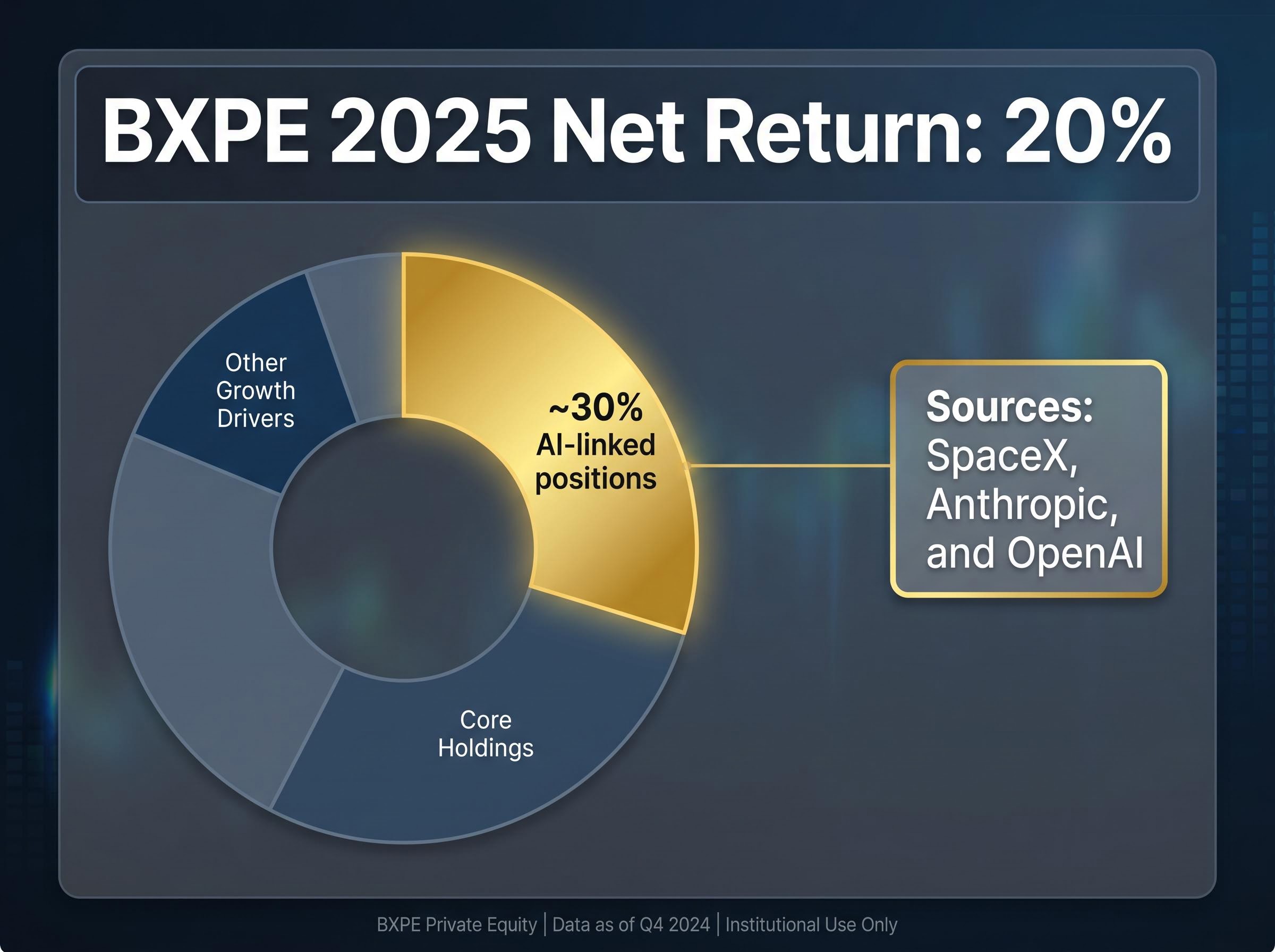
The BXPE fund’s performance illustrates why this structural investment is being made now. The fund reported a net 20% return in 2025, with approximately 30% of that return attributed to AI-linked positions including SpaceX, Anthropic, and OpenAI. Separately, Blackstone provided $8.5 billion in debt financing to CoreWeave in March 2026, a creditor relationship (not an equity stake) that demonstrates the firm’s capacity to deploy capital across the AI value chain. As of 27 April 2026, GuruFocus assigned Blackstone a GF Score of 74/100 with a growth rank of 8/10, reflecting strong growth positioning alongside mixed overall financial strength.
Blackstone’s record Q1 2026 earnings, including the $69 billion in quarterly inflows and a 25% increase in earnings reported by Commercial Observer, provide the financial backdrop that makes the structural investment in N1 legible as a capital-deployment problem rather than simply an organisational preference.
No verified reports of equivalent structural responses from KKR, Apollo, or Carlyle have emerged as of 30 April 2026.
A conventional sector-focused unit manages its own capital pool within a defined investment thesis. N1 operates differently: it is an enabling layer designed to enhance AI deal-making across Blackstone’s existing platforms without managing a competing capital pool. The “AI brain” characterisation captures this distinction. N1’s value is measured by the quality of deals it sources and the speed at which it moves AI opportunities through the firm’s allocation process, not by standalone returns on a ring-fenced fund.
| Dimension | Blackstone Growth (prior standalone model) | N1 (new structure) |
|---|---|---|
| Mandate scope | Growth equity across sectors | AI-focused deal origination across all platforms |
| Geographic base | New York | San Francisco |
| AUM integration | Standalone fund AUM | Operates within firm’s full $1.3 trillion base |
| Deal panel authority | Growth-specific allocation | Cross-platform influence via Khaira’s panel seat |
Jon Korngold led Blackstone Growth before the N1 restructuring. He is now exiting the firm entirely. The simultaneous timing of his departure and N1’s launch is analytically significant: this is not a routine succession but a structural replacement tied to a redefinition of the Growth segment’s purpose.
The contrast between the two leadership positions clarifies the scale of the shift:
Khaira’s consolidated mandate is substantially broader than the role Korngold held. The restructuring did not simply replace one executive with another; it absorbed the Growth leadership into a larger, AI-oriented organisational architecture.
No personal statements from Korngold, public commentary on the terms of departure, or detailed profile material have surfaced from verified sources as of 30 April 2026. The information gap is worth noting: at this seniority level inside a $1.3 trillion firm, the absence of public comment is itself a data point. Leadership transitions of this kind indicate which functions are being scaled and which are being absorbed under new strategic assumptions.
Investors allocated to Blackstone vehicles, particularly BXPE, face three immediate implications from the N1 restructuring:
Investor due-diligence note: As of 30 April 2026, no official Blackstone confirmation of N1’s structure, mandate, or leadership appointments has been filed with the SEC or published via the firm’s investor relations channels. All structural details are sourced from media reporting.
The $69 billion in Q1 2026 inflows suggests capital continues to flow into Blackstone vehicles at scale. Whether that capital is being allocated with awareness of the N1 restructuring’s implications for AI concentration remains an open question for investors conducting due diligence.
The $69 billion in Q1 2026 capital inflows that Blackstone reported reflects more than strong fundraising: the firm explicitly named AI and infrastructure as the primary growth drivers behind that figure, integrating a roughly $1 billion Anthropic stake with a $25 billion Pennsylvania data centre initiative in a deliberate strategy to avoid single-asset concentration risk across the AI value chain.
The strategic logic of N1 is internally coherent: centralised AI mandate, geographic realignment to Silicon Valley, executive consolidation under a deal panel member, and cross-platform leverage across a $1.3 trillion base. As an architectural thesis about how trillion-dollar firms must evolve to compete for AI deal flow, it is the most formalised response any major alternative asset manager has produced.
Whether it becomes a template depends on variables that remain unresolved. No verified competitor restructurings from KKR, Apollo, or Carlyle have appeared as of 30 April 2026. Blackstone’s specific AI portfolio depth, spanning data centres, equity stakes in three of the most prominent AI companies, and a major creditor relationship with CoreWeave, may make it uniquely positioned to benefit from this structure in ways that peers cannot easily replicate.
Investors wanting to place Blackstone’s $8.5 billion CoreWeave creditor position within the broader market context will find our full explainer on institutional AI debt dynamics, which examines how a $15 trillion corporate refinancing wall is pushing leveraged finance capital toward AI ventures, the hidden leverage mechanisms amplifying downside risk, and why 21% of surveyed market participants already view an AI investment crash as an underestimated 2026 threat.
The operational test is Khaira’s. He holds three simultaneous leadership mandates across N1, Blackstone Growth, and Tactical Opportunities Americas, all from a new geography. N1 has no verified AUM, no formal regulatory footprint, and no performance track record. The structure is architecturally interesting. Whether it proves operationally durable is the question Blackstone has placed a very public bet on answering.
This article is for informational purposes only and should not be considered financial advice. Investors should conduct their own research and consult with financial professionals before making investment decisions. Forward-looking assessments of N1’s potential impact are speculative and subject to change based on market developments and firm performance.
N1 is a centralised AI deal-making unit that Blackstone launched in San Francisco in April 2026, designed to operate as an intelligence layer across the firm's existing platforms rather than as a standalone fund, with the goal of enhancing AI deal flow and allocation across its $1.3 trillion asset base.
Jas Khaira is leading N1, relocating from New York to San Francisco to head the division, while simultaneously retaining leadership of Blackstone Growth and Tactical Opportunities (Americas) and holding a seat on the firm's deal panel.
Blackstone's leadership, including President Jon Gray and CEO Steve Schwarzman, communicated that physical proximity to Silicon Valley's AI ecosystem is operationally necessary for early-stage deal sourcing, founder relationships, and access to pre-announcement funding rounds at the firm's scale.
BXPE's AI-linked positions in SpaceX, Anthropic, and OpenAI, which contributed roughly 30% of the fund's net 20% return in 2025, now fall under N1's centralised deal origination process, concentrating AI allocation authority under a single executive with no formal SEC disclosure confirming the structure as of 30 April 2026.
Jon Korngold, who previously led Blackstone Growth, departed the firm entirely when N1 launched, with his prior role absorbed into Khaira's broader consolidated mandate, signalling a structural redefinition of the Growth segment rather than a routine leadership succession.