
Virtu Financial Earnings Smash Estimates as Net Income Doubles
32 mins ago


Traditional Wall Street private equity firms have historically evaluated technology investments from Manhattan boardrooms. That operational model shifted permanently in late April 2026 when Blackstone established a dedicated, centralised outpost in the heart of Silicon Valley to capture the artificial intelligence boom. The launch of a dedicated Blackstone AI division, formally named Blackstone N1, represents the firm’s most significant thematic pivot in recent history.
CEO Steve Schwarzman and President Jon Gray detailed the strategy in an internal memorandum. The document outlined a complete structural reorganisation designed to consolidate major capital pools and direct them toward both generative software and physical hardware. Financial professionals are now analysing this new operational architecture to understand exactly how the world’s largest alternative asset manager is realigning its leadership and infrastructure assets. The creation of N1 provides a clear view into how institutional capital must adapt to fund the next iteration of global technology.
The establishment of Blackstone N1 serves as the firm’s central advisory and operational hub for artificial intelligence and high-growth technology investments. By planting this division in San Francisco, management has acknowledged that geographic proximity to machine learning developers dictates deal flow in the current market cycle. The physical relocation breaks aggressively from the traditional New York-centric private equity model.
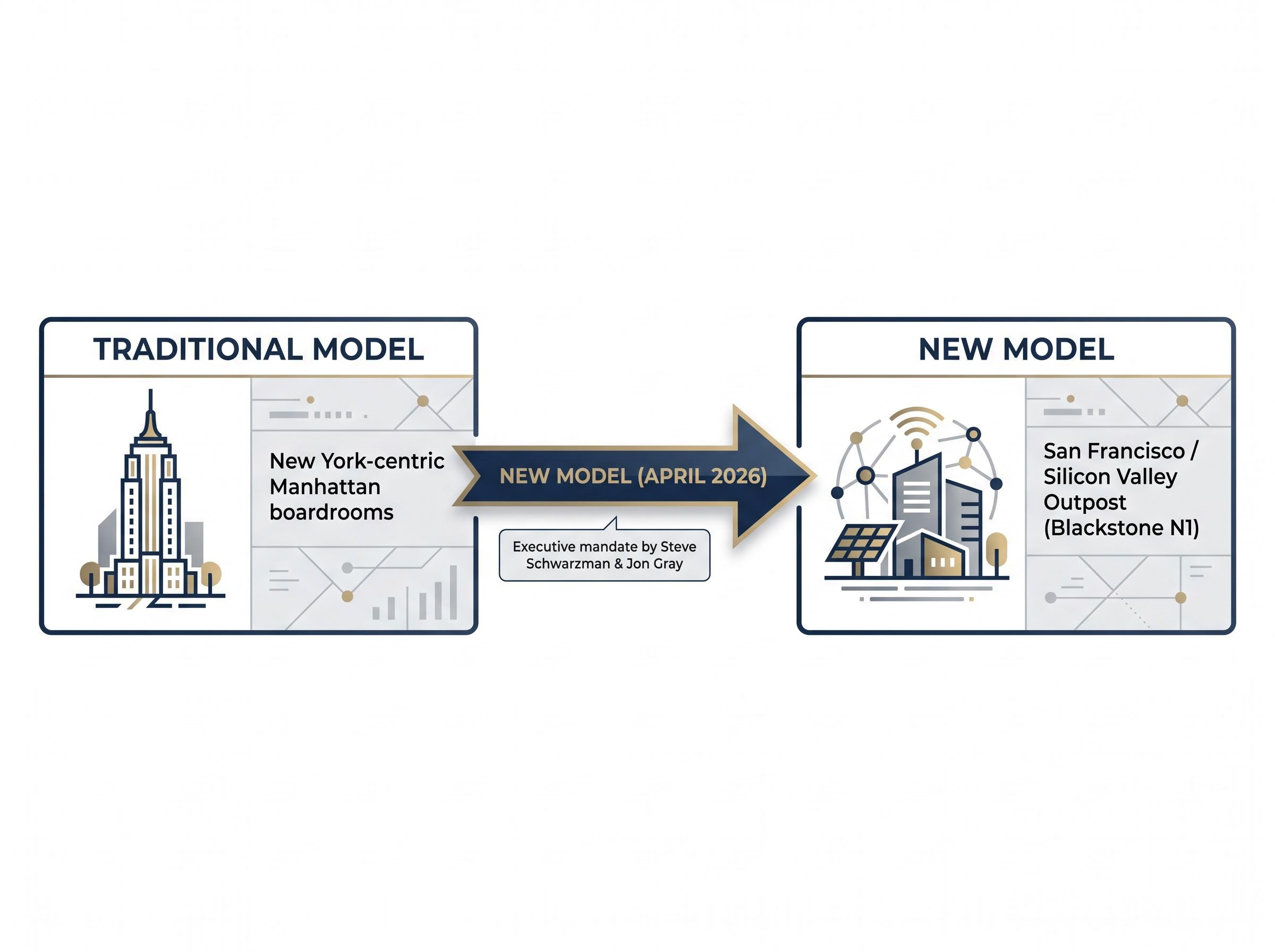
Institutional giants can no longer effectively evaluate valley-based startups from a distance. The memorandum from Schwarzman and Gray made this physical mandate explicit. The executives framed the San Francisco expansion as a non-negotiable requirement for maintaining competitive advantage.
N1 is not merely an administrative update, but a necessary manoeuvre to secure early allocations in highly competitive funding rounds.
This urgency reflects a broader recalibration of investor valuation models across the equity landscape, as capital-intensive operational shifts require financiers to move closer to the hardware ecosystems generating guaranteed revenue streams.
Executive Rationale “Our presence in San Francisco ensures our investment teams remain directly integrated with the founders and engineers building the foundation of this technology cycle,” wrote CEO Steve Schwarzman and President Jon Gray in the internal communication.
This strategic positioning acknowledges that early access to promising models requires local networks. The N1 unit will oversee all artificial intelligence allocations, bringing Wall Street capital directly to the physical source of the innovation.
The creation of N1 highlights a structural problem that asset managers face when attempting to fund rapid-cycle generative technologies. Traditional fund structures break down when evaluating machine learning models. Private equity models typically rely on historical cash flows and predictable growth rates to price assets.
Generative technology requires a different evaluation framework, one built for highly speculative and capital-intensive environments. Asset managers must therefore create centralised, specialised technology divisions rather than leaving artificial intelligence investments siloed across disparate wealth funds. A unified division prevents internal funds from competing against each other for the same technology allocations.
This consolidation streamlines the due diligence pipeline and ensures the firm presents a single, cohesive term sheet to prospective startup targets.
Historically, growth funds, wealth management vehicles, and tactical operations operated independently. This independence creates friction when multiple internal portfolio managers attempt to secure a stake in the same high-growth developer.
The operational mechanics of centralising oversight for multi-billion dollar technology portfolios eliminate this internal competition. By establishing unified evaluation metrics, N1 ensures that all capital deployments align with the firm’s broader thesis. This reorganisation provides analysts with a clear example of modern asset management architecture.
For investors exploring why Wall Street is abandoning traditional technology assets, our detailed coverage of the legacy software market repricing explains how algorithmic disruption triggered a massive wealth destruction event across headcount-dependent enterprise platforms.
Institutional investors closely track executive movements as indicators of true strategic intent. To fund the N1 division, management has pulled massive assets from established vehicles into a singular new operational silo. The restructuring specifically impacts three major internal funds:
The consolidation of these technology assets required significant leadership changes to ensure continuity. Veteran executive Jas Khaira is relocating from New York to San Francisco to assume the role of leading the N1 division. Khaira will maintain a complex dual mandate within the broader firm.
Subsequent Investing.com market reporting indicates that this executive transfer serves as a crucial step in aligning the firm’s leadership structure with its new geographic priorities.
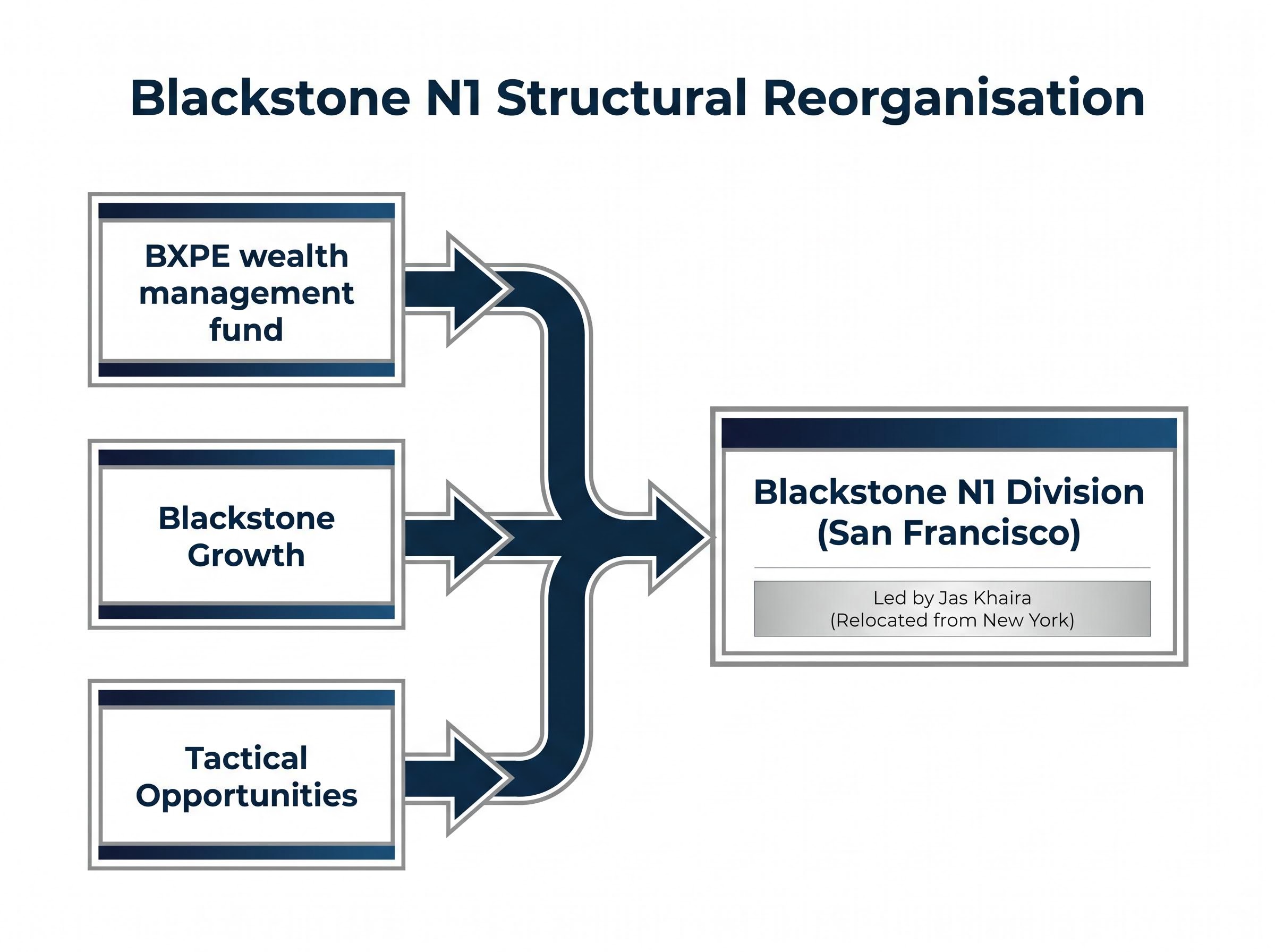
He retains his seat on the internal investment committee and continues his operational responsibilities as Head of Americas for Tactical Opportunities.
This internal rewiring initially sparked market speculation regarding the status of Jon Korngold. The firm has confirmed that Korngold is not departing and remains the Global Head of Blackstone Growth.
His unit is actively managing succession planning and establishing a new operational interface with the San Francisco hub. Understanding exactly who controls these capital flows provides necessary clarity on the internal power dynamics driving the firm’s latest portfolio allocations.
The N1 launch expands the institutional focus from high-profile software investments to the concrete, capital-intensive physical infrastructure required to power them. Blackstone is taking direct stakes in generative developers while simultaneously placing massive bets on the underlying hardware layers. This dual approach grounds the current market enthusiasm in hard, yielding physical assets.
The firm’s direct software holdings are currently centralised around Anthropic. As of February 2026, the asset manager holds an approximate $1 billion stake in the developer at a $350 billion valuation. This position follows a recent $200 million investment boost to maintain equity standing.
At present, the firm has no confirmed direct holdings in rival developer OpenAI. Beyond software, President Jon Gray has publicly stated that the physical infrastructure build-out is the single biggest driver for the firm. To capture this growth, the firm filed for the initial public offering of the Blackstone Digital Infrastructure Trust Inc. on 10 April 2026.
The official SEC Form S-11 registration outlines how this new vehicle will target stabilised data centre properties across major domestic markets to capitalise on unprecedented computing demands.
| Asset Type | Key Targets | Recent Activity |
|---|---|---|
| Direct Software Holdings | Anthropic | $1 billion stake at $350 billion valuation |
| Physical Infrastructure | Data centres, liquid natural gas, battery storage | April 2026 REIT IPO filing targeting $250 million to $1.5 billion assets |
This real estate investment trust operates specifically to target data centre assets valued between $250 million and $1.5 billion. The hardware strategy also includes heavy allocations toward liquid natural gas and battery storage facilities, ensuring the energy grid can support these computing demands.
The scale of the capital involved in the April 2026 announcements demonstrates immediate urgency. The launch of N1 sets a new structural benchmark for competing alternative asset managers. By combining speculative software positions with real estate infrastructure yields, the firm has constructed a portfolio model that balances high-growth potential with hard-asset stability.
These outlays coincide with a historical semiconductor supercycle driven by hyperscalers, who are projected to deploy upwards of $700 billion into physical infrastructure over the coming year.
This reorganisation challenges institutional investors to consider how their own portfolios must adapt to changing market requirements. The permanent establishment of a Wall Street private equity outpost in Silicon Valley signals that remote evaluation is no longer sufficient.
Competing mega-funds will likely face pressure to open their own San Francisco advisory hubs to maintain access to premier deal flow.
This article is for informational purposes only and should not be considered financial advice. Investors should conduct their own research and consult with financial professionals before making investment decisions. Past performance does not guarantee future results. Financial projections are subject to market conditions and various risk factors.
The Blackstone AI division, formally named Blackstone N1, is the firm's dedicated, centralized operational hub in San Francisco for artificial intelligence and high-growth technology investments, established in April 2026.
Blackstone established N1 in San Francisco to gain geographic proximity to machine learning developers, ensuring direct integration with founders and engineers to secure early allocations in competitive funding rounds.
Blackstone N1 consolidates capital from the BXPE wealth management fund, Blackstone Growth, and Tactical Opportunities into a unified division to streamline due diligence and present cohesive term sheets for AI startup targets.
Blackstone N1 employs a dual investment strategy, taking direct stakes in generative software developers like Anthropic and simultaneously placing bets on underlying physical infrastructure, including data centers, liquid natural gas, and battery storage facilities.
Blackstone is investing in AI infrastructure through its newly filed IPO for the Blackstone Digital Infrastructure Trust Inc., which targets stabilized data center properties valued between $250 million and $1.5 billion, along with other energy grid assets.


