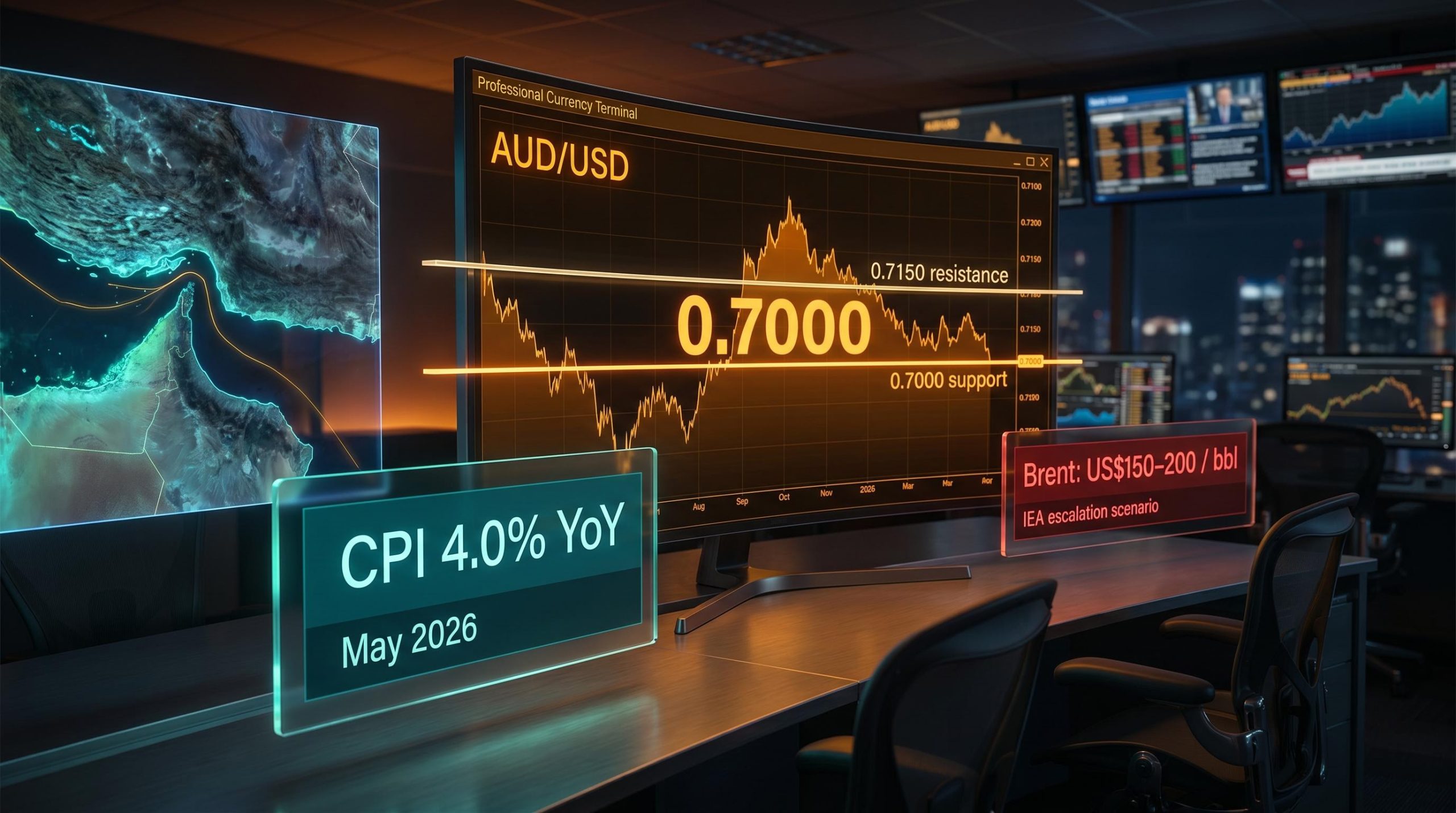
The 0.7000 handle on AUD/USD is not being governed by anything happening in Sydney this week. It is being held hostage by satellite imagery of tanker routes in the Persian Gulf and ceasefire negotiations in Geneva. That is an unusual situation for a currency pair most traders associate with iron ore prices and Reserve Bank of Australia (RBA) guidance.
Three forces are pressing on the pair simultaneously: Strait of Hormuz escalation risk, which carries direct implications for global growth expectations; broad US dollar safe-haven demand tightening the greenback’s grip across G10 foreign exchange; and Australia’s May 2026 Consumer Price Index (CPI) print, released on 24 June 2026 at 4.0% year-on-year, arriving as the one domestic variable capable of counteracting the external pressure.
Here is the framework for tracking which of those three forces is currently in the driver’s seat, and what that tells you about how to interpret each new headline around the pair.
Why the Strait of Hormuz matters to a currency pair in the Pacific
The Strait of Hormuz is a narrow waterway between Iran and the Arabian Peninsula, and roughly 20% of globally traded petroleum liquids pass through it every day. In the first half of 2025, average daily flows ran at 20.9 million barrels per day, according to EIA transit volume data. That is not a rounding error in global energy supply. It is the single largest concentration of oil transit on the planet.
The Hormuz supply disruption compressed Brent crude from around $70 per barrel in late February 2026 to above $110 per barrel in under three months, with EIA data modelling Gulf production shut-ins peaking near 10.8 million barrels per day, a volume roughly equivalent to removing 80% of total US crude output from global markets.
Any credible threat to those flows does not translate into a slow, orderly repricing. It triggers three things almost immediately:
- Physical supply losses measured in millions of barrels per day
- Insurance premium spikes and shipping route disruptions that compound the cost beyond the commodity itself
- Rapid and persistent oil price volatility that feeds into inflation expectations, growth forecasts, and risk positioning globally
IEA analysis of prolonged closure scenarios indicates Brent crude could reach US$150-200 per barrel, with refined products such as diesel and jet fuel spiking even higher.
As of late June 2026, oil flows through the Strait are gradually resuming after earlier disruptions. That resumption does not mean the risk has passed. It means the system is one credible escalation headline away from repricing. If you are positioned in AUD/USD, Strait of Hormuz news is a tier-one macro catalyst, not background noise from a region that feels geographically distant.
When big ASX news breaks, our subscribers know first
How an oil shock reaches the Australian dollar
The Australian dollar is structurally a risk-on, growth-sensitive, pro-cyclical currency. That means its fortunes track global trade volumes, equity market conditions, and commodity demand (particularly from China) rather than oil exports directly. Australia is not an oil economy. So why does an oil shock in the Gulf hurt the AUD?
The RBA drivers of the Australian dollar framework explicitly characterises the AUD as a pro-cyclical, risk-sensitive currency whose value tracks global equity markets and commodity demand, which is precisely why a geopolitical shock concentrated in an energy corridor registers as a first-order threat to the pair rather than a peripheral concern.
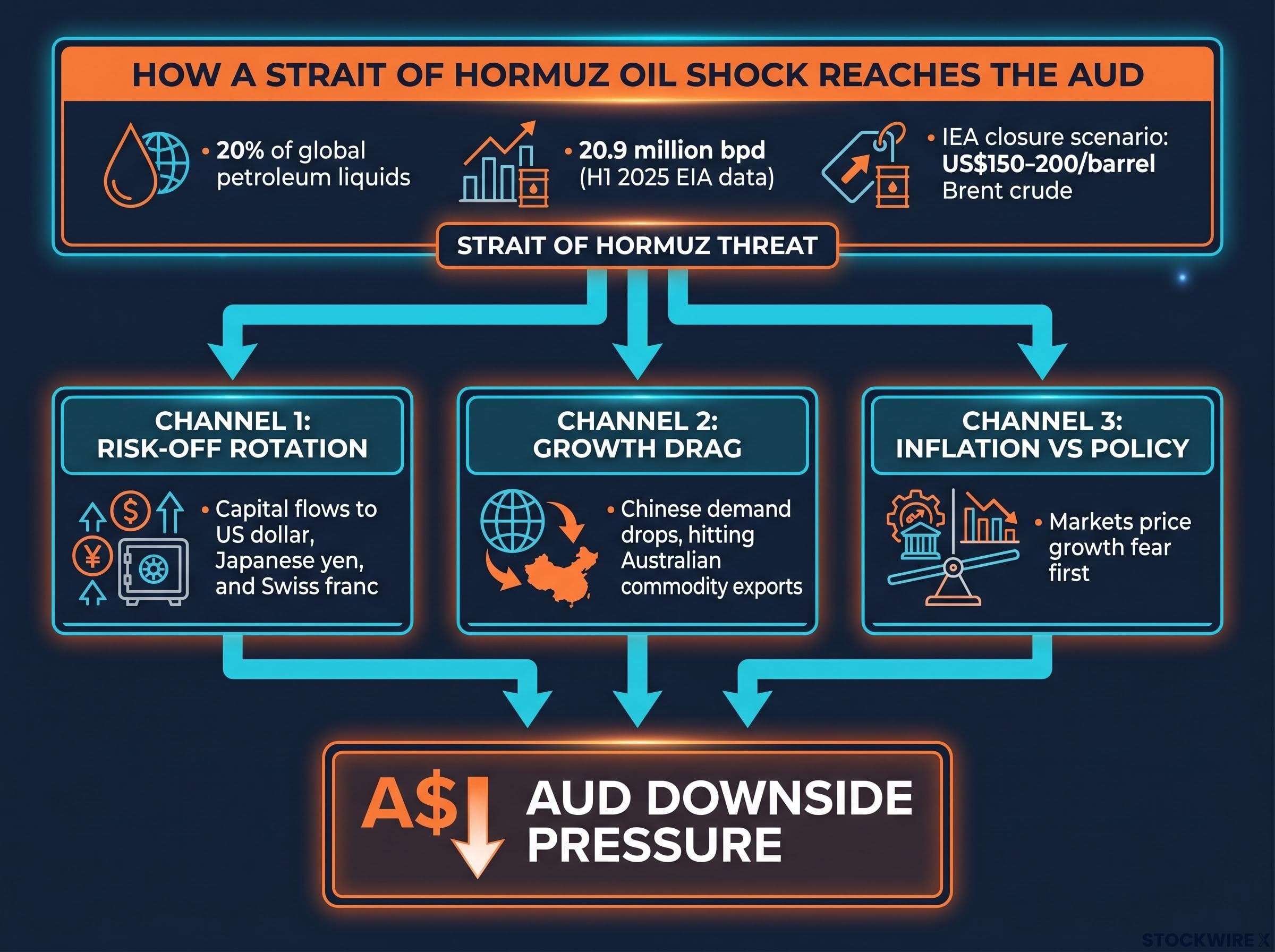
The transmission works through three channels:
- Risk-off rotation into safe havens. Elevated geopolitical risk and rising oil prices pressure global equities and widen credit spreads. Capital flows toward the US dollar, Japanese yen, and Swiss franc at the expense of higher-beta currencies like the AUD.
- Global and Chinese growth drag. Higher energy costs and tighter financial conditions weigh on global output and Chinese industrial demand, reducing appetite for Australian commodity exports and undermining the AUD’s cyclical appeal.
- The inflation-versus-policy trade-off. Oil-driven import-price inflation complicates the RBA’s room to manoeuvre. But in a genuine risk-off environment, markets price growth fear first and nominal yield differentials second. That sequencing is why AUD suffers even if oil-driven inflation nominally argues for higher Australian rates.
During the week of 24 June 2026, the AUD showed relative resilience versus the euro and British pound despite broad dollar strength. That tells you the risk-off transmission is not yet at its most severe phase. But the framework is the same every time a geopolitical shock in a major energy corridor materialises: risk appetite contracts, safe havens absorb the flows, and pro-cyclical currencies bear the cost. For anyone holding AUD/USD, tracking equity indices and credit spreads is currently as important as watching RBA guidance.
The 0.7000 level as a risk thermometer
As of late June 2026, AUD/USD is straddling the 0.7000 level, with sources placing the pair in the vicinity of 0.69 to just above the round number. The slight variation in reported spot levels is itself instructive: the pair is close enough to this threshold that its behaviour here will determine near-term directional momentum.
Why does a round number carry this much weight? Psychological levels like 0.7000 attract clustered options strikes, stop-loss orders, and institutional order flow. That concentration gives the level a structural significance beyond the technical pattern. A clean, sustained break below it would likely trigger stop-loss selling from long positions, invite momentum and CTA (commodity trading adviser) algorithmic selling, and send a sentiment signal that risk-off forces are winning. The downside would accelerate.
AUD/USD under multi-factor pressure is not a novel condition for the pair in 2026; in mid-May, a combination of 3.8% US inflation, WTI crude near $102, and an unresolved Trump-Xi trade truce compressed the pair by 98 pips across two sessions, illustrating how quickly the confluence of yield differentials, risk sentiment, and commodity pricing can override any single supportive domestic data point.
Should risk appetite recover sufficiently, a move back toward 0.7150 remains on the table, with the 50-period moving average converging at that level serving as the point at which bullish momentum would face its first serious test and the AUD’s pro-cyclical character could be reasserted.
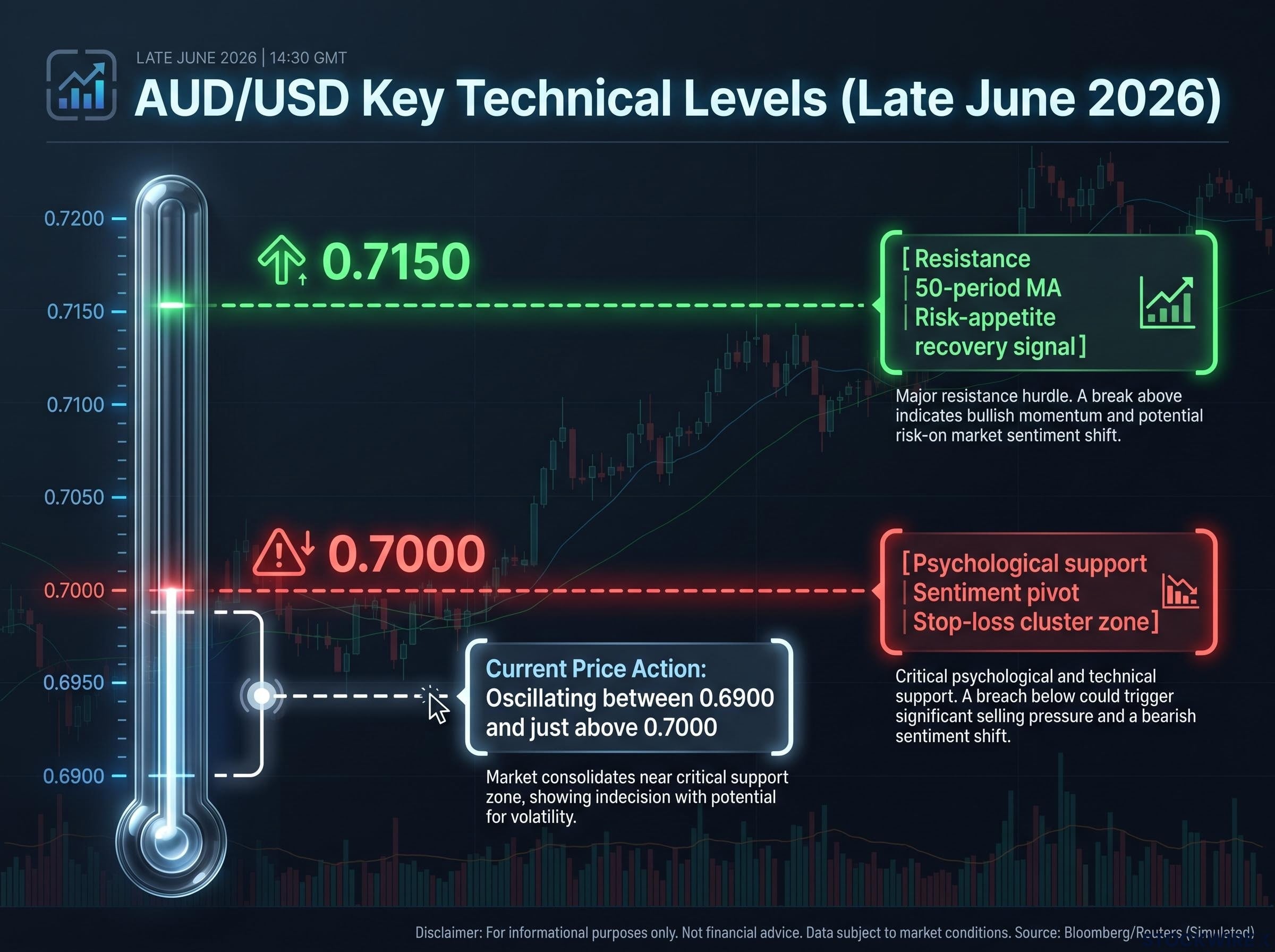
| Level | Significance |
|---|---|
| 0.7000 | Psychological support, sentiment pivot, stop-loss cluster zone |
| 0.7150 | Resistance, 50-period MA, risk-appetite recovery signal |
For anyone evaluating an entry or exit, 0.7000 is less a price target and more a binary sentiment test. Whether real-money buying emerges on dips (bullish confirmation) or whether the level slices on risk-off days without a bounce (bearish signal) will reveal whether fundamentals are anchoring buyers or whether momentum is consuming them.
What the May CPI print means for the pair’s domestic anchor
May 2026 CPI: 4.0% year-on-year Released 24 June 2026 by the Australian Bureau of Statistics. Next release: 29 July 2026.
That 4.0% reading is the domestic counterweight in a tug-of-war. Without it, AUD/USD is trading as a pure risk proxy with nothing holding it up from below. With it, the pair has a fundamental buffer.
Here is why. With the Federal Reserve’s target range sitting at 3.50-3.75% as of June 2026, an above-consensus Australian CPI print that keeps the RBA on hold longer than the Fed is cutting creates a rate differential argument in favour of holding AUD. That yield-support floor is real money: carry trades and institutional positioning respond to rate differentials even when risk sentiment is weak.
The RBA’s June pause followed three consecutive 25 basis point hikes that added 75 basis points to borrowing costs since February, and NAB Group Economics and Commonwealth Bank economists both project no further change through the remainder of 2026, making the rate differential between the cash rate at 4.35% and the Fed’s 3.50-3.75% target range the primary domestic buffer supporting AUD carry positioning.
The two contrasting market-pricing outcomes break down like this:
- Hawkish scenario (strong CPI): Markets price a more persistent RBA hold, the rate differential versus the Fed widens or stays firm, and AUD retains yield support as a partial offset to geopolitical headwinds.
- Dovish scenario (soft CPI): Markets increase the probability of RBA easing, the perceived rate differential narrows, and one of the few remaining buffers protecting AUD from external selling is removed.
The 4.0% print currently sits in the hawkish camp, and that is one of the only offsets to the geopolitical and risk-off pressures documented above. Knowing the domestic data calendar and its policy implications lets you distinguish between AUD weakness driven by genuine fundamental deterioration and weakness driven purely by temporary risk-off flows. That distinction is where timing decisions live.
Scenario matrix: how the three forces combine
The three forces that have been developed separately, geopolitics, USD strength, and CPI, snap together into three distinct combinations. Each implies a different AUD/USD trajectory.
| Scenario | Geopolitical conditions | CPI outcome | AUD/USD implication |
|---|---|---|---|
| 1 | Stable or improving | Strong | Scope to rebound toward 0.7150; carry and risk appetite supportive |
| 2 | Worsening Strait risk | Strong | Choppy two-way trade; AUD outperforms other high-beta FX but underperforms safe havens |
| 3 | Worsening Strait risk | Weak | Most bearish; increased probability of sustained break below 0.7000 |
The distribution of outcomes here is not symmetrical. The pair currently has one domestic fundamental buffer (yield support from the CPI print) and two external headwinds, which means the range of possibilities is asymmetrically skewed to the downside unless geopolitical conditions improve materially.
Three monitoring signals will tell you which scenario is unfolding in real time:
- 0.7000 price behaviour: Does the pair attract real-money buying on dips, or does it slice through on risk-off days without a bounce?
- AUD relative performance versus EUR and GBP: Continued resilience suggests underlying support is intact. A shift to underperformance signals the oil shock is moving into a more severe phase.
- Strait of Hormuz headline flow: Escalation or de-escalation signals remain high-impact macro catalysts with direct relevance to the pair.
What changes the picture from here, and what does not
Two variables are capable of materially shifting the pair’s trajectory. Everything else is noise at this moment.
- Credible Strait of Hormuz de-escalation would remove the largest external headwind, allowing risk appetite to recover and the AUD to reassert its pro-cyclical characteristics. Israeli military operations in Lebanon remain the key complicating factor in the ongoing Geneva negotiations.
- The 29 July 2026 Australian CPI release is the next domestic fundamental reset point, capable of reshaping RBA rate expectations and the rate differential narrative in either direction.
What does not change the picture in isolation: short-term equity bounces, intra-day dollar softness, or one-off data releases from other G10 economies are unlikely to durably lift AUD/USD while the Strait risk premium remains in the price.
The pair is currently in a regime where macro and geopolitical factors are the primary drivers. That regime will not change until at least one of the two dominant forces resolves. Your watchlist should be bounded accordingly:
For investors wanting to understand how energy self-sufficiency displaced rate differentials as the dominant currency valuation driver across this crisis period, our full explainer on the geopolitical forex framework covers USD/JPY’s move to 160.395, AUD’s relative resilience, and the six-month shipping backlog estimate that anchors the current risk premium timeline.
- Strait of Hormuz escalation or de-escalation signals
- 29 July 2026 Australian CPI release
- AUD relative performance versus EUR and GBP as a risk-severity barometer
- Sustained price behaviour around 0.7000 and 0.7150
Until Strait risk visibly de-escalates or the July CPI print reshapes rate differential expectations, treating any AUD/USD rally toward 0.7150 as a potential fade opportunity rather than a trend reversal is the analytically defensible posture. That may change. But the evidence needs to change first.
This article is for informational purposes only and should not be considered financial advice. Investors should conduct their own research and consult with financial professionals before making investment decisions. These statements are speculative and subject to change based on market developments and company performance. Past performance does not guarantee future results.