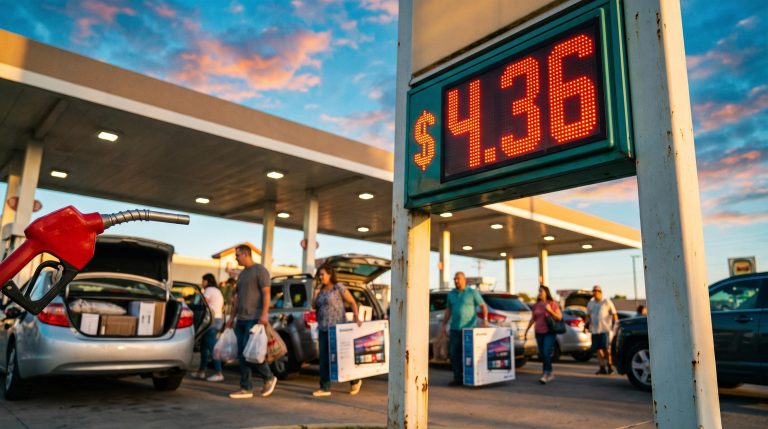
Brent crude has surged from approximately $70 per barrel in late February 2026 to above $110 per barrel as of 18 May 2026, a rise of roughly 57% in under three months. The driver is singular: the Strait of Hormuz, the world’s most consequential oil chokepoint, has been largely closed to tanker traffic since the onset of military conflict in the Middle East. The U.S. Energy Information Administration (EIA) now models Gulf production shut-ins at nearly 10.8 million barrels per day for May 2026, a supply withdrawal without modern precedent. What follows is an analysis of the mechanics behind the oil price surge, the structural reasons the Strait of Hormuz commands such leverage, the scale of the supply disruption, and what EIA and J.P. Morgan forecasts indicate about how long elevated prices may persist.
How Brent crude went from $70 to $110 in three months
The price movement traces a direct causal chain from a specific sequence of geopolitical events to market outcome, not a gradual repricing of risk.
- Late February 2026: Military conflict commenced in the Middle East, and the Strait of Hormuz became largely inaccessible to oil tankers within days.
- March to mid-May 2026: The Strait remained effectively closed to most shipping traffic, according to the EIA’s 12 May 2026 Short-Term Energy Outlook (STEO), triggering sustained supply withdrawal from Gulf producers.
- Weekend of 17-18 May 2026: A drone strike on a UAE nuclear facility and Saudi Arabia’s interception of three separate drones marked the most recent escalation.
- 18 May 2026: U.S. President Trump publicly called for a “durable peace agreement,” a statement that signalled ongoing strain rather than imminent resolution.
Brent crude rose approximately 57% from late February to 18 May 2026, closing at $110.05 on 18 May, with WTI at $101.97.
Brent added approximately 0.72% on 18 May alone, and WTI gained roughly 0.94%, confirming the rally remains live. The price is not a residual of past panic. It reflects an ongoing, unresolved supply disruption where each escalation reinforces the premium rather than fading it.
When big ASX news breaks, our subscribers know first
Why the Strait of Hormuz has the world’s oil markets in a chokehold
The scale of the price response becomes less surprising once the structural role of the Strait of Hormuz is understood. Under normal conditions, approximately one-fifth of global oil supply transits this single waterway, connecting Gulf producers including Saudi Arabia, Iraq, Kuwait, the UAE, Qatar, and Bahrain to export markets in Asia, Europe, and beyond.
No alternative route exists at comparable scale. The Strait is not one corridor among several; it is the corridor. When it closes, the supply it carries does not reroute. It disappears.
The EIA’s 12 May 2026 STEO states explicitly that the Strait was “effectively closed to most shipping traffic” following the onset of military action. It further warns that if reduced vessel volume persists, oil storage behind the chokepoint will fill and force producers to shut in even more production, creating a self-reinforcing squeeze where the disruption compounds itself over time.
What “effectively closed” means for tanker operators
The closure is not a binary on-off switch. Even partial restrictions are sufficient to suppress transits far below normal volumes because of the practical constraints tanker operators face:
- Insurance suspension: Major marine insurers have applied war-risk exclusions to Hormuz transits, making coverage prohibitively expensive or unavailable.
- Naval risk: Active military operations in the waterway create direct physical danger to commercial vessels.
- Operator reluctance: Even where lanes remain technically passable, shipping companies have been unwilling to transit at volumes anywhere near pre-conflict levels given the combination of insurance costs and security risk.
The closure is not governed by a single mechanism: the Hormuz triple lock compounds U.S. naval blockade operations, Iranian toll enforcement on non-U.S. and non-Israeli vessels, and the near-total withdrawal of commercial war-risk insurance, with each layer independently sufficient to suppress tanker transits even if the others were removed.
The result is an operational closure that functions as a near-total one, regardless of whether every lane is physically blocked.
The scale of the shut-in: nearly 11 million barrels a day removed from markets
The EIA’s conflict-scenario modelling provides the best available quantitative estimate of the supply withdrawal, and the numbers carry their own weight.
According to the 12 May 2026 STEO, Gulf production shut-ins across six countries averaged 10.5 million barrels per day (mb/d) in April 2026 and are expected to peak at nearly 10.8 mb/d in May 2026. For context, total U.S. crude oil production runs at approximately 13 mb/d. The Hormuz-linked shut-in is equivalent to removing roughly 80% of America’s entire oil output from global markets.
| Country | Conflict-Scenario Status (EIA STEO, 12 May 2026) | Role in Shut-In |
|---|---|---|
| Saudi Arabia | Production shut in; Hormuz-dependent exports blocked | Largest single contributor to withheld volumes |
| Iraq | Production shut in; southern export terminals inaccessible | Second-largest contributor |
| Kuwait | Production shut in | Fully Hormuz-dependent exports |
| UAE | Production shut in; direct conflict exposure | Significant contributor; also facing infrastructure risk |
| Qatar | Production shut in | Gas and condensate volumes also affected |
| Bahrain | Production shut in | Smaller but fully Hormuz-dependent |
These are modelled conflict-scenario estimates, not independently confirmed operational data. The EIA has been transparent about this distinction. They remain, however, the most authoritative quantitative framework available.
Emergency reserve releases totalling approximately 280 million barrels from SPR and IEA stocks have failed to halt inventory drawdowns, which are running at roughly 8.5 million barrels per day in Q2 2026, more than double any previously recorded pace, confirming that strategic petroleum reserves were sized for demand shocks, not a near-simultaneous withdrawal of a fifth of global seaborne supply.
The EIA warns that if storage behind the chokepoint fills, producers will be forced to shut in even more production beyond currently modelled levels, deepening the supply deficit further.
What the Strait of Hormuz closure actually is and why it matters beyond oil
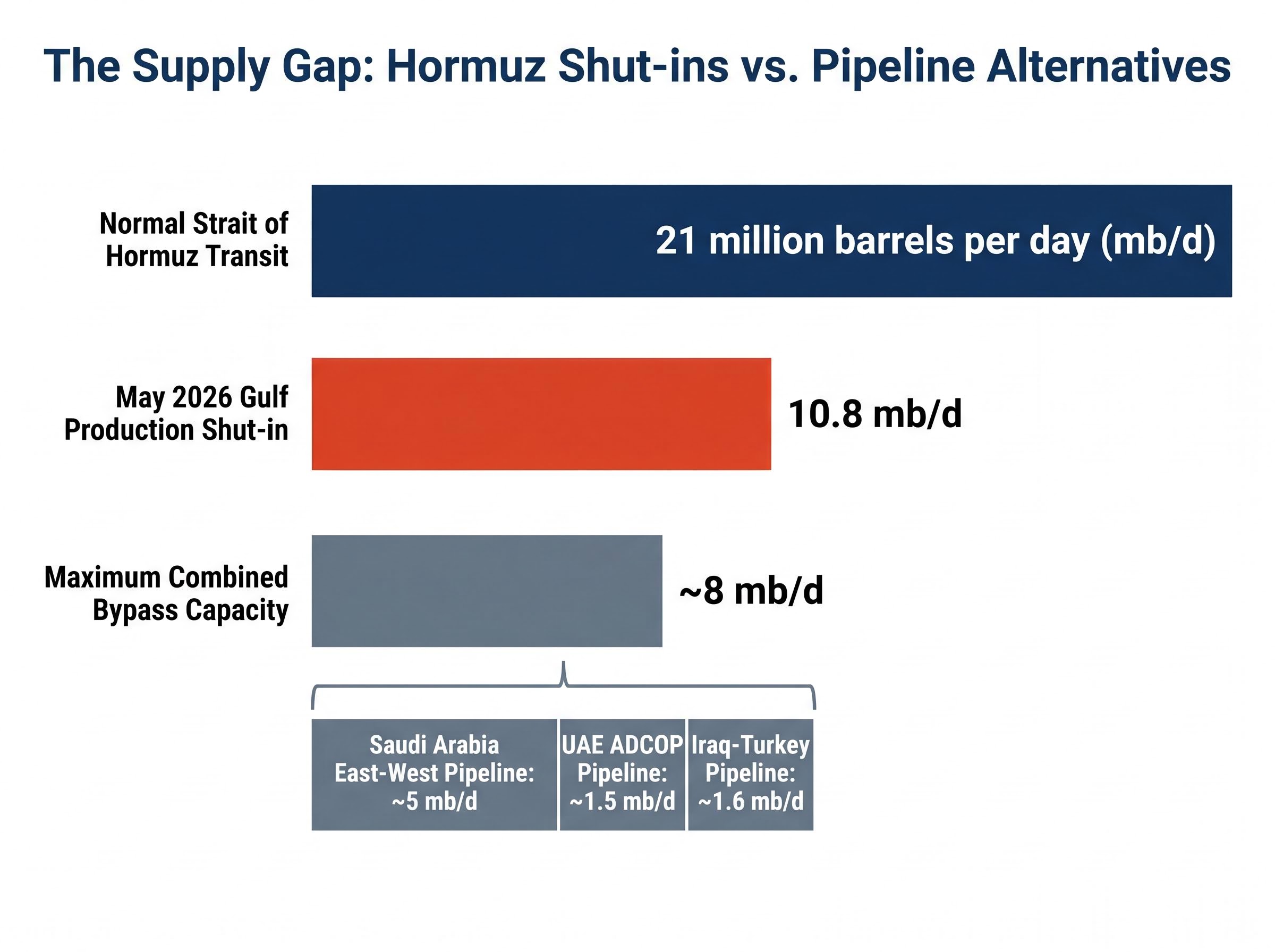
The Strait of Hormuz is a narrow waterway approximately 33 kilometres wide at its narrowest navigable point, flanked by Iran on its northern shore and Oman and the UAE to the south. Under pre-conflict conditions, approximately 21 million barrels per day transited the Strait, according to EIA historical data, making it the single most concentrated bottleneck in global energy trade.
This disruption is qualitatively different from a managed OPEC production cut. When OPEC reduces output, the cut is voluntary, coordinated, and has known parameters: a specific volume, a timeline, and a mechanism for reversal. The Hormuz closure is forced, uncontrolled, and open-ended. There is no coordination mechanism governing how or when the supply returns. The duration depends entirely on the conflict’s trajectory, a variable no producer or institution controls.
The EIA’s current assumption is that the Hormuz closure persists through late May 2026, with shipping traffic beginning to pick up in June 2026, though not returning to pre-conflict levels until later in the year.
Why bypass pipelines cannot fill the gap
Several pipeline alternatives exist on paper, but none approach the scale required:
- Saudi Arabia’s East-West Pipeline (Abqaiq-Yanbu route): The largest bypass option, with a rated capacity of approximately 5 mb/d. Even at maximum throughput, it covers less than half the modelled shut-in volume, and reaching full capacity requires lead time.
- UAE’s ADCOP Pipeline (Habshan-Fujairah): Rated at approximately 1.5 mb/d, bypassing Hormuz to the Indian Ocean coast. A meaningful but limited alternative.
- Iraq-Turkey Pipeline: Historically capable of moving approximately 1.6 mb/d, though operational capacity has been constrained by prior disruptions and maintenance limitations.
Even if all three pipelines operated at maximum rated capacity simultaneously, their combined throughput would cover roughly 8 mb/d at best, well short of the 10.8 mb/d being shut in and far below the 21 mb/d that normally transits the Strait. The gap cannot be closed by existing infrastructure.
Where oil prices are headed: the EIA conflict scenario vs. the soft-fundamentals baseline
Two forecast frameworks currently define the price outlook, and they are measuring different things.
The EIA’s conflict-scenario price path, published in the 12 May 2026 STEO, projects a gradual decline from current levels as the disruption unwinds:
| Time Period | EIA Conflict-Scenario Brent Forecast | Context |
|---|---|---|
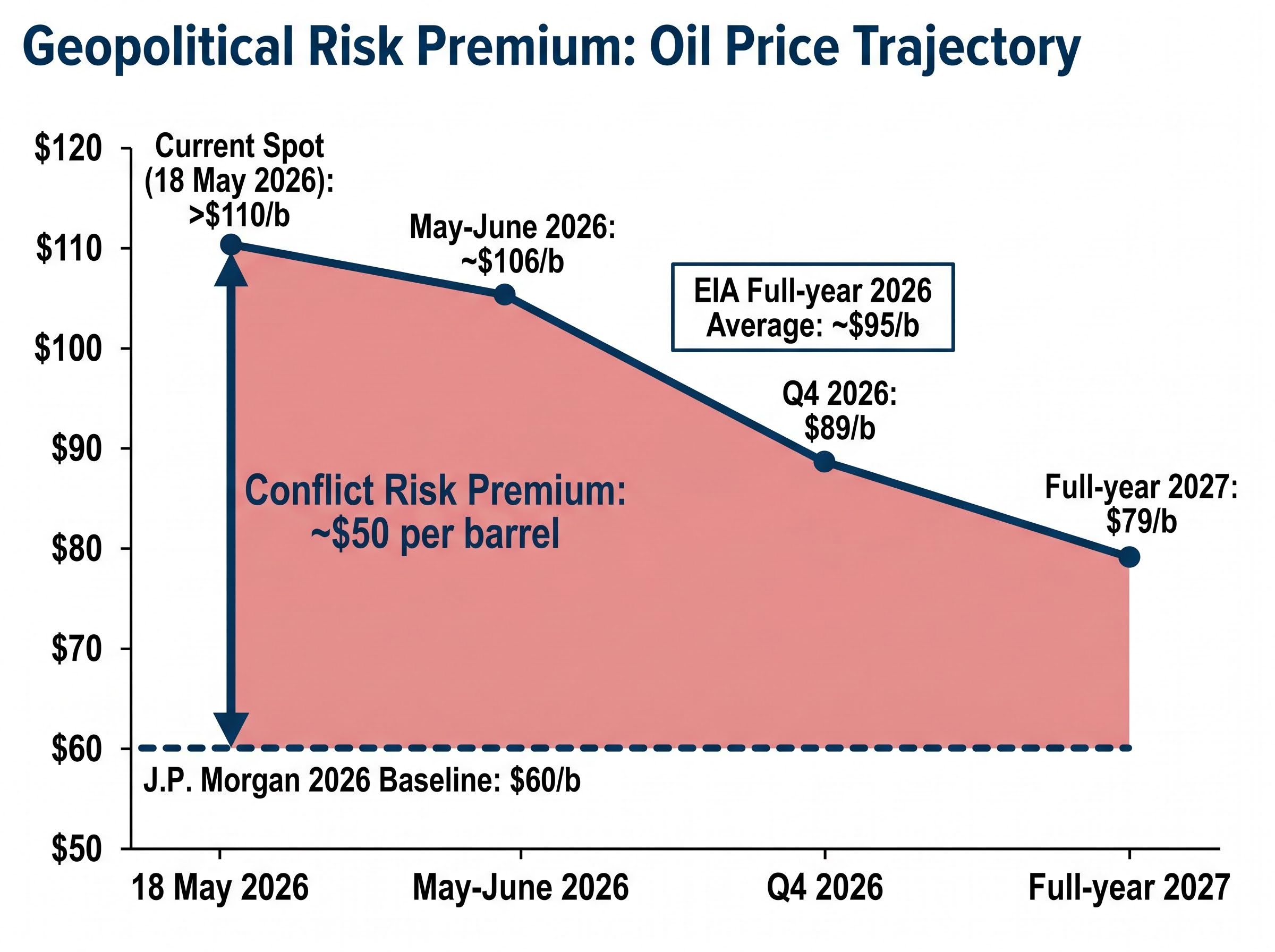
| May-June 2026 | ~$106/b | Peak disruption period; Hormuz assumed closed |
| Q4 2026 | $89/b | Assumes shipping traffic recovery underway |
| Full-year 2026 average | ~$95/b | Blended across disruption and partial recovery |
| Full-year 2027 | $79/b | Assumes sustained de-escalation and production recovery |
J.P. Morgan Global Research, by contrast, maintains a pre-disruption baseline of approximately $60 per barrel for 2026 under non-disruption conditions. This is not a competing conflict forecast. It represents the structural view of where oil prices sit when geopolitical risk is removed from the equation.
The gap between J.P. Morgan’s $60 baseline and the current spot price above $110 is the conflict risk premium, roughly $50 per barrel of pure disruption pricing embedded in live markets.
The EIA explicitly caveats that its price forecast is “highly dependent on our assumptions of both the duration of conflict in the Middle East and resulting outages in oil production.”
J.P. Morgan’s characterisation reinforces this conditionality: the firm has stated that “brief, geopolitically driven crude rallies are likely to continue, but these should eventually subside, leaving soft underlying global market fundamentals.” The question is not whether the premium fades, but when.
Investors wanting to stress-test the EIA and J.P. Morgan projections against the full range of institutional views will find our full explainer on Hormuz oil price forecasts, which maps Goldman Sachs, Barclays, and Bank of America scenarios through 2027 across reopening timelines and includes the tanker transit collapse data that anchors the upper-bound projections.
What elevated oil prices mean for consumers, businesses, and investors right now
The $110-per-barrel Brent price as of 18 May 2026 is not an abstraction. It carries concrete exposure for three distinct groups:
- Consumers: Retail fuel and energy costs follow crude prices with a lag. The full pass-through of the February-to-May rally has not yet appeared at the pump in most markets. The price pressure is still building, not peaking.
- Businesses: Energy-intensive sectors, including airlines, logistics, chemicals, and manufacturing, face direct margin compression. The severity depends on individual hedging positions and contract structures, but unhedged operators are absorbing the full impact of a 57% input cost increase over three months.
- Investors: Energy equity positions in integrated oil majors have benefited from the rally. However, J.P. Morgan’s assessment that geopolitically driven crude rallies “eventually subside” into soft underlying fundamentals sets up a reversal risk. If the EIA’s assumption holds and Brent returns toward $89/b by Q4 2026, that represents a meaningful decline from current levels for energy-long portfolios.
The inflation spillover: why central banks are watching Hormuz
Sustained energy price elevation feeds directly into headline consumer price index measures, creating pressure on central banks to maintain or tighten monetary policy even as growth concerns from the conflict itself build simultaneously.
ING analysts described the global bond sell-off on 18 May as the “dominant story” in financial markets, with energy-price inflation concern identified as the primary driver. The cross-asset spillover illustrates that the Hormuz closure is no longer confined to commodity markets; it is shaping rate expectations and fixed-income positioning globally.
The Fed rate path has narrowed sharply under the oil shock, with CME FedWatch data showing the probability of a June rate cut collapsing from 45% to just 12% while the 2-year Treasury yield rose 22 basis points to 4.65% in a single session, translating the commodity disruption directly into the interest rate environment that governs equity valuations and mortgage costs.
The disruption premium has a shelf life, but its expiry date remains unknown
The oil price surge from $70 to $110 is the direct, quantifiable consequence of a forced chokepoint closure removing nearly 11 million barrels per day from global supply. It is not speculative froth. It is supply-side arithmetic.
The uncertainty runs in both directions. The EIA’s $89/b Q4 2026 forecast implies meaningful price relief if de-escalation proceeds on the assumed schedule and shipping traffic resumes through the Strait. The conflict’s trajectory, however, remains the dominant variable, and the weekend’s drone strikes on UAE and Saudi targets suggest that schedule is far from guaranteed.
Whether monitoring fuel costs, managing energy exposure in a portfolio, or tracking the monetary policy implications of sustained crude elevation, the operational status of the Strait of Hormuz is the single data point that matters most for the near-term price outlook. Until tanker traffic resumes at scale, the premium holds.
This article is for informational purposes only and should not be considered financial advice. Investors should conduct their own research and consult with financial professionals before making investment decisions. The EIA forecasts cited are modelled conflict-scenario estimates, not confirmed operational data. Past performance does not guarantee future results, and financial projections are subject to market conditions and various risk factors.