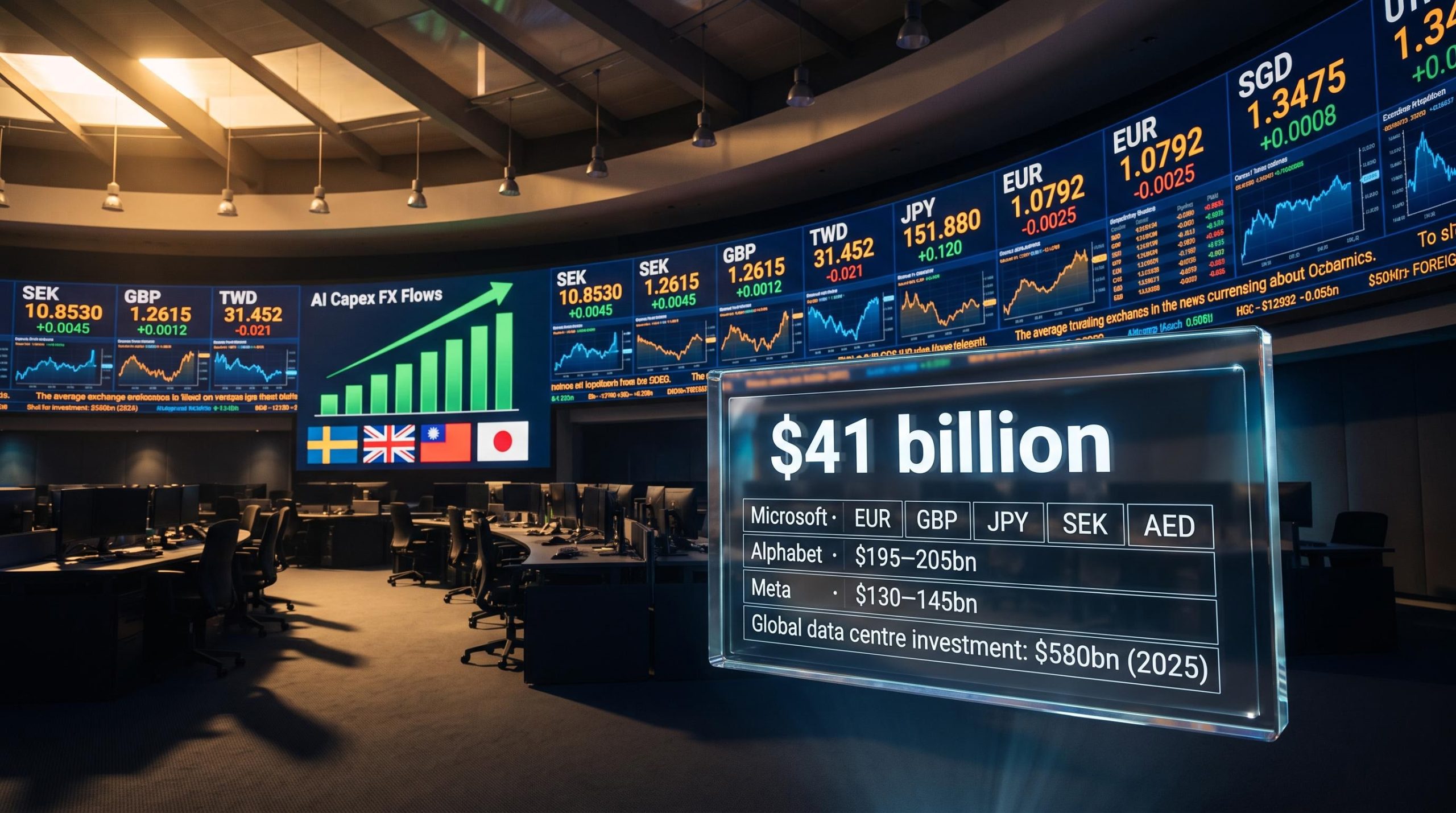
Microsoft spent $41 billion in a single quarter on capital expenditure earlier this year. That figure, annualised, would exceed the GDP of more than half the countries in the United Nations. Almost every dollar of it triggered a currency conversion somewhere: chips invoiced in US dollars, construction crews paid in Swedish kronor, power contracts settled in euros, land purchased in Japanese yen. Corporate foreign exchange, the quiet plumbing of multinational finance, was never designed to handle flows at this scale.
AI infrastructure spending has crossed a threshold. It is no longer a line item buried in a hyperscaler’s cash flow statement. It is a structural input to how currencies move. Foreign exchange markets used to respond to central bank calendars, employment data, and trade balances. Increasingly, they are also responding to hyperscaler procurement schedules, data centre site announcements, and the bond issuance choices of five or six technology firms whose combined capital expenditure now rivals the defence budgets of major economies.
Here is the framework for understanding exactly how this works: how GPU procurement in Taiwan, data centre construction in Sweden, and bond issuance in Tokyo all feed back into currency markets, and why tracking these flows has become as necessary as watching interest rate differentials for anyone serious about understanding where currencies trade over the next several years.
Why building an AI data centre is a currency problem before it is anything else
Building an AI data centre means sourcing components from dozens of countries and then installing them within a single national jurisdiction. That fundamental disconnect, between the geography of procurement and the geography of operation, creates currency exposure at every stage, from hardware purchase through to ongoing power costs.
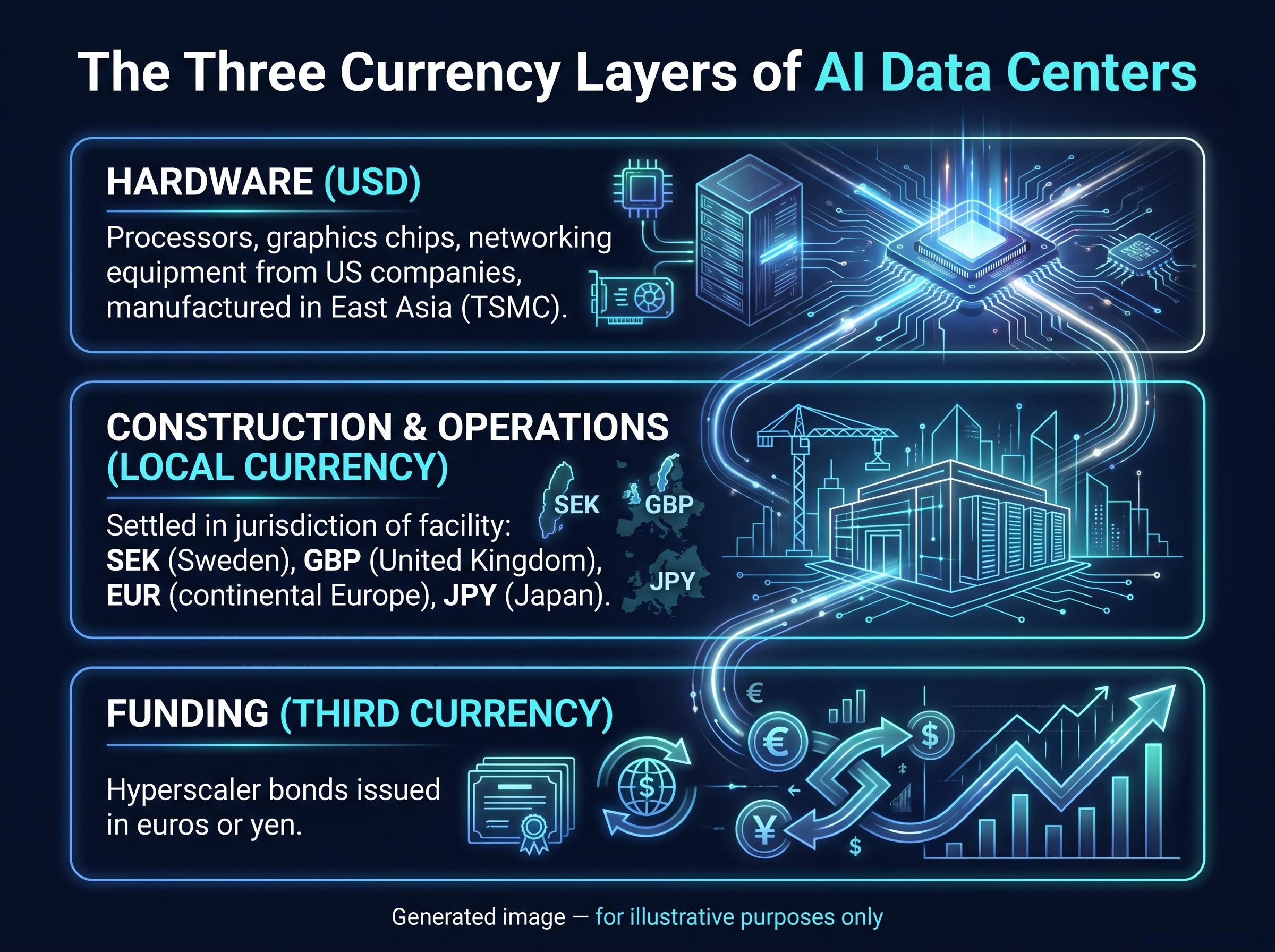
The costs fall into three distinct currency layers:
- Hardware (USD): Processors, graphics chips, and networking equipment are developed by US companies and manufactured predominantly across East Asia, yet purchase contracts are almost universally denominated in US dollars. TSMC, the world’s dominant chip foundry, earns virtually all of its revenue in USD regardless of where fabrication occurs, reflecting the dollar-centric invoicing convention that runs through the entire semiconductor supply chain.
- Construction and operations (local currency): Site acquisition, civil and electrical works, workforce costs, grid connection, and energy supply contracts are all settled in the currency of the jurisdiction where the facility is built: SEK in Sweden, GBP in the United Kingdom, EUR across continental Europe, JPY in Japan.
- Funding (potentially a third currency): When a hyperscaler issues bonds in euros or yen to finance a project, the currency of the debt may differ from both the hardware currency and the operating currency, adding a further layer of exposure.
For a US-headquartered hyperscaler whose functional currency is USD, this means dollar-denominated revenues and hardware costs sit on one side of the ledger while non-USD obligations, in euros, kronor, pounds, and yen, accumulate on the other. The result is a predictable, recurring foreign exchange exposure baked into the architecture of every international data centre project.
Where the mismatch actually lives
The currency challenge extends well beyond whatever spot rate happens to apply when a payment is processed. The deeper issue is sequencing. GPU and server procurement typically involves purchase commitments twelve months or more ahead of delivery, locking in USD obligations long before construction begins. Building costs then land according to an entirely separate timetable, governed by planning approvals, contractor capacity, and utility connection schedules. Because these two payment streams rarely coincide, they cannot naturally cancel each other out, and structured hedges using forwards and swaps must bridge the resulting gap.
At small capex volumes, this is routine treasury housekeeping. But AI infrastructure spending is no longer small.
When big ASX news breaks, our subscribers know first
The numbers that turned a treasury detail into a market force
Annual global data centre investment came to roughly $500 billion in 2024 and was on course to reach $580 billion in 2025, based on IEA figures, with the five largest technology companies between them accounting for more than $400 billion of capital expenditure across 2024.
The scale of AI capital expenditure across Amazon, Microsoft, Alphabet, and Meta reached $130 billion in Q1 2026 alone, with full-year 2026 combined guidance rising to approximately $725 billion and the trajectory already pointing toward a $1 trillion annual run rate by 2027.
The individual corporate disclosures put concrete faces on those aggregates.
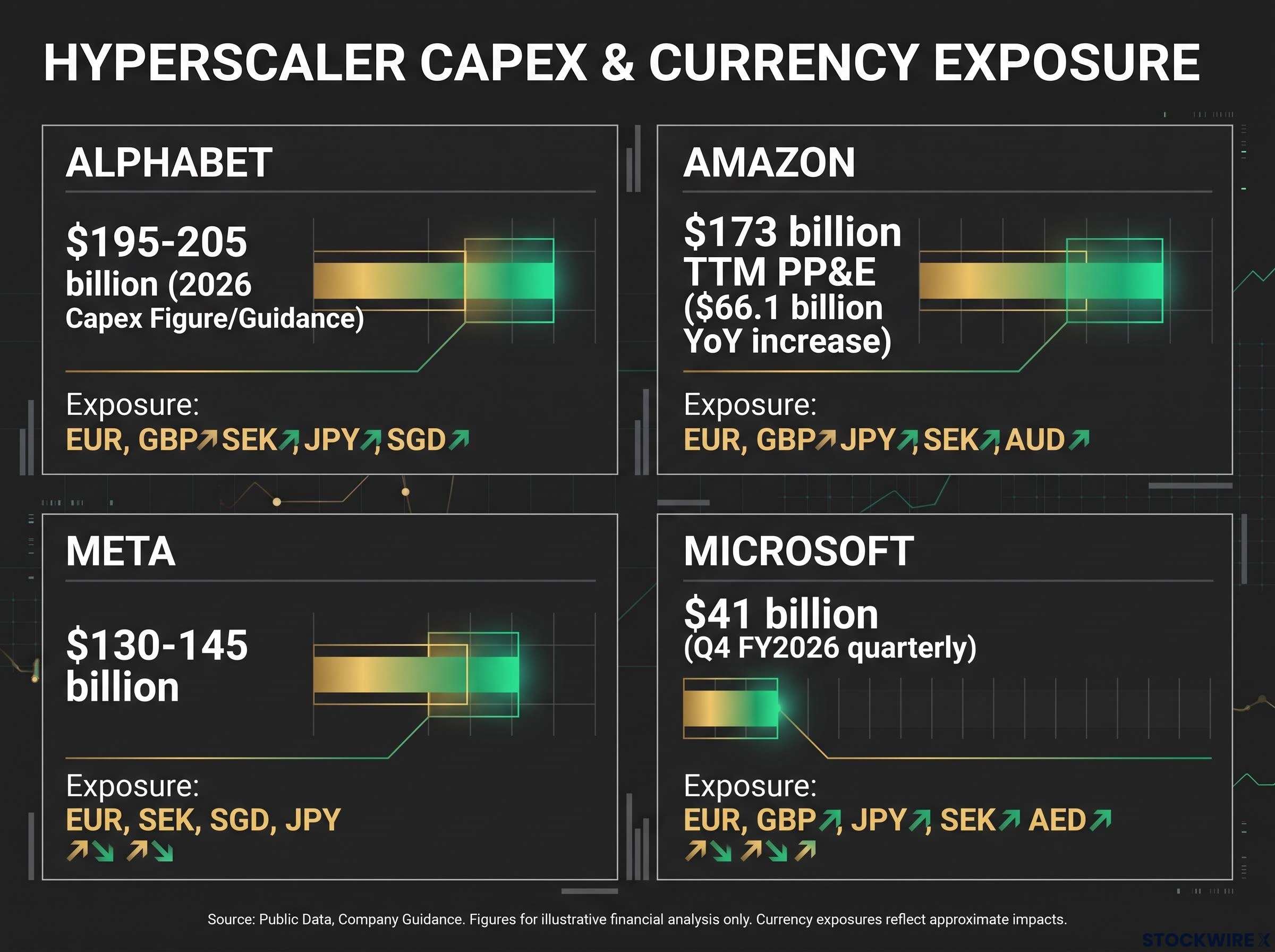
| Company | 2026 Capex Figure/Guidance | Primary Deployment Regions | Implied FX Exposure Currencies |
|---|---|---|---|
| Alphabet | $195-205 billion | US, Europe, Asia-Pacific | EUR, GBP, SEK, JPY, SGD |
| Amazon | $173 billion TTM PP&E ($66.1 billion YoY increase) | US, Europe, Asia-Pacific | EUR, GBP, JPY, SEK, AUD |
| Meta | $130-145 billion | US, Northern Europe, Asia | EUR, SEK, SGD, JPY |
| Microsoft | $41 billion (Q4 FY2026 quarterly) | US, Europe, Asia, Middle East | EUR, GBP, JPY, SEK, AED |
McKinsey projections cited by MUFG put total global data centre investment through 2030 at $7.0 trillion, with $5.2 trillion AI-specific. JLL projects global data centre capacity nearly doubling to 200 GW. These are not five-year forecasts that can be quietly revised away; the construction pipelines and hardware contracts are already committed.
The spending is already visible in national accounts. US data centre equipment imports more than doubled between 2020 and 2025 to over $650 billion, now representing nearly one-fifth of all US merchandise imports.
The World Economic Forum estimates that approximately 80% of the increase in US final private domestic demand in early 2025 came from data centres and related high-tech investment.
When a handful of firms are committing capital at this rate across multiple currencies and geographies, their procurement calendars function as a scheduled, recurring source of FX demand that currency markets cannot ignore.
What makes AI-driven FX flows structurally different from ordinary corporate currency management
Corporate foreign exchange has always existed. Multinationals build factories abroad, acquire companies in different jurisdictions, and pay overseas suppliers. What makes AI infrastructure FX different is not just its size but its character. Three structural features distinguish it:
- Recurring rather than episodic: AI buildout is not a one-off acquisition or a single factory project. It is a continuous, multi-site pipeline running on quarterly procurement cycles, generating repeat FX demand in the same currencies on a schedule tied to hardware lead times and construction milestones, not to macroeconomic data releases. This means the flows are predictable and persistent.
- Timing-mismatched rather than cleanly offsetting: Hardware procurement and facility construction run on separate timetables that rarely converge. Because dollar-denominated equipment commitments and local-currency building costs fall due at different points, they seldom offset each other cleanly, obliging treasuries to deploy forwards, swaps, and foreign-currency deposits to cover the residual exposures. This generates ongoing derivative market flow on top of the underlying cash payments.
- Board-level rather than treasury-level: At this scale, currency management is no longer a back-office function. It rises to the boardroom, where foreign-currency bond issuance, legal-entity design, and cross-currency swap programmes are deployed as instruments of strategic capital allocation rather than routine working-capital hygiene. FX has become a strategic capital allocation decision.
BIS research on optimal FX hedging by non-financial corporations establishes that firms with significant foreign-currency debt exposure systematically deploy cross-currency swaps and forwards to close the gap between asset and liability currencies, the same instrument set hyperscalers are now scaling to meet AI infrastructure obligations.
The data confirms this migration. AI data centre and project finance deals surged from $15 billion to $125 billion in a single year, according to UBS. Reuters reports that hyperscalers are increasingly issuing non-USD bonds in EUR, JPY, GBP, and CHF to match the currency of their assets and liabilities for AI infrastructure, with bankers projecting investment-grade issuance above $2 trillion in 2026. The Bank of England has warned about the growing role of debt in the AI infrastructure buildout, flagging the systemic implications if valuations correct.
The debt dimension of this spending matters for FX markets because hyperscaler cash flows are increasingly insufficient to fund commitments internally, with Barclays models pointing to more than $200 billion in debt issuance required to close the structural funding gap between 2026 and 2028, much of it denominated in non-USD currencies.
When FX hedging becomes a board agenda item
TSMC offers the most compelling corporate illustration of how currency costs have grown to strategic scale. In February 2026, its board sanctioned a capital injection of up to $30 billion into TSMC Global Ltd, with the stated rationale of cutting foreign exchange hedging costs. The fact that a semiconductor manufacturer would commit that sum purely to reduce its currency bill signals that FX exposure has grown from an accounting footnote into a genuine strategic priority.
The quantified sensitivity explains why. A 1% decline in USD relative to TWD was estimated to reduce TSMC’s operating margin by approximately 0.3 percentage points, based on 2025 figures. Over half of TSMC’s capex is settled in non-TWD currencies, predominantly USD, EUR, and JPY, and the firm deploys forwards, swaps, foreign-currency deposits, and foreign-currency debt as hedging tools, with maturities generally set at 12 months or under.
Committing $30 billion of capital through a legal-entity restructuring purely to contain currency costs illustrates how completely FX has shifted from a treasury line item to a board-level capital allocation question. Currency decisions at these firms now carry the same market weight as their rate-setting decisions.
Where the flows are already visible in currency markets
The impact is not theoretical. FX desks at major institutions are already incorporating AI capex flows into their currency frameworks, and the effects are visible across three distinct geographic channels.
Europe provides the clearest direct evidence. According to Reuters, the Swedish krona (SEK) and the British pound (GBP) rank among the primary European beneficiaries of the AI capital spending wave. Large data centre programmes in Sweden and the United Kingdom generate steady local-currency demand for land, construction, and power infrastructure. Analysts now explicitly cite AI data centre capex alongside traditional drivers when explaining the outperformance of SEK and GBP versus European peers.
Asia presents a more complex picture. Goldman Sachs characterises the region’s currency dynamics as significantly shaped by AI exposure, with currencies linked to semiconductor production and AI hardware supply chains, among them KRW, TWD, SGD, and MYR, posting stronger returns than those more reliant on energy imports. MUFG introduces an important qualification: both Taiwan and South Korea have built up substantial trade surpluses on the back of AI hardware sales, but a significant share of those surpluses is being channelled back out through resident capital outflows and equity investment abroad, moderating the exchange-rate appreciation that the trade data alone would imply.
The Taiwan semiconductor supply chain represents a concentration point that amplifies both sides of this dynamic: TSMC’s dominance in leading-edge fabrication means disruption to the island’s operations would simultaneously collapse the USD-denominated hardware flow that anchors AI data centre procurement and trigger a currency shock across TWD, KRW, and USD simultaneously.
Goldman Sachs characterises AI-related investment and the energy price shock as the two dominant drivers of Asian macro markets in 2026.
Commodity exporters represent the most indirect but analytically coherent channel. Sustained data centre buildout drives demand for copper, energy, and industrial metals, creating a positive terms-of-trade effect. According to MUFG, CLP and PEN benefit directly through copper price strength, while AUD, CAD, and BRL draw support from the broader lift to infrastructure-linked commodity demand generated by the AI buildout.
| Currency | Primary AI Linkage | Key Institutional Commentary | Direction of Effect |
|---|---|---|---|
| SEK | Direct capex (construction, power) | Reuters: among biggest European AI beneficiaries | Supportive |
| GBP | Direct capex (data centre builds) | Reuters: AI investment surge beneficiary | Supportive |
| KRW | Supply chain (semiconductors) | Goldman Sachs: AI play; MUFG: blunted by outflows | Supportive, partially offset |
| TWD | Supply chain (foundry exports) | MUFG: trade surplus recycled abroad | Supportive, partially offset |
| SGD | Supply chain (AI hardware hub) | Goldman Sachs: outperforming energy importers | Supportive |
| AUD | Commodity (energy, metals) | MUFG: broader AI infrastructure demand | Supportive |
| CLP | Commodity (copper) | MUFG: direct copper price beneficiary | Supportive |
The fact that FX desks at Goldman Sachs and MUFG are incorporating AI capex pipelines into their currency models tells you something concrete: the market has already decided this is a structural factor. If you are not tracking it, you are working with an incomplete model.
How to read hyperscaler capex announcements as a currency signal
The mechanism is established and the evidence is visible. The practical question is what to monitor.
Hyperscaler capex guidance, site-location decisions, and procurement schedules are now scheduled FX flow generators in the same way that central bank meeting dates are scheduled interest rate events. They deserve the same calendar attention. Goldman Sachs characterises AI-related investment as one of the two dominant drivers of Asian macro markets in 2026, alongside the energy price shock. That framing applies globally.
Concentration amplifies the signal. Five firms are responsible for over $400 billion of annual capex. A guidance revision from Alphabet or Microsoft, or a site-selection announcement in a smaller currency market like Sweden or Malaysia, can materially alter projected FX demand in specific currencies and tenors, particularly where liquidity is thinner. JLL’s projection of global data centre capacity nearly doubling to 200 GW implies the construction-phase FX demand is still in early innings.
The specific data sources and signals worth tracking:
- Hyperscaler quarterly earnings capex guidance and year-on-year revisions
- Project finance deal announcements (tracked by UBS, among others)
- Site-selection news in smaller currency markets (SEK, MYR, SGD jurisdictions)
- Non-USD bond issuance by major tech firms (EUR, JPY, GBP, CHF)
- TSMC and foundry-level hedging disclosures and capital restructuring announcements
When AI capex and macro data point in opposite directions
This is where the practical complexity sits. AI-driven FX flows can move in a direction entirely unrelated to interest rate differentials or conventional risk indicators. A currency may gain ground on the back of AI-related construction inflows even while domestic economic indicators disappoint. A shift in the forward curve may be driven by a capex announcement rather than anything a central bank has said.
Traditional models will generate false signals in these conditions. The practical remedy is awareness of where in the construction or procurement cycle major AI projects sit in a given currency’s jurisdiction. If you know that a $10 billion data centre programme is entering its peak construction phase in Sweden, a strengthening SEK in the face of soft domestic data is not a puzzle; it is a predictable consequence of scheduled capital inflows.
The years ahead: a structural feature, not a cyclical spike
McKinsey projections cited by MUFG put AI-specific data centre investment through 2030 at $5.2 trillion, a figure that implies recurring, multi-currency FX flows at current or greater scale for the rest of the decade.
The persistence of these FX flows is reinforced by the contracted backlog sitting behind the capex headline numbers: more than $2.3 trillion in legally committed, undelivered cloud and AI workload obligations means construction pipelines cannot be quietly wound back, locking in multi-currency demand well beyond the current spending cycle.
The currency implications of AI infrastructure spending are not a transient phenomenon tied to a single hardware cycle. Goldman Sachs projects global data centre power demand rising 165% by 2030, while JLL forecasts capacity nearly doubling. Across hardware, construction, and debt financing, the commitments already made are large enough to sustain multi-currency flow generation for years rather than quarters.
The key uncertainty deserves equal weight. If AI spending decelerates sharply, whether through hardware commoditisation, energy constraints, or demand disappointment, the FX flows would compress. Currencies that have become partially dependent on AI capex demand, SEK and GBP in Europe, CLP and PEN via commodities, would face a negative shock that traditional macro models would not have anticipated. The Bank of England’s financial stability warning on AI-linked debt is a reminder that a valuation correction would have FX consequences, not just equity ones.
The Bank of England financial stability warning on AI-linked debt, published in July 2026, flags that the sustainability of AI-related company debt depends on future earnings potential, a systemic concern that extends well beyond equity valuations into currency and credit markets.
What you should now be incorporating alongside traditional FX analysis:
- Hyperscaler capex guidance cycles and quarterly revisions
- Non-USD bond issuance trends by major technology firms
- Project finance pipeline data for data centre construction
- AI supply-chain trade flow data, particularly semiconductor export volumes from Taiwan and South Korea
Whether AI infrastructure spending matters for currency markets is no longer an open question. The evidence that it does is already in the data. The live challenge is building the analytical capability to track it, quantify it, and weigh it appropriately when it pulls against the signals that conventional macro models produce. For anyone running a currency position or constructing a macro framework, hyperscaler procurement schedules, facility announcements, and capex guidance have earned a place in the same toolkit as central bank communications and trade statistics.
This article is for informational purposes only and should not be considered financial advice. Investors should conduct their own research and consult with financial professionals before making investment decisions. Financial projections referenced in this article are subject to market conditions and various risk factors. Past performance does not guarantee future results.