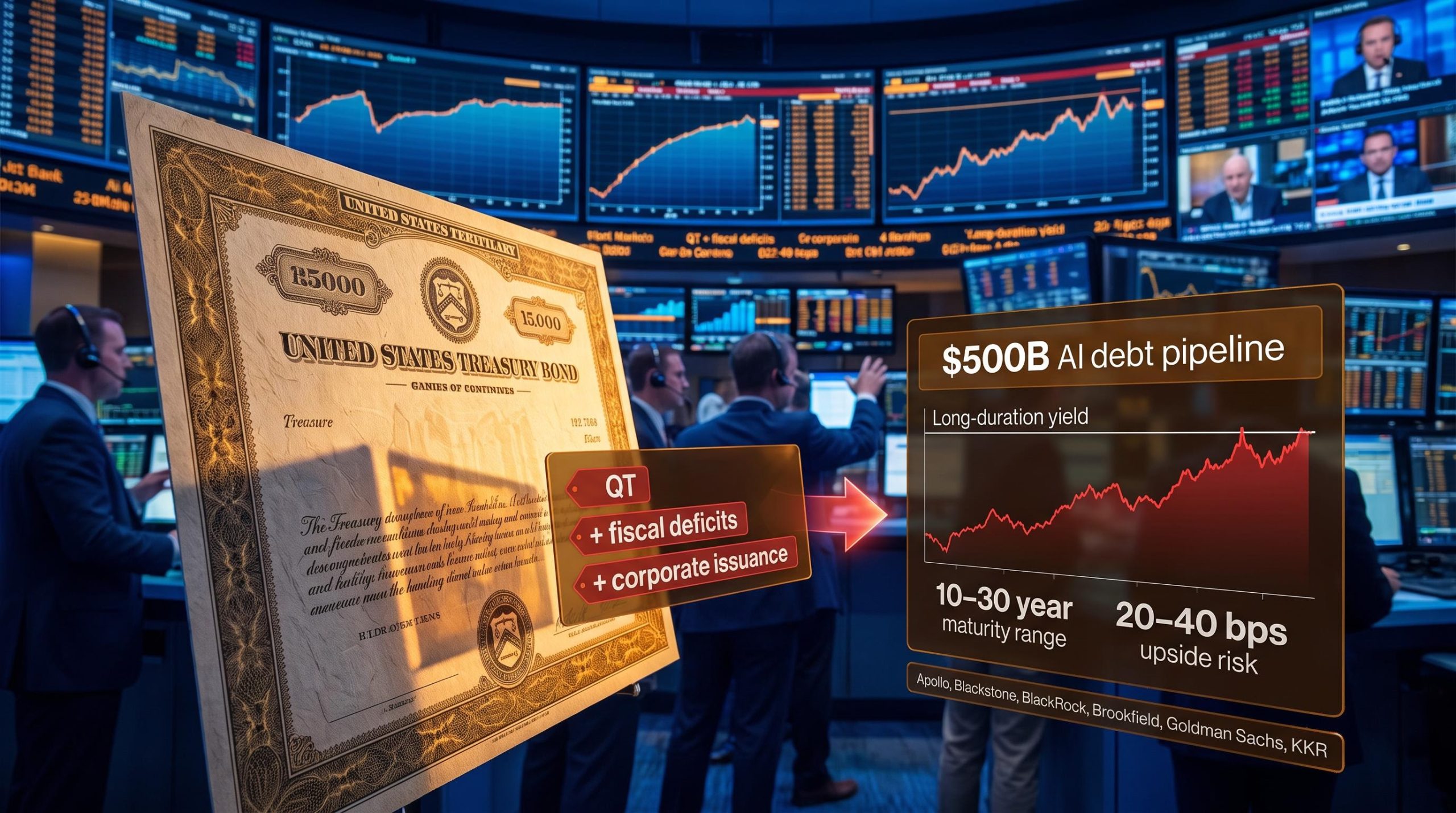
Nvidia just mobilised six of Wall Street’s largest institutions to build a half-trillion-dollar debt machine for AI infrastructure. The equity story got the headlines. The bond market story did not.
The financing platform Nvidia announced on 10 August 2026 works through structured debt vehicles, special-purpose entities, and public bond deals. That debt lands inside a US bond market already under supply pressure from persistent fiscal deficits, quantitative tightening, and heavy corporate issuance calendars. ING analyst Chris Turner has identified heavy technology sector debt issuance as a principal risk capable of disrupting what are currently benign financial conditions. Nvidia’s consortium does not create this risk in isolation. It amplifies a fragile equilibrium that most market commentary is not examining.
Here is the chain reaction: how the financing actually works, what it does to Treasury yields, what bond market deterioration would cost investors across every asset class, and why the bond market dimension of this story matters more than the equity move that dominated yesterday’s coverage.
What Nvidia’s $500 billion plan actually does (and does not do)
The most common misread of the headline figure is the simplest one: that Nvidia is borrowing $500 billion. It is not. Nvidia itself contributes zero balance-sheet capital. The entire sum is third-party money, mobilised through structured vehicles engineered by six institutional partners:
- Apollo: private credit and alternative asset allocation
- Blackstone: infrastructure and real estate capital deployment
- BlackRock (Global Infrastructure Partners unit): infrastructure-focused capital pools
- Brookfield Asset Management: large-scale infrastructure financing
- Goldman Sachs: lead bookrunner on public debt deals, the only bank in the core group
- KKR: private equity and infrastructure capital
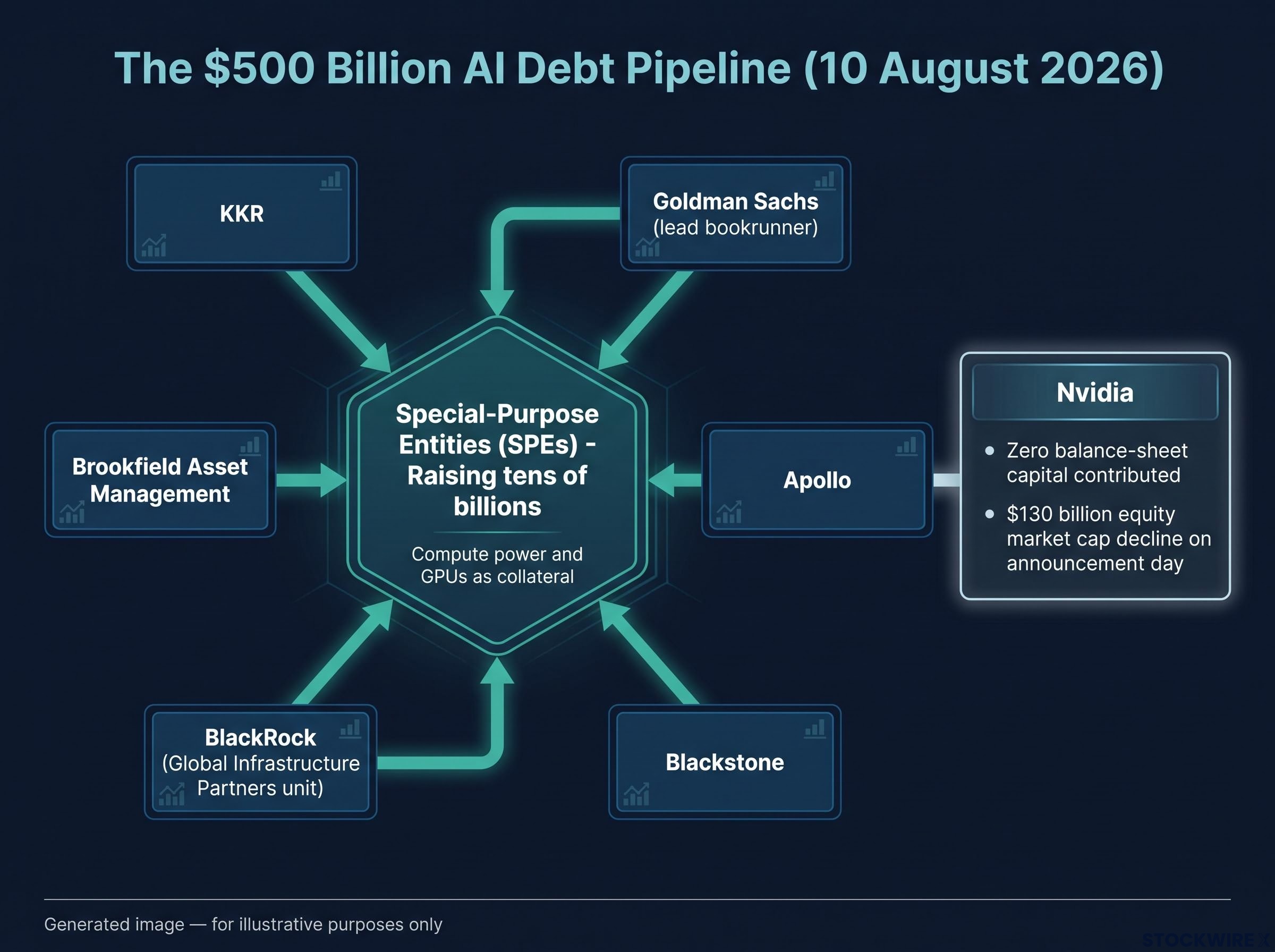
The mechanics work like this. Special-purpose entities (SPEs), which are standalone legal vehicles created specifically to issue debt, will sell bonds and private offerings to investors. Each SPE is designed to raise tens of billions at a time. Compute power and GPUs serve as collateral, described as “liquid” because the capacity can be reallocated among different buyers. The SPEs then lease that compute capacity to end users.
Jensen Huang has framed compute infrastructure as an investable asset class comparable to commercial real estate or toll roads, positioning GPU clusters as yield-bearing physical assets that institutional capital can underwrite at scale.
That framing matters because it signals what this structure is designed to do: not execute a single transaction, but build a persistent, repeat-issuance debt pipeline capable of placing multiple large deals over several years. Nvidia’s equity lost roughly $130 billion in market capitalisation on announcement day. That move drew the attention. The creation of a multi-year institutional debt pipeline did not. The bond market implications start there.
When big ASX news breaks, our subscribers know first
How corporate debt supply pushes Treasury yields higher
The cause-and-effect chain runs through a single bottleneck: the buyer pool.
Investment-grade bond buyers, primarily insurance companies, pension funds, and mutual funds, are the natural purchasers of AI infrastructure bonds. These are the same institutions that buy Treasuries, agency mortgage-backed securities, and traditional corporate bonds. Their capital is finite. When a new issuer arrives with medium- and long-dated bonds targeting the same 10-30 year maturity range as Treasuries, that issuer must offer yields competitive enough to pull capital away from existing alternatives.
That competitive pricing feeds back into the entire curve. If new AI infrastructure bonds offer attractive yields, investors demand more compensation from Treasuries and other corporates to justify holding them instead. The cost of term risk and credit risk rises across the board. What begins as a corporate financing deal in the AI sector shows up in mortgage rates, equity discount rates, and borrowing costs for every company issuing long-duration debt.
Bond yields move inversely to prices, meaning every new dollar of supply that forces issuers to offer higher coupons mechanically reduces the market value of existing holdings; grasping this inverse relationship is the foundation for understanding why a half-trillion-dollar AI debt pipeline matters to every portfolio, not just to fixed-income specialists.
Why the technology sector’s shift to heavy issuance matters
The technology sector was historically a light user of debt markets. That changed as cloud infrastructure, data centres, and now AI required physical capital at scale. Tech companies have become major corporate bond issuers over the past several years.
Nvidia’s consortium formalises and accelerates that shift at an unprecedented level. This is not a single company tapping the bond market for a quarter’s worth of capital expenditure. It is six of the world’s largest alternative asset managers pre-building capital pools designed for repeat issuance at sovereign-level scale.
ING’s Chris Turner has identified heavy technology sector debt issuance as one of the primary near-to-medium-term risks to current benign financial conditions.
When a new half-trillion-dollar debt pipeline targets the same buyers as Treasuries, the cost of all long-duration borrowing in the US economy moves. Not just the cost of AI infrastructure.
Goldman Sachs estimates close to $500 billion in AI-related debt issuance in 2026 alone, and the supply pressure is already distorting investment-grade credit signals in ways that most bond fund holders are absorbing without realising it, with Meta’s long-dated bonds trading at triple-B-equivalent spreads despite a double-A rating.
The yield environment this supply lands into
The pipeline does not arrive into a relaxed bond market. It arrives into one already absorbing maximum supply from three directions simultaneously.
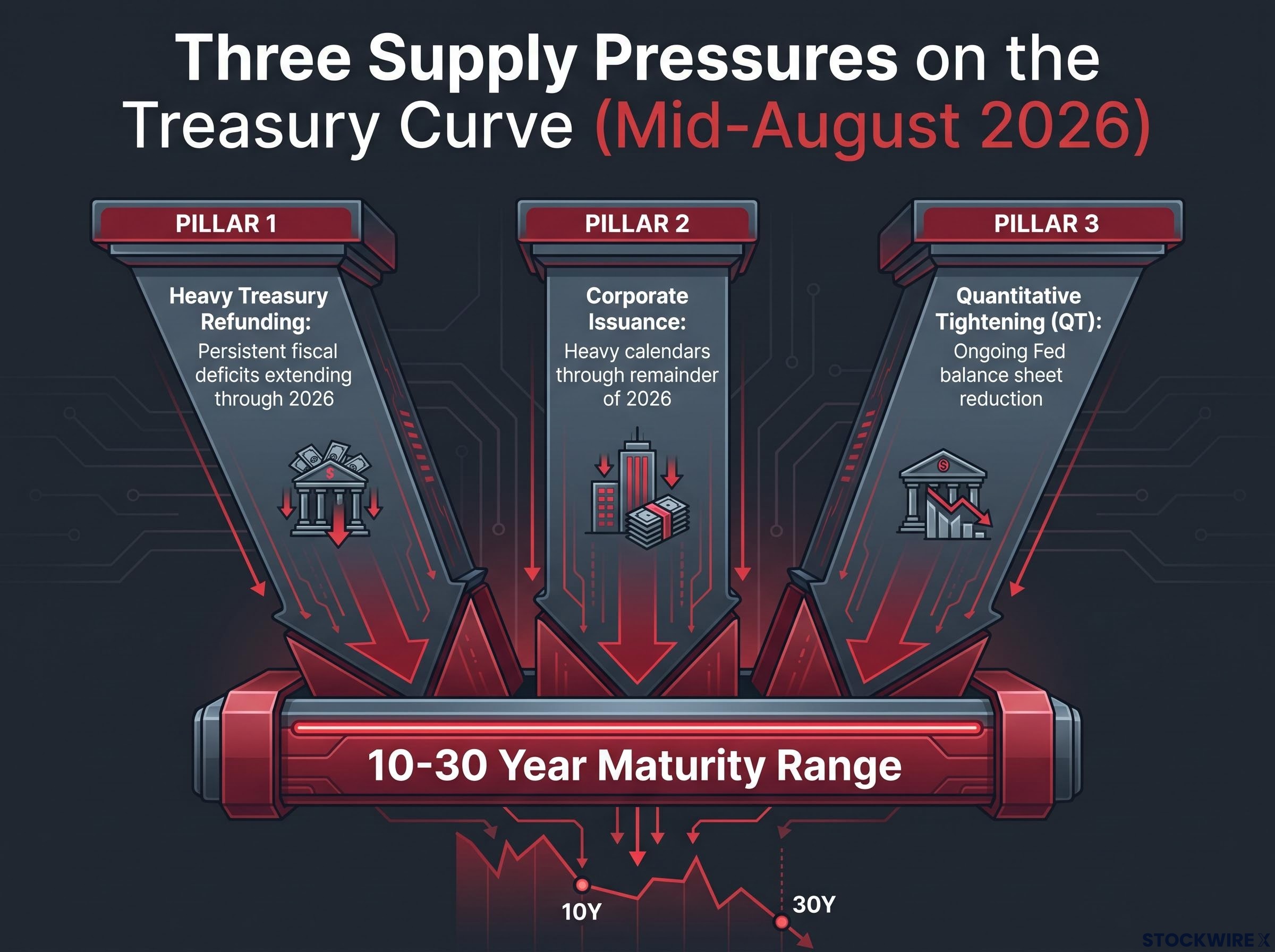
Three concurrent pressures are already loading onto the long end of the Treasury curve as of mid-August 2026:
- Heavy Treasury refunding: persistent fiscal deficits require the US government to issue large volumes of new debt at regular intervals
- Strong investment-grade corporate issuance calendars: multiple sectors are tapping the bond market for capital simultaneously
- Ongoing quantitative tightening (QT): the Federal Reserve’s balance sheet reduction removes a price-insensitive buyer from the long end, a buyer that previously absorbed supply without demanding higher yields
ING’s Chris Turner has explicitly flagged supply-driven upside risks to longer-dated yields as of mid-August 2026. Long-end Treasury yields have pushed toward the ceiling of their recent trading range, leaving little buffer for additional supply.
| Supply pressure | Driver | Duration of pressure |
|---|---|---|
| Treasury refunding | Persistent fiscal deficits requiring large, regular issuance | Structural; extends through 2026 and beyond |
| Corporate issuance | Multi-sector capital expenditure and refinancing needs | Cyclical; heavy calendars through remainder of 2026 |
| Quantitative tightening | Fed balance sheet reduction removing price-insensitive demand | Policy-dependent; ongoing until explicitly paused or reversed |
The same supply shock that would be manageable in a slack bond market carries materially greater risk when the market is already absorbing maximum sovereign and corporate supply simultaneously. When yields are already elevated, additional issuance carries greater potential to push through prior range highs, triggering momentum selling from systematic strategies and duration hedgers. Nvidia’s pipeline is the additional weight arriving at exactly the wrong moment.
What bond market deterioration actually looks like in practice
Market practitioners distinguish between two scenarios, and the difference between them is not abstract. It determines whether the impact on your portfolio is a drag or a repricing event.
| Dimension | Scenario 1: mild deterioration | Scenario 2: significant deterioration |
|---|---|---|
| Yield move | 20-40 basis points higher over several weeks | Sharp, concentrated move driven by simultaneous sovereign, corporate, and AI issuance |
| Credit spread response | Slight widening; spreads remain within recent ranges | Material widening as investors demand greater risk compensation across credit |
| Equity impact | Modest valuation compression from higher discount rates | Broad repricing across risk assets as financial conditions shift from supportive to restrictive |
| Borrower effect | Marginal projects become less attractive at higher hurdle rates | High-yield and smaller borrowers face acute tightening; funding markets seize for lower-rated issuers |
A basis point is one-hundredth of a percentage point. A 20-40 basis point rise means yields move 0.20%-0.40% higher, which sounds modest until you consider what it does to mortgage affordability and corporate borrowing costs at scale.
Nvidia’s consortium increases the probability that mild deterioration tips toward the severe scenario. The mechanism is straightforward: by layering another sizable demand call onto an already heavy supply environment, the pipeline shrinks the margin of error at the long end. If a large Treasury auction coincides with a major AI infrastructure bond deal during an already-strained absorption period, the combined supply can overwhelm available demand. That is when yields break higher, momentum selling kicks in, and credit spreads widen in sympathy.
The mild scenario is a drag on returns. The severe scenario reprices every risk asset you hold. The distinction hinges on whether issuance volumes land at scale during periods when the market’s absorption capacity is already stretched.
The signals to watch before this becomes a real crisis
Four specific, observable variables will tell you whether the supply pressure is being absorbed or accumulating into something that requires portfolio-level attention. Each is trackable in real time, well before bond market stress makes headlines.
- Treasury auction dynamics: watch for breaks in 10-year and 30-year yields above recent range highs, particularly when accompanied by heavy volume and weak auction tails (a “tail” is the gap between what the government hoped to pay and what it actually had to pay to clear the auction). The highest-risk moments are when major AI infrastructure bond deals coincide with large scheduled Treasury auctions.
- Issuance calendar crowding: monitor weeks when multiple large investment-grade deals, including data centres, energy infrastructure, and AI platforms, hit markets simultaneously. All six of Nvidia’s partners (Apollo, Blackstone, BlackRock/GIP, Brookfield, Goldman Sachs, KKR) are independently active in large-ticket infrastructure financing, which creates the potential for simultaneous supply across multiple deal pipelines beyond the consortium itself.
- Credit spread behaviour: this is the diagnostic that separates manageable pressure from genuine stress.
- Fed communication: the policy ceiling variable that determines whether yields have an upper bound.
Credit spreads and Fed signals: the two that confirm stress has arrived
Credit spreads, which measure the extra yield investors demand to hold corporate bonds instead of Treasuries, tell you the most important story. If spreads remain tight while yields rise, the market is absorbing supply without distress. If spreads widen in tandem with rising yields, that signals generalised risk repricing, a more concerning outcome where investors are not just demanding more yield but actively retreating from credit risk.
On the Fed side, any indication that the Federal Reserve accepts higher long-term yields as benign normalisation reduces the probability of stabilising intervention. Conversely, explicit concern about tightening financial conditions could set a practical ceiling on how far yields drift before prompting a policy response. A reader watching these four signals will know whether the pressure is manageable or systemic well before it dominates the news cycle.
The relationship between Treasury yields and policy has shifted materially in the current cycle, with Wolfe Research, Apollo, and Mohamed El-Erian each identifying bond market stress, not equity selloffs, as the primary forcing mechanism on White House decision-making, a dynamic that gives the Federal Reserve’s communication an outsized role in determining how far AI-supply-driven yield moves can run.
The financing chain that could raise the cost of the AI boom it was designed to fund
The central irony of Nvidia’s half-trillion-dollar financing platform deserves to be stated plainly.
The same debt-funded AI infrastructure buildout that Nvidia and its Wall Street partners are enabling could, through bond market pressure, raise the cost of capital for AI projects themselves, and for every other sector of the economy.
AI infrastructure credit is, as of this announcement, a new asset class. It will sit alongside government bonds, traditional investment-grade corporates, and project finance, competing for the same pool of institutional capital and creating new systemic linkages between AI sector performance and broad fixed-income market functioning.
If long-term yields and spreads move too far in response to this supply, some projected returns on AI infrastructure will not clear higher hurdle rates. Data centre projects that pencil at a 5% cost of capital may not pencil at 6.5%. The buildout the financing was designed to accelerate could slow itself down through the very market mechanism it uses to fund itself.
Real yield hurdle rates at 2.22% on the 10-year TIPS benchmark mean that AI infrastructure projects must clear a materially higher threshold than the sub-1% real rate environment in which many of these buildout projections were originally modelled, directly compressing the return case for data centres that pencilled at lower costs of capital.
This self-limiting dynamic is almost entirely absent from the current coverage. Nvidia’s roughly $130 billion equity market cap decline on announcement day drew enormous attention. The macro fixed-income implications, the possibility that a Wall Street-engineered, sector-concentrated credit complex could shift the cost of money for the entire economy, have received a fraction of that scrutiny. ING’s framing of this as a real macroeconomic risk, not merely an AI-sector story, is the more important read.
The incremental pressure from AI infrastructure financing is not necessarily catastrophic in isolation. But it is material in size, concentrated in time, and tightly linked to the long-duration funding markets that anchor the global cost of money.
This article is for informational purposes only and should not be considered financial advice. Investors should conduct their own research and consult with financial professionals before making investment decisions.
These statements are speculative and subject to change based on market developments and company performance. Past performance does not guarantee future results.
Reading the bond market risk beneath the AI headline
The chain reaction runs in one direction. AI infrastructure debt supply targets the same investor pool as Treasuries. That supply lands into a yield environment already at range highs from fiscal deficits, corporate issuance, and quantitative tightening. The result is a concrete mechanism for tipping the mild deterioration scenario toward the severe one, where credit spreads widen, financial conditions tighten, and every risk asset reprices.
The practical takeaway is the monitoring framework: Treasury auction dynamics, issuance calendar crowding, credit spread behaviour, and Fed communication. Those four variables will tell you whether this risk is being absorbed or building toward something that demands action.
The equity move happened in one day. The bond market effect will build over months as SPE issuance ramps up. ING’s risk horizon begins now, from mid-August 2026, and extends across a multi-year execution timeline. That slower cadence is precisely why it risks being missed until conditions have already shifted. The bond market risk in this story is a process, not an event, and that process is already in motion.