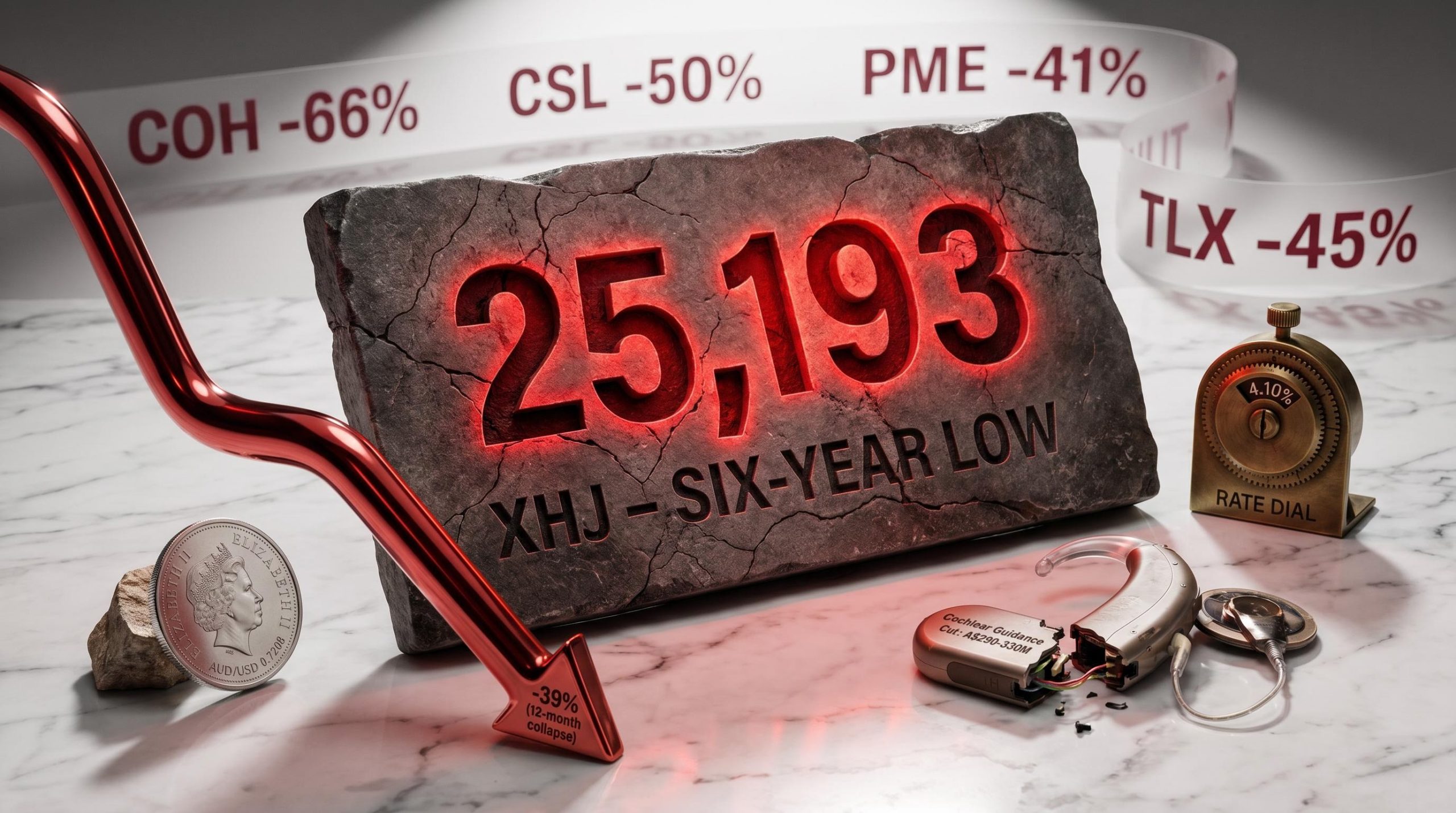
The S&P/ASX 200 Health Care Index (XHJ) has shed 39% of its value over 12 months, making it the worst-performing segment of the entire Australian sharemarket. Worse than technology. Worse than resources. The index hit a six-year low of 25,193 points on 30 April 2026, a level not seen since 2020.
This is not a story about one bad company or one bad quarter. The collapse reflects four macro forces converging simultaneously on a sector that investors historically treat as defensive: a rising Australian dollar eroding offshore earnings, domestic interest rates compressing growth stock multiples, weakening US consumer sentiment turning medical procedures into discretionary spending, and regulatory instability in the US market that the sector’s largest constituents depend on for revenue. What follows unpacks each force in sequence, uses Cochlear’s April guidance shock as a case study in how consumer stress transmits into healthcare earnings, and identifies the specific metrics Australian investors should monitor as conditions evolve.
The anatomy of a 39% collapse: one sector, four simultaneous headwinds
XHJ 12-month return: approximately -39.92%, reaching a six-year low of 25,193 points on 30 April 2026.
The scale of the damage is striking. The analytical signal, however, lies in its breadth. When a plasma giant, a radiology software firm, a hearing implant manufacturer, and a radiopharmaceutical company all fall simultaneously and sharply, the explanation cannot rest on individual management failure.
| Company | ASX Code | 12-Month Return |
|---|---|---|
| CSL | CSL | -50% |
| Cochlear | COH | -66% |
| Pro Medicus | PME | -41% |
| Telix Pharmaceuticals | TLX | -45% |
| ResMed | RMD | -19% |
| Sonic Healthcare | SHL | -24% |
| Ansell | ANN | -13% |
| Ramsay Health Care | RHC | +18% |
For context, the ASX 200 technology sector fell 26% over the same period, meaning healthcare underperformed even a battered peer group by a wide margin. Four headwinds explain the gap: currency translation losses, interest rate pressure on valuations, demand destruction in elective procedures, and US regulatory uncertainty. Each operates through a distinct mechanism, and all four arrived at once.
ASX market breadth deterioration in the week ending 1 May 2026 tells the same story from a different angle: 22 index constituents hit fresh 52-week lows while the headline ASX 200 fell just 0.65%, with healthcare contributing five of those lows and recording zero offsetting new highs across the entire sector.

When big ASX news breaks, our subscribers know first
Currency translation: the AUD appreciation that erodes reported offshore profits
The AUD/USD closed at 0.7208 on 4 May 2026, up approximately 12% over the prior 12 months. For companies earning the majority of revenue in US dollars, that appreciation works like a silent tax on reported profits.
The transmission mechanism is mechanical. Revenue is earned offshore in USD. When that revenue is translated back to Australian dollars at a stronger exchange rate, the reported AUD figure shrinks, even if the underlying business grew in local currency terms. Earnings per share compresses. Valuation multiples follow.
- Offshore revenue is earned in USD
- Translated back to AUD at a less favourable rate
- Lower AUD profit is reported to the market
- Earnings per share and valuation multiples compress accordingly
Why the AUD matters more to XHJ than most indices
CSL carries an estimated 45% weighting in the XHJ (a figure that requires verification against S&P Dow Jones official composition data). That concentration means currency-driven pressure on a single stock mechanically drags the entire index lower, well beyond what CSL’s individual decline would suggest in isolation. CSL’s 50% 12-month fall, the deepest among the large-cap constituents, reflects this dynamic in stark terms.
ResMed, with its substantial US-denominated revenue base, faces the same translation headwind. A company can grow volumes, retain customers, and execute operationally, yet still report weaker AUD profits simply because the exchange rate has moved against it. For AUD-denominated investors, separating business quality from reported earnings deterioration requires watching the currency as closely as the income statement.
The AUD resilience drivers in 2026, primarily elevated LNG and gold export revenues linked to the Hormuz supply shock, help explain why the currency has strengthened against the USD even as domestic CPI creates offsetting pressure, a dynamic that makes the translation headwind for XHJ constituents more persistent than a simple rate-differential story would suggest.
What high interest rates do to healthcare stocks that other sectors avoid
Interest rates do not hit all stocks equally. For healthcare companies priced on earnings years into the future, higher rates function as a valuation scalpel rather than a blunt instrument.
The mechanism centres on how investors value future earnings today:
- Rate rises increase the discount rate applied to future earnings in valuation models.
- Growth stocks with earnings weighted further into the future are discounted more severely, because those distant cash flows lose more present value when the discount rate climbs.
- The share price falls even if the underlying business has not deteriorated operationally.
Pro Medicus illustrates this clearly. The radiology software company has strong fundamentals and a growing US contract base. Its share price has still fallen 41% over 12 months. Rate-driven multiple compression, not a business failure, is the primary analytical explanation.
The Reserve Bank of Australia meets on 4-5 May 2026, with an 86% market-implied probability of a further 25 basis point hike to 4.35%. Two rate rises have already been implemented during 2026. This is a continuing headwind, not a resolved one.
Ramsay Health Care gained 18% over the same 12-month period, a reminder that rate sensitivity within the sector is sub-sector specific. Hospital operators with regulated pricing and nearer-term cash flows face very different dynamics to high-multiple software names.
Cochlear’s guidance reset: how cost-of-living pressure turns implants into deferrals
Cochlear revised FY26 underlying net profit guidance to A$290-330 million, down from approximately A$435-460 million, a reduction of roughly 30-35%.
The numbers arrived on 21-22 April 2026 and they arrived fast. Cochlear shares fell approximately 35-39% in a single session, sending the stock to a decade low near $88.88 as of early May. Over 12 months, the total decline reached 66%, the deepest among major XHJ constituents.

| Metric | Prior Guidance | Revised Guidance |
|---|---|---|
| FY26 Underlying Net Profit | A$435-460 million | A$290-330 million |
| Share Price Impact (Single Session) | N/A | Approximately -35% to -39% |
The causal chain starts in the United States, where consumer sentiment recorded its sharpest monthly decline in five years during April 2026. Under financial stress, patients defer elective procedures. A hearing implant, while life-improving, is not life-sustaining. Its timing can shift by months or years when household budgets tighten.
US consumer sentiment hit a record low of 49.8 on the University of Michigan’s final April 2026 reading, the same month Cochlear cut its guidance by 30-35%, and the timing is not coincidental: hearing implant deferral rates track consumer confidence with a lag of weeks rather than quarters.
Reduced patient reimbursement levels in China, expected to lower premium product sales in the second half of FY26, compounded the US consumer effect. The result was a guidance reset of a scale rarely seen in ASX large-cap healthcare.
Not all healthcare demand is inelastic
The Cochlear case exposes a structural vulnerability that the “defensive” label obscures. Genuinely non-deferrable procedures, such as emergency surgery and life-sustaining treatments, remain insensitive to consumer confidence. Cochlear’s hearing implants sit in a different category: the timing is flexible, and flexibility becomes deferral when cost-of-living pressures peak.
The distinction between deferrable and non-deferrable healthcare demand is the difference between a business that absorbs a recession and one that amplifies it.
Understanding the XHJ: why this index is structurally concentrated and globally exposed
The S&P/ASX 200 Health Care Index, commonly referred to by its ticker XHJ, tracks the healthcare constituents of the ASX 200. Unlike a diversified sector index where dozens of similar-sized companies contribute roughly equal weight, the XHJ is concentrated. CSL alone carries an estimated 45% of the index, meaning its individual share price moves have an outsized effect on the headline number.
That concentration matters because “Australian healthcare” is predominantly a global revenue story. The sector’s largest constituents earn the majority of their profits offshore, particularly in the United States:
- CSL: Global revenue base, heavily USD-weighted
- ResMed: US-dominant revenue
- Cochlear: Global, with significant US and China exposure
- Pro Medicus: US contract base expanding rapidly
- Telix Pharmaceuticals: US regulatory exposure for key products
Investors who buy XHJ exposure expecting domestic healthcare defensiveness are acquiring a portfolio that is heavily weighted to global macro variables: USD strength, US consumer confidence, and US regulatory policy.
FDA uncertainty as a persistent risk premium
The US Food and Drug Administration (FDA) under the Trump/RFK Jr. administration has generated contradictory policy signals and management instability throughout 2026. For ASX-listed names with US approval exposure, this creates a risk premium that is unlikely to resolve quickly.
Former CSL chief executive Dr Paul McKenzie noted at the company’s 2025 annual general meeting that US influenza vaccination rates had declined more sharply than anticipated, an example of regulatory sentiment translating into measurable revenue impact. Rare diseases advocacy groups have separately reported increasing difficulty securing biotech funding amid FDA policy uncertainty.
What to watch now: the metrics that will signal whether the sector has bottomed
The XHJ’s path from here depends on whether the four headwinds resolve in sequence or persist together. A single improving variable may not be sufficient to drive a re-rating if the others remain entrenched.
The nearest-term catalyst is the RBA rate decision on 5 May 2026. With an 86% probability of a 25 basis point hike already priced in, the base case is a continuation of rate pressure. Any surprise hold would represent a meaningful sentiment shift for growth-oriented names.
| Metric to Watch | Current Reading | Bullish Signal for XHJ |
|---|---|---|
| AUD/USD | 0.7208 | Sustained move below 0.70 |
| RBA Cash Rate | 4.10% (pre-May decision) | Rate hold or forward guidance signalling a pause |
| US Consumer Sentiment | Multi-year lows | Stabilisation in Michigan or Conference Board indices |
| Cochlear Guidance | A$290-330 million | Upward revision or management commentary confirming demand recovery |
| FDA Policy Stability | Elevated uncertainty | Consistent approval signals and reduced leadership turnover |
In priority order for Australian investors:
- The RBA rate decision (nearest-term, highest certainty of resolution date)
- AUD/USD trajectory (continuous, directly tied to CSL’s earnings translation)
- US consumer sentiment readings (leading indicator for Cochlear-style demand deferral)
- Cochlear’s next management update (company-specific, but the sector’s most watched catalyst)
- China reimbursement policy developments (secondary, affecting Cochlear’s H2 FY26)
US consumer sentiment readings tracked by the University of Michigan survey fell to historically low levels through April 2026, with the index touching 47.6, a figure that functions as a forward indicator for elective procedure volumes across the following two to three quarters.
Tracking each signal independently, rather than waiting for a single catalyst, provides a more granular picture of where conditions may begin to shift.
For investors wanting to translate the rate trajectory into portfolio action, our dedicated guide to ASX sector positioning ahead of RBA rate cuts examines which ASX sectors have historically moved first when the RBA shifts direction, the valuation leverage that high-growth technology and healthcare names carry into an easing cycle, and why the 2025-2026 policy reversal makes disciplined exit awareness as important as entry timing.
A six-year low and a mislabelled sector: what the XHJ collapse reveals about defensive assumptions
The XHJ’s collapse to a six-year low of 25,193 points is not cyclical bad luck. It is the product of four structural forces, currency, rates, demand destruction, and regulatory uncertainty, arriving simultaneously at a sector whose actual risk profile does not match its label.
The Cochlear guidance shock provided the clearest evidence: elective healthcare demand is consumer-confidence-sensitive in ways that the defensive assumption fails to account for. Ramsay Health Care’s 18% gain over the same period shows that genuinely domestically-anchored hospital services, with regulated pricing and non-deferrable demand, behave very differently.
Two rate rises during 2026, with a likely third on 5 May, mean the pressure has been building across the year, not arriving suddenly. Recovery will require several of these macro variables to reverse in sequence, and that sequencing makes patience and specificity in monitoring more valuable than a single macro call.
The ASX healthcare sector’s “defensive” label has been structurally invalidated. What investors own under the XHJ ticker is not domestic healthcare stability; it is a concentrated, globally exposed portfolio of USD earners, growth multiples, and consumer-confidence-sensitive demand, each responding to a different headwind, and all of them blowing at once.
This article is for informational purposes only and should not be considered financial advice. Investors should conduct their own research and consult with financial professionals before making investment decisions. Past performance does not guarantee future results. Financial projections are subject to market conditions and various risk factors.