
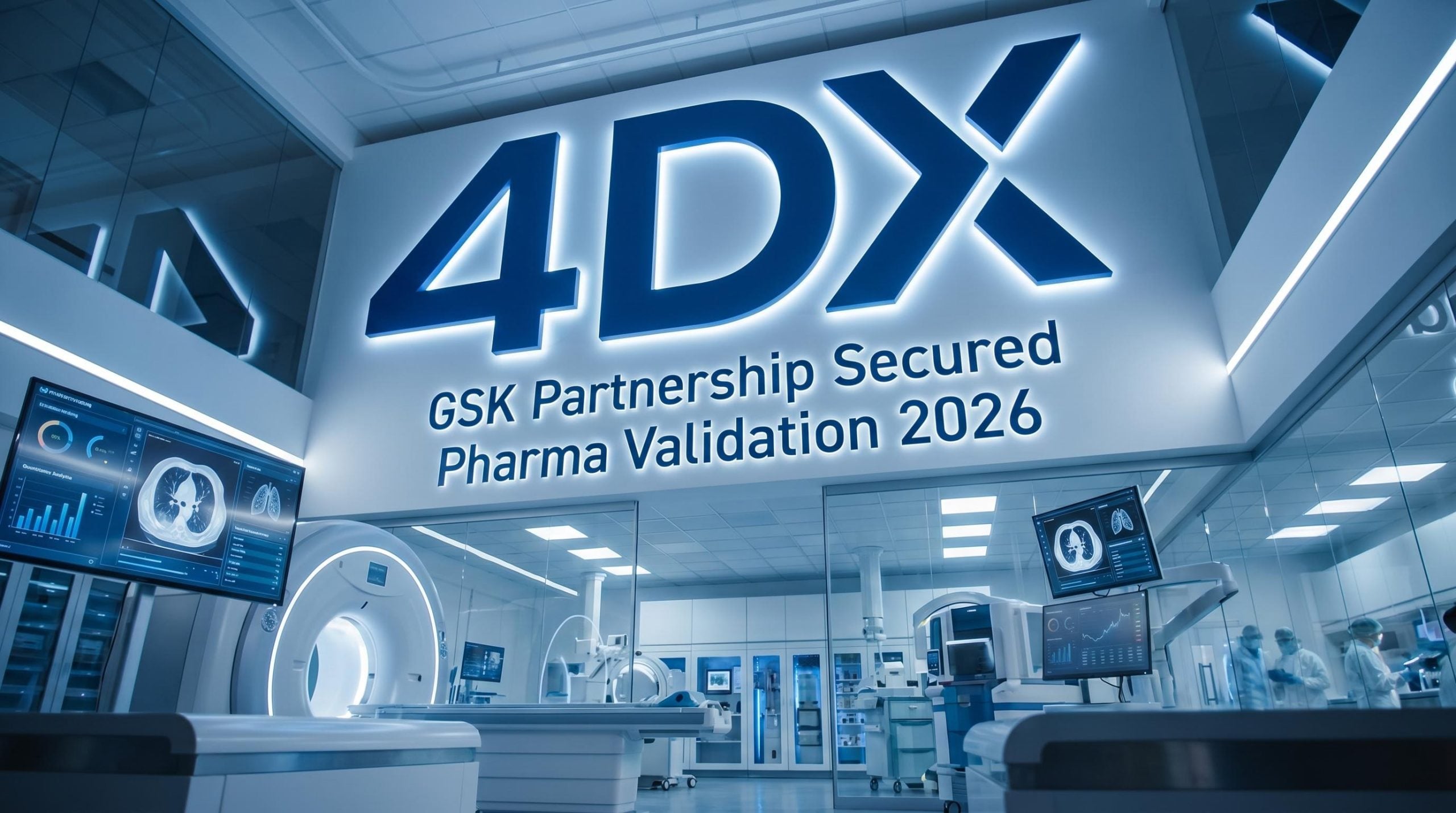
4DMedical secures GSK contract as pharma adoption accelerates
4DMedical (ASX: 4DX) has executed a contract with GlaxoSmithKline (GSK), one of the world’s largest pharmaceutical companies, to supply quantitative lung imaging analytics for pulmonary drug development. The one-year agreement, commencing 1 May 2026, will see 4DMedical provide advanced functional lung imaging biomarkers through the Flywheel Exchange platform, supporting GSK’s clinical research programmes.
The engagement represents a significant validation of pharmaceutical industry demand for 4DMedical’s imaging analytics platform. GSK joins AstraZeneca as a tier-one pharmaceutical client, establishing a pattern of adoption among major drug developers seeking quantitative imaging endpoints for respiratory clinical trials. The contract enables sensitive assessment of lung structure and function across trial cohorts, improving patient stratification, trial efficiency, and longitudinal disease monitoring.
Andreas Fouras, Managing Director and CEO
“Our engagement with GSK demonstrates the growing importance of 4DMedical’s quantitative imaging analytics in pharmaceutical development. As biopharmaceutical companies seek more sensitive, reproducible endpoints to support respiratory drug development, our platform is increasingly well positioned to serve this expanding market alongside our established clinical business. Importantly, this engagement also creates the potential to support programs beyond development, including the future use of our technology as a companion diagnostic as therapies progress through to commercialisation.”
The pharmaceutical relationship creates a recurring revenue stream beyond 4DMedical’s clinical software-as-a-service deployments. If the company’s imaging analytics support a therapy through development, they may become embedded as companion diagnostics in commercial use, generating long-term revenue tied to drug sales. This dual revenue model diversifies income sources while reinforcing the clinical validity of 4DMedical’s platform across both therapeutic development and clinical care pathways.
When big ASX news breaks, our subscribers know first
What pharmaceutical imaging contracts mean for medtech investors
Pharmaceutical companies increasingly rely on quantitative imaging analytics to improve clinical trial design and execution. Traditional endpoints in respiratory drug trials often lack sensitivity or reproducibility, making it difficult to demonstrate treatment effect in smaller patient populations or shorter timeframes. 4DMedical’s platform provides imaging biomarkers that measure lung function with greater precision than standard clinical assessments, enabling drug developers to detect meaningful changes earlier and with statistical confidence.
Imaging biomarkers serve as objective measures of biological processes that can indicate disease progression or treatment response. In pulmonary drug development, these may include regional ventilation patterns, perfusion distribution, or airway remodelling. By quantifying these parameters from routine CT scans, 4DMedical eliminates the need for specialised nuclear medicine procedures or invasive testing, making longitudinal assessment feasible across multi-site trials.
The business model creates two distinct revenue pathways. Clinical deployments generate software-as-a-service revenue as hospitals use the technology for patient care. Pharmaceutical contracts provide research-focused revenue as drug developers use the same analytics to support trial endpoints. Critically, successful use in drug development may lead to companion diagnostic designation, where the imaging test becomes a required component of therapy delivery. This creates potential for long-term recurring revenue streams tied to approved therapies.
For investors, pharmaceutical contracts signal commercial validation beyond hospital adoption. They demonstrate that the technology meets the rigorous standards required for regulatory submissions and that major drug developers view the analytics as strategically valuable. The GSK engagement, following the established AstraZeneca relationship, suggests this revenue stream is becoming structural rather than opportunistic.
UK clearance unlocks major European market for CT:VQ
CT:VQ has received UKCA certification for clinical use in the United Kingdom, enabling immediate commercial deployment across NHS and private healthcare providers. The clearance follows CE Mark certification in March 2026, completing regulatory access across the European Union and United Kingdom. CT:VQ now holds clearance in all major Western healthcare markets: the United States, European Union, United Kingdom, Canada, and New Zealand.
The UK diagnostic imaging market is characterised by high chest CT utilisation across respiratory, oncology, and acute care pathways. Millions of chest CT scans are performed annually for lung cancer screening, chronic obstructive pulmonary disease (COPD), interstitial lung disease, pulmonary embolism, and emergency medicine. CT:VQ integrates into these established workflows by extracting quantitative ventilation and perfusion data from routine non-contrast CT scans, eliminating the complexity and resource constraints associated with nuclear medicine studies.
UK clinical research strengthens the global evidence base supporting CT:VQ adoption. 4DMedical has active research programmes at the Royal Brompton Hospital in London, an internationally recognised centre of excellence in cardiopulmonary medicine with strong collaborative ties to North American academic medical centres. Engagement with UK clinicians enhances the clinical credibility of the platform while enabling investigator-initiated research that complements the company’s US commercial strategy.
| Product | FDA (USA) | CE Mark (EU) | MHRA (UK) | Canada | New Zealand |
|---|---|---|---|---|---|
| CT:VQ | ✓ | ✓ | ✓ | ✓ | ✓ |
| CAC | ✓ | ✓ | — | ✓ | — |
| CT LVAS | ✓ | ✓ | — | ✓ | — |
Geographic diversification reduces reliance on the US market while positioning 4DMedical to support multi-national clinical research and pharmaceutical trials. The regulatory footprint enables the company to engage with European pharmaceutical companies and contract research organisations, expanding the addressable market for both clinical and research-focused deployments.
US deployment momentum continues
CT:VQ deployment across leading US academic medical centres continues to advance. The technology is now deployed at six institutions: Stanford, Cleveland Clinic, UC San Diego Health, University of Chicago Medicine, Mayo, and University of Miami. Additional institutions are actively evaluating the technology, with deployment timelines progressing through procurement and implementation phases.
These reference site deployments validate the clinical adoption thesis. Academic medical centres set clinical standards and influence practice patterns across regional and community hospitals. Early adoption at prestigious institutions creates a foundation for broader market penetration as evidence accumulates and clinical workflows mature.
CAC reimbursement pathway established in US
The Centers for Medicare & Medicaid Services (CMS) has established HCPCS code G0680, creating a dedicated reimbursement pathway for AI-enabled opportunistic analysis of coronary artery calcium from routine chest CT scans. The code provides reimbursement of US$15.50 per study in the hospital outpatient setting, effective immediately.
Opportunistic analysis refers to the extraction of clinically relevant data from imaging studies performed for other indications. Traditional coronary artery calcium scoring requires dedicated cardiac CT scans with specific protocols. 4DMedical’s CAC solution analyses calcium burden from routine chest CT scans performed for pulmonary or oncological indications, generating cardiovascular risk information without additional imaging, radiation exposure, or clinical workflow burden.
The creation of a specific reimbursement code removes a critical economic barrier to adoption. Hospitals can now generate incremental revenue from existing chest CT volumes while providing physicians with cardiovascular risk stratification data that informs patient management. This market infrastructure accelerates adoption by aligning clinical value with economic incentives.
4DMedical’s CAC solution has also received regulatory clearance from Health Canada, coinciding with the company’s participation at the Canadian Association of Radiologists (CAR) Annual Scientific Meeting in Montreal. The Canadian market represents an additional geographic pathway for CAC deployment.
Key CAC milestones include:
- CMS reimbursement code established (US) — HCPCS G0680 providing US$15.50 per study reimbursement
- Health Canada clearance confirmed — enabling clinical deployment across Canadian institutions
- CAR Annual Scientific Meeting participation (Montreal) — presenting cardiopulmonary imaging portfolio to Canadian radiologists and health system leaders
The CAC solution expands 4DMedical’s addressable market beyond pulmonary imaging into cardiovascular risk assessment. The ability to generate both pulmonary and cardiac analytics from a single chest CT scan positions the company’s platform as a comprehensive cardiopulmonary imaging solution.
ASX 200 inclusion signals institutional re-rating
4DMedical has been included in the S&P/ASX 200 Index, effective prior to the open of trading 20 April 2026. The ASX 200 is Australia’s primary benchmark equity index, representing the largest 200 companies by market capitalisation. Inclusion broadens institutional shareholder base and increases visibility among index-tracking and passive investment funds.
Index inclusion reflects market recognition of the progress achieved over the past twelve months. Key milestones driving the re-rating include:
- FDA clearance of CT:VQ (September 2025)
- Six US academic medical centre deployments
- Philips distribution agreement for CT:VQ
- CE Mark certification (European Union)
- AstraZeneca and GSK pharmaceutical engagements
The transition from the ASX All Ordinaries to the ASX 200 increases institutional ownership through passive index funds and creates potential for improved liquidity. Fund managers with ASX 200 mandates become eligible investors, expanding the investor base beyond specialised healthcare and technology funds.
Index membership is a consequence of commercial progress rather than a catalyst. However, it validates the market’s assessment that 4DMedical has transitioned from an early-stage development company to an established commercial entity with regulatory clearances, revenue-generating products, and partnerships with tier-one pharmaceutical and medical device companies.
Commercial pipeline outlook
Management has indicated the commercial pipeline is at its deepest and most advanced stage, with further shareholder updates expected shortly. The company’s progress across multiple dimensions (regulatory clearances, clinical deployments, pharmaceutical partnerships, reimbursement pathways) positions it to capitalise on established market access.
Andreas Fouras, Managing Director and CEO
“Collectively, milestones such as pharmaceutical engagement with a global leader, expanding geographic reach, a growing cardiopulmonary portfolio, and inclusion in the ASX 200, reinforce 4DMedical’s position as a global platform company in CT-based cardiopulmonary imaging. However, what excites me most is what lies ahead. Our commercial pipeline is the deepest and most advanced it has ever been, and I look forward to updating shareholders shortly.”
The combination of regulatory infrastructure, clinical adoption at reference sites, pharmaceutical validation, and reimbursement mechanisms creates a foundation for accelerated revenue growth across multiple product lines and geographic markets.
Want the Next Healthcare Breakout in Your Inbox?
Join 20,000+ investors receiving FREE breaking ASX news within minutes of release, complete with in-depth analysis. Click the “Free Alerts” button at Big News Blast to get market-moving healthcare announcements the moment they drop, with expert coverage already done for you.