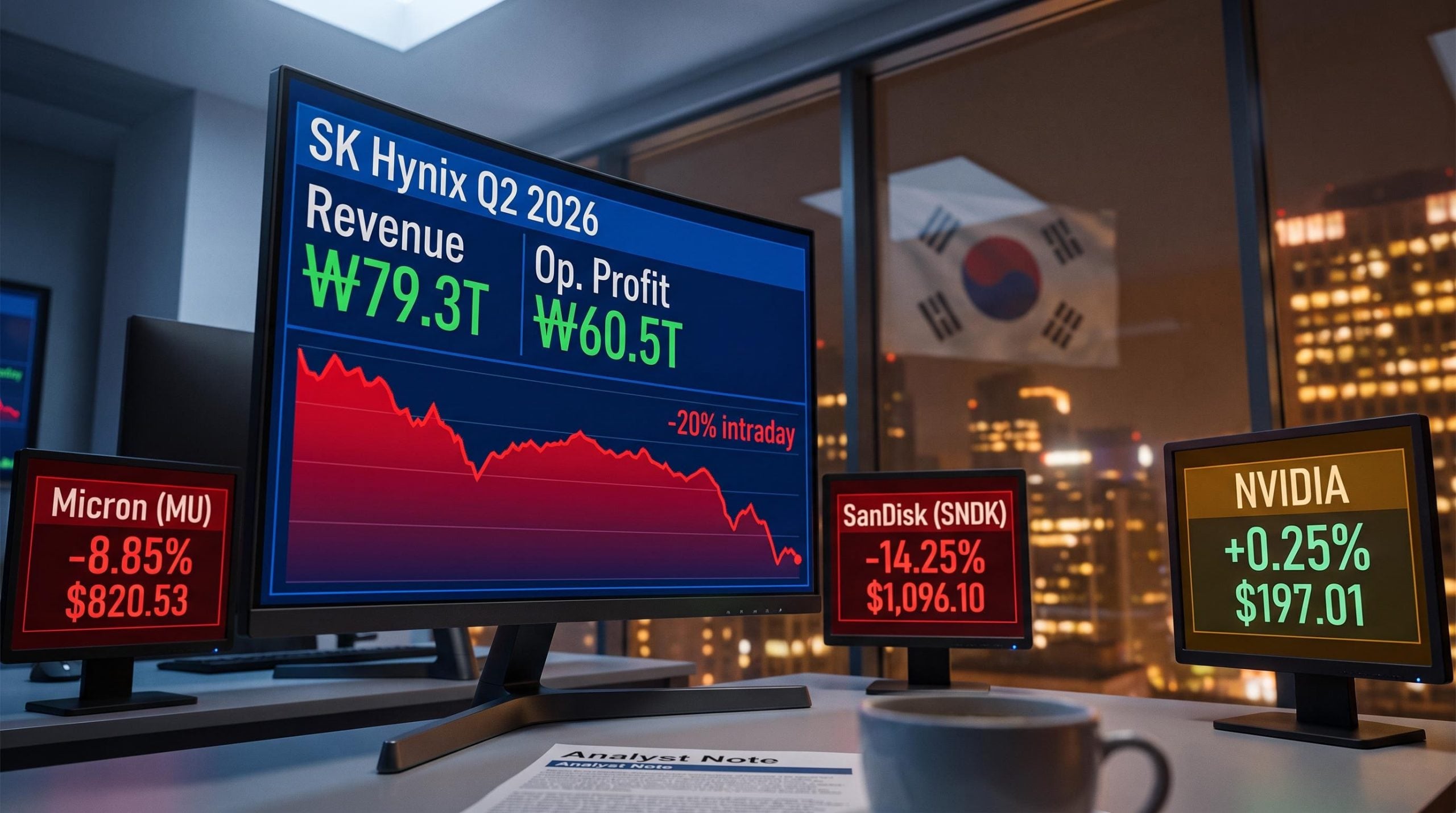
On 29 July 2026, SK Hynix reported the highest operating profit in the history of the memory industry. Revenue rose 257% year on year. Operating margin hit 76%. Net profit climbed more than 1,300%.
The stock’s intraday response was a drop of up to 20% before recovering to close roughly 9-10% lower.
The disconnect is not an anomaly. It is a signal about how AI chip stocks are now valued: the benchmark is no longer how good a quarter was in absolute terms, but how good it was relative to what an already-elevated share price had already assumed. When that assumption runs even slightly ahead of reality, the correction is swift, severe, and rarely contained to the company that disappointed.
Here is how the mechanics of that dynamic work, which specific companies were caught in the contagion, and what practical framework investors can apply before the next AI chip earnings print lands. The distinction between an expectations failure and a fundamental one now determines returns more than headline growth rates do.
Record results that still disappointed the market
The raw numbers deserve their full weight. SK Hynix posted Q2 2026 revenue of ₩79.3 trillion, up 257% year on year and 51% quarter on quarter. Operating profit reached ₩60.5 trillion, a 557% year-on-year increase. Net profit hit ₩93.9 trillion, up more than 1,300%.
A 76% operating margin is an extraordinary level for a memory supplier, a business segment historically characterised by deep cyclical swings and single-digit margin troughs.
None of it was enough. Analyst consensus had pencilled in revenue in the ₩82-84 trillion range and operating profit around ₩63-64 trillion. The miss on both lines was approximately 5-6%, a modest shortfall in isolation but a significant one when the stock price had already paid in advance for a beat.
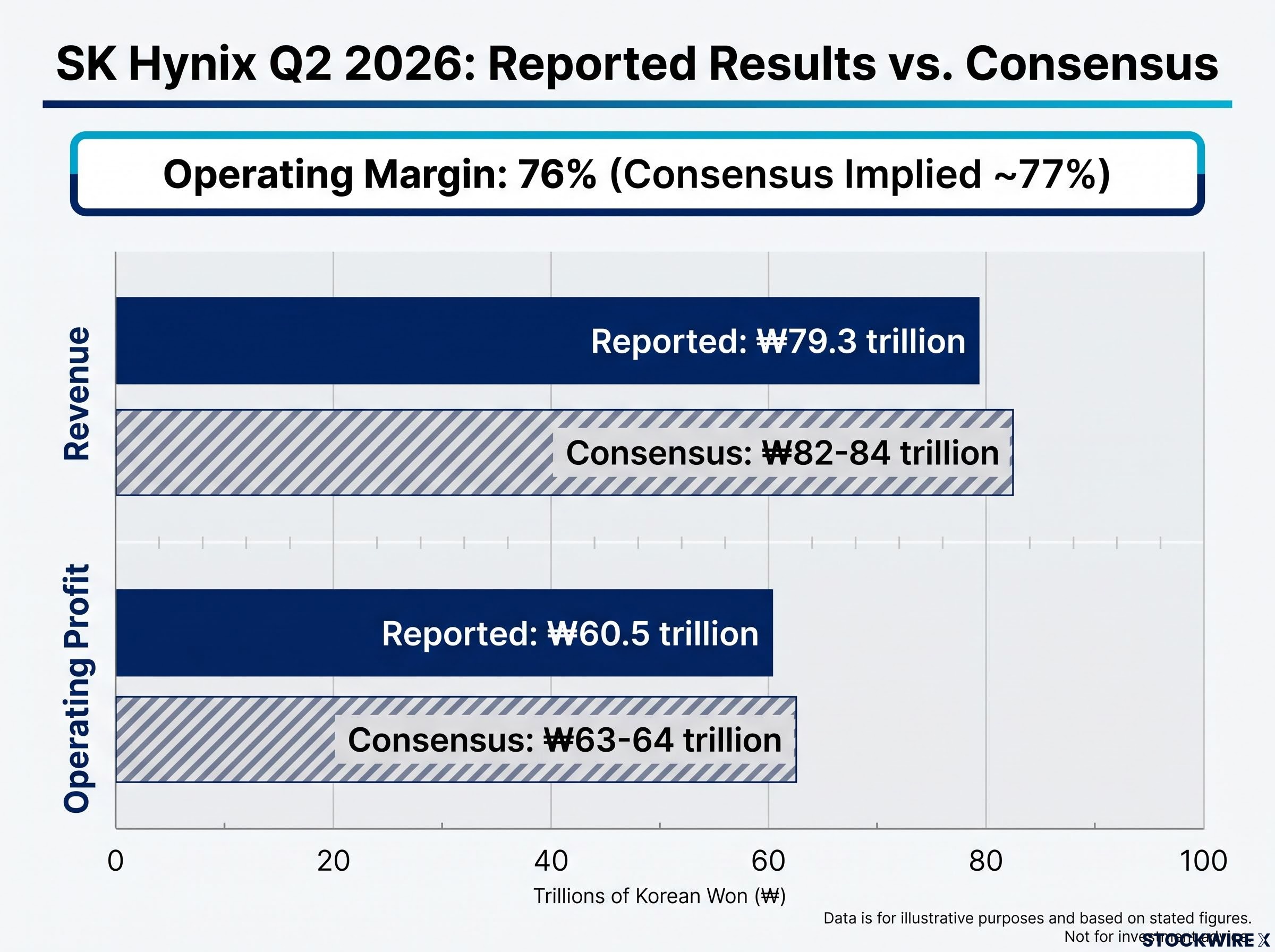
| Metric | Reported | Consensus | Miss |
|---|---|---|---|
| Revenue | ₩79.3 trillion | ₩82-84 trillion | ~5-6% |
| Operating profit | ₩60.5 trillion | ₩63-64 trillion | ~5-6% |
| Operating margin | 76% | Implied ~77% | Marginal |
Shares fell as much as 20% intraday before closing roughly 9-10% lower. The SK Hynix ADR declined approximately 9%. The KOSPI finished the session approximately 6% lower, weighing on the broader South Korean market.
There was an earnings quality complication too. Roughly half of pretax profit derived from non-operating investment-asset gains rather than core memory operations, weakening the apparent record in investors’ eyes. The market’s reaction was not irrational panic. It was a rational, if brutal, re-rating of a stock whose price had already paid for results even better than these.
When big ASX news breaks, our subscribers know first
How “priced for perfection” turns a win into a loss
The mechanism that punishes record quarters is worth understanding precisely, because it applies to every AI chip name, not just SK Hynix.
When a compelling narrative, in this case the AI infrastructure supercycle, drives a stock higher over successive quarters, the share price stops reflecting what the company has already delivered. It begins reflecting what the company must deliver next. Each re-rating embeds a more demanding forward earnings path into the price. The only benchmark that then matters is whether reality clears that embedded path.
The feedback loop works in three steps:
- A compelling AI narrative drives the share price higher, compressing future expected growth into the current valuation.
- That elevated valuation embeds a demanding forward earnings path: sustained HBM dominance, durable margin expansion well above historical memory norms, and continuously accelerating shipment volumes.
- When reality is excellent but not extraordinary, the gap between price and fundamentals closes rapidly via a sharp selloff.
The result is that a stock’s own prior success becomes the trap. The better the narrative has worked, the higher the bar it sets for the next print.
The SK Hynix episode is not an isolated incident; the same repricing logic played out in early July 2026 when a reset in AI stock valuations sent the Philadelphia Semiconductor Index down roughly 10%, with AMD and Intel each falling more than 10% despite no change in underlying demand fundamentals.
The peak-margin problem specific to SK Hynix
The 76% operating margin, rather than reassuring investors, raised the question of whether the ceiling had been reached. Memory-industry margins at this level have historically proven unsustainable; the sector’s deep cyclicality has, in every prior cycle, eventually compressed margins back toward long-run averages.
Investors weighed that history against the AI-supercycle thesis. Concerns around slower-than-hoped HBM (high-bandwidth memory, the specialised memory architecture used in AI accelerators) shipment growth and rising capital expenditure reinforced the view that peak margins might have arrived rather than representing a new baseline.
For anyone holding AI chip stocks, the lesson is specific: a position’s risk profile is determined not by the company’s trajectory but by the gap between that trajectory and what the current price already demands of it.
What HBM and memory suppliers are built on, and where that leaves them
SK Hynix dominates HBM, the memory technology that sits at the heart of every major AI training and inference system. That commercial position is powerful. But the structural characteristics of a component supplier create vulnerabilities that platform businesses do not face.
The same HBM supply dynamics that drove Micron, SanDisk, and SK Hynix to combined gains exceeding 250% in the 30 days ending 12 May 2026, including sold-out capacity through 2026-2027 and a looming Samsung strike, are the precise conditions that set the elevated expectations the 29 July print then failed to clear.
The distinction matters because, on 29 July, the market priced it in real time. NVIDIA edged up 0.25% to $197.01, the notable exception in the selloff. The platform layer held. The component layer did not.
The contrast runs across four dimensions:
- Customer concentration: HBM suppliers depend on a small number of GPU makers and hyperscale cloud providers. Platform vendors sell to thousands of enterprise customers.
- Pricing power: HBM supply and pricing contracts, flagged earlier in 2026 as potentially capping upside, limit a component supplier’s ability to capture the full value of a demand surge. Platform vendors set their own prices.
- Capex intensity: Memory fabs require massive, multi-year capital commitments before revenue arrives. Platform businesses scale software with lower marginal cost.
- Margin durability: Memory margins are cyclical by nature. Platform margins tend to compound as network effects and switching costs deepen.
The market had priced HBM champions as though they possessed platform-like economics. The Q2 result was the moment that valuation mismatch surfaced. Owning the best component supplier in a hot cycle is not the same risk profile as owning the platform layer, and that distinction should inform position sizing and exit planning.
The contagion map: which stocks moved and why
The selling did not stay with SK Hynix. On 29 July, the AI chip complex moved as a single unit, and the specific equity moves reveal which names the market treated as thematically correlated versus which it let stand on their own fundamentals.
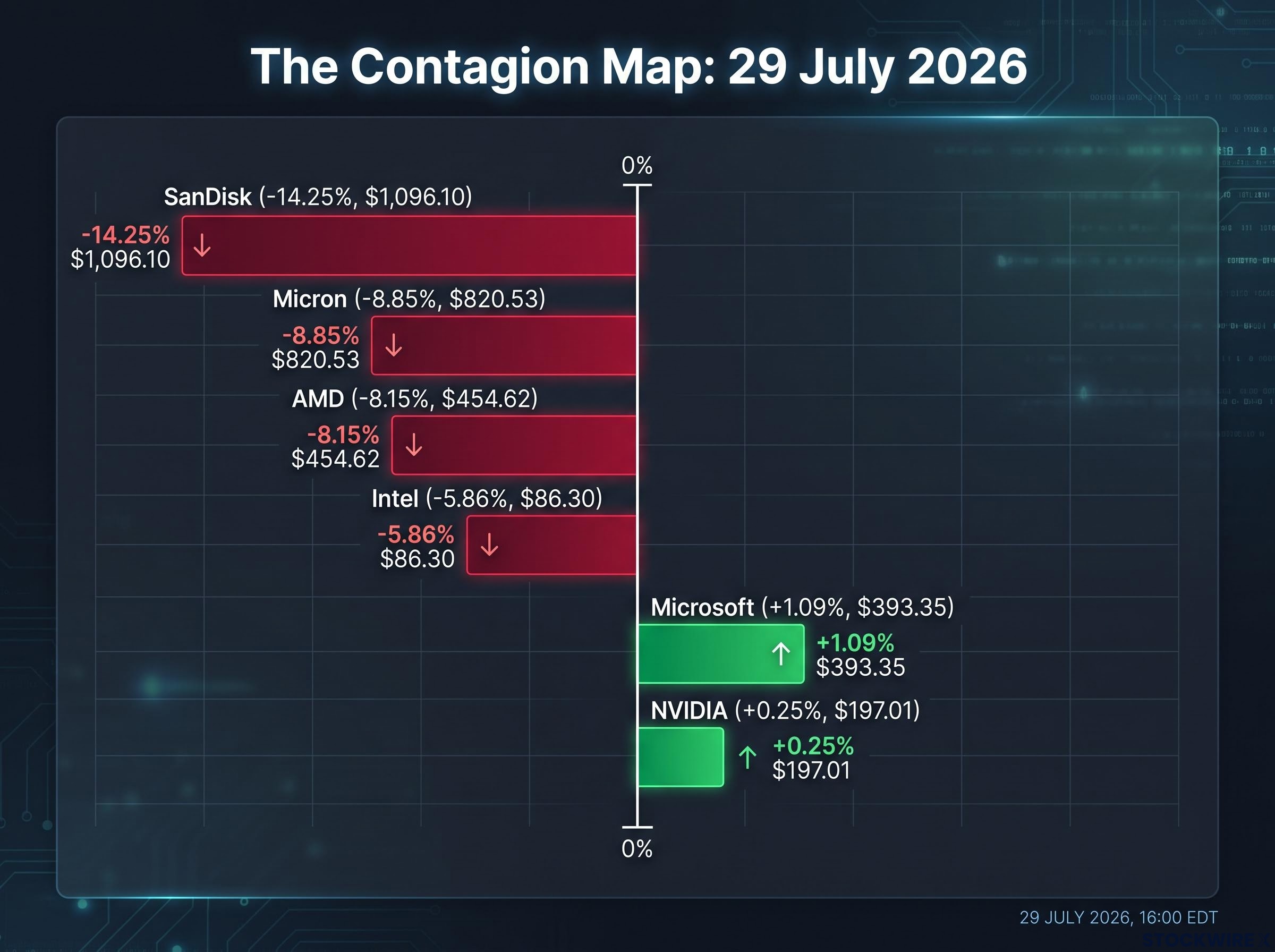
| Company | Price change | Closing price | Approx. volume |
|---|---|---|---|
| Micron (MU) | -8.85% | $820.53 | 61.04M shares |
| SanDisk (SNDK) | -14.25% | $1,096.10 | 26.63M shares |
| AMD | -8.15% | $454.62 | 36.32M shares |
| Intel (INTC) | -5.86% | $86.30 | 154.35M shares |
| NVIDIA (NVDA) | +0.25% | $197.01 | 134.11M shares |
| Microsoft (MSFT) | +1.09% | $393.35 | 32.37M shares |
SanDisk’s 14.25% decline was the sharpest among the contagion names, a severity that underscores how aggressively investors de-risk the memory and storage complex when a bellwether disappoints.
The mechanism is straightforward. Investors running AI-thematic baskets, sector ETFs, and momentum strategies de-risk the entire complex rather than re-underwriting each name individually. Quant and macro funds keyed to “AI exposure” or “semiconductors” as a factor trigger synchronised selling across disparate chip names when a single bellwether misses.
The synchronised moves across Micron, SanDisk, AMD, and Intel on 29 July reflect systematic selling mechanics that operate independently of any individual company’s fundamentals: quant and macro funds running AI-exposure or semiconductor factors de-risk entire baskets when a single bellwether misses, a dynamic Bank of America has modelled as capable of generating up to $134 billion in global equity outflows under a continued decline scenario.
Microsoft’s relative resilience, gaining 1.09%, likely reflected its upcoming earnings release that evening, which insulated it from the selling. NVIDIA’s stability reflected the platform-layer distinction discussed above.
The pattern tells you something precise: in a thematic selloff, diversifying across chip names is not genuine risk reduction, because they move as one when sentiment turns.
The capex-monetisation pressure that made this moment inevitable
SK Hynix’s selloff did not happen in isolation. It landed within a broader earnings-season reckoning over whether AI capital expenditure is producing returns.
Alphabet and Tesla had already raised Wall Street anxieties by reporting substantial AI infrastructure outlays whose contribution to near-term earnings remained unclear. Microsoft and Meta Platforms were due to publish results after the close on 29 July, under considerable pressure from investors to show concrete AI revenue gains. Apple and Amazon had their own reports pencilled in for later in the week.
The investor demand being articulated across all of these prints was specific: visible evidence of monetisation through rising utilisation, higher achieved pricing, or AI-linked revenue acceleration, rather than multi-year investment narratives taken on faith.
Why chipmakers face the harshest version of this test
Semiconductor manufacturers must commit massive, multi-year capital expenditure for fabs, equipment, and next-generation memory well before revenue is fully realised. They cannot pace spending to near-term demand signals the way software or platform businesses can.
SK Hynix’s ongoing HBM capacity expansion plans and rising capex were cited alongside the margin disappointment as the specific operational signals that concerned investors. The company was spending aggressively to build capacity for a future it was confident about, at a moment when the market demanded proof that each dollar spent was generating a visible, near-term return.
That structural feature means any hint of margin normalisation or demand softness lands harder on chip stocks than on the platform layer. For anyone holding AI-exposed names going into earnings, the question has changed: it is no longer whether the company is growing, but whether it can show that each dollar of AI capex is producing measurable returns now, not in a future cycle.
What the SK Hynix episode changes for investors in AI equities
The AI trade has transitioned from its first phase, narrative-driven multiple expansion, to its second phase: execution against demanding embedded assumptions. That transition requires a different toolkit from the one that worked in 2023 and 2024.
The central analytical decision every AI chip investor now faces after a sharp selloff is whether the repricing reflects an expectations failure or a fundamental one. The SK Hynix case was clearly the former: 257% revenue growth and 557% operating profit growth are not the numbers of a broken business. But a 5-6% consensus miss triggered a 9-10% closing decline and an intraday move of up to 20%. The asymmetry is the point.
The easy phase of the AI trade is over. The market is no longer rewarding the existence of AI exposure. It is grading execution against the specific path already priced into each stock.
The practical investor orientation from here involves five distinct elements:
- Track expectations, not just results. Monitor consensus estimates and, where available, buy-side whisper numbers. The operative question before any print is what the stock price already assumes.
- Recognise thematic correlation risk. Diversifying across chip names offers limited protection when the entire complex trades as a single basket during sentiment shocks.
- Differentiate component suppliers from platform players. NVIDIA’s resilience on 29 July was not luck. It reflected a structural distinction in business model that should inform position sizing.
- Scrutinise earnings quality. Separate core operating profit from non-operating investment gains before forming a view on any AI chip result. When half of pretax profit comes from non-operating sources, the headline record is weaker than it appears.
- Size for elevated volatility around prints. The precedent from earlier in July 2026, where a brokerage note projecting 8% below consensus triggered a 15% intraday decline, reinforces that this asymmetry is not new but appears to be intensifying.
The new standard AI chip stocks must clear, and what that means from here
The SK Hynix episode does not signal that AI demand has collapsed. Revenue growth of 257% and operating profit growth of 557% speak to genuine structural demand that remains intact. The absolute magnitude of these results would have been considered extraordinary at any prior point in the memory industry’s history.
What the episode does signal is that investors are no longer rewarding the existence of AI exposure. They are grading execution against the specific path already priced into each stock. The KOSPI’s 6% decline on a single supplier’s miss illustrates how a thematic re-rating can move an entire equity market.
The question the reader faces is whether a sharp drawdown on record results represents a broken thesis or an expectations reset. Three variables will help distinguish between them ahead of the next SK Hynix and Micron earnings prints:
- HBM contract pricing trends: whether new contracts reflect stable, rising, or compressing pricing for next-generation HBM.
- HBM shipment volume trajectory: whether volume growth is accelerating, plateauing, or falling short of the capacity being built.
- Earnings quality composition: whether non-operating gains continue to inflate headline net profit or whether core operating results close the gap.
The right response to a selloff like this is not to abandon the AI infrastructure thesis. It is to evaluate whether the repricing has corrected the expectations mismatch or simply created a new one at a lower price. That distinction, applied rigorously before each earnings print, is where the edge now sits.
For readers whose instinct after a 9-10% closing decline on record results is to exit the position entirely, our full explainer on panic selling in sharp selloffs examines why the highest-probability mistakes are made at the precise moment the case for selling feels most compelling.
This article is for informational purposes only and should not be considered financial advice. Investors should conduct their own research and consult with financial professionals before making investment decisions. Past performance does not guarantee future results. Financial projections are subject to market conditions and various risk factors.