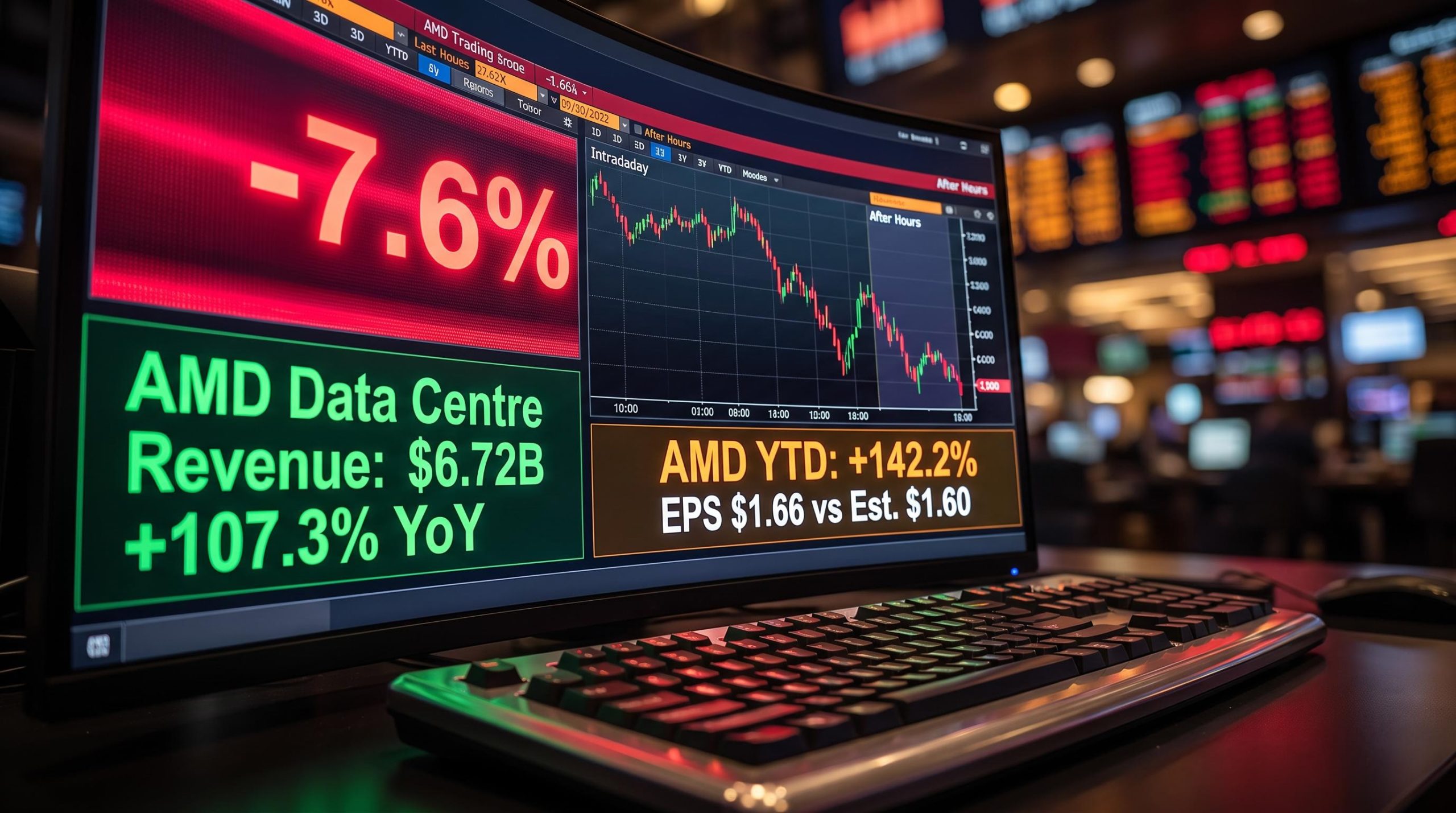
AMD reported adjusted earnings per share of $1.66 against a consensus estimate of $1.60, revenue of $11.54 billion against expectations of $11.25 billion, and triple-digit year-over-year growth in its data centre segment. Yet the stock dropped 7.6% in after-hours trading.
That contradiction is the reason most investors clicked on this article, and it is also the most useful thing about AMD stock after earnings. When a stock has already climbed 142% before an earnings print, the relationship between quarterly results and stock price reaction stops following the logic most retail investors rely on. Understanding why that disconnect happens changes how you read every high-momentum earnings event going forward.
Here is the framework for separating what AMD’s quarterly numbers say about its business from what the after-hours reaction says about how the stock was priced walking in.
What the numbers actually showed
Start with what AMD actually delivered, because the results themselves were strong by any reasonable measure.
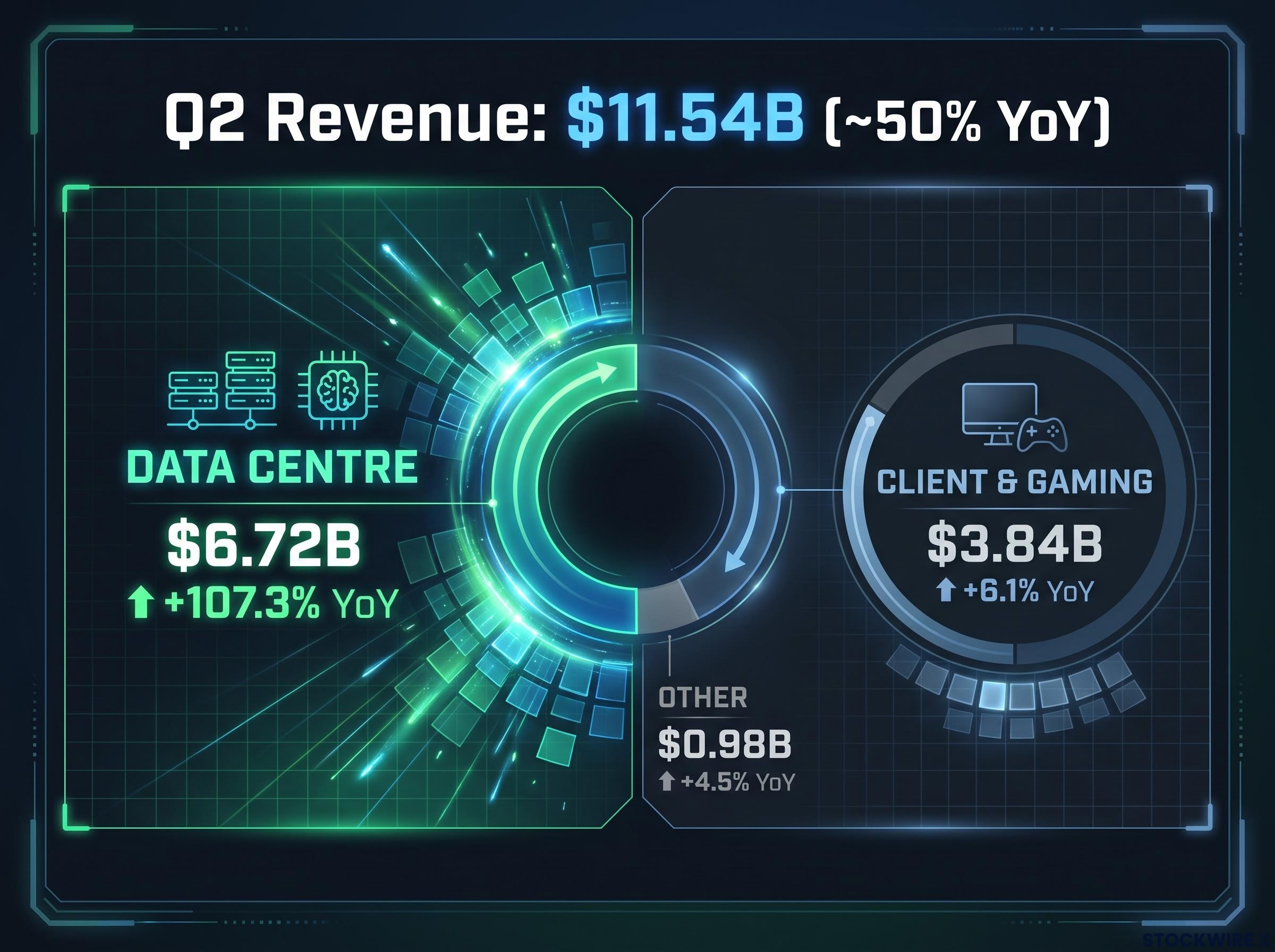
AMD beat the adjusted EPS consensus by $0.06 and topped the revenue estimate by roughly $290 million. Year-over-year revenue growth came in at approximately 50%, up from $7.69 billion in Q2 2025 to $11.54 billion in Q2 2026.
| Metric | Reported | Estimate | vs. Estimate | Year-over-Year Change |
|---|---|---|---|---|
| Adjusted EPS | $1.66 | $1.60 | Beat | — |
| Total Revenue | $11.54B | $11.25B | Beat | ~50% |
| Data Centre Revenue | $6.72B | — | — | +107.3% |
| Client & Gaming Revenue | $3.84B | — | — | +6.1% |
| Q3 2026 Revenue Guidance | ~$13.0B (±$300M) | $12.51B | Beat | ~41% YoY |
The data centre line is the one that matters most for the long-term thesis. At $6.72 billion with 107.3% year-over-year growth, AMD has fully doubled its data centre business inside 12 months.
$6.72 billion in data centre revenue, up 107.3% year over year. AMD’s strategic pivot from its consumer-focused heritage toward AI and cloud infrastructure is executing at scale.
The Client and Gaming segment’s 6.1% growth adds breadth. A recovering PC market is not the growth engine, but it means AMD’s revenue base is widening rather than narrowing. The headline beat figures are the entry point; the segment composition tells you where the real earnings power is concentrating.
When big ASX news breaks, our subscribers know first
Why the guidance story matters as much as the quarter itself
A beat on its own tells you the past quarter was strong. A beat-and-raise tells you management sees the momentum continuing. That distinction matters.
Forward guidance weighting is the mechanism that makes AMD’s Q3 target of approximately $13 billion more consequential than the Q2 EPS beat itself: institutional models price future earnings streams, so a guidance print above consensus can shift price faster than a historical quarter that merely confirms expectations.
AMD set its Q3 2026 revenue target at roughly $13.0 billion (plus or minus $300 million), clearing the analyst consensus of $12.51 billion by a meaningful margin. The sequential step up from $11.54 billion to approximately $13 billion works out to around 13% quarter-on-quarter expansion, with year-over-year growth for Q3 coming in at roughly 41%.
That gap between AMD’s own guidance and the consensus estimate tells you something specific: AMD is not simply executing on existing demand. It is signalling that demand acceleration is continuing into Q3, which is the kind of sequential momentum institutional models need to see to justify sustained valuation multiples.
The commercial pipeline behind those figures is named and specific:
- Anthropic: commitments totalling up to 2 gigawatts
- Meta Platforms: commitments totalling up to 6 gigawatts
- Core Scientific: commitments totalling up to 2.5 gigawatts
These commitments, disclosed at AMD’s July 2026 investor event, are not aspirational. They are the contracted demand backdrop that gives the guidance credibility.
The Helios ramp and what it adds to the H2 2026 picture
CEO Lisa Su pointed to the initial ramp of Helios, a new product line beginning in the second half of 2026. Helios supplements, rather than replaces, the existing EPYC server CPU and Instinct GPU portfolio. It functions as an incremental revenue catalyst layered on top of a product stack that is already growing at triple-digit rates in the data centre. For investors tracking the forward revenue curve, Helios is the line item that was not in the numbers yet.
How a 142% run-up changes the rules for reading earnings reactions
This is where the interpretation shifts. Everything above tells you the business is executing. Now consider what the stock had already done before a single Q2 number was reported.
Through 4 August 2026, AMD shares had advanced 142.2% on a year-to-date basis. Nvidia had returned roughly 13.6% across the same period, while the S&P 500 was up approximately 13%.
AMD’s year-to-date gain: +142.2%. Over the same period, Nvidia returned roughly 13.6% and the S&P 500 roughly 13%. The gap between those numbers is the entire context for the after-hours reaction.
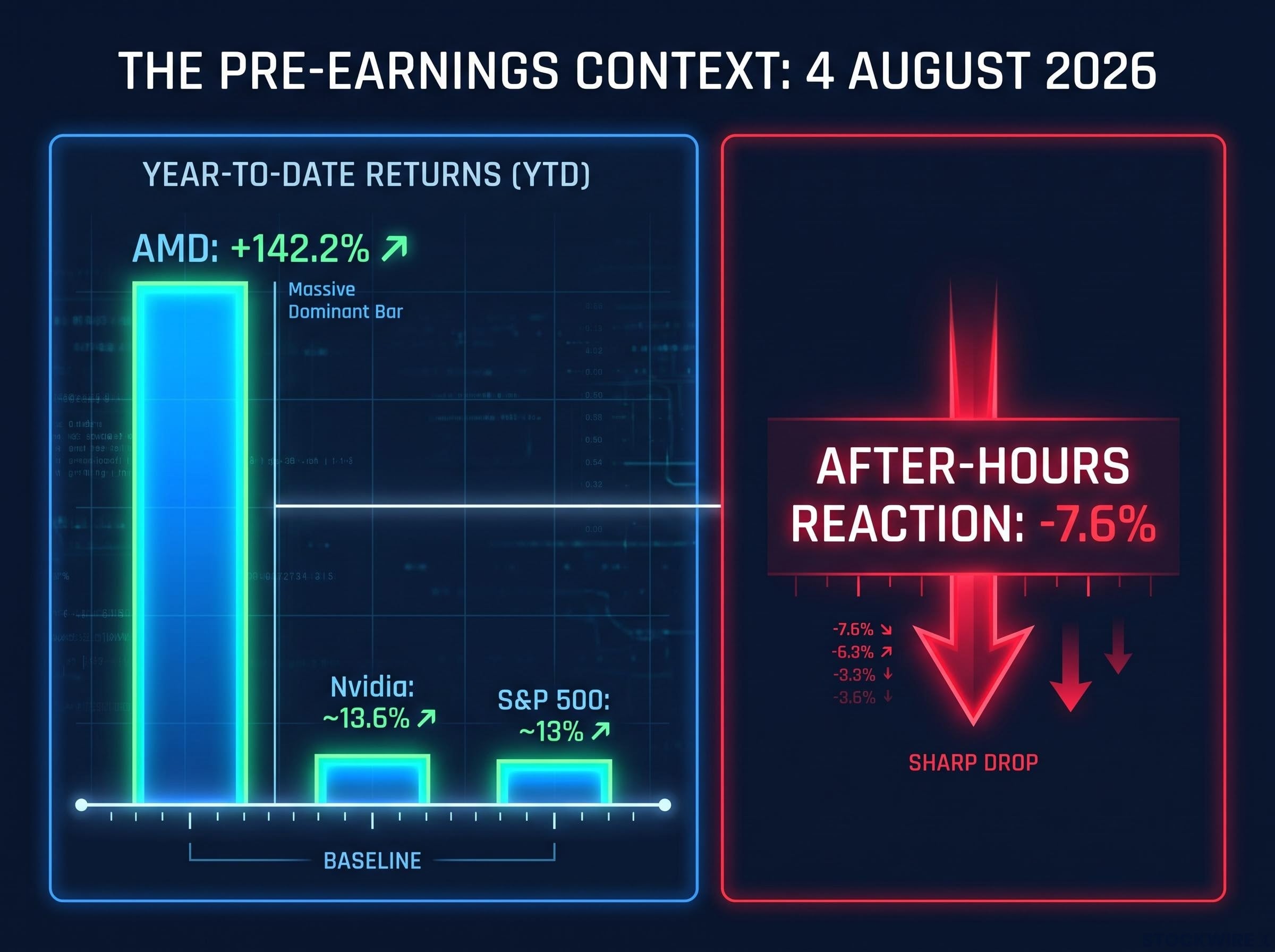
That performance gap is not a footnote. It is the single most important variable for interpreting what happened after hours. When a stock has already priced in a strong outcome over the course of a 142% run, the post-earnings question is not whether the company beat estimates. The question is whether results exceeded already-elevated expectations by enough to justify further multiple expansion.
AMD’s Q2 results were strong, but they were broadly consistent with what bullish investors had already been modelling: high double-digit data centre growth, strong EPYC and Instinct demand, and revenue in the low-teens billions over the next few quarters. That makes the report a confirmation rather than a new upside shock, and confirmations in high-momentum names tend not to unlock further price gains. The 142% run means AMD’s stock had already absorbed years of expected earnings growth before the Q2 numbers hit. Even a genuine beat can leave a stock with nowhere new to go when the expectations bar is set that high.
The contrast with AMD’s Q1 2026 Wall Street re-rating is instructive: in May, a 57% data centre revenue surge combined with a $700 million guidance beat produced an 18% after-hours gain, illustrating how the same business executing at a similar pace generates a different price reaction depending on what the market had already priced in.
The mechanics behind “buy the rumour, sell the news”
What played out in AMD’s after-hours session follows a recognisable sequence that repeats across high-anticipation stocks. Understanding the pattern makes it possible to interpret these moves without mistaking positioning behaviour for fundamental deterioration.
The sequence has three stages:
- Accumulation phase: Over weeks and months, investors bought AMD shares in anticipation of strong AI-driven results. July’s investor event, where Anthropic, Meta, and Core Scientific commitments were disclosed, accelerated the pre-earnings buying. Analyst previews highlighted expected data centre strength and upside to guidance. Capital flowed in before the numbers arrived.
- Earnings confirmation: The actual Q2 results landed and broadly matched the bullish thesis. Triple-digit data centre growth, EPS beat, revenue beat, guidance above consensus. The thesis was confirmed, not exceeded.
- Profit-taking release: Traders who had accumulated positions used the liquidity around the earnings event to take profits. The absence of a new upside surprise became a reason to reduce exposure rather than add more. The selling was driven by positioning, not by any deterioration in AMD’s business.
That is what a “buy the rumour, sell the news” event looks like from the inside. It is not a formula. It is a sequence of behaviour that recurs in stocks where the positive thesis is widely known before earnings are released.
Why after-hours moves are especially noisy
The 7.6% drop occurred in after-hours trading, where volume is a fraction of regular session volume. A relatively small number of large institutional orders can shift the price substantially in that environment. A cluster of funds deciding to trim a position at a stretched valuation can produce a high-single-digit move without the broader investor base changing its view on AMD’s long-term value.
The supply and demand mechanics behind the after-hours move are more concentrated than in regular session trading: thin volume amplifies the price impact of institutional order flow, meaning a cluster of funds trimming positions can push a stock down several percent without any change in the broader investor consensus.
This does not make the move meaningless. But it does mean the 7.6% figure likely overstates the degree to which broader sentiment shifted, and partial retracements during regular-session trading are common in these scenarios. For an investor watching in real time, the takeaway is to wait for regular-session price discovery before drawing firm conclusions.
Reading the fundamentals apart from the price action
The business and the stock are not the same instrument, and this quarter is a clean illustration of why separating the two matters.
AMD’s data centre transformation is a structural, multi-year story. $6.72 billion in data centre revenue and 107% year-over-year growth is a genuine business repositioning, not a one-time spike. At its July 2026 investor event, management revised its CPU server market size estimate upward to more than $200 billion by 2030, targeting a share of over 50% of that opportunity. If AMD executes against those targets over a two-to-three year horizon, the current earnings base is still early in its growth curve.
The signals from Q2 that support the long-term bull thesis are specific:
- Data centre revenue doubled year over year, confirming the AI infrastructure demand story
- Named customer commitments (Anthropic, Meta, Core Scientific) provide visibility into the demand pipeline
- The Helios product ramp adds an incremental growth catalyst in H2 2026
- The structural risk: AMD’s 142% year-to-date run has likely pulled forward several years of expected earnings growth, meaning execution risk is elevated because there is limited margin for disappointment
Strong business execution does not guarantee near-term price appreciation when valuation is stretched. For an investor with a two-to-three year horizon, the Q2 results added evidence in favour of the thesis. For a trader managing a position that is already up 142%, the risk/reward calculus looks different. Which time horizon you are operating on determines how you should read this quarter.
What this earnings reaction actually changes, and what it does not
The Q2 results confirmed the thesis. AMD’s data centre business is executing at scale. The AI infrastructure demand story is intact. The forward revenue trajectory, at approximately $13 billion for Q3, is stronger than consensus had modelled. None of that is in question after this earnings report.
What the after-hours drop does not resolve is the valuation question. Whether AMD at its current price adequately reflects the long-term opportunity, or whether 142% of year-to-date gains have already paid out the returns the market was expecting, remains genuinely open. The drop itself does not answer it.
- What Q2 confirmed: EPS beat, revenue beat, data centre at $6.72 billion and up 107%, Q3 guidance of approximately $13 billion above consensus. The business earned its reputation this quarter.
- What Q2 left open: Forward valuation and whether multiple expansion has run ahead of earnings power. The stock’s pre-earnings run means the bar for future positive reactions has been set high.
For investors wanting to assess whether AMD’s current price adequately reflects its forward earnings power, our dedicated guide to valuation metrics covers the P/E, free cash flow yield, and discounted cash flow tools used to distinguish a fairly priced growth stock from one where multiple expansion has already run ahead of fundamentals.
The investor’s decision point comes down to time horizon. A two-to-three year thesis around AMD’s AI earnings power received more supporting evidence on 4 August 2026. A near-term position already up 142% faces a different calculation than a new entry would. The question worth sitting with is whether the current price is compensated by the opportunity, or whether the run-up has already delivered the gains you were expecting.
This article is for informational purposes only and should not be considered financial advice. Investors should conduct their own research and consult with financial professionals before making investment decisions. Past performance does not guarantee future results. Financial projections are subject to market conditions and various risk factors.