A buyer spent roughly $23.5 million on Tesla call options on 27 October 2026, betting the stock climbs well above its current level by next April. Only weeks earlier, other Tesla call buyers got the direction right and still watched their contracts expire worthless. The difference between those outcomes comes down to two numbers: 171 days to expiry now, against 17 days then.
Tesla has rallied since Barclays upgraded the stock and Elon Musk confirmed that Tesla and SpaceX had formed committees to discuss a possible combination. In that kind of tape, a print this size gets read as a signal, often as proof that someone knows something.
That reading is where you can lose money. Copying a trade whose full structure you cannot see, or whose timing assumptions you do not share, turns someone else’s hedge into your directional bet.
Here is what this trade does and does not reveal, what the buyer needs to be right about, and how to judge the next large print that lights up your screen.
What did the $23.5 million Tesla trade actually involve?
Start with the ticket. Two near-identical blocks of roughly 2,150 contracts each hit the April 16, 2027 $390 calls about five minutes apart, the first at 9:31 a.m. ET. Each contract covers 100 shares, and all figures are in US dollars.
According to Bullflow, the first block filled at the ask for about $11.52 million, or $5,360 per contract ($53.60 per share). The second block, which swept the market, cost about $11.97 million.
| Detail | Block 1 | Block 2 |
|---|---|---|
| Contracts | About 2,150 | About 2,152 |
| Premium | About $11.52M | About $11.97M |
| Per-share price | About $53.60 | About $55.60 |
| Break-even | About $443.60 | About $445.60 |
The sources disagree on the total. Tasty Live’s Signal Versus Noise puts combined premium at about $23.49 million, while Bullflow-based reporting gives about $23.05 million, simply double the first block. The gap comes from the second block’s higher price.
The scale relative to existing positions stands out. Open interest, the number of contracts already outstanding, sat at about 216-222 at the $390 strike beforehand, making this trade roughly 20 times that figure. Tesla traded near $396-$400 at execution per the original source and closed at $407.46; one figure is intraday, the other the close.
What the print does not establish
The flow report does not say whether these blocks opened new positions, closed old ones, or formed one leg of a spread or hedge. The tiny prior open interest makes fresh positioning plausible, but you should treat it as unconfirmed until next-day open interest posts. That figure is the confirming evidence; the headline is not.
Volume measures activity, while exposure created only shows up in next-day open interest at the same strike; a rise of roughly the contracts traded suggests new positions, though even then the buyer’s direction stays unknown.
When big ASX news breaks, our subscribers know first
Why did earlier Tesla calls expire worthless before the rally?
Those confirmed facts matter more when you look at what happened to the last round of bullish bets. Roughly $16 million in calls had been positioned around the Roadster event, the earnings report and the prospect of a SpaceX tie-up. Held to expiry, all four positions would have finished with no value.
The thesis was not the problem. Each catalyst eventually arrived, or at least moved. The calendar simply ran out first.
- October $390 call: Break-even of $401.95. Tesla closed at $372.22 at expiry on the Friday before 27 October, then rallied through the strike by Monday.
- $385 call (expired 16 October): Break-even of $393.36. Five days later, Tesla traded at $393.93 after hours, above break-even and useless to the holder.
- Separate illustration, $387.50 call (expired 7 October): Not one of the main trades, but it fell about 97.5% to $0.01 while out of the money.
The gap that mattered Tesla closed at $372.22 against a $401.95 break-even. Days later, the stock was through the strike.
An options-activity report also recorded unusually large Tesla options volume on 16 October, a reminder that heavy flow and a profitable outcome are separate things.
The earlier trade had 17 days to work. For a call buyer, being right about direction is only half the job. The expiry date decides whether the thesis gets paid, which is exactly the problem the April structure tries to solve.
How do break-evens, open interest and time decay shape a long-dated call?
Extra time solves one problem and leaves another untouched: the price the stock still has to reach.
Break-even and the move required
A call’s break-even at expiry is the strike plus the premium paid. Here that means $390 plus roughly $53.60-$55.60, landing at $443.60-$445.60. From the execution level, Tesla needs to rise roughly 11-12% by 16 April 2027 for the buyer simply to recover the premium.
Barclays’ $450 target sits only about $6-$7 above those break-evens. If the most bullish recent call on the Street proves exactly right, the position makes a modest profit at expiry, not a windfall.
Those levels apply at expiration only. Before then, the contracts can show a paper gain at lower prices if the stock moves quickly or volatility rises.
Open interest and time decay
Open interest tells you how many contracts remain open after each session. If next-day open interest rises by roughly the size of the trade, new positions likely stayed on; a drop suggests closing.
Two other forces shape value. Longbridge’s education material describes theta as value lost as time passes, and implied volatility as the market’s estimate of expected movement.
| Factor | Long-dated call | Short-dated call |
|---|---|---|
| Time decay | Slower at first; accelerates near expiry | Fast, especially in the final weeks and days |
| Implied volatility | Large part of premium; a drop can cut value even if the stock rises | Sensitive to event volatility and post-event collapse |
| Break-even | Larger move needed because of purchased time value | Lower premium, but the move must come quickly |
| Timing | Thesis can be right and still show interim losses | Thesis must work before theta consumes the premium |
| Event exposure | More time to survive delays | Catalyst may arrive after expiration |
The 171-day window gives robotaxi news, another earnings report and merger developments time to arrive. It does not lower the bar. Long-dated buys patience, not safety.
Do the Barclays upgrade and SpaceX talks justify the $390 strike?
That bar lines up neatly with the news. On 26 October, Barclays analyst Dan Levy upgraded Tesla from Equal Weight to Overweight and lifted his target from $370 to $450, according to CNBC. He cited sharply inflecting robotaxi miles, an expected return to auto growth after two years of declines, strong energy demand and rising Shanghai exports, alongside a possible SpaceX deal premium.
The auto growth thesis rests on a recovery from two years of declines, and Tesla’s Q2 deliveries of 480,126 vehicles ended that run, though about 28,000 units came from inventory drawdown, so margins remain the open question.
Six days earlier, Musk confirmed the two companies had formed independent committees to discuss a combination, telling Reuters a merger would be “a good idea.” Tesla added about 3.4%, and SpaceX shares rose about 8% in extended trading.
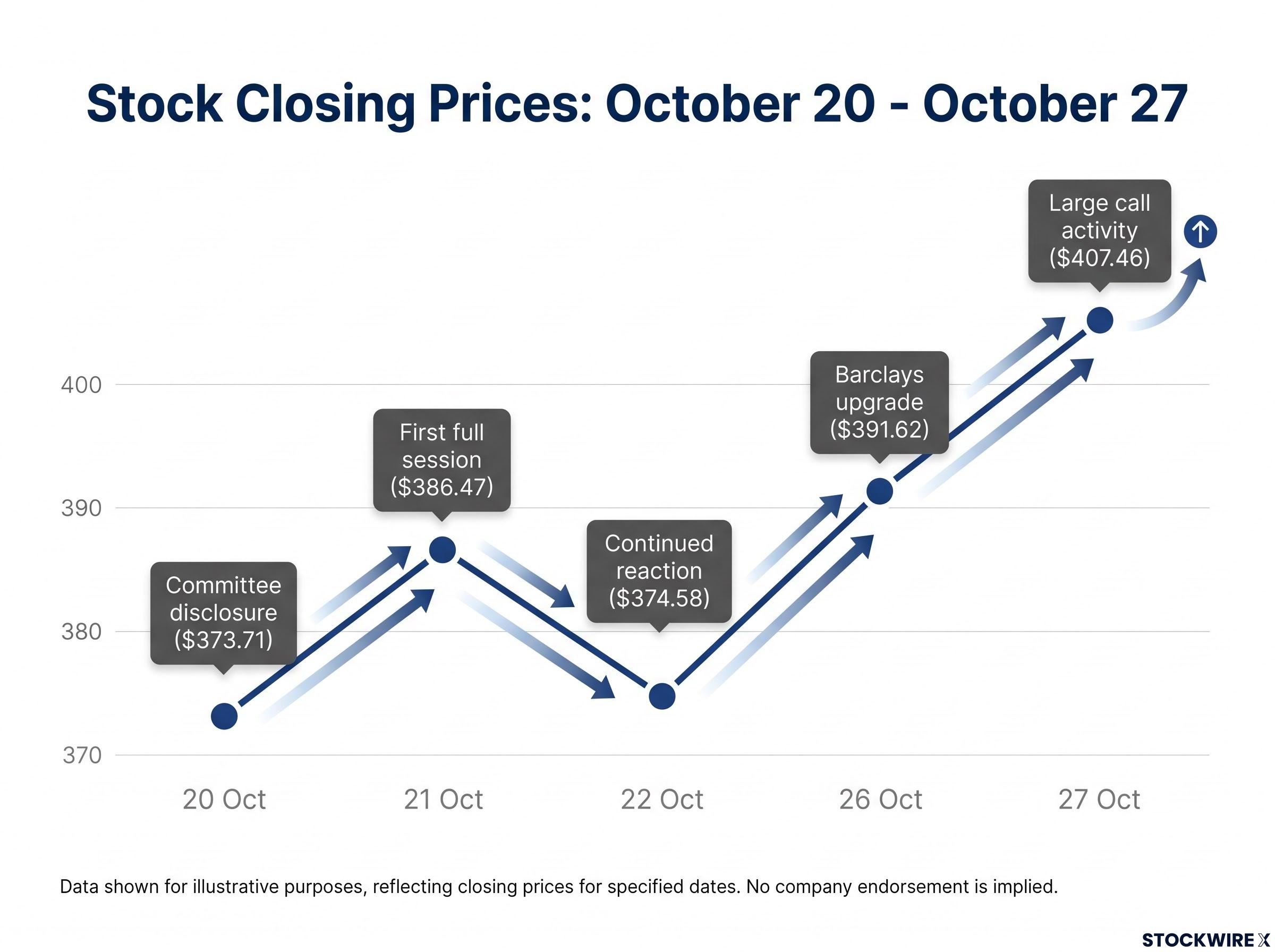
| Date | Context | TSLA close |
|---|---|---|
| 20 Oct | Committee disclosure | $373.71 |
| 21 Oct | First full session after disclosure | $386.47 |
| 22 Oct | Continued reaction | $374.58 |
| 26 Oct | Barclays upgrade (about 5.2% gain) | $391.62 |
| 27 Oct | Large call activity | $407.46 |
The fit is tidy. It is not proof. As of 29 October, no merger agreement, exchange ratio or shareholder vote had been confirmed, and Reuters reported the deal would need substantial shareholder approval.
Musk is CEO of both companies and holds significant stakes in each, making him a conflicted party in any negotiation. Commentary circulating about specific analyst deal-price estimates and Tesla’s valuation has not been independently confirmed, so treat it with caution.
| Bull case | Bear case |
|---|---|
| Barclays expects auto growth to resume after two years of declines | No agreed merger terms or exchange ratio |
| Robotaxi miles have inflected sharply, per Barclays | Shareholder approval hurdles |
| Strong energy demand and rising Shanghai exports | Governance conflicts, with Musk leading both companies |
| A SpaceX deal could deliver a premium to Tesla holders | Valuation and execution concerns raised by critics remain unverified but unresolved |
The catalysts explain why someone might favour this strike. Linking them to this buyer’s intent is inference, and the stock has already absorbed much of the good news.
How should you read large options-flow signals without over-reading them?
If news can rationalise a trade after the fact, the flow itself needs a stricter test. Each label on a flow screen means less than it seems.
A fill at the ask is consistent with aggressive buying but does not prove bullishness. A sweep splits an order across exchanges for speed; that urgency can reflect hedging or a multi-leg strategy. A block is a large negotiated print, and SomerQuant notes its direction is ambiguous without context.
The $23 million headline could be gross premium on one leg, with premium collected elsewhere in a spread. It could hedge short stock or other exposure. Headline premium is not directional risk.
Alerts on unusual options activity confirm that abnormal volume hit a strike; they do not show whether the trade was a directional bet, a portfolio hedge or one leg of a multi-leg structure, so context has to come from elsewhere.
Trade-Ideas cautions that high volume without a next-day rise in open interest can signal a day trade, offsetting trade or spread. Proflex Finance stresses that next-day open interest is the better evidence of whether positions stayed open.
The principle Options flow is descriptive, not predictive. It shows capital moved, not that the buyer knows the outcome.
Before acting on any large print, run this check:
- Did next-day open interest rise by roughly the trade size?
- Was there activity at related strikes or expirations?
- Did stock volume spike alongside it?
- How did implied volatility move?
- Is there a visible paired stock or options trade?
Options markets are overseen by the SEC, FINRA and the Options Clearing Corporation (OCC), but none of that oversight tells you a trader’s intent. Treat flow as one input, never a trade signal on its own.
What this trade tells you, and what it cannot
The April structure fixes the problem that sank the October trades: it gives the thesis time. What it does not do is shrink the hurdle. Tesla still needs to finish above roughly $443.60-$445.60 by 16 April 2027 for the buyer to profit at expiry.
Three things will sharpen the picture. Next-day open interest at the $390 strike will show whether the position stayed open. Committee updates on terms will reveal whether the merger catalyst is real or stalled. Tesla’s next earnings report will test the auto and robotaxi claims behind the Barclays upgrade.
Your call is whether you share the thesis on your own evidence, not whether someone else spent big.
This article is for informational purposes only and should not be considered financial advice. Investors should conduct their own research and consult with financial professionals before making investment decisions. Past performance does not guarantee future results, and forward-looking statements are speculative and subject to change.