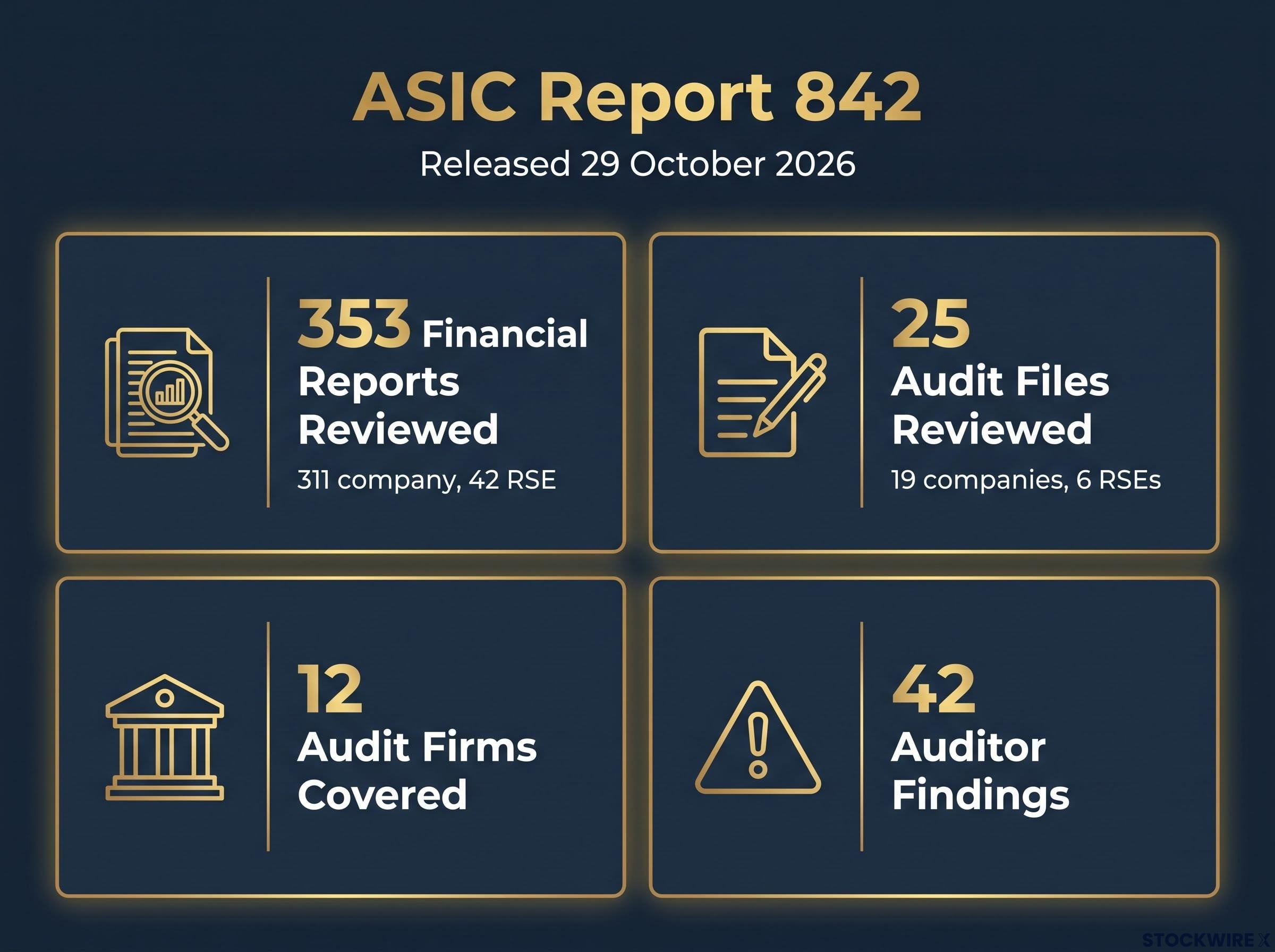
ASIC has named large audit firms alongside 42 auditor findings from 25 audit files in Report 842, released today, 29 October 2026. The latest round of ASIC audit surveillance found that some auditors did not adequately challenge the judgements behind revenue, impairment and asset values. Those three lines often decide reported profit and balance sheet strength.
The regulator widened its review this year to 353 financial reports and 25 audit files, up from 15 files in 2024-25. Commissioner Kate O’Rourke said report preparers and auditors still fall short of basic standards.
An audit gives reasonable, not absolute, assurance. Report 842 shows where that assurance is thinnest.
Here is what the findings tell you about which numbers in a set of accounts deserve more caution, and which signals to check before you rely on them.
What did ASIC find, and which numbers are most exposed?
The core finding is simple. Auditors did not adequately challenge management assumptions or gather enough supporting evidence on revenue recognition, impairment and asset valuations.
The weakness sits in estimates, not arithmetic. Impairment is a write-down taken when an asset is judged to be worth less than its recorded value. That figure depends on forecasts of growth, margins and discount rates, all supplied by management. When the auditor accepts those inputs without pushing back, the reported number reflects the company’s own view of itself.
Impairment charge corrections show how this weakness plays out in practice: ASIC’s surveillance has previously forced a listed company to book an additional $25 million after finding its cash-generating unit methodology breached accounting standards.
Auditors also failed to document compliance with ethics, independence and quality management requirements.
| Item | Finding |
|---|---|
| Financial reports reviewed | 353 (311 company, 42 RSE) |
| Company financial reporting surveillances | 30 |
| Audit files reviewed | 25 (19 companies, 6 RSEs), up from 15 in 2024-25 |
| Audit firms covered by files | 12 |
| Auditor comment forms | 15, containing 42 findings |
The files reviewed covered 12 firms, although the original summary reports the comment forms going to auditors at 11 firms.
Super funds, known as registrable superannuation entities (RSEs), were covered separately in Report 841 on 14 October 2026. In some cases auditors did not adequately test the prices, methods, assumptions or data that external managers supplied for unlisted investments.
What ASIC’s Commissioner expects Kate O’Rourke said auditors should be independent, gather stronger evidence, question management assumptions and record their conclusions.
For you, the message is that a clean audit opinion does not by itself confirm that profit, impairment and asset value figures were tested hard.
When big ASX news breaks, our subscribers know first
Do the findings prove audits are failing across the board?
Forty-two findings from 25 files sounds alarming. The sample design matters, though.
ASIC selects files through a mix of risk-based targeting and random choice. That means the findings show serious weaknesses in selected audits, not a measured failure rate across the market.
- ASIC: recurring weaknesses in judgement-heavy areas require auditors to test assumptions and challenge management.
- ANAO and CPA Australia: the small, mostly risk-targeted sample cannot support industry-wide conclusions.
- AICD: evidence does not show systemic decline, though it backs stronger surveillance and some non-audit service limits.
The Australian National Audit Office (ANAO) also found ASIC lacked mechanisms to show whether quality improvements stemmed from its own interventions. CPA Australia has pointed to limited scope and potentially biased sampling. The Australian Institute of Company Directors (AICD) has taken the most reassuring line.
Both readings hold. The problem is systemic as a regulatory risk, because the same weaknesses in scepticism, evidence, valuation and independence keep recurring. It is not proven as a statistical claim about every audit. No comment on Report 842 from super fund or investor representative groups was located.
What an audit opinion cannot promise
- Reasonable assurance, not absolute assurance
- Materiality thresholds mean some errors may go undetected
- Estimates can be reasonable at the time yet wrong in hindsight
- Fraud involving collusion or management override is hard to detect
- No guarantee of solvency or future performance
Treat the report as a prompt to look harder at specific accounts, not a reason to distrust every audited report or to dismiss the warning.
Who has been named, and what has ASIC done about it?
Naming firms marks a shift from commentary to consequences. The six largest firms, BDO, Deloitte, EY, Grant Thornton, KPMG and PwC, have been put on notice.
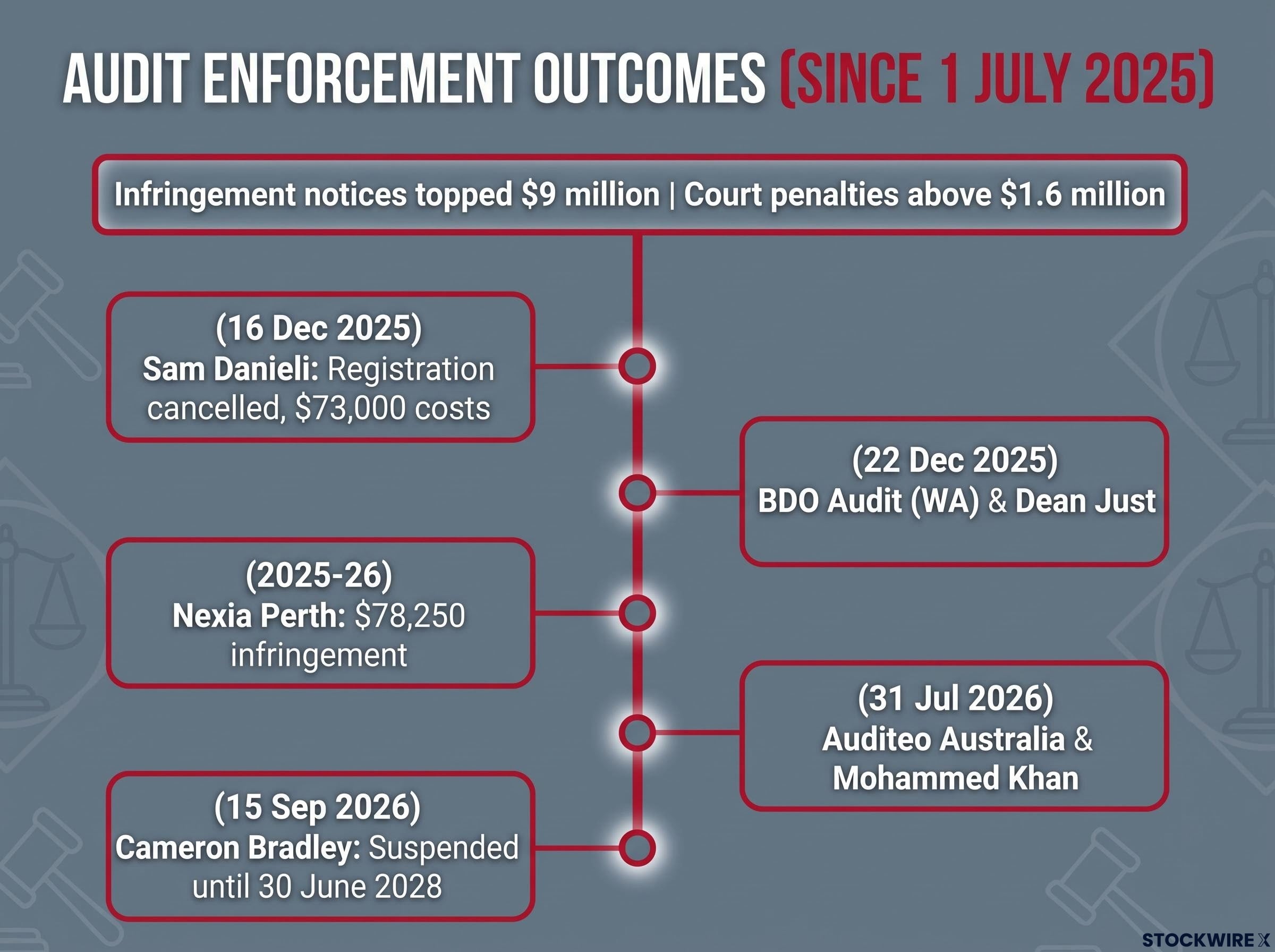
Enforcement since 1 July 2025 includes Federal Court proceedings against three auditors and two related audit companies. The Company Auditor Disciplinary Board (CADB) delivered two cancellations and one suspension, and three auditors voluntarily cancelled their registrations. Infringement notices for late financial reports topped $9 million, with court penalties above $1.6 million.
| Date | Auditor or firm | Outcome |
|---|---|---|
| 22 December 2025 | BDO Audit (WA) and Dean Just | First civil-penalty case against an authorised audit company, over Dubber audits; unresolved |
| 31 July 2026 | Auditeo Australia and Mohammed Khan | Federal Court proceedings over First Guardian Master Fund audits; unresolved |
| 15 September 2026 | Cameron Bradley | Suspended until 30 June 2028; costs of $93,589 |
| 16 December 2025 | Sam Danieli | Registration cancelled over 10 ASX-listed audits; costs of $73,000 |
| 2025-26 | Nexia Perth | $78,250 infringement notice on prohibited services |
Company accounts have shifted too. Ten companies improved disclosure of material business risks, while others changed asset recognition, deferred tax assets and employee benefit provisions.
Deferred tax asset reversals illustrate the stakes for balance sheets: ASIC’s surveillance has previously forced one ASX-listed company to remove about 31% of its reported total assets after its recognition of tax losses lacked sufficient evidence.
Each named case involved an audit opinion that did not prevent later allegations or findings of inadequate evidence or scepticism. A past clean opinion is not a substitute for your own checks.
Independence plans at the six largest firms
The six firms must self-assess and prepare action plans addressing Report 817 on independence, released 7 October 2025. O’Rourke said firms must show their plans deliver meaningful, lasting improvement. The status of each firm’s plan was not located.
What should you check in the accounts, and what does ASIC plan for 2026-27?
The findings translate into six checks for the next annual report you open.
- Key audit matters: does the auditor flag revenue, impairment, valuation or going concern?
- Impairment headroom: would a small assumption change wipe it out?
- Revenue: watch for unusual sales bunched at period end.
- Valuations: look for stale comparables and unobservable inputs.
- Going concern and cash: is operating cash flow negative despite reported profits?
- Independence and corrections: check audit tenure, non-audit services, restatements and auditor resignations.
Going concern means the assumption that a company can keep operating and paying its debts for the foreseeable future. ASIC’s RG 34 treats some going-concern reporting failures as significant contraventions that must be reported. Australian Auditing and Assurance Standards Board (AUASB) research shows professional investors rate going-concern judgements highly, with a 72.1% figure for that item.
ASIC’s 2026-27 programme expands the scope:
- Review 25 audit files, selected on material correction concerns, audit-quality risk information and random selection
- Include managed investment schemes for the first time
- Keep focus on impairment, goodwill, revenue, provisions, financial instruments, going concern and RSE investment valuation
- Monitor and report on firms’ remedial actions
ASIC’s financial reporting priorities for the coming year place revenue recognition, impairment and financial instrument measurement at the centre of surveillance, the accounting areas most exposed to management bias and the same ones Report 842 flagged.
Expect more findings to follow. This is general information, not personal financial advice.
What Report 842 changes for investors, and what it does not
Report 842 sharpens where to look. It does not show every audit is flawed, and it does not replace your own analysis.
The items worth tracking are the outcomes of the BDO/Dubber and Auditeo/First Guardian proceedings, the six firms’ independence plans and ASIC’s 2026-27 report on remedial actions.
The practical decision is how much weight to give an unmodified opinion when judgement-heavy numbers drive a company’s valuation. Audit gives reasonable, not absolute, assurance, so you should seek professional advice where it matters.
This article is for informational purposes only and should not be considered financial advice. Investors should conduct their own research and consult with financial professionals before making investment decisions.