
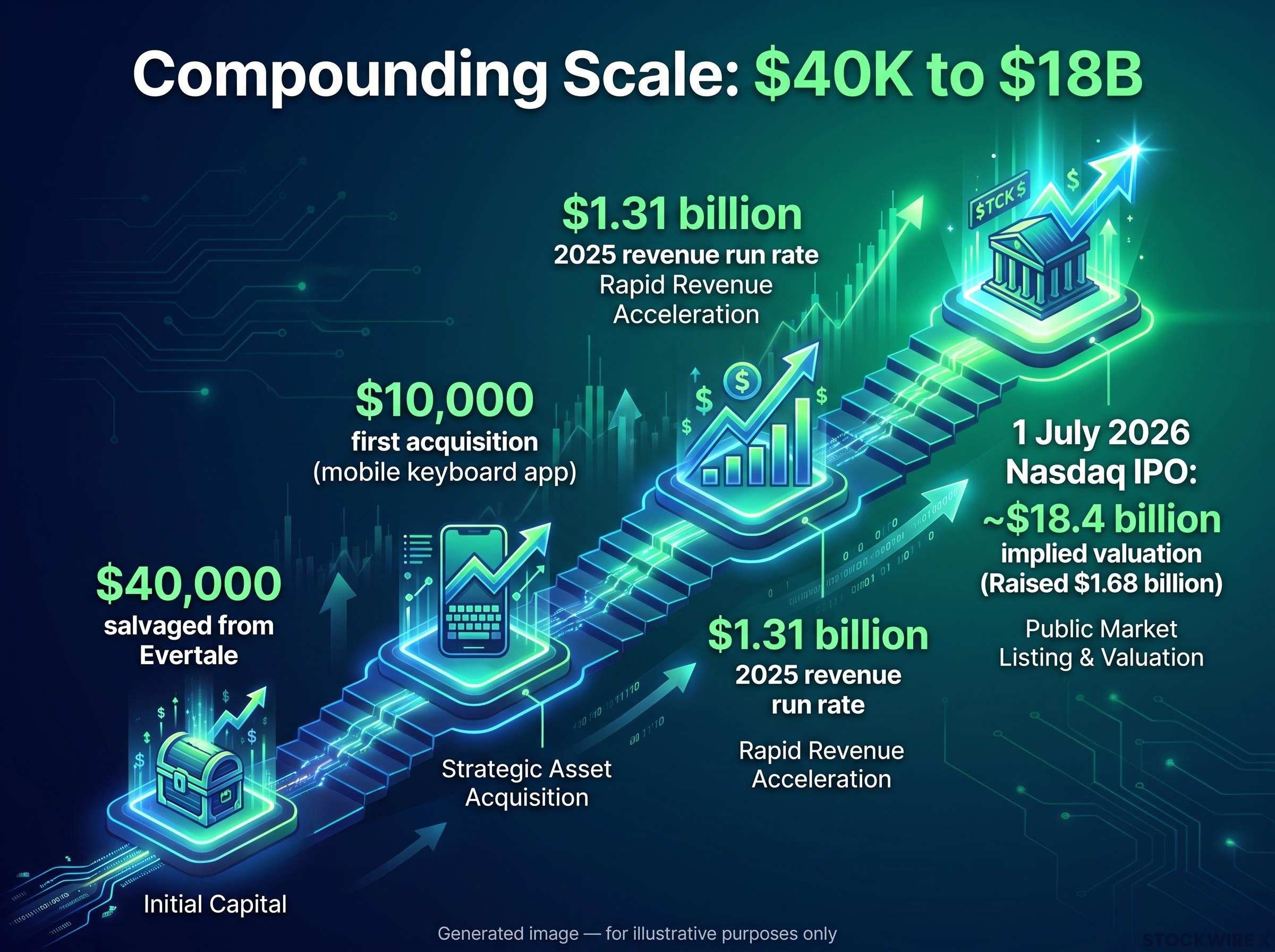
Bending Spoons started with roughly $40,000 salvaged from a failed AI company. It is now worth roughly $18 billion, and it has never built a product from scratch.
In a sector that rewards founders who move fast and break things, this company built its logic on the opposite premise: that proven products already exist in abundance, that building new ones is statistically wasteful, and that the real edge sits in acquiring, operating, and compounding what others have already made work. The firm listed on the Nasdaq on 1 July 2026, and within ten weeks it had signed agreements to buy both Airtable and Miro at a combined enterprise value above $2.6 billion, each at discounts of 80-90% below their prior peak valuations.
What comes next lays out how the acquisition strategy actually works, why the current software valuation environment makes it unusually powerful right now, and where the structural limits become visible as deal size grows. This is not a company growing by building. Understanding what it is doing instead matters for anyone watching how the next wave of software consolidation unfolds.
From $40,000 to $18 billion: the model Bending Spoons built
The most instructive number in the whole story is the first one. When the co-founders’ earlier venture, a journaling app called Evertale, folded after roughly three years, its venture backers handed over their equity for a token sum rather than pay for a formal wind-down. That left the team with about $40,000.
They did not treat it as a consolation prize. They treated it as seed capital for a completely different kind of company, one built to compound without needing to raise fresh money at every step.
The founding sequence reads as a single line of causation:
- An AI company (Evertale) launches around 2010 and collapses after roughly three years
- Roughly $40,000 is salvaged when investors relinquish their stake for a nominal amount
- That same $40,000 funds the first acquisition, a mobile keyboard customisation app for iPhone bought from a single developer for about $10,000
- The playbook is repeated at progressively larger scale
The logic behind the pivot came from an honest self-assessment. According to CEO Luca Ferrari, the team concluded their genuine strengths were in engineering, design, monetisation, and marketing, and not in the far harder discipline of finding product-market fit from a blank page.
“The competency was never in inventing demand. It was in engineering, design, monetisation, and marketing. Product-market fit is what we buy; the rest is what we bring.” (Ferrari’s framing, paraphrased from his description of the model’s core competencies.)
That distinction is why the first $10,000 app matters as more than a founding anecdote. It was the model in miniature: acquire something that already worked, apply a repeatable operating layer, and grow the revenue. Every deal since has been the same shape at a larger denomination.
By 2025, the annual revenue run rate had reached $1.31 billion. When the company priced its Nasdaq IPO at $29 per share on 1 July 2026, above its marketed range, it raised $1.68 billion at an implied valuation of about $18.4 billion. By Reuters’ coverage on 4 August 2026, the share price had reached $36.22.
IPO valuation construction sets the ceiling for post-listing returns independently of business quality; a company priced at a premium to peers inherits near-zero tolerance for execution variance, meaning the gap between Bending Spoons’ $29 offering price and the $36.22 price recorded by Reuters on 4 August 2026 may reflect early demand rather than a durable re-rating.
Here is the read for you. The $40,000 origin is not a rags-to-riches flourish; it signals that the model was designed to compound on internal cash flow rather than external funding rounds. That is precisely what made the 2026 listing a milestone rather than a rescue.
What Bending Spoons actually looks for
The screening process is structured rather than opportunistic. Targets are filtered on size, earnings predictability, and significant value-creation potential across three dimensions: technology, product, and monetisation.
The company favours mature businesses, typically ones that have operated for ten to twenty years or more, with established brands and loyal user bases. It deliberately limits building products from scratch, citing the low historical success rate of new launches at scale, and instead adds incremental features inside brands it already owns.
One number frames the upside it is still chasing. Ferrari has said cross-portfolio synergies, the value created by connecting customers across different products, have contributed only about 3% of value creation historically, with the expectation that this share grows as the portfolio scales toward enterprise software.
When big ASX news breaks, our subscribers know first
Why this is not private equity, and why the distinction matters
Any sophisticated reader has already arrived at the obvious question: is this just private equity with a better story? Buy undervalued assets, run them harder, sell them on. The comparison is fair to raise, and it falls apart on inspection.
Ferrari’s argument for why PE firms cannot copy the model is structural, not rhetorical. A private equity owner keeps each acquired company as a separate entity because it needs to sell that entity later, cleanly and whole. That requirement rules out the very thing Bending Spoons relies on: centralised engineering teams, shared growth infrastructure, and common data platforms running across every product it owns.
“Private equity has to keep the businesses separable because the plan is always to sell them. That prevents shared engineering, shared infrastructure, shared data. Our plan is to keep them.” (Ferrari’s PE-differentiation argument, paraphrased.)
The other difference is time horizon. Bending Spoons states it intends to hold permanently, which changes what “improvement” means: not a two-to-five-year uplift dressed for resale, but a product folded into a shared operating machine indefinitely.
The comparison that fits better is a conglomerate one. Earlier profiles have likened the company to Berkshire Hathaway or Danaher, and the analogy holds on acquisition-led growth and operational discipline. Where it strains is durability: software, and collaboration software in particular, faces faster disruption cycles than insurance or industrial machinery.
| Dimension | Bending Spoons | Traditional PE |
|---|---|---|
| Holding period | Permanent, by stated intent | Typically 3-7 years to exit |
| Shared infrastructure | Centralised engineering, data, growth platforms | Kept separate to preserve saleability |
| Integration depth | Fully absorbed into one operating platform | Standalone with financial oversight |
| Exit orientation | None; hold and compound | Resale or IPO is the goal |
| Value creation | Operating and monetisation uplift | Financial engineering plus operational |
The clearest evidence of the operating layer in action is Evernote, the long-standing note-taking app Bending Spoons bought well before the IPO. Under new ownership it saw new subscription tiers and price increases, stricter limits on free usage, and significant staff reductions, with a mixed reception: some long-time users criticised the higher prices and removed features, while others noted better stability. Remini, the AI photo-enhancement app, showed the same pattern through intensified growth marketing and rapid feature iteration built on shared engineering.
That history tells you roughly what to expect at Airtable and Miro: aggressive monetisation, headcount consolidation, and tighter feature gating, with user reception treated as a secondary consideration to revenue.
The SaaS discount window: Airtable, Miro, and the market Bending Spoons is betting on
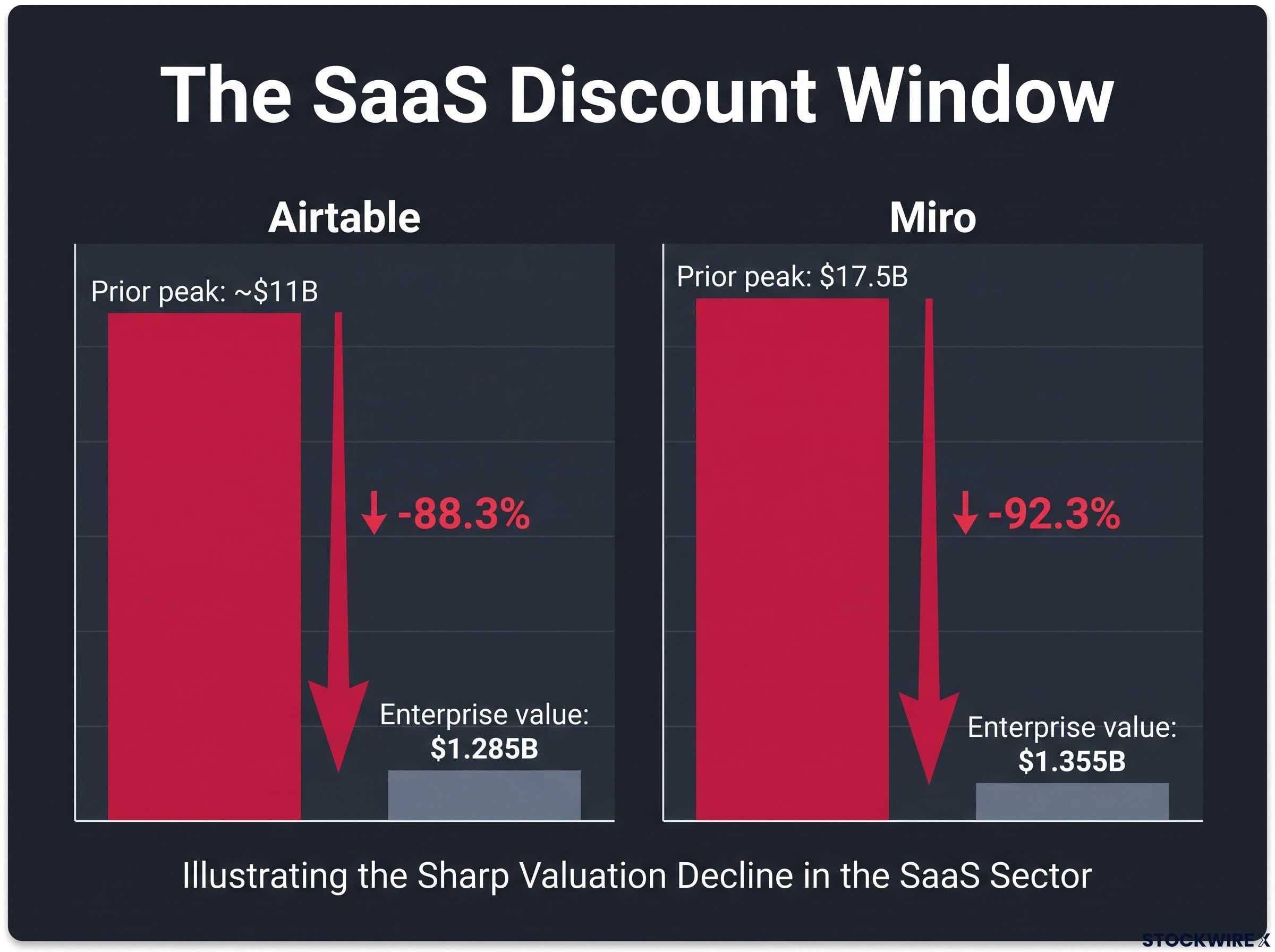
Start with the scale of the collapses, because it is genuinely striking. Airtable, once valued at roughly $11 billion, was acquired for a $1.285 billion enterprise value. Miro, valued at $17.5 billion at its late-2021 peak, was acquired for a $1.355 billion enterprise value, around 90% below where it once stood.
These are not fire-sale consumer apps. They are multi-billion-dollar global collaboration platforms bought at prices that would have been unthinkable three years earlier.
The pricing environment Bending Spoons is exploiting has a specific structural cause: SaaS valuation compression driven by AI disruption fears has pushed large-cap multiples to roughly 9.5x EV/Sales, a full standard deviation below historical norms, even as Q1 2026 sector revenue growth hit 17% year-on-year, the strongest reading in over three years.
| Company | Enterprise value | Implied equity value | Prior peak valuation | Discount from peak |
|---|---|---|---|---|
| Airtable | $1.285B (all-cash) | ~$2.25B | ~$11B | ~$9B discount (Fortune) |
| Miro | $1.355B (all-cash) | ~$1.79B | $17.5B | ~90% below peak |
The Airtable deal was announced on 4 August 2026 and closed on 4 September 2026. The Miro agreement was signed on 10 September 2026 and, as of now, has not yet been reported as closed.
One detail in the Miro deal is worth pausing on. Certain Miro shareholders agreed to reinvest $295 million of their proceeds into newly issued Bending Spoons equity, choosing a stake in the acquirer over cash. That is a form of market validation: sellers betting that the operating platform is worth more than the money on the table.
“Buys Miro at 90% discount as SaaS unicorns sell for scraps.” (Forbes headline, 10 September 2026.)
Here is what the timing tells you. Bending Spoons deployed roughly $2.64 billion in combined enterprise value across two deals within ten weeks of raising $1.68 billion. It treated the IPO proceeds not as a growth reserve but as immediate acquisition firepower, aimed squarely at a repricing window it believes it can exploit.
What AI disruption is doing to SaaS valuations
The window exists because of a specific pressure. According to SiliconRepublic, the valuation collapses form part of a broader “downward trend attributed to the major AI-led disruption in the SaaS sector in recent years.”
The mechanism is straightforward. AI-native tools are compressing the perceived future value of established collaboration categories, so the market has marked down the growth stories of products like Airtable and Miro even where the products themselves remain widely used.
That gap is the whole thesis. Bending Spoons is implicitly betting that these platforms retain durable user bases even as their growth narratives have collapsed, and that the real opportunity is monetisation rather than growth. Whether that bet distinguishes it as a smart operator or an opportunist exploiting a temporary dislocation depends entirely on how long the discount window stays open.
Where the model faces its hardest test
The most useful scrutiny of this model does not come from criticism. It comes from applying the model’s own logic at greater scale and watching where the strain appears.
Ferrari has been explicit that he prefers fewer, larger acquisitions because the time and resources needed to integrate a company do not scale proportionally with its revenue. That preference cut cleanly at consumer-app scale. It becomes a genuine question at $1.3 billion-per-deal scale, because Airtable and Miro are enterprise platforms with complex customer bases, not apps run by a handful of people.
Both Airtable and Miro built their revenue models on per-seat pricing, and per-seat pricing erosion is now one of the most structurally documented risks in enterprise software; AI-native entrants are entering markets with consumption-based alternatives designed to undercut incumbent costs by 80-90%, which frames the monetisation playbook Bending Spoons will apply as a race against a pricing-model transition its acquired platforms did not design for.
The specific risks fall into three variables:
- Scale complexity: Airtable and Miro are multi-billion-dollar global collaboration platforms with enterprise customers, fundamentally harder to integrate than Evernote or Remini
- Buyer’s market dependency: the capital-recycling opportunity narrows materially if SaaS valuations normalise or competition for distressed assets intensifies
- SaaS disruption durability: the resilience of mature software brands across a full AI transition cycle is genuinely untested
“The time and resources required to integrate a company do not scale proportionally with its revenue, which is why fewer, larger acquisitions are preferable.” (Ferrari’s stated rationale, paraphrased.)
At consumer scale that rationale was an efficiency argument. At enterprise scale it becomes the pressure point, because a $1.3 billion collaboration platform demands a depth of operational attention that a $10,000 keyboard app never did.
The synergy question sharpens the same tension. Customer-facing synergies have historically added only about 3% of value creation, and Ferrari expects that to grow as the portfolio moves into enterprise software. Whether it actually does is one of the model’s key open questions.
There is also the matter of evidence, or the lack of it. As of now, no operational changes at Airtable or Miro under Bending Spoons have been publicly documented; the Airtable close was only three weeks ago, and Miro has not yet closed.
What you should take from this is not a verdict. The model’s logic is internally consistent and proven at consumer-app scale, but Airtable and Miro represent a real step-change in complexity that has not been tested. The next twelve months of integration decisions will be the strongest evidence either way.
What the next chapter of the Bending Spoons thesis will actually look like
Strip the model back to its core and it is four moves in a loop: buy proven product-market fit, transform operations through shared infrastructure, hold permanently, and recycle the cash flow into the next acquisition. The $1.31 billion 2025 revenue run rate is the baseline this was built on, before Airtable and Miro were added.
The IPO fits that loop rather than breaking it. It was not a traditional liquidity event; it was a capital-raising mechanism that immediately funded the two largest acquisitions in the company’s history, with the Miro agreement signed on 10 September 2026 and not yet closed.
Rather than reacting to each new deal announcement, you can track three variables that will actually determine whether the model scales to enterprise software:
- The speed and character of operational changes at Airtable and Miro. Does the Evernote-style monetisation and consolidation playbook translate to enterprise platforms, or does enterprise complexity blunt it?
- Whether the SaaS discount window stays open. Further acquisitions at these prices depend on valuations staying depressed. Normalisation closes the opportunity.
- Whether cross-portfolio synergies grow beyond 3%. Ferrari expects them to rise with enterprise scale. The evidence will show in the numbers, not the announcements.
The Berkshire and Danaher comparison is best held as a question, not a conclusion. Ferrari has stated a goal of reaching global best-in-class status within this acquisition-driven model, and whether software durability supports that will emerge from operational evidence over the next two to three years.
For investors tracking whether Airtable and Miro’s user bases are structurally durable or vulnerable to displacement, our deep-dive into enterprise AI adoption patterns examines why 70-80% of enterprise AI pilots fail, which organisations are achieving genuine operational embedding, and what the ROI data shows separates surface-level deployment from infrastructure-level integration.
Bending Spoons is no longer a curiosity. It is a listed company operating at a scale where its choices shape how millions of enterprise users experience the tools they rely on daily, and the framework for reading it is now worth holding.
This article is for informational purposes only and should not be considered financial advice. Investors should conduct their own research and consult with financial professionals before making investment decisions. Past performance does not guarantee future results, and forward-looking statements are speculative and subject to change based on market developments and company performance.