#
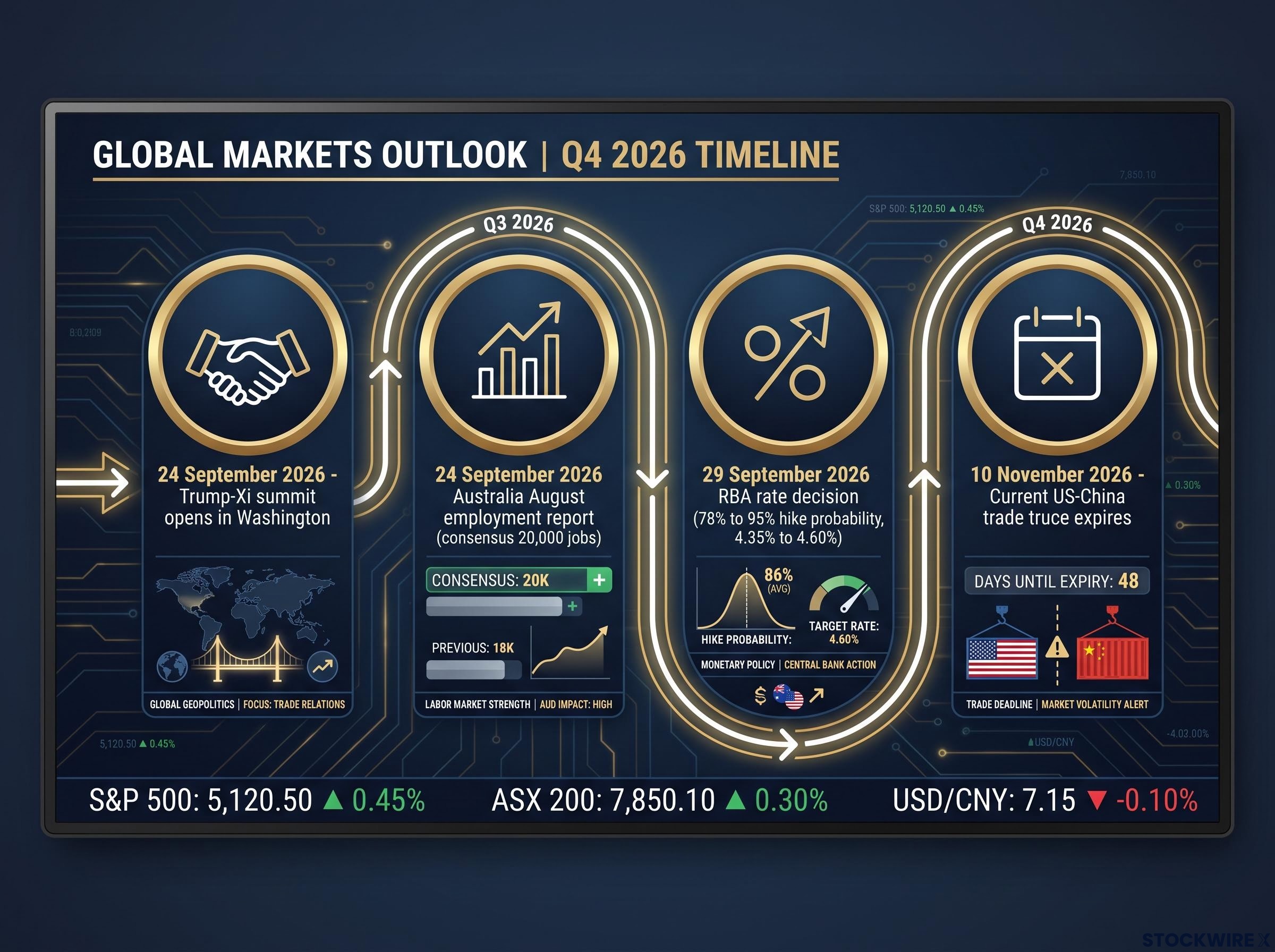
On the morning of 24 September 2026, two clocks strike at once. The Trump-Xi summit opens in Washington, and Australia’s August employment report lands in the same window. One trading session, two live macro catalysts, both capable of moving the same set of assets in opposite directions.
Neither event is small on its own. The summit could deliver a tariff reduction framework worth roughly US$30 billion in mutual cuts, while markets are pricing a 78% to 95% probability of a Reserve Bank of Australia (RBA) rate hike days later. The harder question is how these macro events interact, because their combined impact on AUD/USD, Australian resource equities, and critical minerals is where the real risk concentrates.
Here is the specific cross-asset map you need before both catalysts go live. Not a single-event view, but the picture of which positions carry exposure to both at the same time, so you know what to watch first when you sit down at your screen on the 24th.
What the Trump-Xi summit could actually deliver, and what it almost certainly will not
Start with the optimistic version, stated plainly. A three-day state visit beginning 24 September 2026 produces an extension of the US-China trade truce first struck in South Korea last October, currently set to expire on 10 November 2026. Policymakers are consulting on a mutual tariff reduction framework covering approximately US$30 billion of products on each side.
If that framework lands, it would lower duties on US energy and agricultural exports to China and reduce tariffs on Chinese-origin inputs that American manufacturers rely on. China currently holds a 10% blanket levy on US goods, with steeper sector-specific rates on liquefied natural gas. The US administration has proposed new 7.5% overproduction tariffs but is expected to hold them back until after the summit, keeping them as leverage.
That is the constructive case. The camps interpreting it, however, sit far apart.
What the summit agenda covers
The formal agenda spans six areas, each carrying its own market weight:
- Trade and tariffs: the headline item, and the one markets will price first.
- AI governance: Nvidia’s Jensen Huang and other tech executives are attending the state dinner, signalling how central technology competition has become.
- Taiwan: a persistent friction point, and one Trump has reportedly considered softening on in exchange for economic concessions.
- Critical minerals: directly relevant to supply-chain security and mining equity valuations.
- Energy: tied to the LNG tariff question.
- Agriculture: a core piece of any US export-facing deal.
Goldman Sachs found the optimist case has some grounding on the ground in China.
A Goldman Sachs survey found that 38% of onshore Chinese investors expect incremental progress from the summit.
Why historical precedents argue for a short-rally, long-fade response
The sceptical camp points to pattern. The 2020 Phase One deal and the 2019 G20 truce both produced the same shape: an initial risk-on move that faded once the structural tensions underneath resurfaced. Optics-only agreements and easily reversible tariff tweaks tend to rally on the headline and unwind on the follow-through.
The Phase One implementation gap matters here because it sets the precedent: in the original deal, China met only 58% of its purchase targets, and no standing bilateral dialogue mechanism existed to flag the shortfall in real time, which is precisely the structural flaw any new framework needs to address.
That short-rally, long-fade dynamic is the default outcome, not the exception. What you need to hold onto is that as of 20 September 2026, no legally binding tariff agreement has been finalised. Any market move on summit headlines is pricing probability, not outcome, which means position sizing on the announcement should reflect uncertainty rather than confirmation.
When big ASX news breaks, our subscribers know first
Australia’s employment data and the RBA rate decision: reading the final piece of the puzzle
The jobs number and the rate decision are not two separate events. They are a two-step signal chain, and reading them in sequence is what separates a genuine repricing from a passing wobble.
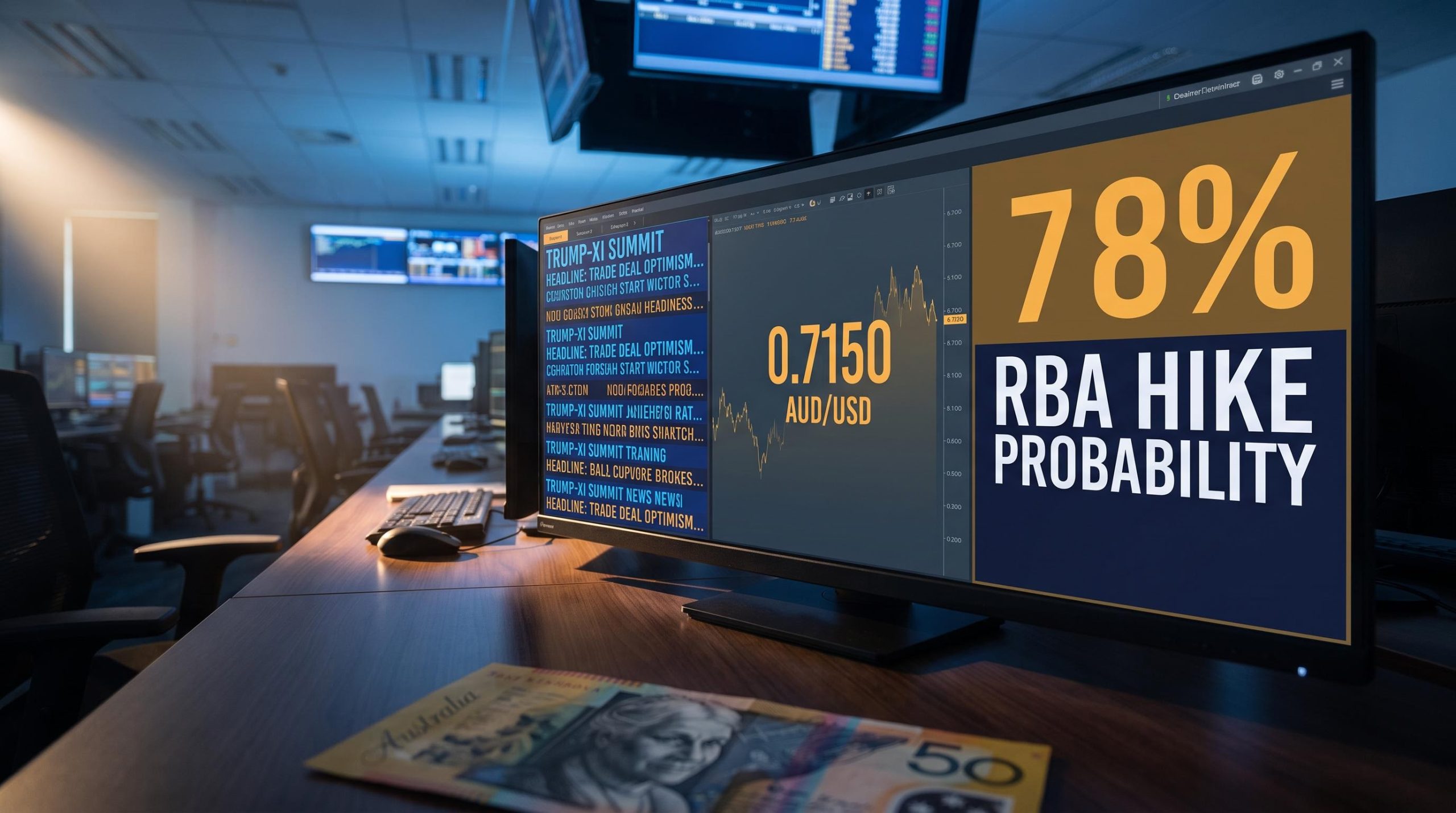
Markets are pricing a 78% to 95% chance of a 25 basis point RBA hike on 29 September 2026, lifting the cash rate from 4.35% to 4.60%, with a 37% probability of a follow-on move in November. The August employment report, due 24 September, is the last major data point before that meeting. Consensus, where visible, pointed to roughly 20,000 jobs added after July’s surprise decline of 15,800, with unemployment holding at 4.5%.
The structural reason a single print is unlikely to derail the hike sits in the inflation data, not the labour market.
The RBA tightening divergence from the Fed, ECB, and Bank of England that emerged in May 2026 created a meaningful yield premium for Australian assets; that premium is what markets are now pricing as the structural support for AUD even if the employment print comes in soft.
| Indicator | Latest reading | Market implication |
|---|---|---|
| Trimmed-mean CPI | 3.6% year-on-year | Above the RBA’s 2-3% target, supporting the hawkish case |
| Market services inflation | 3.9% year-on-year | Domestic price pressure the RBA cannot ignore |
| RBA cash rate path | 4.35% to a likely 4.60% | Hike near-certain; November follow-on at 37% |
Rents up 3.7% reinforce the picture. Governor Michele Bullock has anchored the RBA’s stance on this persistence.
RBA Governor Michele Bullock has emphasised that the underlying pulse of inflation is too strong and the economy continues to operate above capacity.
The consensus has already shifted to match. NAB, Westpac, ANZ, and CBA have all abandoned their earlier pause forecasts in favour of a hike. Alternative indicators cut both ways: ANZ-Indeed job ads rose 2.5% month-on-month in August, suggesting labour demand is holding, while Roy Morgan’s broader measure put real unemployment at 11.7% and Deloitte Access Economics sees the rate drifting toward 4.7% by end-2026.
So what would genuinely move the needle? Not a modest miss against the 20,000 consensus. It would take a print weak enough to crack the RBA’s inflation narrative, because that narrative, not the employment trajectory, is what drives the 78% to 95% hike pricing. The read you should take is that a mildly soft jobs number is not a reason to fade the Australian dollar. The tightening rationale rests on sticky inflation, and one labour print rarely overturns it.
When both catalysts hit the same assets: the AUD/USD and commodities convergence
AUD/USD is not sensitive to one catalyst this week. It is exposed to two at once, and whether they point the same direction or pull against each other determines how the currency trades.
A confirmed RBA hike lifts the domestic yield premium, the extra return investors earn for holding Australian assets. A credible trade truce extension improves the China-linked demand story for Australian exports. Historically, both forces support the currency simultaneously, which is why a convergence of RBA hawkishness and a US-China thaw is a constructive setup for the Aussie. As of 16 September 2026, AUD/USD traded just below 0.7150, having reached a near four-month high above 0.7200 earlier in the month, with technical support in the 0.7076-0.7082 range.
The commodity picture is steadier than the currency. Iron ore has held slightly above US$100 per tonne since August 2025, so stability is the baseline. A trade thaw does not dramatically reprice it upward; it removes downside tail risk, which broadly supports ASX resource and energy names without triggering a surge.
Then comes the part that runs against instinct. A diplomatic thaw is a headwind for critical minerals.
If Washington and Beijing cooperate, the perceived urgency of Western supply-chain diversification drops. That compresses the geopolitical risk premium built into ex-China mining and rare earth equities. Past tariff pauses have triggered sharp downward repricing in exactly these stocks. If you hold rare earth or critical minerals positions, a positive summit outcome weakens the scarcity narrative that supports those valuations.
Geopolitical scarcity pricing in critical minerals reflects the same dynamic identified in broader portfolio construction: Australian LNG and resource assets carry a supply-reliability premium that compresses directly when the geopolitical tension generating that premium visibly eases.
| Asset class | Scenario: trade thaw + RBA hike | Direction of effect | Key driver |
|---|---|---|---|
| AUD/USD | Both catalysts constructive | Supportive | Yield premium plus China demand |
| Iron ore | Stable above US$100/t | Mildly supportive | Downside tail risk removed |
| ASX resource equities | Broad support | Positive | Export demand and commodity stability |
| Critical minerals / rare earths | Scarcity premium compresses | Negative | Reduced diversification urgency |
The cross-asset logic resolves into three scenarios, ranked by probability:
- Confirmed hike only: the RBA moves, the summit disappoints. AUD supported by yield, critical minerals unaffected or firmer.
- Confirmed truce only: the summit delivers, the RBA holds. China demand story helps commodities but pressures the geopolitical scarcity trade.
- Both catalysts simultaneously: the strongest AUD setup, but the sharpest squeeze on critical minerals as two supportive macro forces coincide with one narrative-eroding one.
Most investors reflexively expect a trade thaw to lift everything commodity-adjacent. For geopolitically priced assets, the logic runs the other way.
What professional investors expect, and why the market consensus is not the same as the likely outcome
Here is the honest centre of the week. The consensus already embeds a probability-weighted view, which means the asymmetric opportunities do not sit in the base case. They sit in the scenarios the market has under-priced relative to their real odds.
What is priced: a high-probability RBA hike at 78% to 95%, and partial trade optimism. What is not fully priced: a summit that produces no meaningful progress, or a jobs number that materially undershoots alongside an unexpectedly dovish shift in RBA communication.
There is a political variable markets struggle to model. Trump’s reported willingness to moderate on Taiwan in exchange for economic concessions ahead of the November US midterms introduces a driver contingent on domestic political calculation, not trade logic. That kind of variable resists clean pricing.
The three tail scenarios and their cross-asset reads:
- No summit progress: risk-off tone, AUD pressured on the China-demand side, critical minerals firmer as the scarcity premium reasserts.
- Jobs miss plus dovish pivot signal: the one combination that could genuinely soften AUD, since it threatens the inflation narrative underpinning the hike.
- Both catalysts disappoint: the widest repricing, hitting AUD and resource equities together while critical minerals catch a relative bid.
The negotiating window is not open-ended.
The current US-China truce is set to expire on 10 November 2026, a hard deadline that constrains how much negotiating optionality either side actually holds.
The framework to leave with is this: if both catalysts deliver exactly as priced, the market moves will likely be modest. The positions worth holding through this window are those sized for the scenarios where one or both surprise, because that is where the unpriced return lives. The useful question is not “what will happen?” but “what is already in the price, and what is not?”
This article is for informational purposes only and should not be considered financial advice. Investors should conduct their own research and consult with financial professionals before making investment decisions. Past performance does not guarantee future results, and forward-looking scenarios are speculative and subject to change based on market developments.
Positioning for a week where the calendar itself is the risk
You have the map. The task now is monitoring, not prediction, because the base case is priced and the informational value comes from watching how markets update as each data point lands.
Three sequential checkpoints structure the week:
- Summit day-one statement (24 September 2026 morning): read the tone. Optimistic and specific points one way; vague and procedural signals the short-rally, long-fade pattern.
- Australia jobs release (24 September 2026, local time): measure the print against the 20,000 consensus, but weigh whether it threatens the RBA’s inflation narrative, not just whether it beats or misses.
- RBA meeting outcome (29 September 2026): confirm the hike and, more importantly, parse any shift in communication.
The cross-asset tells worth flagging:
- AUD/USD breaking below 0.7076-0.7082 support: a warning that the constructive dual-catalyst setup is unwinding.
- Iron ore reaction to day-one headlines: the cleanest read on how markets price the demand story.
- Critical minerals movement: a counter-directional indicator, where strength suggests the summit underwhelmed.
The practical takeaway is that this week rewards scenario awareness over directional conviction. The positions to check first are the ones with unacknowledged exposure to both catalysts at once, because that is where the risk is compounding invisibly.
For investors whose portfolios carry unacknowledged exposure to supply-chain fragmentation, our dedicated guide to geopolitical fragmentation risk examines how diverging regional industrial blocs are reshaping allocation frameworks across semiconductors, EVs, and critical minerals.